Blog Archives
Q: What’s on the easel today?
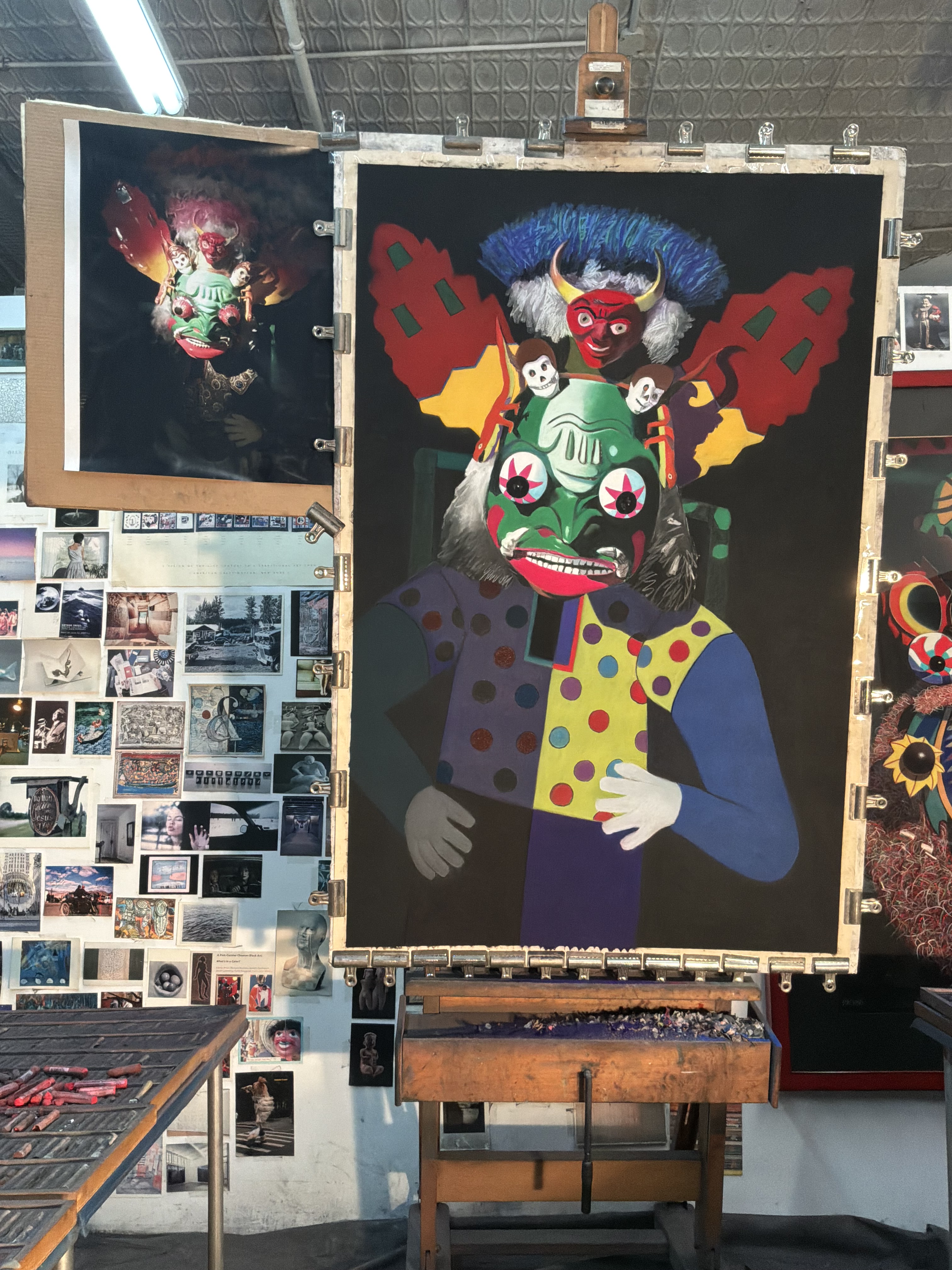
Work in progress
A: I continue working on “Gatecrasher,” soft pastel on sandpaper, 58” x 38.” In February I was privileged to visit this mask on exhibit at MUSEF La Paz in Bolivia. It was my second visit to the museum; the first was in 2017. Even more so this time, I was bowled over with how spectacular this particular mask is in person. Plus, I had forgotten its huge size. So I am absolutely determined to bump up my game and even more inspired to make this painting as strong and powerful as I possibly can!
Comments are welcome!
Pearls from artists* # 690
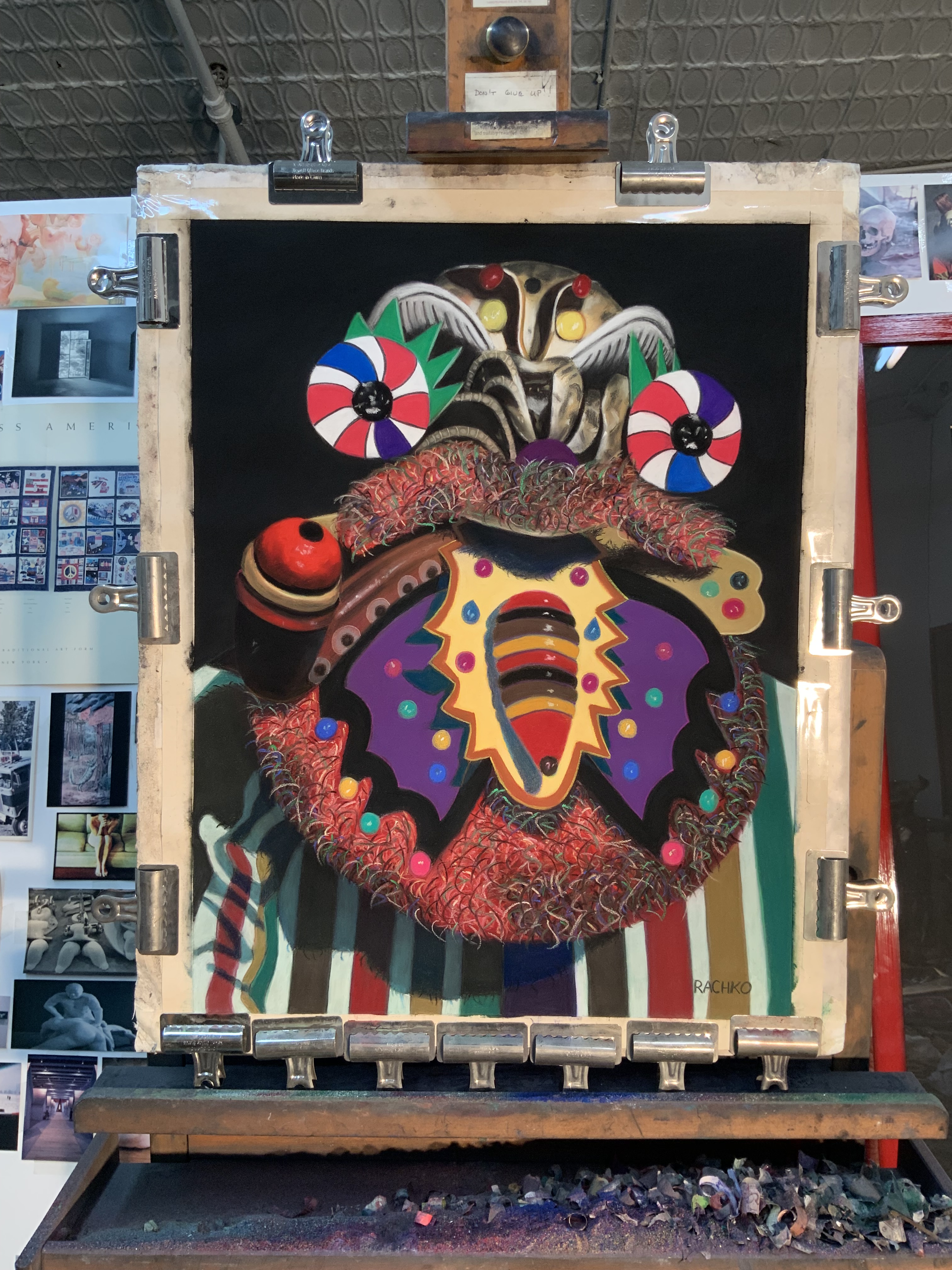
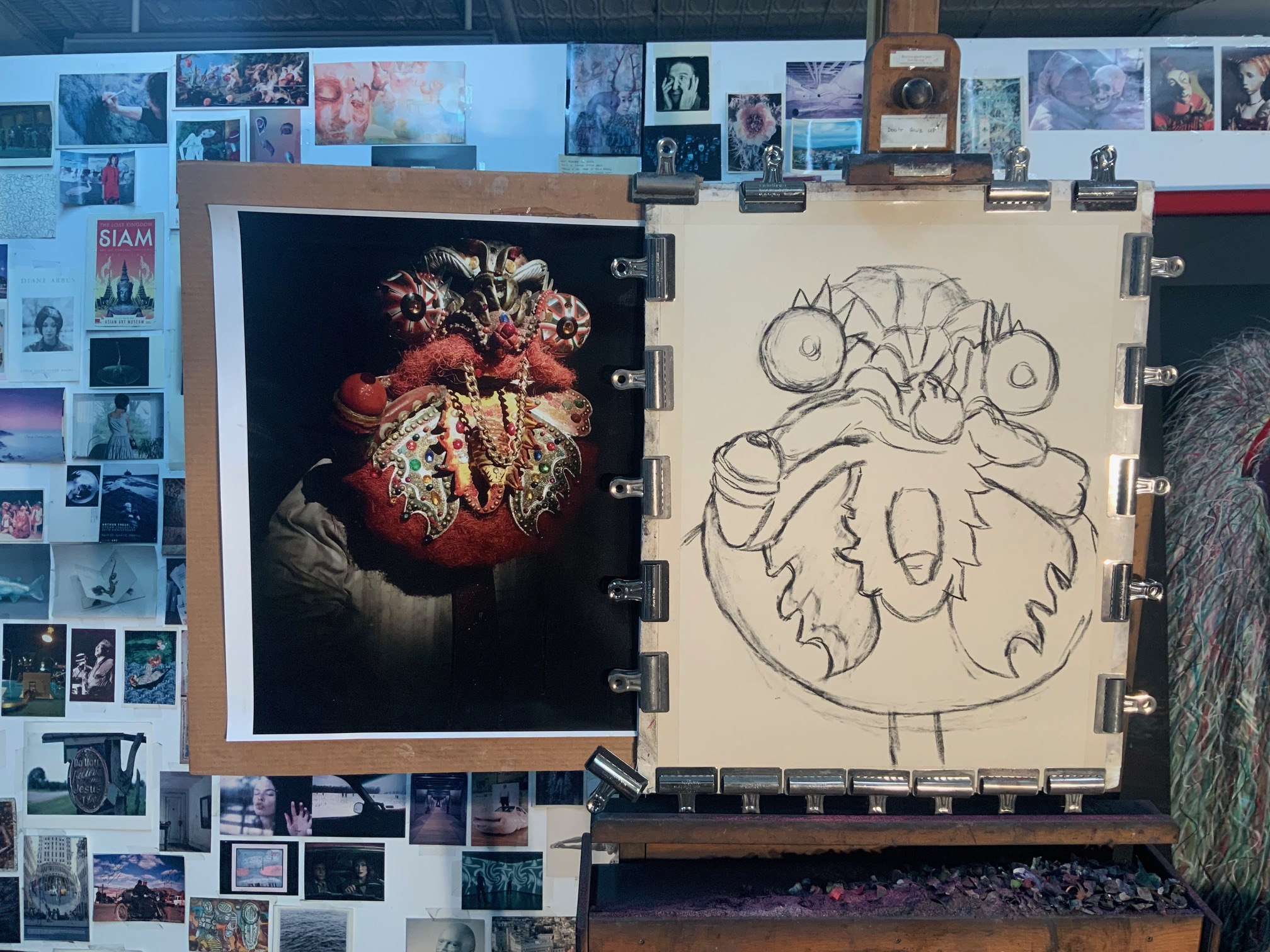
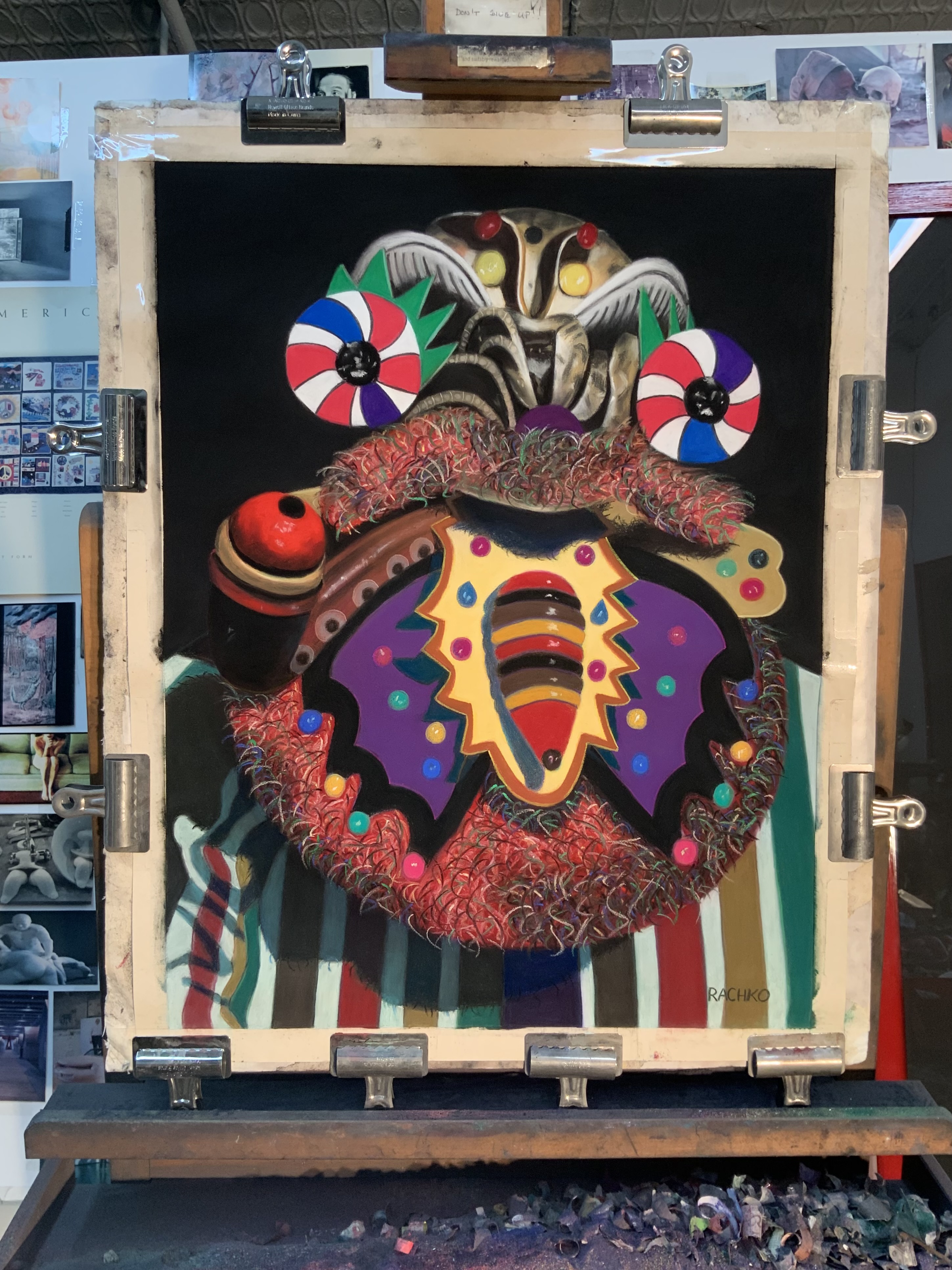
“Showman,” soft pastel on sandpaper, 26” x 20”
*an ongoing series of quotations – mostly from artists, to artists – that offers wisdom, inspiration, and advice for the sometimes lonely road we are on.
PC: And today, don’t you think a picture communicates primarily through its metiére? A mysterious transubstantiation takes place between the thing itself and the way in which our eye receives it. Or, more precisely, a painter’s metiére has life in it, as if it were still laden with the artist’s passion. You feel his pulse beating in it, his need to register the victory of his presence in physical space but outside the reach of time.
HM: Every painter with real talent has his own metiére, a way of laying on the paint with relish, with a certain voluptuous feel, which means that you could say that metiére of this or that painter is like velvet, or satin, or taffeta. As to manner… No one knows where this comes from. It’s magic. It’s not something you can learn. There are very rich paintings, like those of Cézanne, and others very lightly painted that have real density all the same: Velazquez, for example, with his Phillip IV. He uses a scumble for the landscape, which is very beautiful and solid with matiére—the scumble is so well proportioned that it combines with the background and harmonizes perfectly; the Rubens painting on wood in the Louvre, Portrait of Hélène Fourmont and Her Children, is painted mainly in colored oils, yet how deep and solid the colors seem!
Chatting with Henri Matisse: The Lost 1941 Interview, Henri Matisse and Pierre Courthion, edited by Serge Guilbaut
Comments are welcome!
Pearls from artists* # 689

*an ongoing series of quotations – mostly from artists, to artists – that offers wisdom, inspiration, and advice for the sometimes lonely road we are on.
This is what I wish someone had told me years ago:
The art world is not a meritocracy. Like the world at large, it is a system based on hoarded capital and exploited labor. This system owes you nothing, even if you have extraordinary talent, work tremendously hard, never give up, and do all the right things. There are no ‘extra points’ for effort, earnestness, dedication, or sacrifice.
(We ALL think WE are going to be the exception.)
Unless you have fantastic connections or pedigree, after you build and maintain the basics of making strong work and getting the word out, a great deal depends on luck. Many of the artists you admire are likely living difficult lives you might not be willing to live, making sacrifices you might not be willing to make. Many who appear to support themselves with their work are in fact, partially or fully supported by spouses, family money, or jobs they do not discuss. They keep these jobs secret because some art world players refuse to validate your work if you are not ‘seriously committed’ enough to be a full-time artist. (Of course, artists who were not born wealthy need validation from these very players to be ABLE to create full-time.)
Kate Kretz in Art From Your Core: A Holistic Guide to Visual Voice
Comments are welcome!
Q: Over your 40-year career as an artist, you have managed to keep presentation, technical, subject matter, conceptual consistencies in your art practice and work. How do you manage to filter out inspirations that might be luring at that moment but do not support your art practice? For example, you master pastel works. There must have been moments when you might have been inspired to make oil works. How do you keep such inspirations aside. (Question from Vedica Art Studios and Gallery)

A: About thirty-five years ago, when my pastel paintings were becoming larger—around 60” x 40”—I had to choose between transitioning to oil on canvas or continuing with pastel. Framing was the main concern. I wasn’t certain large pastels could be framed, and even if they could, the cost might be prohibitive. However, I had already fallen in love with pastel and knew no other medium could offer such vibrant colors or velvety textures. Determined, I resolved the framing issue (art-making is fundamentally problem-solving), committed myself fully to soft pastel, and have continued inventing and refining techniques ever since.
My goal from the beginning has always been improvement as an artist. If an activity doesn’t contribute to my growth—as a person or as an artist—I typically don’t pursue it. Time and energy are finite resources, so I try to use them wisely.
Comments are welcome!
Q: What’s on the easel today?
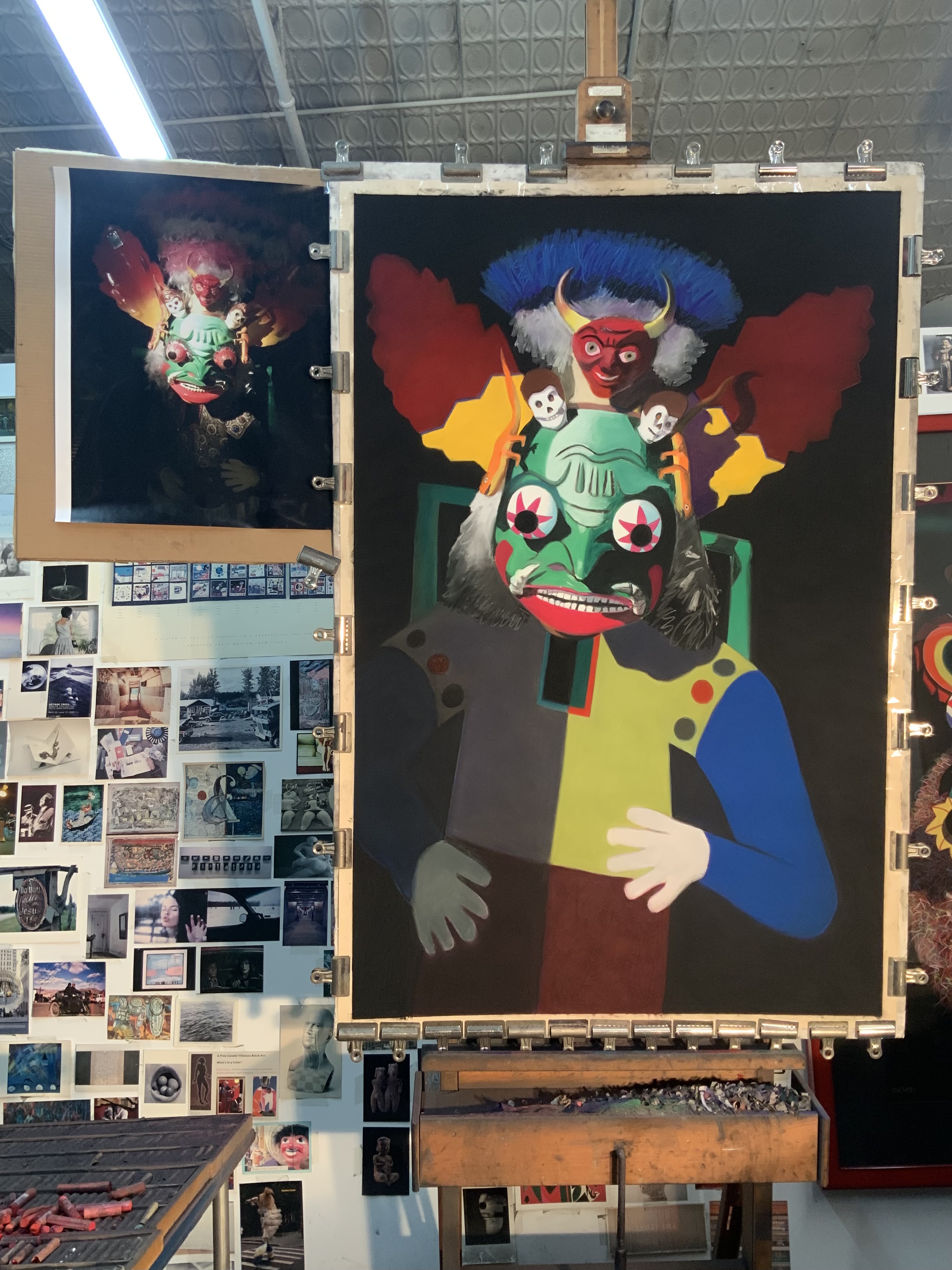
A: I continue working on “Gatecrasher,” 58” x 38,” soft pastel on sandpaper.
Comments are welcome!
Pearls from artists* # 679
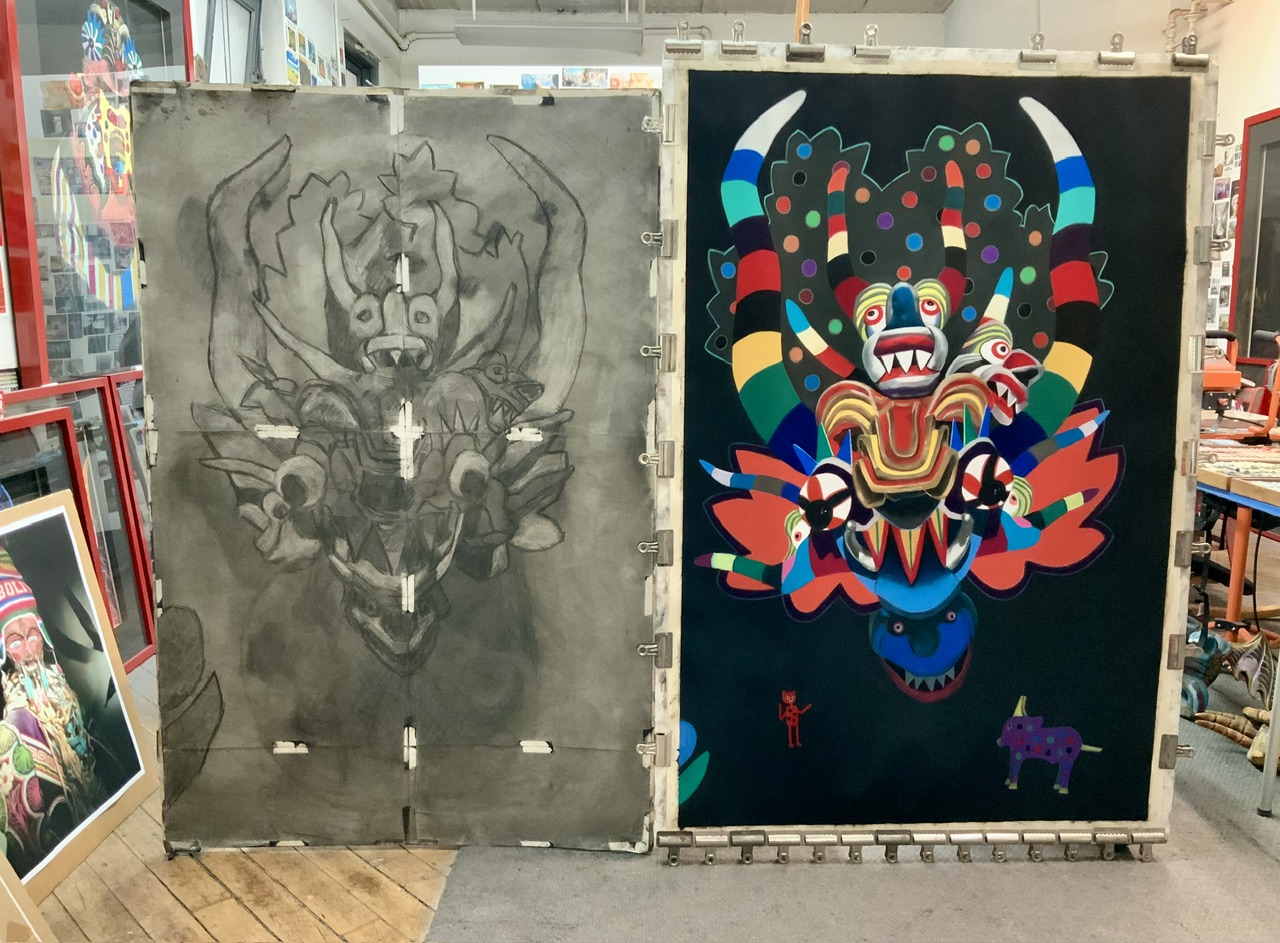
*an ongoing series of quotations – mostly from artists, to artists – that offers wisdom, inspiration, and advice for the sometimes lonely road we are on.
PC: In your painting, you’ve always kept this speed of movement. One senses that you work something out slowly, deep down, that it’s hard work, but there’s always something fresh about its expression
HM: That’s because I revise my notion several times over. People often add or superimpose completing things without changing their plan, whereas I rework my plan every time. I always start again, working from the previous state. I try to work in a contemplative state, which is very difficult: contemplation is inaction and I act in contemplation.
In all the studies I’ve made from my own ideas, there’s never been a faux pas because I’ve always unconsciously had a feeling for the goal; I’ve made my way toward it the way one heads north, following the compass. What I’ve done, I’ve done by instinct, always with my sights on a goal I still hope to reach today. I’ve completed my apprenticeship now. All I ask is four or five years to realize the goal.
PC: Delacroix said that too. Great artists never look back.
HM: Delacroix also said – ten years after he’d left the place – “I’m just beginning to see Morocco.” He needed the perspective. Rodin said to an artist, “You need to stand back a long way for sculpture.” To which the student replied, “Master, my studio is only ten meters wide.”
Chatting With Henri Matisse: The Lost 1941 Interview, Henri Matisse with Pierre Courthion, edited by Serge Guilbaut
Comments are welcome!
Q: How do you decide when a pastel painting is finished?

“Magisterial,” soft pastel on sandpaper, 58” x 38” in progress
A: During the months that it takes to create a pastel painting, I search for arresting colors that work well together. The goal is to make a painting that I have never seen before and that leads the viewer’s eyes around in interesting ways. To do this I build up and blend together as many as 25 to 30 layers of pigment. I am able to complete some areas, like the background, fairly easily – maybe with just six or seven layers of black Rembrandt pastel. The more realistic parts of a pastel painting take many more applications. In general, details always take plenty of time to refine and perfect.
No matter how many pastel layers I apply, however, I never use fixatives. It is difficult to see this in reproductions of my work, but some of the finished surfaces achieve a texture akin to velvet. My technique involves blending each layer with my fingers, pushing the pastel deep into the tooth of the sandpaper, and mixing new colors directly on the paper. Fortunately, the sandpaper holds plenty of pigment so I am able to include lots of details.
Before I pronounce a pastel painting finished, I let it sit against a wall in my studio for a few days so I can look at it later with fresh eyes. I consider a piece done when it is as good as I can make it, when adding or subtracting something would diminish what is there. Always, I try to push myself and my materials to their limits, using them in new and unexpected ways.
Comments are welcome.


Q: What’s on the easel today?

Work in progress
A. I’m working on “Herald,” 26” x 20,” soft pastel on sandpaper.
Comments are welcome!


 barbararachkoscoloreddust.com