Blog Archives
Pearls from artists* # 31
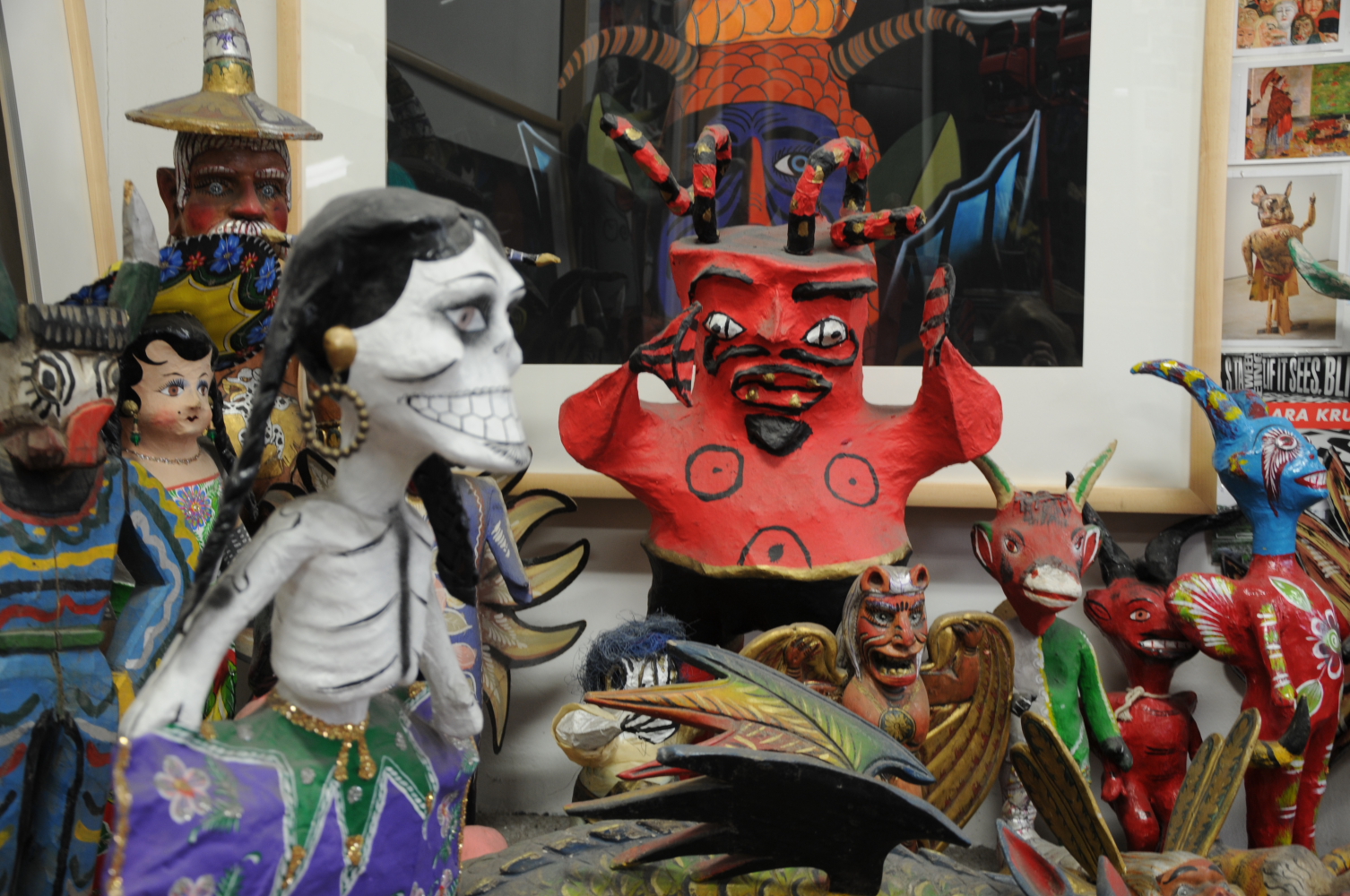
A corner of Barbara’s studio
* an ongoing series of quotations – mostly from artists, to artists – that offers wisdom, inspiration, and advice for the sometimes lonely road we are on.
When we are children we unquestioningly see the objects around us as alive; we speak to them, give them names, breathe life into them. The imagination knows no bounds. As we grow up, we gradually lose this facility, until we finally arrive in an utterly “demystified” world that draws clear boundaries between what is alive and what is not, between subjective and objective perception. According to Sigmund Freud, culture is the only domain in our modern society that gives a measure of legitimacy to the persistence of this infantile desire to see things as animate. In the field of art, imagination is the precondition on which fiction of any sort rests; in art, mental states can be projected onto objects and images, but not in social reality or the sciences.
Dietrich Karner in Animism: Modernity Through the Looking Glass
Comments are welcome!
Q: Can you speak in more detail about how losing your husband, Dr. Bryan C. Jack, on 9/11 affected your artistic practice?

“She Embraced It and Grew Stronger,” 2003, 58″ x 38″, first large pastel-on-sandpaper painting completed after Bryan was killed
A: On September 11, 2001, Bryan, who was a high-ranking, career, federal government employee, a brilliant economist (with an IQ of 180 he is still the smartest man I’ve ever met) and a budget analyst at the Pentagon, was en route to Monterrey, CA to give his monthly guest lecture for an economics class at the Naval Postgraduate College there. He had the horrible misfortune of flying out of Dulles airport and boarding the plane that was high-jacked and crashed into the Pentagon, killing 189 people.
Losing him was the biggest shock of my life, devastating in every possible way. I think about him every day and I continually think about how easily I, too, could have been killed on 9/11. I had decided not to travel with Bryan to California, a place I absolutely love visiting, only because the planned trip was too short. His plane crashed directly into my (Navy Reserve) office on the fifth floor, e-ring of the Pentagon. I still imagine how close we came to Bryan having been killed on the plane and me perishing in the building. To this day I believe that I was spared for a reason and I strive to make every day count.
The six months after 9/11 passed by in a blur, except that I vividly remember an October 2001 awards ceremony at the DAR Hall in Washington, DC. I was picked up by a big black limousine, sent by the Department of Defense. At the ceremony I sat with members of the president’s cabinet. I accepted the Defense Exceptional Civilian Service Medal for Bryan, an award he would have accepted himself had he been alive, and was addressed face-to-face by George Bush, Jr., not someone I particularly liked (to put it nicely). Later Bryan was given more awards – a Presidential Rank Award, a Defense Distinguished Civilian Service Medal, and the Defense of Freedom Medal. Many other honors came in and I’ll mention two. Bryan’s hometown of Tyler, Texas named a magnet school after him – Dr. Bryan C. Jack Elementary School (the principal and I cut the ribbon at the opening ceremony) – and Stanford University set up the “Bryan Jack Memorial Scholarship,” which annually helps two deserving students attend Stanford Business School.
The following summer I was ready to – I HAD to – get back to work so my first challenge was to learn how to use Bryan’s 4 x 5 view camera. In July 2002 I enrolled in a one-week view camera workshop at the International Center of Photography in New York. Much to my surprise I already knew quite a lot from watching Bryan. Thankfully, I was soon on my way to working again. After the initial workshop, I decided to begin with the basics since I had never formally studied photography before. I threw myself into learning this new (to me) medium. Over the next few years I enrolled in a series of classes at ICP, starting with Photography I. Along the way I learned to use Bryan’s extensive camera collection (old Leicas, Nikons, Mamiyas, and more) and to make my own large chromogenic prints in the darkroom. In October 2009 it was extremely gratifying to have my first solo photography exhibition with HP Garcia in New York (please see the exhibition catalogue on the sidebar). I remember tearing up at the opening as I imagined Bryan looking down at me with his beautiful smile, beaming as he surely would have, so proud of me for having become a photographer.
Comments are welcome!
Pearls from artists* # 28

Flower sellers in Chichicastenango, Guatemala
* an ongoing series of quotations – mostly from artists, to artists – that offers wisdom, inspiration, and advice for the sometimes lonely road we are on.
We have talked a good deal about our duty, and how we could attain the right goal, and we came to the conclusion that in the first place our aim must be to find a steady position and a profession to which we can entirely devote ourselves. It is wise to do so, for life is but short and time passes quickly; if one is master of one thing and understands one thing well, one has at the same time insight into and understanding of many things.
One must especially have the end in mind, and the victory one would gain after a whole life of work and effort is better than one that is gained earlier. Whoever lives sincerely and encounters much trouble and disappointment, but is not bowed down by them, is worth more than one who has always sailed before the wind and has only relative prosperity. One must never trust the occasion when one is without difficulties.
Irving Stone with Jean Stone, editors, Dear Theo: The Autobiography of Vincent Van Gogh
Comments are welcome!
Pearls from artists* # 26
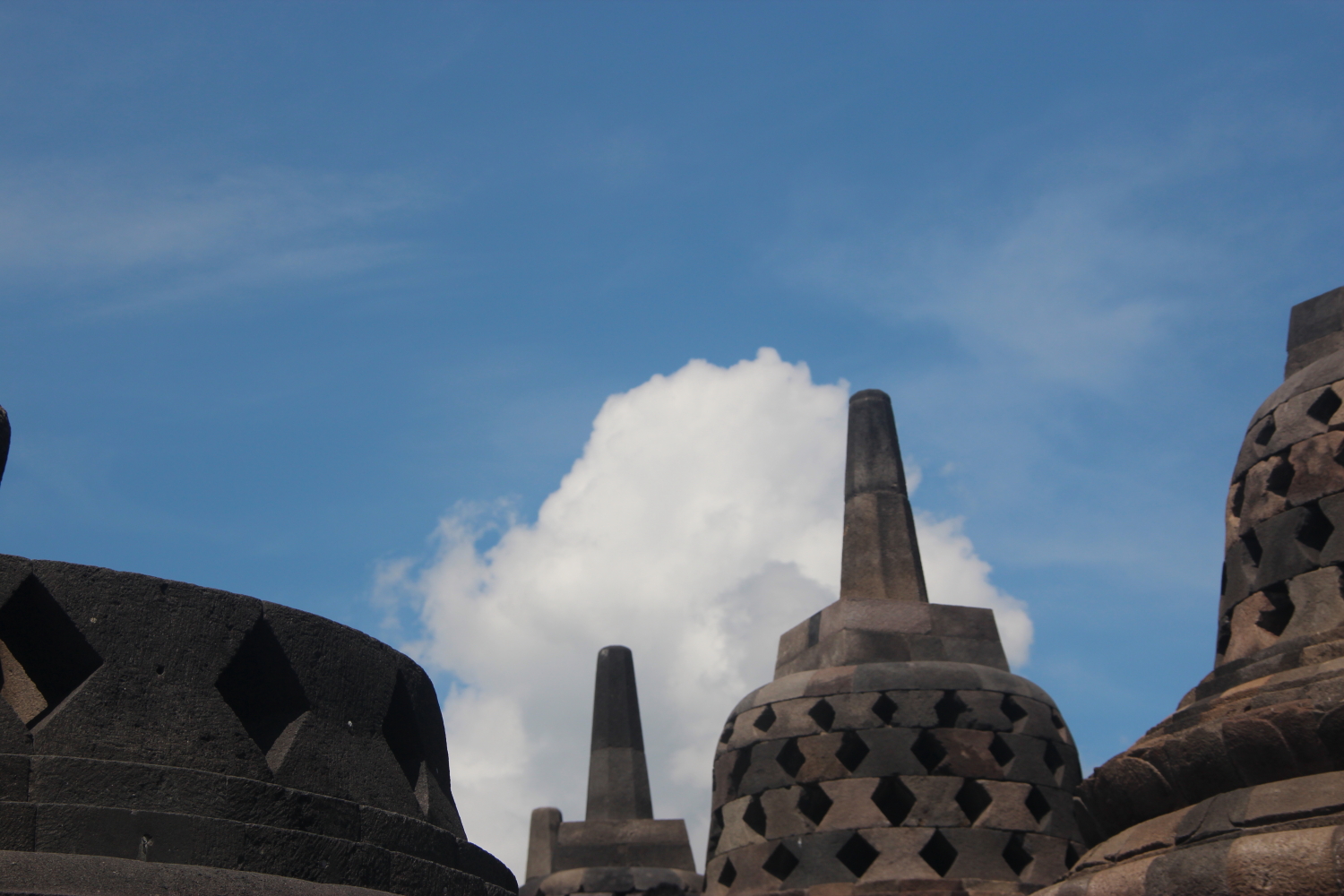
Borobudur, Java
* an ongoing series of quotations – mostly from artists, to artists – that offers wisdom, inspiration, and advice for the sometimes lonely road we are on.
Beauty is made up of relationships. It derives its prestige from a specific metaphysical truth, expressed through a host of balances, imbalances, waverings, surges, halts, meanderings, and straight lines, the peculiar quality of which, as a whole, add up to a marvelous number, apparently born without pain. Its distinguishing mark is that it judges those who judge it, or imagine that they possess power to do so. Critics have no hold over it. They would have to know the minutest details of how it works, and this they cannot do, because the mechanics of beauty are secret. Hence the soil of an age is strewn with a litter of cogs that criticism dismantles in the same way as Charlie Chaplin dismantles an alarm clock after opening it like a tin can. Criticism dismantles the cogs. Unable to put them back together or understand the relationships that give them life, it discards them and goes on to something else. And beauty ticks on. Critics cannot hear it because the roar of current events clogs the ears of their souls.
Jean Cocteau in Andre Bernard and Claude Gauteur, editors, Jean Cocteau: The Art of Cinema
Comments are welcome!
Q; When did you start pursuing art as a serious profession?
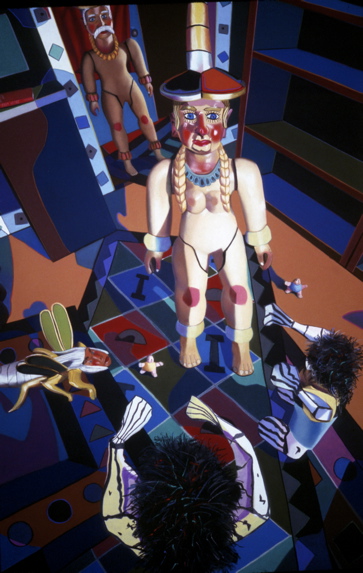
“Answering the Call,” 58″ x 38,” soft pastel on sandpaper
A: In the mid-1980s I was in my early 30s, a lieutenant on active duty in the Navy, working a soul-crushing job as a computer analyst on the midnight shift in a Pentagon basement. It was literally and figuratively the lowest point of my life. Remembering the joyful Saturdays of my youth when I had studied with a local New Jersey painter, I enrolled in a drawing class at the Art League School in Alexandria, Virginia. Initially I wasn’t very good, but it was wonderful to be around other women and a world away from the “warrior mentality” of the Pentagon. I was having fun! Soon I enrolled in more classes and became a very motivated full-time art student who worked nights at the Pentagon. As I studied and improved my skills, I discovered my preferred medium – soft pastel on sandpaper. Although I knew I had found my calling, for more than a year I agonized over whether or not to leave the Navy. Once I did decide, there was another delay. The Navy was experiencing a manpower shortage so Congress had enacted a stop-loss order, which prevented officers from resigning. I could only do what was allowed under the order. I submitted my resignation effective exactly one year later: on September 30, 1989. With Bryan’s (my late husband) support, I left the Navy that day. So I think of myself as having been a professional artist beginning on October 1, 1989. I should mention that I remained in the Navy Reserve for the next 14 years, working mainly at the Pentagon two days every month and two weeks each year (commuting between New York and Washington, DC after I moved in 1997). Finally on November 1, 2003, I officially retired as a Navy Commander.
Comments are welcome!
Pearls from artists * # 20
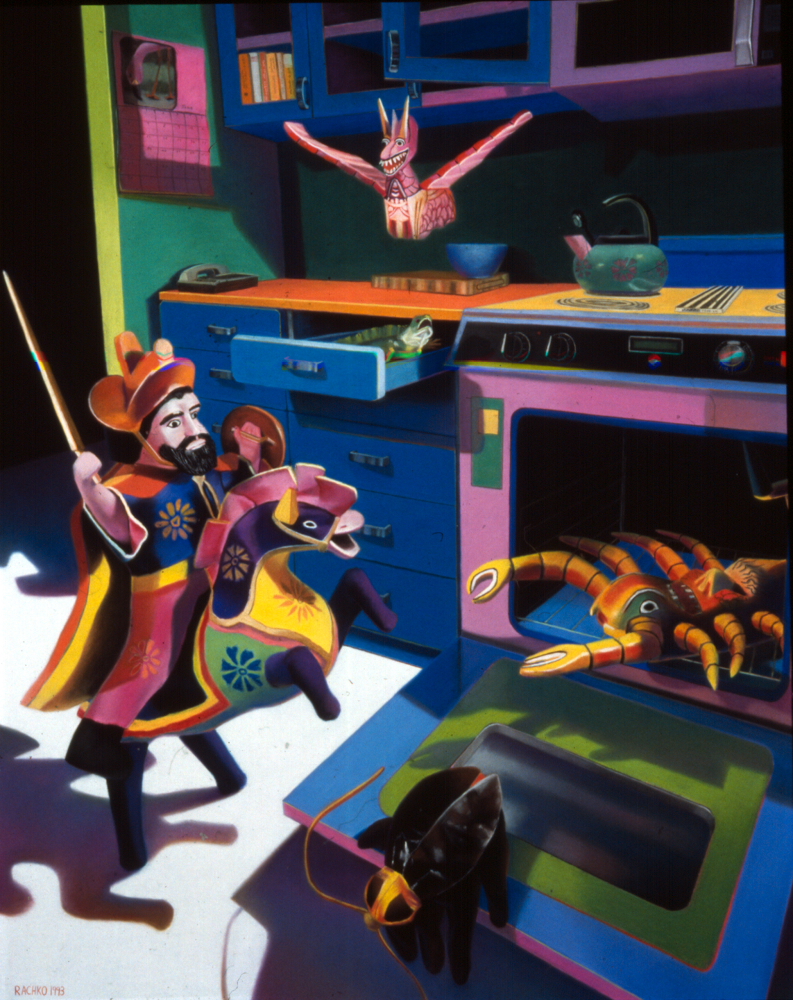
“The Magical Other,” soft pastel on sandpaper, 1993, 48″ x 38″
* an ongoing series of quotations – mostly from artists, to artists – that offers wisdom, inspiration, and advice for the sometimes lonely road we are on.
If, indeed, for any given time only a certain sort of work resonates with life, then that is the work you need to be doing in that moment. If you try to do some other work, you will miss your moment. Indeed, our own work is so inextricably tied to time and place that we cannot recapture even our own aesthetic ground of past times. Try, if you can, to reoccupy your own aesthetic space of a few years back, or even a few months. There is no way. You can only plunge ahead, even when that carries with it the bittersweet realization that you have already done your best work.
This heightened self-consciousness was rarely an issue in earlier times when it seemed self-evident that the artist (and everyone else, for that matter) had roots deeply intertwining their culture. Meanings and distinctions embodied within artworks were part of the fabric of everyday life, and the distance from art issues to all other issues was small. The whole population counted as audience when artists’ work encompassed everything from icons for the Church to utensils for the home. In the Greek amphitheater twenty-two hundred years ago, the plays of Euripides were performed as contemporary theater before an audience of fourteen thousand. Not so today.
Today art issues have for the most part become solely the concern of artists, divorced from – and ignored by – the larger community. Today artists often back away from engaging the times and places of their life, choosing instead the largely intellectual challenge of engaging the times and places of Art. But it’s an artificial construct that begins and ends at the gallery door. Apart from the readership of Artforum, remarkably few people lose sleep trying to incorporate gender-neutral biomorphic deconstructivism into their personal lives. As Adam Gopnik remarked in The New Yorker, “Post-modernist art is, above all, post-audience art.”
David Bayles & Ted Orland, Art & Fear: Observations on the Perils (and Rewards)of Artmaking
Comments are welcome!
Q: Why do you work in series?
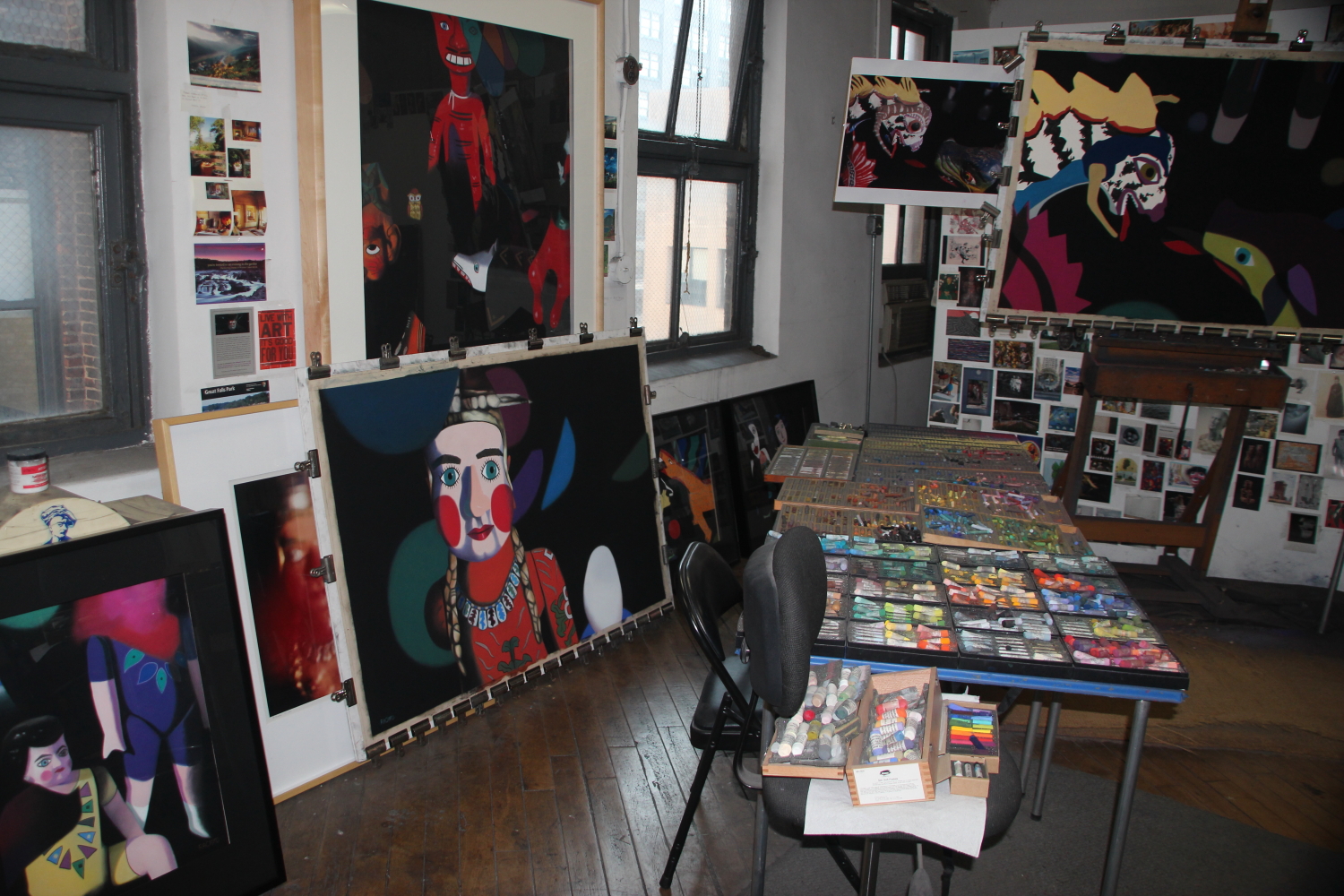
The studio recently
A: I don’t really have any choice in the matter. It’s more or less the way I have always worked so it feels natural. Art-making comes from a deep place. In keeping with the aphorism ars longa, vita brevis, it’s a way of making one’s time on earth matter. Working in series mimics the more or less gradual way that our lives unfold, the way we slowly evolve and change over the years. Life-altering events happen, surely, but seldom do we wake up drastically different – in thinking, in behavior, etc. – from what we were the day before. Working in series feels authentic. It helps me eke out every lesson my paintings have to teach. With each completed piece, my ideas progress a step or two further.
Last week I went to the Metropolitan Museum to see an exhibition called, “Matisse: In Search of True Painting.” It demonstrates how Matisse worked in series, examining a subject over time and producing multiple paintings of it. Matisse is my favorite artist of any period in history. I never tire of seeing his work and this particular exhibition is very enlightening. In fact, it’s a must-see and I plan to return, something I rarely do because there is always so much to see and do in New York. As I studied the masterpieces on the wall, I recognized a kindred spirit and thought, “Obviously, working in series was good enough for Matisse!”
Comments are welcome!
Q: Does your work look different to you on days when you are sad, happy, etc.?

Recent work
A: I’m more critical on days when I am sad so that the faults, imperfections, and things I wish I had done better stand out. Fortunately, all of my work is framed behind plexiglas so I can’t easily go back in to touch up newly-perceived faults. It reminds me of the expression, “Always strive to improve, whenever possible. It is ALWAYS possible!” However, I’ve learned that re-working a painting is a bad idea. You are no longer deeply involved in making it and the zeitgeist has changed. The things you were concerned with are gone: some are forgotten, others are less urgent. For most artists the work is autobiography. Everything is personal. When I look at a completed pastel painting, I usually remember exactly what was happening in my life as I worked on it. Each piece is a snapshot – maybe even a time capsule, if anyone could decode it – that reflects and records a particular moment. When I finally pronounce a piece finished and sign it, that’s it, THE END. It’s as good as I can make it at that point in time. I’ve incorporated everything I was thinking about, what I was reading, how I was feeling, what I valued, art exhibitions I visited, programs that I heard on the radio or watched on television, music that I listened to, what was going on in New york, in the country, in the world, and so on. It is still a mystery how this heady mix finds its way into the work. During the time that I spend on it, each particular painting teaches me everything it has to teach. A painting requires months of looking, reacting, correcting, searching, thinking, re-thinking, revising. Each choice is made for a reason and as an aggregate these decisions dictate what the final piece looks like. On days when I’m sad I tend to forget that. On happier days I remember that the framed pastel paintings that you see have an inevitability to them. If all art is the result of one’s having gone through an experience to the end, as I believe it is, then the paintings could not, and should not, look any differently.
Comments are welcome.
Pearls from artists* # 14

“Myth Meets Dream,” soft pastel on sandpaper
* an ongoing series of quotations – mostly from artists, to artists – that offers wisdom, inspiration, and advice for the sometimes lonely road we are on.
The tendency to complete a Gestalt is so strong that it is surprising so many people have trouble finishing tasks. It just shows the inherent difficulty of getting anything physical accomplished. Matter is stubborn. Only dogged effort brings a concept into an arena in which it can demand the serious attention we give a challenge to our own physical selves. It is here that “conceptual art” tends to be, using Alexandra’s (Truitt’s daughter) adjective, “lame.” The concept, remaining merely conceptual, falls short of the bite of physical presence. Just one step away is the debilitating idea that a concept is as forceful in its conception as in its realization.
I see that this might be considered an intelligent move. The world is cluttered with objects anyway. The ideas in my head are invariably more radiant than what is under my hand. But something puritanical and tough in me won’t take that fence. The poem has to be written, the painting painted, the sculpture wrought. The beds have to be made, the food cooked, the dishes done, the clothes washed and ironed. Life just seems to me irremediably about coping with the physical.
Ann Truitt, Daybook: The Journal of an Artist
Comments are welcome.
Pearls from artists* # 2

Tucson, AZ
* an ongoing series of quotations – mostly from artists, to artists – that offers wisdom, inspiration, and advice for the sometimes lonely road we are on.
Ms. Dillard is speaking about writing here, but her comments apply to all the arts.
Push it. Examine all things intensely and relentlessly. Probe and search each object in a piece of art. Do not leave it, do not course over it, as if it were understood, but instead follow it down until you see it in the mystery of its own specificity and strength. Giacometti’s drawings and paintings show his bewilderment and persistence. If he had not acknowledged his bewilderment, he would not have persisted. A twentieth-century master of drawing, Rico Lebrun, taught that “the draftsman must aggress; only by persistent assault will the live image capitulate and give up its secret to an unrelenting line.” Who but an artist fierce to know – not fierce to seem to know – would suppose that a live image possessed a secret? The artist is willing to give all his or her strength and life to probing with blunt instruments those same secrets no one can describe in any way but with those instruments’ faint tracks.
Admire the world for never ending on you – as you would admire an opponent without taking your eyes from him, or walking away.
One of the few things I know about writing is this: spend it all, shoot it, play it, lose it, all, right away, every time. Do not hoard what seems good for a later place in the book, or for another book; give it, give it all, give it now. The impulse to save something good for a better place later is the signal to spend it now. Something else will arise for later, something better. These things fall from behind, from beneath, like well water. Similarly, the impulse to keep to yourself what you have learned is not only shameful, it is destructive. Anything you do not give freely and abundantly becomes lost to you. You open your safe and find ashes.
After Michelangelo died, someone found in his studio a piece of paper on which he had written a note to an apprentice, in the handwriting of his old age: “Draw, Antonio, draw, Antonio, and do not waste time.”
Annie Dillard, The Writing Life
Comments are welcome.


 barbararachkoscoloreddust.com