Blog Archives
Q: What’s on the easel today?

Work in progress
A: I’m continuing work on “Judas,” a piece I started some weeks ago. A second in-progress pastel-on-sandpaper painting is on the right in the photo above.
Comments are welcome!
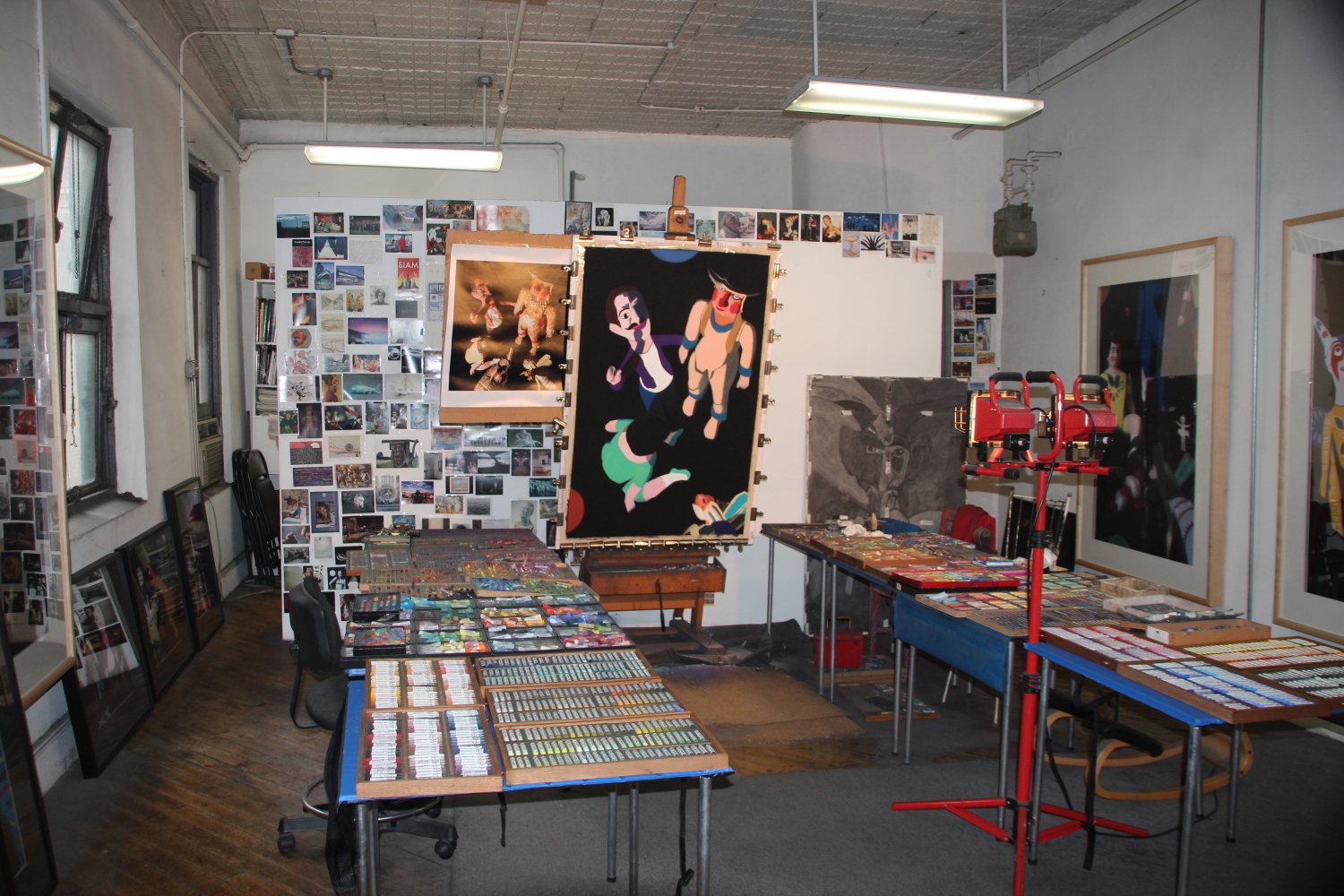
Q: How do you organize your studio?

Barbara’s studio
A: Of course, my studio is first and foremost set up as a work space. The easel is at the back and on either side are two rows of four tables, containing thousands of soft pastels.
Enticing busy collectors, critics, and gallerists to visit is always difficult, but sometimes someone wants to make a studio visit on short notice so I am ready for that. I have a selection of framed recent paintings and photographs hanging up and/or leaning against a wall. For anyone interested in my evolution as an artist, I maintain a portfolio book with 8″ x 10″ photographs of all my pastel paintings, reviews, press clippings, etc. The portfolio helps demonstrate how my work has changed during my nearly three decades as a visual artist.
Comments are welcome!
Q: What’s on the easel today?
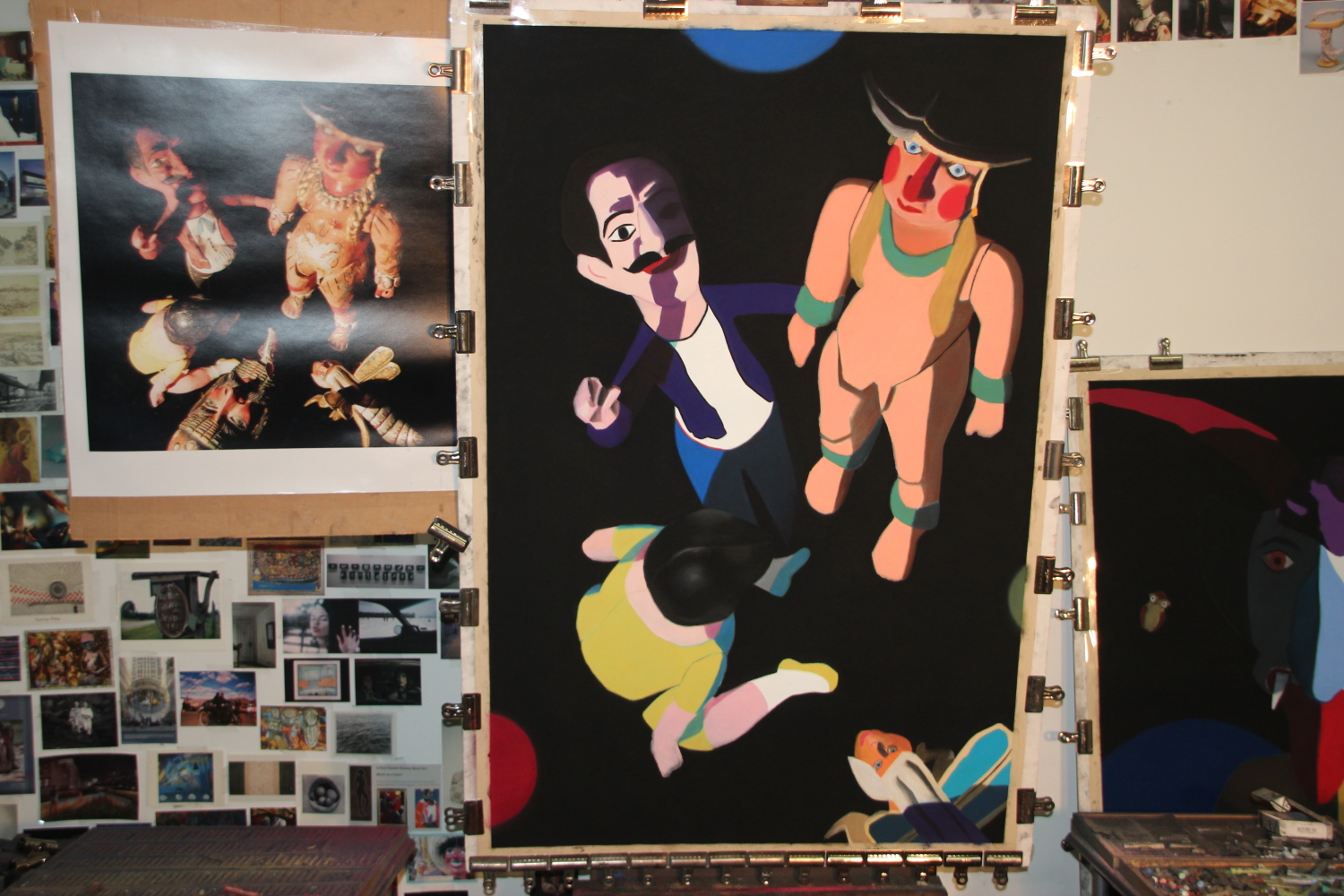
“The Ancestors,” in progress
A: I’m continuing to work on a 58″ x 38″ pastel-on-sandpaper painting that I started some weeks ago. It’s working title is “The Ancestors.”
Comments are welcome!
Q: What’s on the easel today?
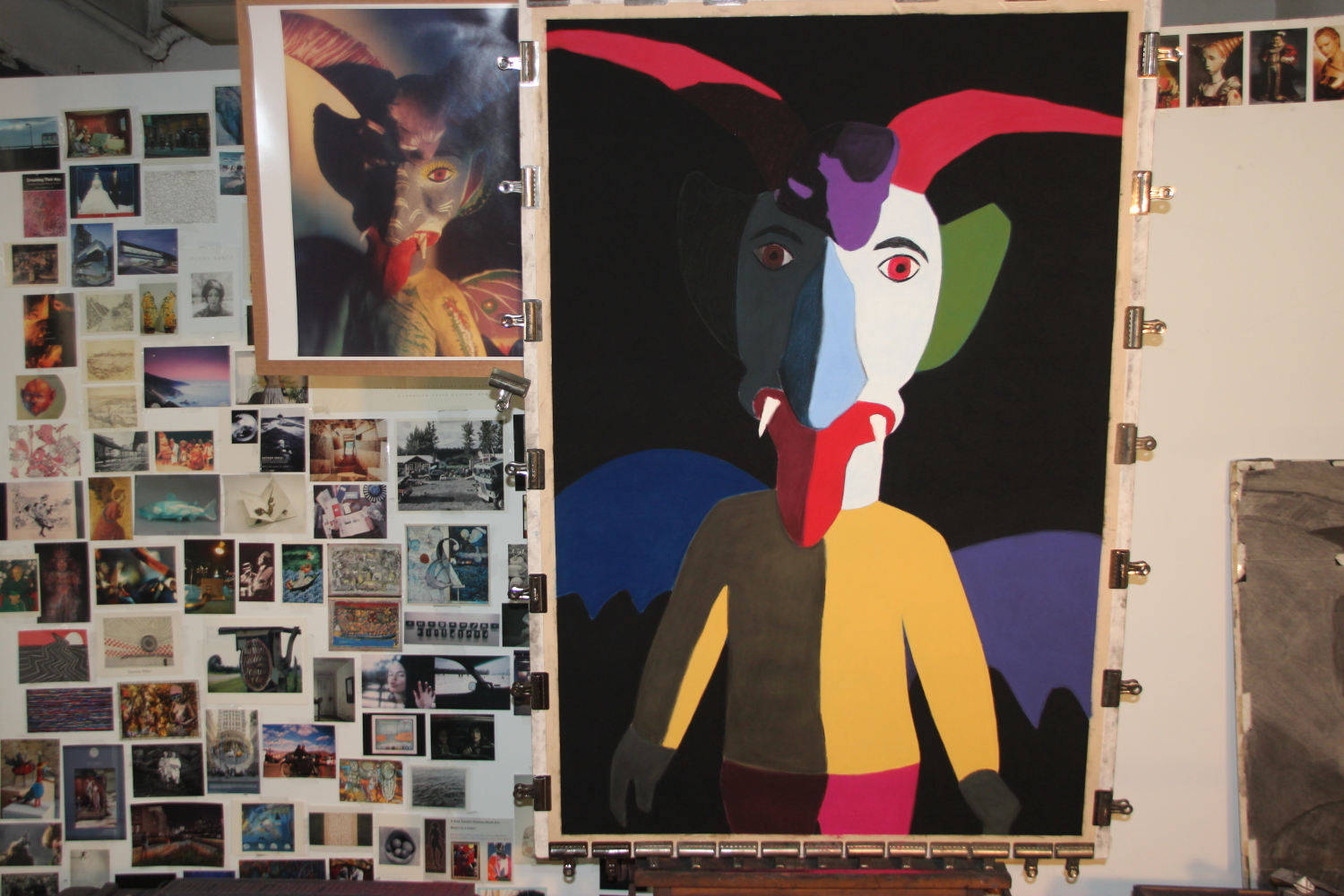
Work in progress, 58″ x 38″
A: Today is a day off to let my fingers heal. When I start a new painting, I need to rub my fingers against raw sandpaper in order to blend the pastel. With each layer the tooth of the paper gets filled up and becomes smooth, but until then my fingers suffer. Here is what I’ve been working on.
This pastel-on-sandpaper painting is an experiment, an attempt to push myself to work with bigger and bolder imagery. The photograph clipped to the easel is one of my favorites. It depicts a Judas that Bryan and I found in a dusty shop in Oaxaca. Among the Mexican and Guatemalan folk art pieces that I’ve collected are five papier mâché Judases. This particular one is unusual because it has a cat’s head attached at the forehead (the purple shape in the painting). They are not made to last. In some Mexican towns large Judases are hung from church steeples, loaded with fireworks, and burned in effigy. This takes place at 10:00 a.m. on the Saturday morning before Easter. Mexico is primarily a Catholic nation, of course, so effigy burning is done as symbolic revenge against Judas for his betrayal of Christ. The Judas in the photo is small and meant for private burning by a family (rather than in public at a church) so by bringing it back to New York I rescued it from a fire-y death! In sympathy with Mexican tradition, I began this painting last Saturday (the day before Easter) at 10 a.m.
Comments are welcome!
Q: What’s on the easel today?
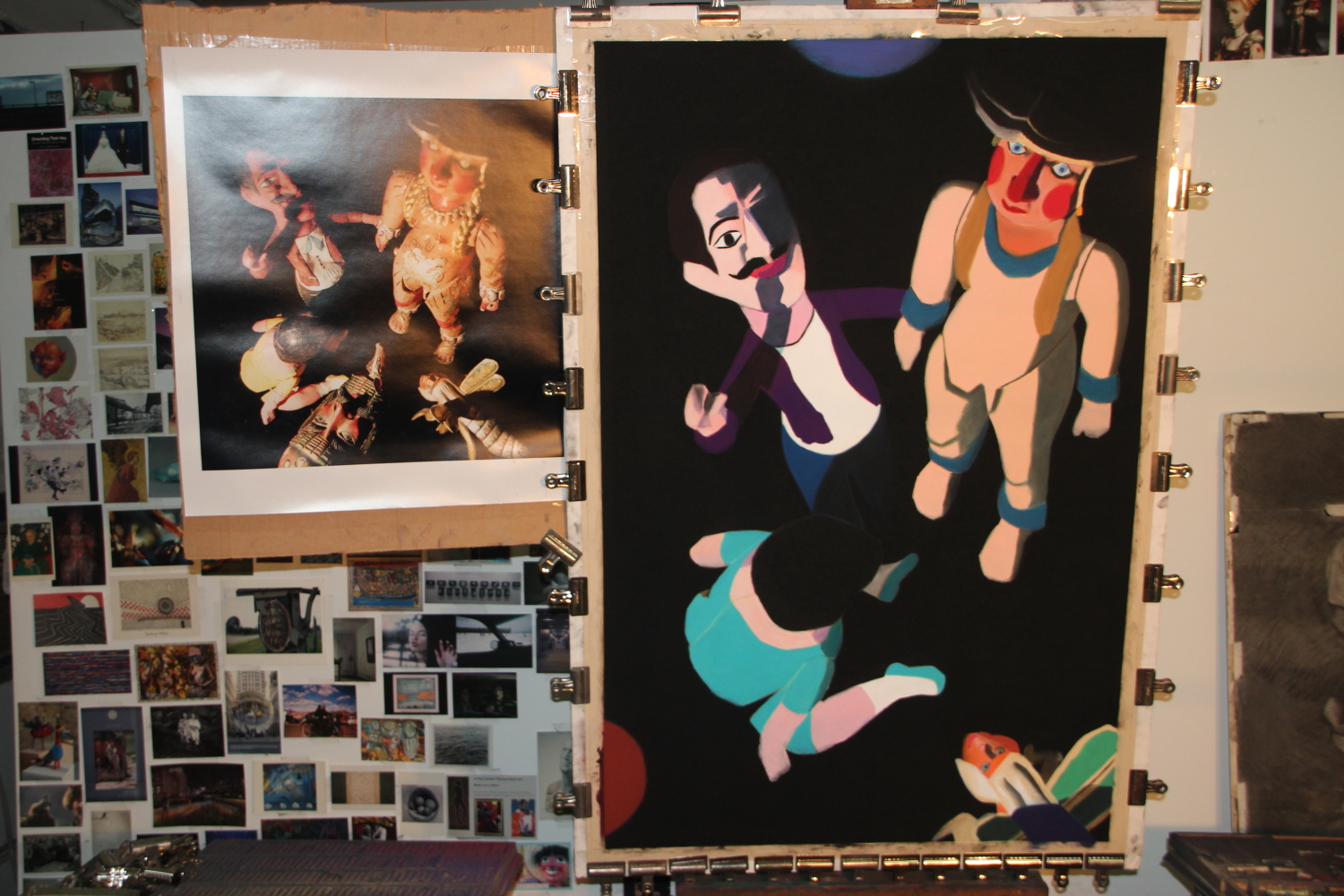
Untitled painting
A: I’ve been working on this pastel-on-sandpaper painting for a few weeks.
Comments are welcome!
Q: What’s on the easel today?
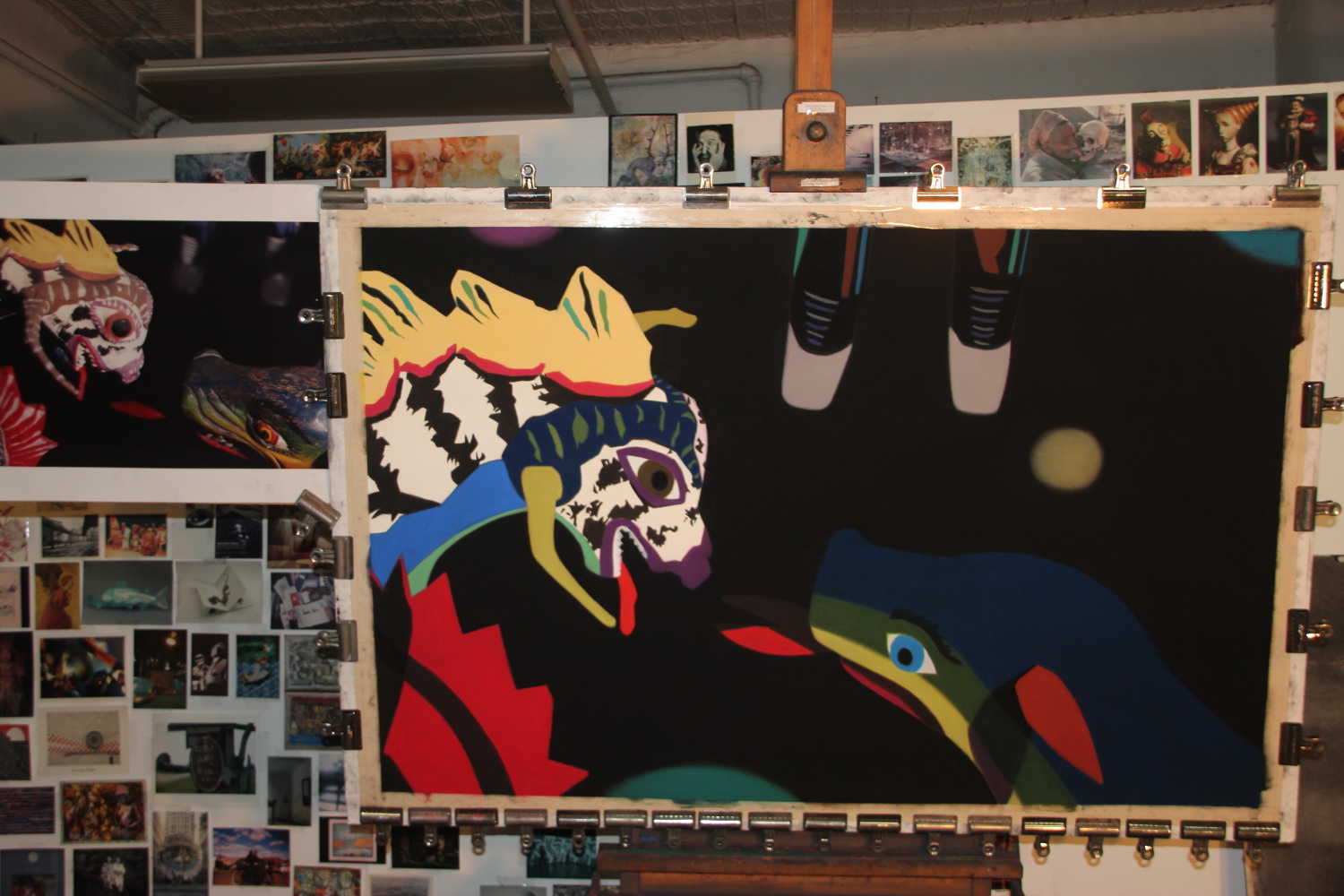
“Stalemate” in progress, soft pastel on sandpaper
A: A large pastel painting with the working title, “Stalemate.” For this one I went back and looked at some of my older 35 mm negatives. I selected one from 2002 and made the photographic print you see above, clipped to the left side of my easel. This piece is unusual because I’m painting the figures much larger than life size. I like what’s happening, but it’s slow going.
The title, “Stalemate,” is one I thought of some twenty-odd years ago, when I worked on a very different pastel painting – a table top still life – by that name. Somehow I couldn’t resolve some problems in the composition so I never finished it. I haven’t seen it in years, but it’s probably sitting in my Alexandria basement someplace.
Comments are welcome!
Q: Do you listen to music while you work?

A corner of the studio
A: I always have the stereo on when I work in my studio, either tuned in to WBGO (the Newark-based jazz station), WNYC (for news and talk radio; Leonard Lopate, Fresh Air, etc.), WFMU (Fordham University’s radio station, to learn what college kids are listening to) and other local radio stations. I still listen to cd’s, I read the lyrics and the liner notes, and I prefer to listen to music the way artists intended it, meaning that I listen to entire albums from start to finish instead of jumping around between single tracks by different artists. When it comes to music, I’m interested in everything: jazz (especially classic jazz artists like Thelonious Monk, Miles Davis, John Coltrane, Art Blakely, etc.), blues, classical, pop, rock, world music (especially artists from Brazil, Cuba, and any country in Africa), electronic, indy, experimental, ancient music, etc. You name it, I probably listen to it, and if I don’t, I’m eager to learn all about it. When I’m working, certain artists are better to listen to at particular points in a painting. For example, one of my favorite artists to start a new painting with is Lady Gaga. The beat, her energy, and sheer exuberance are perfect when I’m standing in front of my easel with a blank piece of sandpaper in front of me. Gaga’s music gets me moving and working fast, putting down colors instinctively without thinking about them, just feeling everything.
It’s a different story when I am at my apartment and am shooting a photo setup. Then I might or might not listen to music. Lately it’s more about working fast (I shoot 24 images in about 15 minutes), choosing a variety of interesting vantage points, getting surprising effects, etc.
Comments are welcome!
Q: Do you have air filters in your work space?
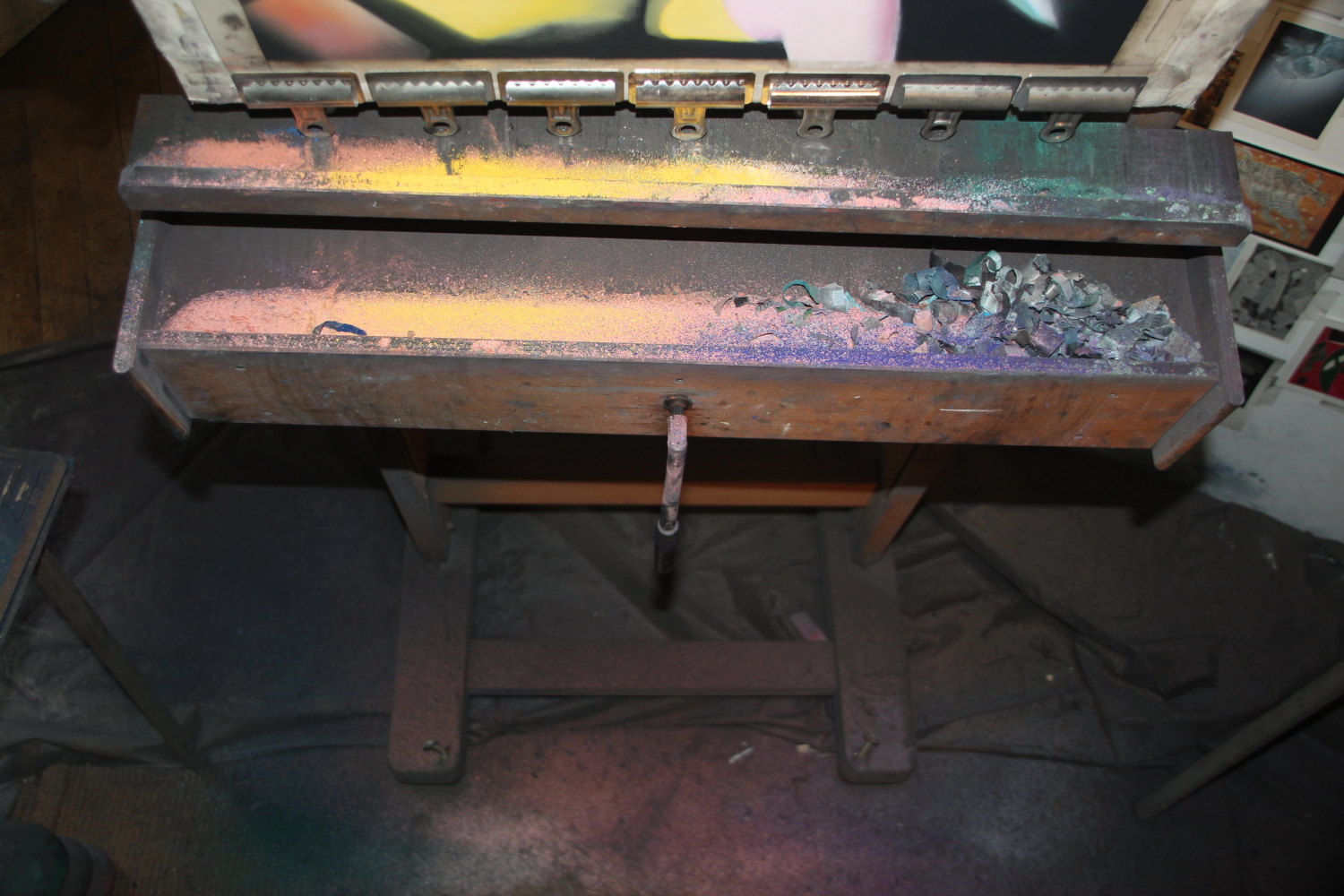
Pastel dust
A: No, but I wear a surgical mask when I work, to prevent breathing the pastel dust. Also, on my hands I use a barrier cream, called Artgard, to prevent pigment being absorbed into my skin through cuts. I take care that my head is always higher than my hand as I work, so the dust is below my mouth and nose. It may be hard to tell from the photo but my easel is tilted forward, allowing pastel dust to fall onto the easel and floor. I am well aware of the toxicity of pastel and believe I take the proper precautions. After twenty-six years working with soft pastel, so far I’ve managed to stay healthy.
Comments are welcome.
Q: Are you close to finishing any pastel paintings?
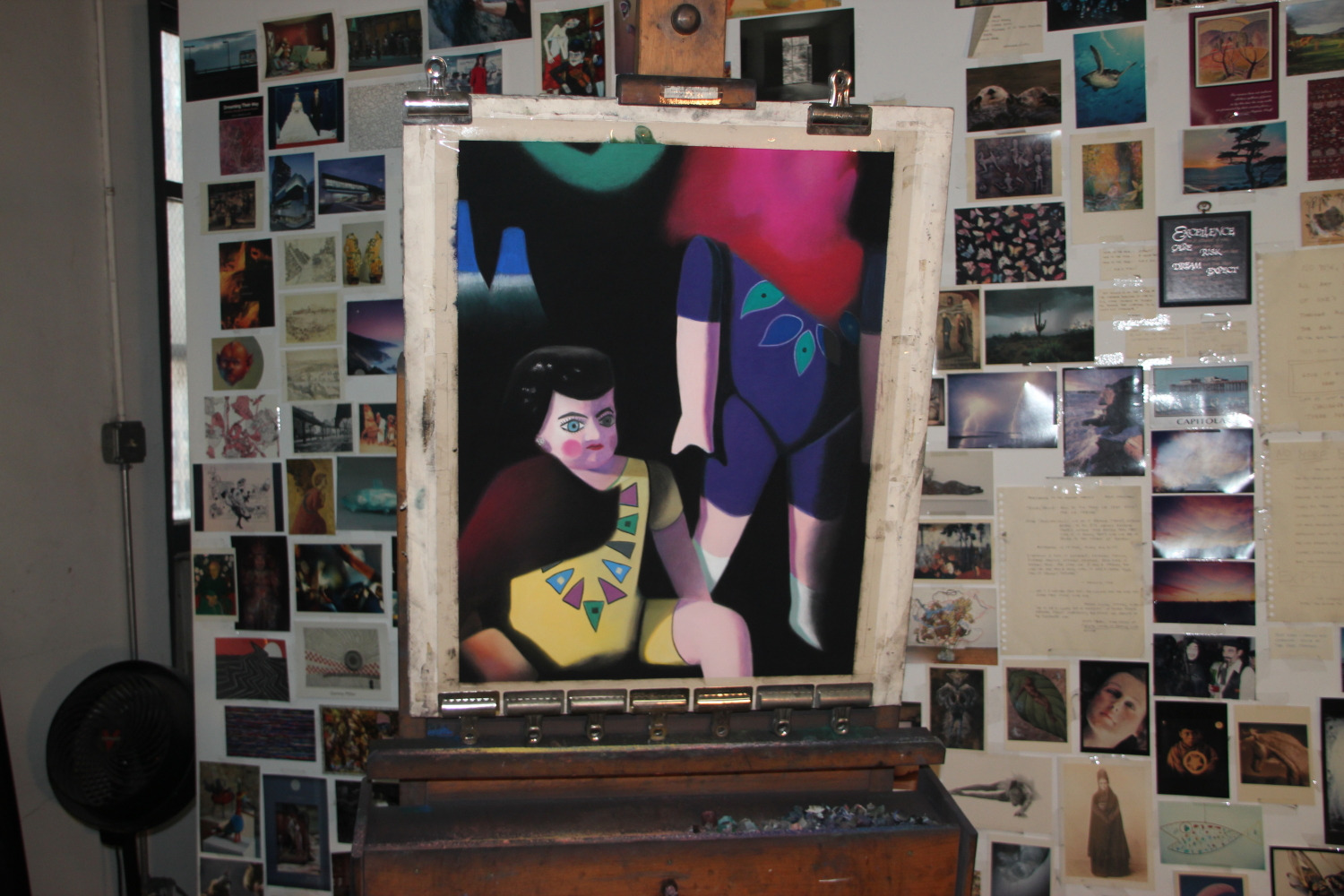
“Absence” not quite finished
A: I’m putting finishing touches on a small one, “Absence,” which is 26″ x 20″ unframed. It depicts paper mache figures that I bought some years ago in Oaxaca and Mexico City. I added those two blue and white “volcano” shapes on the left after my recent trip to Bali. Check out the dust (and torn pastel wrappers) on the easel. That’s what inspired the name of my blog.


 barbararachkoscoloreddust.com