Blog Archives
Pearls from artists* # 68

Hudson Rail Yards, NYC
* an ongoing series of quotations – mostly from artists, to artists – that offers wisdom, inspiration, and advice for the sometimes lonely road we are on.
Get to know what you really want. Hold on and treasure your vision. Acknowledge that your life is a work in progress and that your goals will change and develop over time. Knowing deeply what you want to accomplish shores up doubt, builds fortitude, and pushes you to take more action. This awareness changes how you hear and use information. Your senses will be sharpened. You begin to listen to everything differently; you interpret what you read, what you do, and whom you meet with your goals in mind. You will ask better questions of those around you and seek more meaningful help. All of this will produce a subtle yet profound shift in how you proceed and the actions you take. It will reshape your life and have major consequences for your career.
Jackie Battenfield in The Artist’s Guide: How to Make a Living Doing What You Love
Comments are welcome!
Pearls from artists* # 58

Cabo San Lucas, Mexico
* an ongoing series of quotations – mostly from artists, to artists – that offers wisdom, inspiration, and advice for the sometimes lonely road we are on.
I remember as a teenager having a group of friends at school and another group whom I spent the weekends with. I functioned fine until on occasions when I was with friends from both groups at the same time. Then it became really difficult, because I was used to acting very differently with the two groups. With one I was the leader, very vocal and outspoken about my opinions. With the other group I wanted desperately to belong and so I adapted to fit in, which meant not really being myself.
The lack of authenticity is painful. It applies to all levels of life. If our voice as a painter is inauthentic, we’re in trouble. In the end there is nothing so compelling as to be yourself. This is why being an artist can be so exhilarating. If you want to uncover your truth, you have a daily technique to come to terms with your limitations and to overcome them. You have an opportunity to look at the limiting stories you have written in your head and heart and rewrite them with boldness and vision. The quality of your attention influences how you see things.
What you put your attention on grows stronger in your life. Life, if you look around you, whether inside or in nature, is one bubbling mass of creativity. Recognize we have no shortage of it. If you focus your attention on what you now decide is fundamental , that quality will grow in your life. Not what our parents or teachers or friends or media or anybody says or said. What we now put our attention on will grow in our life. If you want to paint and put your focus there you will unleash a torrent of energy and enthusiasm.
Ian Roberts in Creative Authenticity: 16 Principles to Clarify and Deepen Your Artistic Vision
Comments are welcome!
Pearls from artists* # 46

Artist’s backyard
* an ongoing series of quotations – mostly from artists, to artists – that offers wisdom, inspiration, and advice for the sometimes lonely road we are on.
Some things will naturally excite us more than others. This is where art begins, when we separate our inner-directed impulse from the outer-directed deluge of other people’s work and opinion. “The artists are the ones who bare themselves to this experience of essence… Their vocation is to communicate that experience to others. Not to communicate it is to surrender the vision to atrophy; the artist must paint, or write, or sculpt – else the vision withers away and he or she is less apt to have it again.”
The trick is to be able to learn to juggle at least two things at once. We need to keep the initial impulse in its entirety before us as we start engaging in the execution of the parts.
Ian Roberts in Creative Authenticity: Sixteen Principles to Clarify and Deepen Your Artistic Vision
Comments are welcome!
Pearls from artists* # 41

White Sands, NM
* an ongoing series of quotations – mostly from artists, to artists – that offers wisdom, inspiration, and advice for the sometimes lonely road we are on.
If you look at the work of an artist over a lifetime there is always transformation. Some hit a lively place early and then seem to lose it later. Others find that place progressively throughout their life; others still, find it late. But regardless, they are all learning to isolate the poetic place within them. That focus on the poetic in our own work increases our appreciation of the beauty around us, increases our growth, and increases our divine connection.
One thing you see in many artists’ work is that as they continue over the decades to translate their experience of the poetic into form, they learn to communicate better. They strip away all the extraneous stuff and artistic baggage they had. They say more with less.
The problem is seldom that what we truly, deeply experience is too simple to simplify. There is power in stripping everyhing away to reveal the vision. That’s what takes a lifetime.
Ian Roberts in Creative Authenticity: 16 Principles to Clarify and Deepen Your Artistic Vision
Comments are welcome!
Pearls from artists* # 24
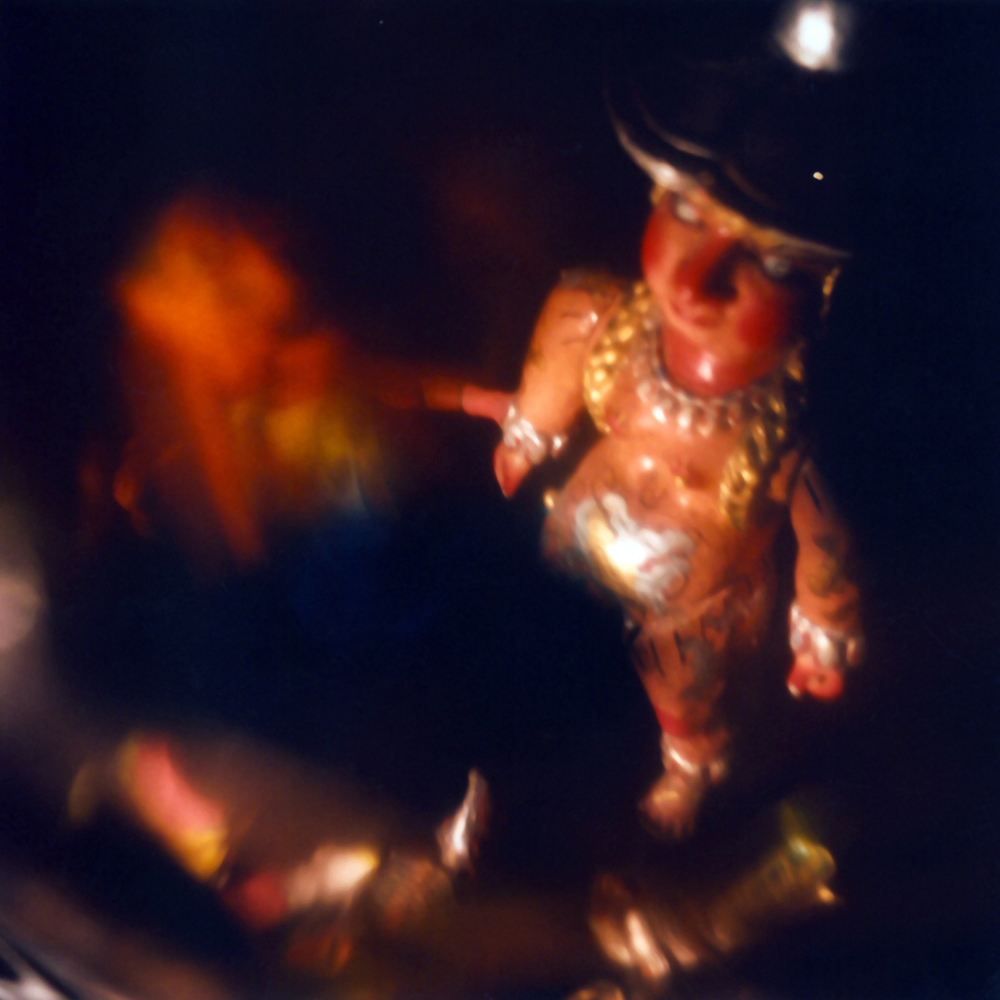
Untitled, chromogenic print, 24″ x 24,” edition of 5
* an ongoing series of quotations – mostly from artists, to artists – that offers wisdom, inspiration, and advice for the sometimes lonely road we are on.
A person is not an artist until he works at his art, no matter how eloquently he speaks during the cocktail hour or how fine are the images that come to his mind. As David Salle, the visual artist, put it, “It’s easy to be an artist in your head.” We, as artists, know this. We realize that often we are not able to translate our vision into splendid art. Even the finest artists write books that are not great, paint pictures that are not great, compose pieces that are not great, involve themselves in projects that are not great. But artists can only try – and must try.
When you love what you are doing, know what you are doing, and do it, a confidence is bred in you that is the best stretcher of limits. Then you can say, as the visual artist June Wayne said, “Now when I start something, I expect to carry it off.”
Eric Maisel, A Life in the Arts
Comments are welcome!
Pearls from artists* # 11

Great Salt Lake
* an ongoing series of quotations – mostly from artists, to artists – that offers wisdom, inspiration, and advice for the sometimes lonely road we are on.
Virtually all artists spend some of their time (and some artists spend all of their time) producing work that no one else much cares about. It just seems to come with the territory. But for some reason – self defense, perhaps – artists find it tempting to romanticize this lack of response, often by (heroically) picturing themselves peering deeply into the underlying nature of things long before anyone else has eyes to follow.
Romantic, but wrong. The sobering truth is that the disinterest of others hardly ever reflects a gulf in vision.In fact there’s generally no good reason why others should care about most of any one artist’s work. The function of the overwhelming majority of your artwork is simply to teach you how to make the small fraction of your artwork that soars. One of the basic and difficult lessons every artist must learn is that even the failed pieces are essential. X-rays of famous paintings reveal that even master artists sometimes made basic mid-course corrections (or deleted really dumb mistakes) by over-painting the still wet canvas. The point is that you learn how to make your work by making your work, and a great many pieces you make along the way will never stand out as finished art. The best you can do is make art you care about – and lots of it!
The rest is largely a matter of perseverance. Of course once you’re famous, collectors and academics will circle back in droves to claim credit for spotting evidence of genius in every early piece. But until your ship comes in, the only people who will really care about your work are those who care about you personally. Those close to you know that making the work is essential to your well being. They will always care about your work, if not because it is great, then because it is yours – and this is something to be genuinely thankful for. Yet however much they love you, it still remains as true for them as for the rest of the world: learning to make your work is not their problem.
David Bayles and Ted Orland, Art & Fear
Comments are welcome.
Pearls from artists* # 8
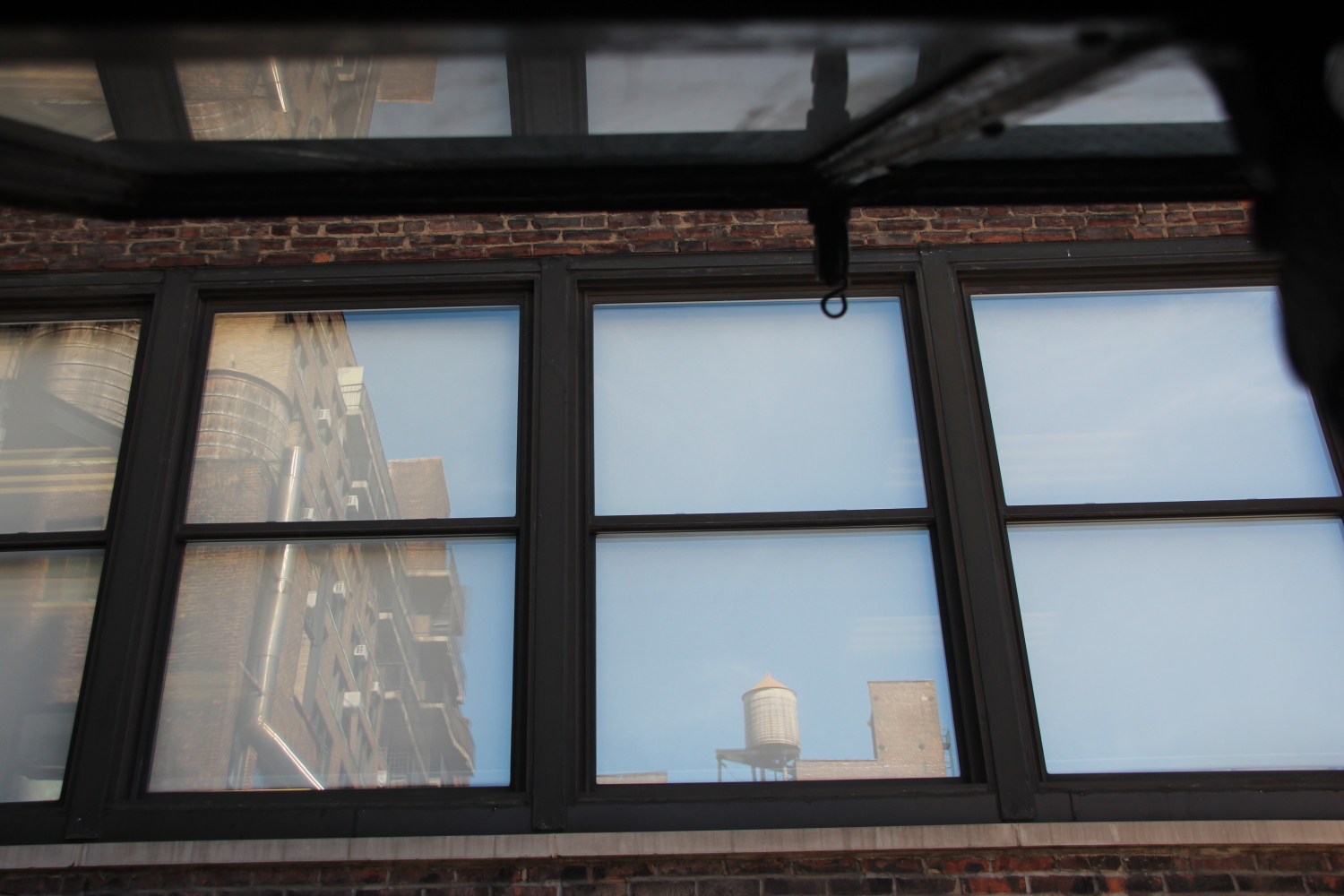
A view from the studio
* an ongoing series of quotations – mostly from artists, to artists – that offers wisdom, inspiration, and advice for the sometimes lonely road we are on.
Here is a fairly sober version of what happens in the small room between the writer and the work itself. It is similar to what happens between a painter and the canvas.
First you shape the vision of what the projected work of art will be. The vision, I stress, is no marvelous thing: it is he work’s intellectual structure and aesthetic surface. It is a chip of mind, a pleasing intellectual object. It is a vision of the work, not of the world. It is a glowing thing, a blurred thing of beauty. Its structure is at once luminous and translucent; you can see the world through it. After you receive the initial charge of this imaginary object, you add to it at once several aspects, and incubate it most gingerly as it grows into itself.
Many aspects of the work are still uncertain, of course; you know that. You know that if you proceed you will change things and learn things, that the form will grow under your hands and develop new and richer lights. But that change will not alter the vision or its deep structures; it will only enrich it. You know that and you are right.
But you are wrong if you think that in the actual writing or in the actual painting, you are filling in the vision. You cannot fill in the vision. You cannot even bring the vision to light. You are wrong if you think that you can in any way take the vision and tame it to the page. The page is jealous and tyrannical; the page is made of time and matter; the page always wins. The vision is not so much destroyed, exactly, as it is, by the time you have finished, forgotten. It has been replaced by this changeling, this bastard, this opaque lightless chunky ruinous work.
Here is how it happens. The vision is, sub specie aeternitatis, a set of mental relationships, a coherent series of formal possibilities. In the actual rooms of time, however, it is a page or two of legal paper filled with words and questions; it is a terrible diagram, a few books’ names in a margin, an ambiguous doodle, a corner folded down in a library book. There are memos from the thinking brain to witless hope.
Nevertheless, ignoring the provisional and pathetic nature of these scraps, and bearing the vision itself in mind – having it before your sights like the very Grail – you begin to scratch out the first faint marks on the canvas, on the page. You begin the work proper. Now you have gone and done it. Now the thing is no longer a vision: it is paper.
Words lad to other words and down the garden path. You adjust the paints’ values and hues not to the world, not to the vision, but to the rest of the paint. The materials are stubborn and rigid; push is always coming to shove. You can fly – you can fly higher than you thought possible – but you can never get off the page. After every passage another passage follows, more sentences, more everything on drearily down. Time and materials hound the work; the vision recedes ever farther into the dim realms.
And so you continue the work, and finish it. Probably by now you have been forced to toss the most essential part of the vision. But this is a concern for mere nostalgia now: for before your eyes, and stealing your heart, is this fighting and frail finished product, entirely opaque. You can see nothing through it. It is only itself, a series of well-known passages, some colored paint. Its relationship to the vision that impelled it is the relationship between any energy and any work, anything unchanging to anything temporal.
The work is not the vision itself, certainly. It is not the vision filled in, as if it had been a coloring book. It is not the vision reproduced in time; that were impossible. It is rather a simulacrum and a replacement. It is a golem. You try – you try every time – to reproduce the vision, to let your light so shine before men. But you can only come along with your bushel and hide it.
Annie Dillard, The Writing Life
Comments are welcome.


 barbararachkoscoloreddust.com