Blog Archives
Q: How do you feel about the fact that more people view an artist’s work online than ever see it in person?

A: This has been a dilemma for decades. Don’t get me wrong. Artists are indeed fortunate to have alternative ways to share our art, such as on the internet, but there is just no substitute for seeing art in person! I remember friends telling me about a review of a Nan Goldin exhibition that said, “All of the pleasure circuits are fired in looking.” That rarely happens when you view art online. Yet this is how most people experience our work – at a remove and on a small screen.
Nowadays, a global audience will see art on their phones instead of in our studios or in a gallery or museum. My pastel paintings are quite large and very detailed so when people finally see them in person, they are often surprised. They had gotten used to seeing them in a much smaller scale online, where very few of the meticulous and subtle details I incorporate into them are visible.
Comments are welcome!
Q: Does your work look different to you on days when you are sad, happy, etc.?

Barbara’s Studio
A: I am much more critical on days when I am sad so that the faults, imperfections, and things I wish I had done better stand out. Fortunately, all of my work is framed behind plexiglas so I can’t easily go back in to touch up perceived faults. I am reminded of the expression, “Always strive to improve, whenever possible. It is ALWAYS possible!” However, I’ve learned that re-working a painting is a bad idea. You are no longer deeply involved in making it and the zeitgeist has changed. The things you were concerned with are gone: some are forgotten, others are less urgent.
For most artists our work is autobiography. Art is personal. When I look at a completed pastel painting, I usually remember exactly what was happening in my life as I created it. Each piece is a snapshot – maybe a time capsule, if anyone could decode it – that reflects and records a particular moment. When I finally pronounce a piece finished and sign it, that’s it, THE END. It’s as good as I can make it at that point in time. I’ve incorporated everything I was thinking about, what I was reading, how I was feeling, what I valued, art exhibitions I visited, programs that I heard on the radio or watched on television, music that I listened to, what was going on in New York, in the country, and in the world.
It is still a mystery how this heady mix finds its way into the work. During the time that I spend on it, each particular painting teaches me everything it has to teach. A painting requires months of looking, reacting, correcting, searching, thinking, re-thinking, revising. Each choice is made for a reason and together these decisions dictate what the final piece looks like. On days when I’m sad I tend to forget that. On happier days I remember that the framed pastel paintings that you see have an inevitability to them. If all art is the result of one’s having gone through an experience to the end, as I believe it is, then the paintings could not, and should not, look any differently.
Comments are welcome.
Q: Why art? (Question from “Arts Illustrated”)

A: I love this question! I remember being impressed by Ursula von Rydingsvard’s exhibition at the National Museum of Women in the Arts a few years ago. What stayed with me most was her wall text, “Why Do I Make Art by Ursula von Rydingsvard.” There she listed two dozen benefits that art-making has brought to her life.
I want to share some of my own personal reasons for art-making here, in no particular order. My list keeps changing, but these are true at least for today.
1. Because I love the entire years-long creative process – from foreign travel whereby I discover new source material, to deciding what I will make, to the months spent in the studio realizing my ideas, to packing up my newest pastel painting and bringing it to my Virginia framer’s shop, to seeing the framed piece hanging on a collector’s wall, to staying in touch with collectors over the years and learning how their relationship to the work changes.
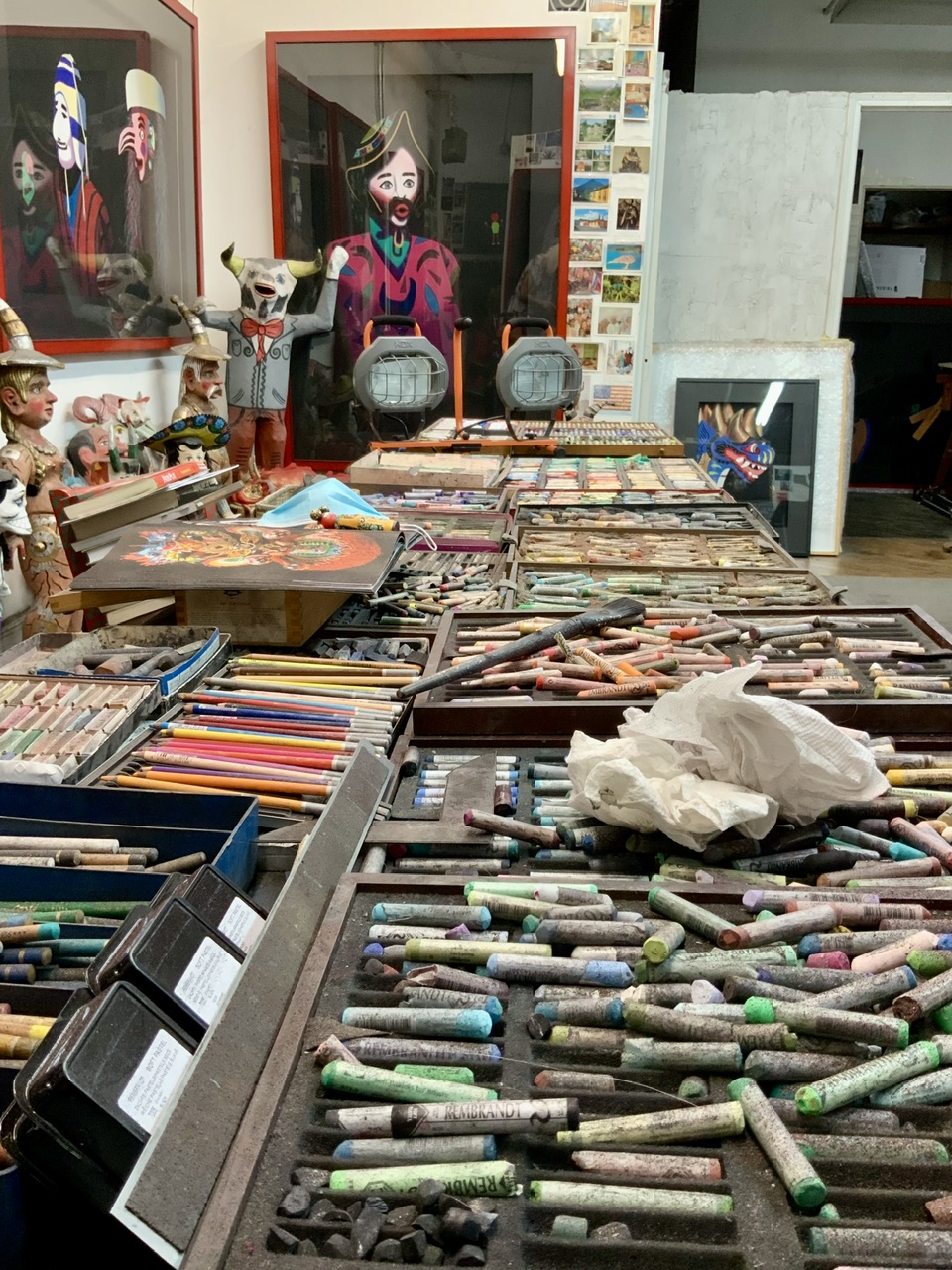
2. Because I love walking into my studio in the morning and seeing all of that color! No matter what mood I am in, my spirit is immediately uplifted.
3. Because my studio is my favorite place to be… in the entire world. I’d say that it is my most precious creation. It’s taken more than twenty-two years to get it this way. I hope I never have to move!
4. Because I get to listen to my favorite music all day.
5. Because when I am working in the studio, if I want, I can tune out the world and all of its urgent problems. The same goes for whatever personal problems I am experiencing.
6. Because I am devoted to my medium. How I use pastel continually evolves. It’s exciting to keep learning about its properties and to see what new techniques will develop.
7. Because I have been given certain gifts and abilities and that entails a sacred obligation to USE them. I could not live with myself were I to do otherwise.
8. Because art-making gives meaning and purpose to my life. I never wake up in the morning wondering, how should I spend the day? I have important work to do and a place to do it. I know this is how I am supposed to be spending my time on earth.
9. Because I have an enviable commute. To get to my studio it’s a thirty-minute walk, often on the High Line early in the morning before throngs of tourists have arrived.
10. Because life as an artist is never easy. It’s a continual challenge to keep forging ahead, but the effort is also never boring.
11. Because each day in the studio is different from all the rest.
12. Because I love the physicality of it. I stand all day. I’m always moving and staying fit.
13. Because I have always been a thinker more than a talker. I enjoy and crave solitude. I am often reminded of the expression, “She who travels the farthest, travels alone.” In my work I travel anywhere.
14. Because spending so much solitary time helps me understand what I think and feel and to reflect on the twists and turns of my unexpected and fascinating life.
15. Because I learn about the world. I read and do research that gets incorporated into the work.
16. Because I get to make all the rules. I set the challenges and the goals, then decide what is succeeding and what isn’t. It is working life at its most free.
17. Because I enjoy figuring things out for myself instead of being told what to do or how to think.
18. Because despite enormous obstacles, I am still able to do it. Art-making has been the focus of my life for thirty-nine years – I was a late bloomer – and I intend to continue as long as possible.
19. Because I have been through tremendous tragedy and deserve to spend the rest of my life doing exactly what I love. The art world has not caught up as much as I would like yet, but so be it. This is my passion and my life’s work and nothing will change that.
20. Because thanks to the internet and via social media, my work can be seen in places I have never been to and probably will never go.
21. Because I would like to be remembered. The idea of leaving art behind for future generations to appreciate and enjoy is appealing.
Comments are welcome!
Pearls from artists* # 638

Barbara’s Studio
*an ongoing series of quotations – mostly from artists, to artists – that offers wisdom, inspiration, and advice for the sometimes lonely road we are on.
I was in the presence of a woman [Grace Hartigan] who had sacrificed everything, including her only child, to be what she was: an artist. The rewards had been few, beyond a life well-lived (not materially, but spiritually) and the recognition in her waning years that she had been honest about who she was and what she needed. A rare accomplishment for a woman of any generation, it was particularly so of hers, when servitude to family was the only goal toward which a “healthy” woman was to aspire. Grace was living proof that, on the contrary, a life dreamed could be a life lived. All it took was courage, commitment, and humor. I remember both of us laughing a lot that afternoon. Though the subject was serious, the stories Grace told were fantastic and the woman who recounted them was as wild as the twenty-six-year-old who had abandoned everything in 1948 to paint, though she wasn’t even sure how.
Mary Gabriel in Ninth Street Women
Comments are welcome!
Q: Did you formally study art? (Question from “Cultured Focus Magazine”)

A: My bachelor’s degree in Psychology is from the University of Vermont. I did not formally study art, unless you want to count the several years-worth of drawing and painting classes I took at the Art League School in Alexandria, VA. I never went to art school so do not have a bachelor’s or master’s degree in art.
Much later, in the early 2000s, I was compelled to study photography at the International Center of Photography in New York. This is a rather long story.
On September 11, 2001, my husband Bryan Jack, a high-ranking federal government employee, a brilliant economist and a budget analyst at the Pentagon, was on his way to present his monthly guest lecture in economics at the Naval Postgraduate College in Monterey, CA. He was a passenger on the plane that departed from Dulles Airport and was high-jacked and crashed into the Pentagon.
Losing Bryan on 9/11 was the biggest shock of my life, devastating in every way imaginable. We were soulmates and newly married. I have lived with his loss every single day for more than twenty years now. Life has never been the same.
In the summer of 2002 I was beginning to feel ready to get back to work. Learning about photography and cameras became essential avenues to my well-being.
My first challenge was learning how to use Bryan’s 4 x 5 view camera. Bryan had always taken the 4 x 5 negatives from which I derived the reference photos that were essential tools for making pastel paintings. I enrolled in a one-week view camera workshop at the International Center of Photography in New York. Surprisingly, it was very easy. I had derived substantial technical knowledge just from watching Bryan for many years.
After the view camera workshop, I decided to throw myself into learning this new medium, beginning with Photography I. I spent the next few years taking many classes at ICP and learning as much as I could. Eventually, I learned how to use Bryan’s extensive collection of film cameras, to properly light the setups that served as subject material for my “Domestic Threats” pastel paintings, and to make my own large chromogenic prints in a darkroom.
Then in October 2009 I was invited to present a solo photography exhibition at a gallery in New York. Continuing to make art after Bryan’s death had seemed like such an impossibility. I remember thinking how proud he would have been to know I became a good photographer.
Comments are welcome!
Pearls from artists* # 630

With Margaret Anderson, Naoshima, Kagawa, Japan
*an ongoing series of quotations – mostly from artists, to artists – that offers wisdom, inspiration, and advice for the sometimes lonely road we are on.
Fresh experiences can lead to new tastes and a life that feels longer, Julie contended. Remember when you were little and an hour-long car ride felt like a lifetime? “I think it’s because, truly, everything’s new. When you experience new things, time slows down a little bit,” she told me. “When you go on trips – which is my favorite thing to do – everything is new, and you feel young again. And reinvigorated with new ideas, new perspectives, a new understanding of yourself.”
Julie Curtiss quoted in Get The Picture: A Mind-Bending Journey Among the Inspired Artists and Obsessive Art Fiends Who Taught Me How to See by Bianca Bosker
Comments are welcome!
Q: What inspires you to create? (Question from “Cultured Focus Magazine”)
A: You remember the expression, to whom much is given, much is expected? Having discovered around the age of 5 or so that I could draw anything I could see, I know I have been given a tremendous gift. I remember being completely surprised as a kid to realize that not everyone can do this.
Therefore, I feel a kind of sacred obligation to develop my abilities as far as possible, to make the most of my short time on this earth. It is a thrill to see not only what is going to happen next in the studio, but also in my life. For example, I have become a world traveler. I wonder, which new country will I visit next?
Comments are welcome!
Pearls from artists* # 626

*an ongoing series of quotations – mostly from artists, to artists – that offers wisdom, inspiration, and advice for the sometimes lonely road we are on.
This is why, when writers who are just starting out ask me when it gets easier, my answer is never. It never gets easier. I don’t want to scare them, so I rarely say more than at, but the truth is that, if anything, it gets harder. The writing life is filled with predictable uncertainties, but with the awareness that we are always starting over. That everything we will ever write will be flawed. We may have written one book, or many, but all we know – if we know anything at all – is how to write the book we’re writing. All novels are failures. Perfection itself would be a failure. All we can hope is that we will fail better. That we will not fall prey to the easy enchantments of repeating what may have worked in the past. I try to remember that the job – as well as the plight, and the unexpected joy – of the artist is to embrace uncertainty, to be sharpened and honed by it. Each time we come to the end of a piece of work, we have failed as we have leapt – spectacularly, brazenly – into the unknown.
Dani Shapiro in Still Writing: The Perils and Pleasures of a Creative Life
Comments are welcome!
Pearls from artists* # 625

*an ongoing series of quotations – mostly from artists, to artists – that offers wisdom, inspiration, and advice for the sometimes lonely road we are on.
The artist not equipped with the necessary arrogance will be repeatedly sidetracked or subverted by the agendas of others. He will lack a sufficient sense of purpose, will frequently stall and block, and will bring a nagging passivity to his art career. His resolve to do great art may remain a potent idea only, a kind of unexplained force in his body. He is likely to accomplish much less than he otherwise might, support others rather than find support for himself, attempt the small rather than the large, and rebound less well from rejection.
The self-centered artist, on the other hand, is challenged to remember that he is neither god nor Superman, but a human being with human limitations. He hasn’t the time to turn every idea into a book, the ability to top each work with a greater one, the energy to toil ceaselessly at his art, nor the right to trample others as he pursues his goals. If he mistakes or oversteps these limits he will put himself in harm’s way and may find himself struck down by his own obsessional energy, by burnout, by depression, by self-abuse, or by the angry complaints of those whose rights he has cavalierly trampled.
Eric Maisel in A Life in the Arts: Practical Guidance and Inspiration for Creative and Performing Artists
Comments are welcome!
Pearls from artists* # 628

Beginning
*an ongoing series of quotations – mostly from artists, to artists – that offers wisdom, inspiration, and advice for the sometimes lonely road we are on.
We have nothing to go by, but still, we must begin. It requires chutzpah – the Yiddish word for that ineffable combination of courage and hubris – to put down one word, then another, perhaps even accumulate a couple of flimsy pages, so few that they don’t even firm the smallest of piles, and call it the beginning of a novel. Or memoir. Or story. Or anything, really rather than a couple of flimsy pages.
When I’m between books, I feel as if I will never have another story to tell. The last book has wiped me out, has taken everything from me, everything I understand and feel and know and remember, and … that’s it. There’s nothing left. A low-level depression sets in. The world hides its gifts from me. It has taken me years to realize that this feeling, the one of the well being empty, is as it should be. It means I’ve spent everything. And so I must begin again.
I wait.
I try to be patient. I remember Colette, who wrote that her most essential art was “not that of writing, but the domestic task of knowing how to wait, to conceal, to save up crumbs, to reglue, regild, change the worst into the not-so-bad, how to lose and recover in the same moment that frivolous thing, a taste for life.” Colette’s words, along with those of a few others, have migrated from one of my notebooks to another for over twenty years now. It’s wisdom I need to remember – wisdom that is easy to forget.
Dani Shapiro in Still Writing: The Perils and Pleasures of a Creative Life
Comments are welcome!


 barbararachkoscoloreddust.com