Blog Archives
Pearls from artists* # 693

*an ongoing series of quotations – mostly from artists, to artists – that offers wisdom, inspiration, and advice for the sometimes lonely road we are on.
Earlier I wrote that I as an artist must concern myself with painting and not waste energy on trying to decipher other people’s intentions or motives. I still believe this to be correct.
(My main purpose in life is to paint, this is my profession. I am most happy when I am alone in the studio working. The other problems of politics exist outside my studio.)
note: I am not sure of this. I am sure of one thing that I am most happy when I am alone working in the studio. The distance between art + politics is one of grey. I have thought of my involvement in art as being one of combat—the paintings are weapons designed to destroy oppressors i.e., the establishment. Art is none of This! Art is Art.
A painting does not represent anything but itself. It shouldn’t look like anything else or make for any allusions. A painting is a painting just as a Rose is a Rose! May God bless Gertrude Stein!
Jack Whitten Notes From the Woodshed
Comments are welcome!
Pearls from artists* # 690
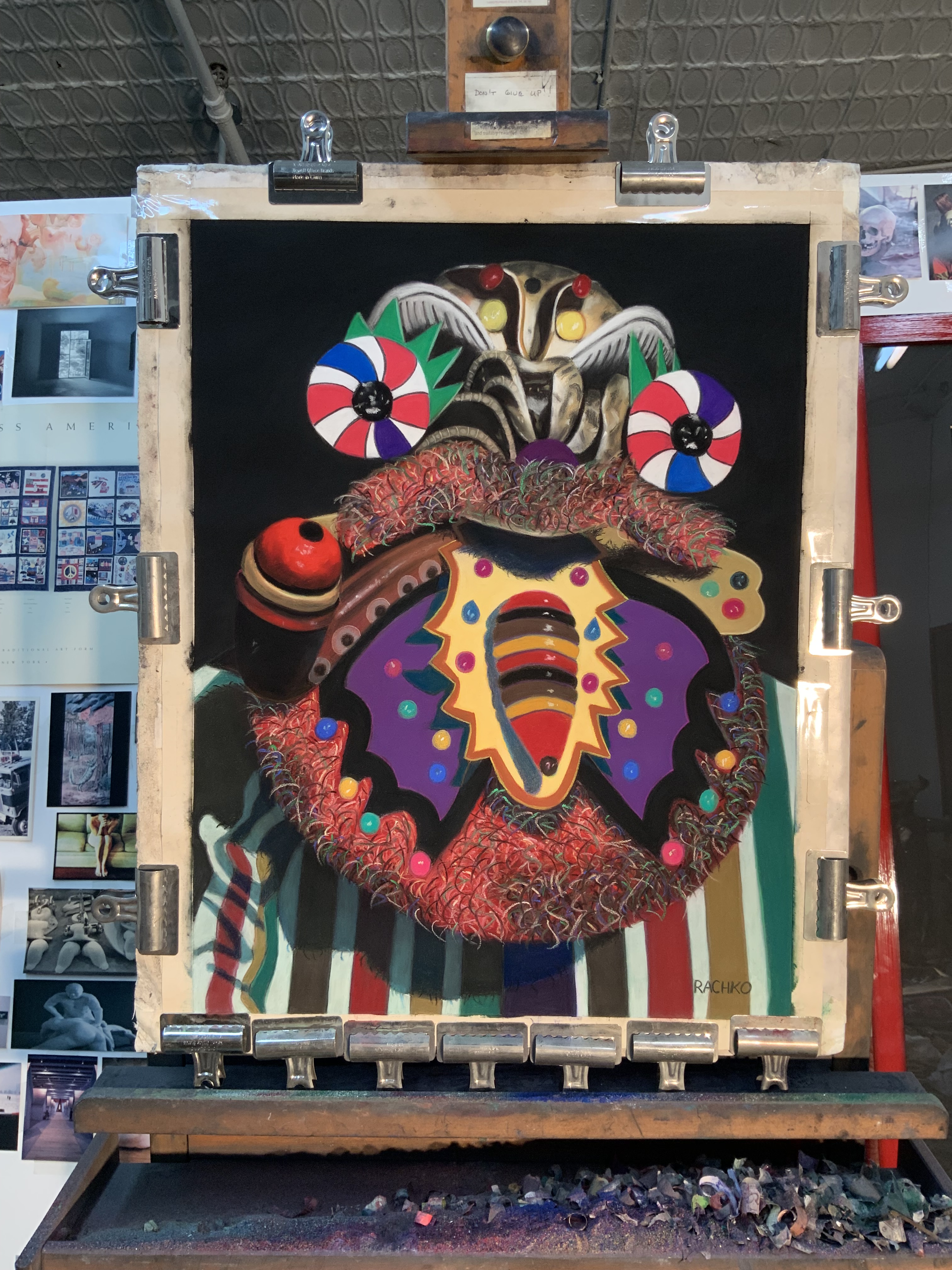
“Showman,” soft pastel on sandpaper, 26” x 20”
*an ongoing series of quotations – mostly from artists, to artists – that offers wisdom, inspiration, and advice for the sometimes lonely road we are on.
PC: And today, don’t you think a picture communicates primarily through its metiére? A mysterious transubstantiation takes place between the thing itself and the way in which our eye receives it. Or, more precisely, a painter’s metiére has life in it, as if it were still laden with the artist’s passion. You feel his pulse beating in it, his need to register the victory of his presence in physical space but outside the reach of time.
HM: Every painter with real talent has his own metiére, a way of laying on the paint with relish, with a certain voluptuous feel, which means that you could say that metiére of this or that painter is like velvet, or satin, or taffeta. As to manner… No one knows where this comes from. It’s magic. It’s not something you can learn. There are very rich paintings, like those of Cézanne, and others very lightly painted that have real density all the same: Velazquez, for example, with his Phillip IV. He uses a scumble for the landscape, which is very beautiful and solid with matiére—the scumble is so well proportioned that it combines with the background and harmonizes perfectly; the Rubens painting on wood in the Louvre, Portrait of Hélène Fourmont and Her Children, is painted mainly in colored oils, yet how deep and solid the colors seem!
Chatting with Henri Matisse: The Lost 1941 Interview, Henri Matisse and Pierre Courthion, edited by Serge Guilbaut
Comments are welcome!
Pearls from artists* # 684

*an ongoing series of quotations – mostly from artists, to artists – that offers wisdom, inspiration, and advice for the sometimes lonely road we are on.
I often think that we should invent another word altogether for what real artists are doing… outside of, and despite, the market, so we could divorce ourselves from what ‘Art’ has devolved into. I aspire to create a new and visionary paradigm far away from the old one. I wish all the art magazines and blogs would declare that there is no longer any money to be made or any fame to be had, so all the people who were in for the wrong reasons would simply go away.
I want artists everywhere to figure out how to tap into their own deep well, the unpredictable source inside that can keep their work fresh and alive. I hope they build confidence to consistently preserve their integrity and independence. I long for them to trust their own intuition, to keep them on their true path as their work evolves. Finally, I yearn for them to reject anything that gets in the way of actualizing their deepest voice, so they might step into that expansive space that the universe has intended for them since the day they appeared on this earth.
Kate Kretz in Art From Your Core: A Holistic Guide to Visual Voice
Comments are welcome!
Pearls from artists* # 665

*an ongoing series of quotations – mostly from artists, to artists – that offers wisdom, inspiration, and advice for the sometimes lonely road we are on.
We are wordlessly persuaded and taught outright to hide so much of what we have unearthed in our lives. But artists throughout the centuries have described the power of using anguish as a catalyst to fuel their creativity. In Greek epic poetry, ‘Kleos’ refers to immortal renown. Unlike present-day fame, this term referred exclusively to heroes who had surmounted a great obstacle or persevered through tremendous difficulties. There is a certain authority that comes from those who have endured hardship. They have earned the depth of their work.
Darkness contains a great deal of energy. We can use it for destruction or creativity. Only those who tolerate it are able to illuminate the shadowy corners, revealing the nefariousness that hopes to stay hidden. We cannot change our past, or any hell that we have been through. But art provides the means to exorcise the pain that has taken up residence in our body and fashion it into a form outside ourselves, in an infinitely affirmative gesture. The darkness we have passed through was not endured in vain if we mold it into a vision that lights the way out… for us, and for all the other souls who undoubtedly need it.
Kate Kretz in Art From Your Core: A Holistic Guide to Visual Voice
Comments are welcome!
Pearls from artists* # 654

*an ongoing series of quotations – mostly from artists, to artists – that offers wisdom, inspiration, and advice for the sometimes lonely road we are on.
The cynical art world, where ‘nothing is a miracle,’ benefits from disempowered artists who have been tricked into feeling devalued, and trained to live at the mercy of the marketplace. But the exact opposite is true. The art world would collapse without our coveted holy vision. Artists are born with unconventional gifts that mark them as innovative thought leaders. Society is only beginning to understand how these gifts may be employed. We possess the power to expose what is going on beneath the surface, initiate difficult conversations, and help people process an increasingly complex world. We fire bullets of truth to pierce the ever-thickening wall of relentless lies. We see things more clearly, precisely because we are on the outside. We foster empathy and point out our common humanity. We remind people that they do not have to go along with this; there are other ways to live. We have the conviction to scream at the top of our lungs when society is veering terribly off course. That the antidote to capitalism is meaning. At our best, through a rather miraculous process, artists change the world.
Kate Kretz in Art From Your Core: A Holistic Guide to Visual Voice
Comments are welcome!
Pearls from artists* # 651
*an ongoing series of quotations – mostly from artists, to artists – that offers wisdom, inspiration, and advice for the sometimes lonely road we are on.
We are engaged in a mission that can be perplexing to those around us. We are playing a long game that no one else can see. Every time we walk into the studio, it is a mini act of defiance against all of those who believe we are wasting our time. If you do not shore up and internalize this right to make art until it becomes a part of you, outside forces will repeatedly rise up to challenge it, creating conflict. Understand deep in your being that making art is a vital part of who you are, to be your own strongest advocate. Be greedy for the time and space your work requires to be actualized.
Kate Kretz in Art From Your Core: A Holistic Guide to Visual Voice
Comments are welcome!
Pearls from artists* # 633

The Studio
*an ongoing series of quotations – mostly from artists, to artists – that offers wisdom, inspiration, and advice for the sometimes lonely road we are on.
… as he makes clear repeatedly throughout the text, there can be no such thing as a revolution in art. The “plastic process” as he [Mark Rothko] labels, it – the development of art – is inherently evolutionary. An artist can react against it, but there is no way to be outside it; it is the fabric with which he or she weaves. Technique, ways of seeing, representing, and balancing, are all in a common pool from which the artist draws.
Christopher Rothko in The Artist’s Reality: Philosophies of Art by Mark Rothko
Comments are welcome!
Pearls from artists* # 616
*an ongoing series of quotations – mostly from artists, to artists – that offers wisdom, inspiration, and advice for the sometimes lonely road we are on.
This may be the most important piece of advice I can give you: The Internet is nothing like a cigarette break. If anything, it’s the opposite. One of the most difficult practical challenges facing writers in this age of connectivity is the fact that the very instrument on which most of us write is also a portal to the outside world. I once heard Ron Carlson say that composing on a computer is like writing in an amusement park. Stuck for a nanosecond? Why feel it? With the single click of a key we can remove ourselves and take a ride on a log flume instead.
By the time we return to work – if, indeed, we return to our work at all – we will be further away from our deepest impulses rather than closer to them. Where were we? Oh, yes. We were stuck. We were feeling uncomfortable and lost. We have gained nothing in the way of waking-dream time. Our thoughts have not drifted, but rather, have ricocheted from one bright and shiny thing to another.
Dani Shapiro in Still Writing: The Perils and Pleasures of a Creative Life
Comments are welcome!
Q: What makes you just want to run back to the studio and start something new?
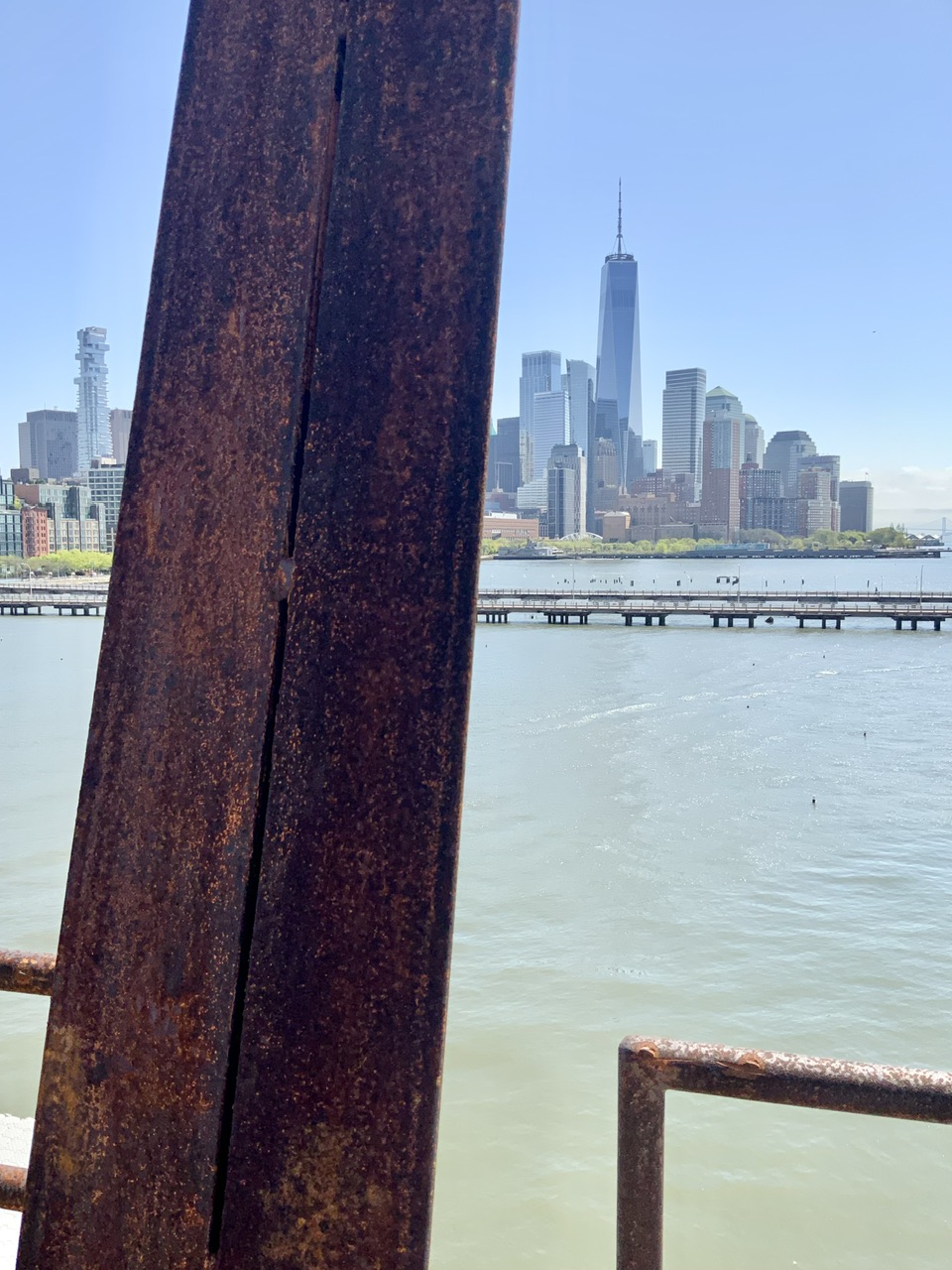
View of Lower Manhattan
A: I always work in series, which means that one pastel painting generally leads into the next. Considerable thought and planning go into each one before I begin, so it would be rare for me to just start something new out of the blue.
Sometimes on days off from the studio when we have beautiful weather, I can can hardly wait to go outside for a walk. I grab my iPad Pro and search for new sights to photograph. After a couple of hours, I usually return home with a handful of interesting images. Photography is such a departure from the slowness of my work in the studio, considering that in a good year I make 3 or 4 pastel paintings.
Comments are welcome!


 barbararachkoscoloreddust.com
Pearls from artists* # 673
Oct 22
Posted by barbararachkoscoloreddust
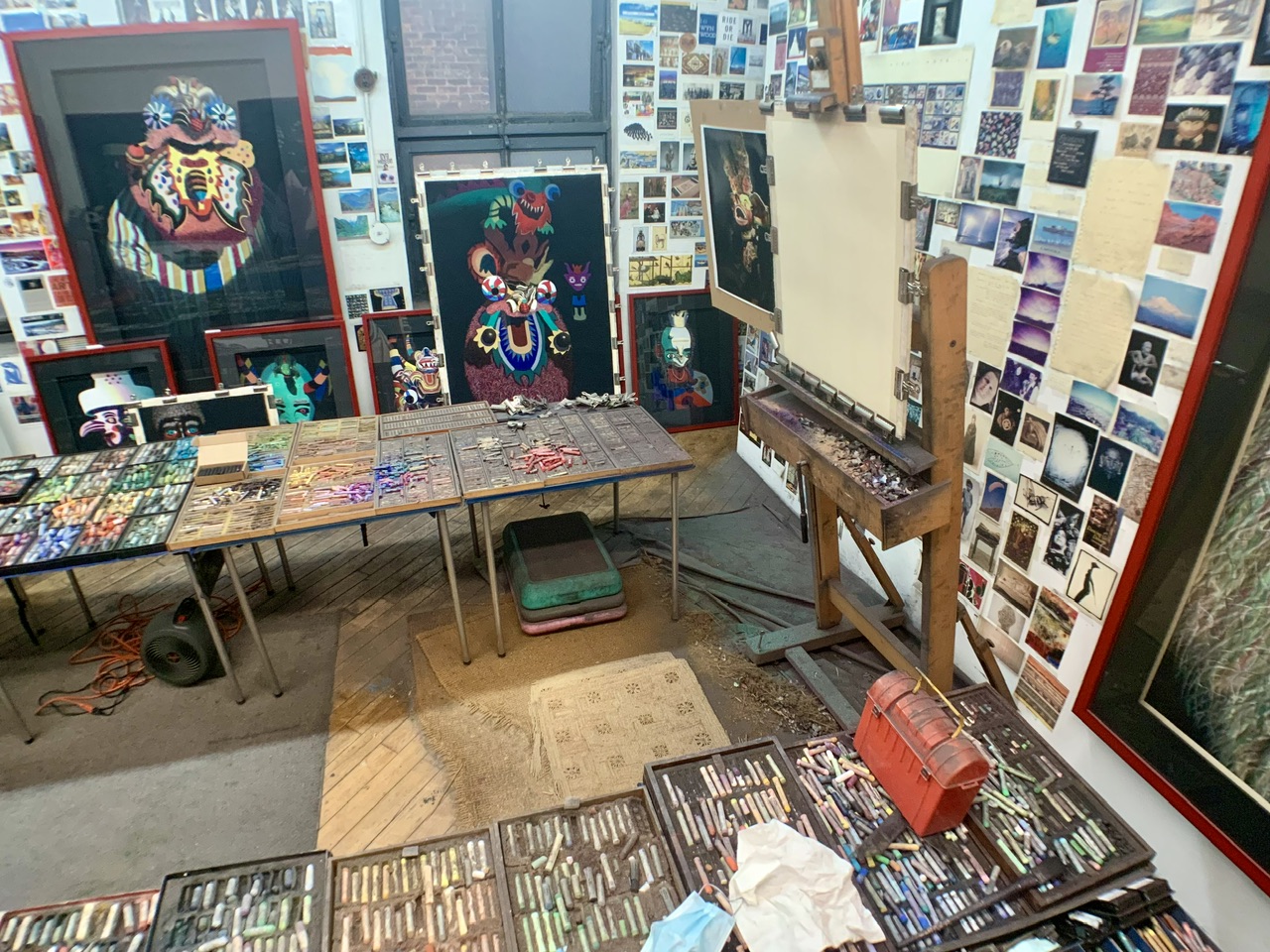
Barbara’s Studio
*an ongoing series of quotations – mostly from artists, to artists – that offers wisdom, inspiration, and advice for the sometimes lonely road we are on.
You may occasionally have the opportunity to publicly comment about the work, which helps to shape its life, but others will also interpret, criticize, and project their own agendas onto it. You must learn to be ok with that. You cannot follow your art around, explaining it and defending it. Once released, the life of your work depends on all sorts of factors completely out of your control. Separating your ego and self-worth from what you produce can be challenging, but it is essential. It protects your vital studio activity from the damaging effects of the outside world. Letting go of the old work also frees you up to move forward and focus on the next great idea.
Kate Kretz in Art From Your Core: A Holistic Guide to Visual Voice
Comments are welcome!
Share this:
Posted in 2025, An Artist's Life, Inspiration, Pearls from Artists, Quotes, Studio
Comments Off on Pearls from artists* # 673
Tags: activity, agendas, around, ”Art From Your Core: A Holistic Guide to Visual Voice”, challenging, comment, completely, control, criticize, damaging, defending, depends, effects, essential, explaining, factors, follow, forward, interpret, Kate Kretz, letting, occasionally, opportunity, others, outside, produce, project, protects, released, self-worth, separating, Studio