Blog Archives
Pearls from artists* # 680

“Sacrificial” (on the wall) and “Trickster” (on the floor)
*an ongoing series of quotations – mostly from artists, to artists – that offers wisdom, inspiration, and advice for the sometimes lonely road we are on.
What makes a work transcendent and powerful is a personal intensity, an ‘extra’ quality. Yet that intensity is exclusive to each artist: extra strangeness, subtlety, causticity, bravado, sensuality, rawness, grandiosity, succinctness, mystery, vulnerability, truth, etc. For an individual artist to infuse an object or an experience with their own ‘extra’ quality requires not only skill or ideas, but the profound benevolence of consistently delivering in spades.
It is this passion and genuine feeling, specific to each creator, that lives on in the art as a gift. It is wrapped up in the work, forever suspended in time. The artist says,
Here… everything I possessed in this moment is embodied in this object… All skills I have painstakingly learned, all of the knowledge I possess, the joy and pain I have felt and all the experiences I have lived. I spun these into the perfect, most sublime form, and packed it up, but for you to unwrap anytime you need sustenance. It will nourish, comfort, and surround you, because you have chosen it.
Each viewer selects which works of art speak to them… which embodied feelings, concepts, and knowledge they value. An empathic connection is forged through the art object or experience. What is love, but to say to someone, ‘you are truly seen and understood?’ Art offers this as well, by reaching out to puncture through the membrane of our emotional isolation, to articulate how we feel in the moments when we cannot find words. It tells the artist and viewer alike, ‘You are not alone. You are not alone in how your brain works. You are not alone in the pain you feel. You are not alone in what you notice or appreciate, or in how much love you have to give.’
Pour that love into an art object. It can handle all the devotion you pack into it, and more.
Kate Kretz in Art From Your Core: A Holistic Guide to Visual Voice
Comments are welcome!
Pearls from artists* # 672

*an ongoing series of quotations – mostly from artists, to artists – that offers wisdom, inspiration, and advice for the sometimes lonely road we are on.
Let me now, therefore, turn directly to the question of the European individual and, for a start, cite the observations of the Swiss psychologist, Carl G. Jung, throughout whose works the term “individuation” is used to indicate the psychological process of achieving individual wholeness. Jung makes the point that in the living of our lives every one is us is required by his society to play some specific social role. In order to function in the world we are all continually enacting parts Jung calls personnae, from the Latin persona, meaning “mask, false face,” the mask worn by an actor on the Roman stage, through which he “sounded” (per-sonare, “to sound through). One has to appear in some mask or other if one is to function socially at all; and even those who choose to reject such masks can only put on others, representing rejection, “Hell no!” or something of this sort. Many of the masks are playful, opportunistic, superficial; others, however, go deep, very deep, much deeper than we know. Just as every body consists of a head, two arms, a trunk, two legs, etc., so does every living person consist, among other features, of a personality, a deeply imprinted persona through which he is made known no less to himself than to others, and without which he would not be. It is silly, therefore, to say, for example, “Let’s take off our masks and be natural!” And yet – there are masks and masks. There are the masks of youth, the masks of age, the masks of the various social roles, and the masks also that we project upon others spontaneously, which obscure them, and to which we then react.
Joseph Campbell in Myths to Live By
Comments are welcome!
Q: How do you decide when a pastel painting is finished?

Signing “Apparition,” soft pastel on sandpaper, 58” x 38”
A: During the several months that I work on a pastel painting, I search for the best, most eye-popping colors, as I build up and blend together as many as 25 to 30 layers of pigment. I am able to complete some areas, like the background, fairly easily – maybe with six or seven layers – but the more realistic parts take more applications because I am continually refining and adding details. Details always take time to perfect.
No matter how many pastel layers I apply, however, I never use fixatives. It is difficult to see this in reproductions of my work, but the finished surfaces achieve a texture akin to velvet. My technique involves blending each layer with my fingers, pushing pastel deep into the tooth of the sandpaper. The paper holds plenty of pigment and because the pastel doesn’t flake off, there is no need for fixatives.
I consider a given painting complete when it is as good as I can make it, when adding or subtracting anything would diminish what is there. I know my abilities and I know what each individual stick of pastel can do. I continually try to push myself and my materials to their limits.
Comments are welcome.
Pearls from artists* # 652

Dyke Marsh, Alexandria, VA
*an ongoing series of quotations – mostly from artists, to artists – that offers wisdom, inspiration, and advice for the sometimes lonely road we are on.
And now my old dog is dead, and another I had after him, and my parents are dead, and that first world, that old house, is sold and lost, and the books I gathered there lost, or sold – but more books bought, and in another place, board by board and stone by stone, like a house, a true life built, and all because I was steadfast about one or two things: loving foxes, and poems, the blank piece of paper, and my own energy – and mostly the shimmering shoulders of the world that shrug carelessly over the fate of any individual, that they may, the better, keep the Niles and the Amazons flowing.
And that I did not give to anyone the responsibility for my life. It is mine. I made it and I can do what I want with it. Give it back, someday, without bitterness to the wild and weedy dunes.
Mary Oliver in Upstream: Selected Essays
Comments are welcome!
Q: Is there anything you wish you could change about life as a visual artist?

Barbara’s Studio
A: While there is much to admire and maybe even envy about being an artist, it does have some downsides. Among these, for me, is that enormous amounts of solitude are required to create art. I wish this were not the case.
Our work is entirely unique and because it starts as an idea in our heads, we must work solo to bring it into the world. We spend our days pondering, looking, and reacting, rather than speaking to anyone. As typical workdays go, it is rather odd.
I sometimes envy filmmakers who require collaboration with a large team of experts in order to practice their art. They have fellow professionals with whom they can discuss their ideas and they can solicit advice on how to make improvements. Artists rarely have this luxury.
On the other hand, visual artists don’t have to wait for anyone else to do their jobs before we can get to work. We don’t have to deal with personality conflicts or other people’s agendas. Our individual creative process is generally free of obstacles created by others. When you really think about it, the only thing that is required of an artist is to go to the studio and get to work! We are free to make our own rules and our own schedules, and, creatively speaking, are largely responsible for our own advances and setbacks.
Comments are welcome!
Pearls from artists* # 646

Signing “Apparition,” soft pastel on sandpaper, 58” x 38”
*an ongoing series of quotations – mostly from artists, to artists – that offers wisdom, inspiration, and advice for the sometimes lonely road we are on.
We are the sum of our unique, individual life experiences. The trials we have faced, the causes we fight for, the fears that haunt us, the oddities of our minds; all of these and more become the food for our spirit. The universe does not need repetition from the past; another pretty, but pointless nude, sunlit but stale impressionist landscape, or old and cold minimalist cube. It needs you. It needs you to strip away all that clouds your genuine sense of self. It needs you to unearth and unabashedly own your messy, honest, and magnificent truth. And it needs you to deepen and shape that truth into an authentic core, one that will nourish you and your work for a lifetime.
Kate Kretz in Art From Your Core: A Holistic Guide to Visual Voice
Comments are welcome!
Pearls from artists* # 605

*an ongoing series of quotations – mostly from artists, to artists – that offers wisdom, inspiration, and advice for the sometimes lonely road we are on.
At first the concept of the unconscious was limited to denoting the state of repressed or forgotten contents. Even with Freud, who makes the unconscious – at least metaphorically – take the stage as the acting subject, it is really nothing but the gathering place of forgotten and repressed contents, and has a functional significance thanks only to these. For Freud, accordingly, the unconscious is of an exclusively personal nature, although he was aware of its archaic and mythological thought forms.
A more or less superficial layer of the unconscious is undoubtedly personal. I call it the personal unconscious. But this personal unconscious rests upon a deeper layer, which does not derive from personal experience and is not a personal acquisition but is inborn. This deeper layer I call the collective unconscious. I have chosen the term “collective” because this part of the unconscious is not individual but universal; in contrast to the personal psyche, it has contents and modes of behavior that are more or less the same everywhere and in all individuals. It is, in other words, identical in all men and thus constitutes a common psychic substrate of a suprapersonal nature which is present in every one of us.
Carl Jung in The Archetypes and the Collective Unconscious, translated by RFC Hull
Comments are welcome!
Q: When you’re not creating art what’s your next favorite creative activity?

Hudson Yards, NYC iPad Photo
A: I love taking photographs with my iPad Pro! It has a 12.9″ screen so I can see every detail of the image. It is equivalent to using an 8 x 10 view camera with the advantages of being relatively lightweight and portable; does not require a tripod, a hood, or other special equipment like individual film holders; and the image appears right side up on the screen. It’s a perfect camera!
I have owned and used many film and digital cameras, but my iPad Pro has been my favorite for several years now. It’s great for my specific needs. I take it all over the world!
Comments are welcome!
Q: With so many soft pastels to choose from, do you have a way of organizing them so that you can find the color you need?
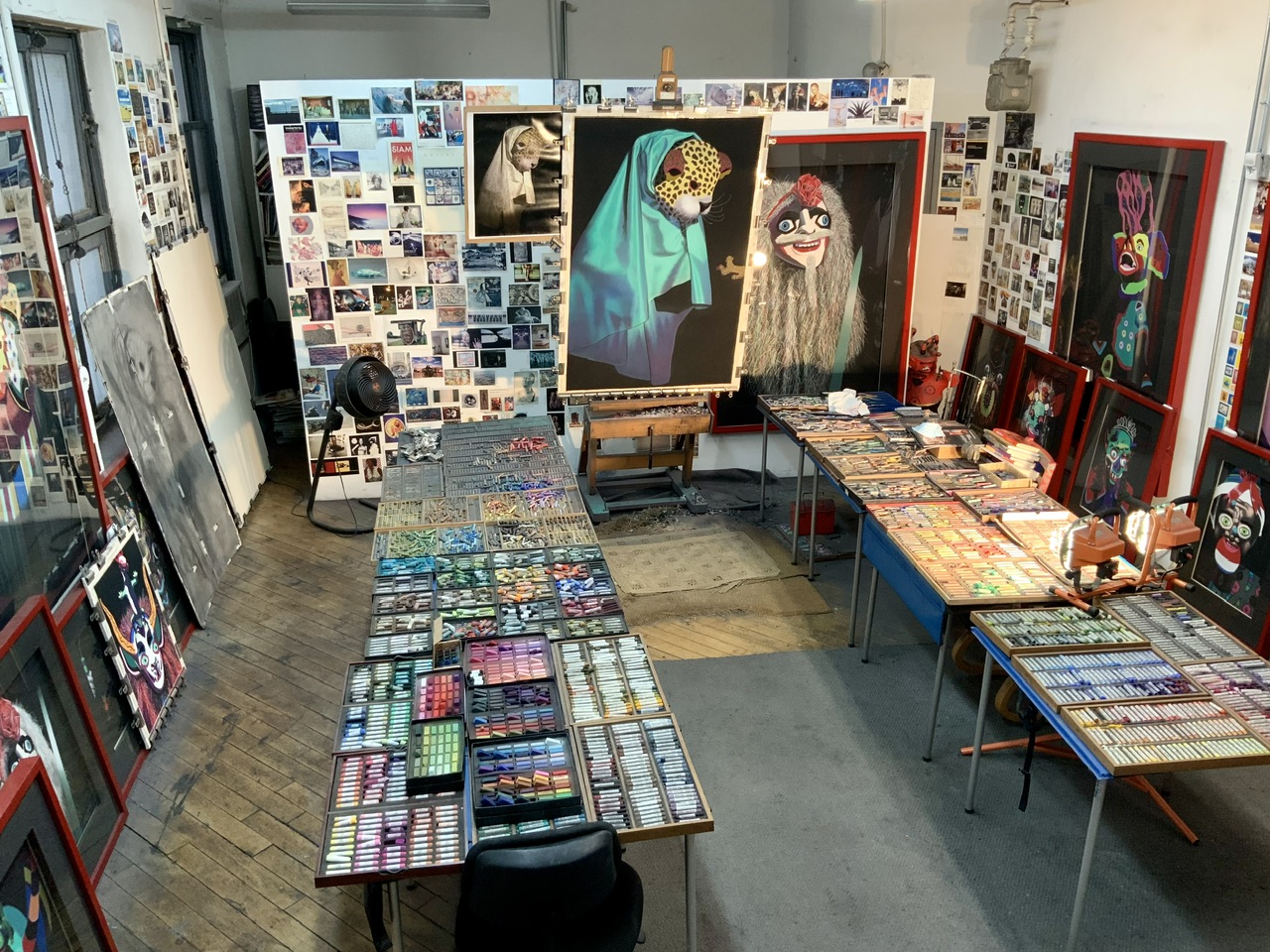
Barbara’s Studio
A: The arrangement of my pastels evolved organically. I keep them in their original trays. My oldest pastel sets are closer to the easel and the newest ones are the furthest away. After 37 years of experience working in pastel, I am well-acquainted with their individual properties. I know exactly where to find each color based on which manufacturer makes it.
Comments are welcome!
Pearls from artists* # 551

Barbara’s Studio
*an ongoing series of quotations – mostly from artists, to artists – that offers wisdom, inspiration, and advice for the sometimes lonely road we are on.
A creative process is a philosophical search, shaped by matters of practice and procedure that extend from the first touch of the artist’s pencil, brush, or chisel to the final decisions about what constitutes completeness.
Stylistic particularism – the decision as to what kind of abstract or representational artist you’re going to be – shapes, deepens, and extends the artist’s imaginative powers. Most artists who work for many years see their style evolve, sometimes dramatically. In the 1930s and 1940s Giacometti, who had first been admired for Surrealist sculptures in which representational elements are set in essentially abstract structures, found himself increasingly focused on the direct observation of the human figure. What by the mid-1940s could look like a wholesale transformation of his artistic language was the result of individual decisions all of which, during Giacometti’s career of nearly five decades, interlocked. They reinforced one another. They added up.
Between Abstraction and Representation by Jed Perl in The New York Review of Books, November 24, 2022
Comments are welcome!


 barbararachkoscoloreddust.com