Blog Archives
Q: During one of the most gripping times of your life, you were personally affected by the 9/11 attack on our country. Your husband was killed on the plane that crashed into the Pentagon. Would you mind telling us about it and how it has shaped your work?
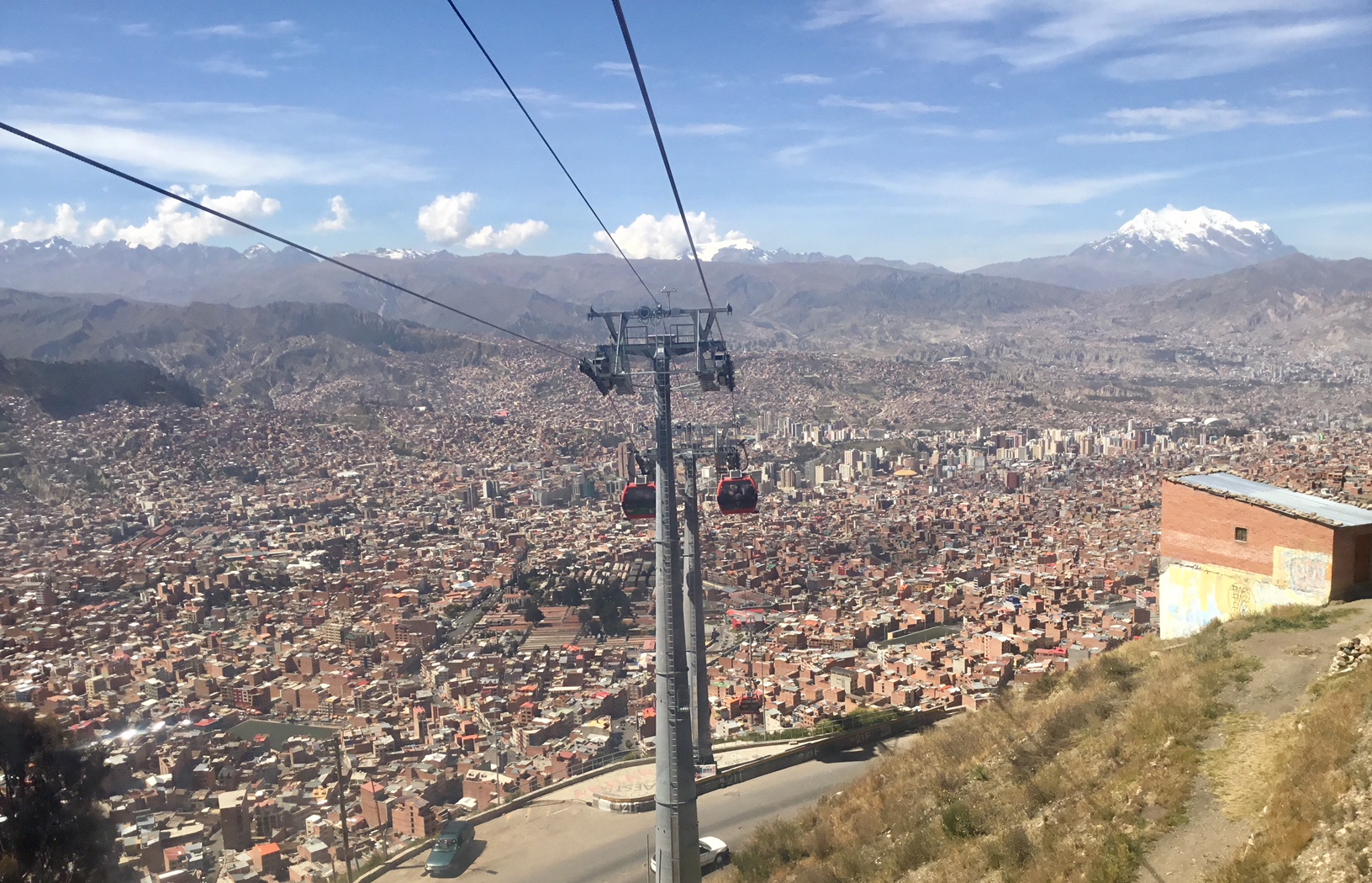
‘Mi Teleferico’ line, La Paz, Bolivia
A: In the summer of 2002 I was ready to – I HAD to – get back to work in my studio. I knew exactly what I must do. More than ever before, learning and painting would become the avenues to my well-being.
Because I use reference photos for my pastel paintings, the first challenge was to learn how to use Bryan’s 4 x 5 view camera. At that time I was not a photographer. Bryan had always taken reference photos for me.
In July 2002 I enrolled in a view camera workshop at New York’s International Center of Photography. Much to my surprise I had already absorbed quite a lot from watching Bryan. After the initial workshop, I continued more formal studies of photography for several years. In 2009, I am proud to say, I was invited to present a solo photography exhibition at a New York gallery!
In 2003 I resumed making my Domestic Threats series of pastel paintings, something that had seemed impossible after Bryan’s death. The first large pastel painting that I created using a reference photograph taken by me confirmed that my life’s work could continue. The title of that painting, “She Embraced It and Grew Stronger,” was autobiographical. “She” is me, and “it” meant continuing on without Bryan and living life for both of us.
Having had a long successful run, the Domestic Threats series finally ended in early 2007. Around that time I was feeling happier and had come to better terms with losing Bryan. While this is a tragedy I will never truly be at peace with, dealing with the loss became easier with time.
Then in 2007 I suddenly became blocked and did not know where to take my work next. I had never experienced creative block and especially for a full-time professional artist, this was a painful time. Still, I continued to go to the studio every day and eventually, thanks to a confluence of favorable circumstances, the block ended.
My next pastel painting series was called Black Paintings. I viewed the black background as literally, the very dark place that I was emerging from, exactly like the figures emerging in these paintings. The figures themselves were wildly colorful and full of life, but that black background – one critic has dubbed it my “blackground” – is always there.
Still the work continues to evolve. In 2017 I began my third pastel painting series called Bolivianos, based on a mask exhibition encountered in La Paz at the The National Museum of Ethnography and Folklore. Many people have proclaimed this to be my most bold, daring, and exciting pastel painting series yet. And I think they may be right! Continuing on the journey I began 30+ years ago, I am looking forward to creating many new, striking pastel paintings!
Comments are welcome!
Q: Does your attraction to Mexican folk art have anything to do with the way you see life or your taste for color?
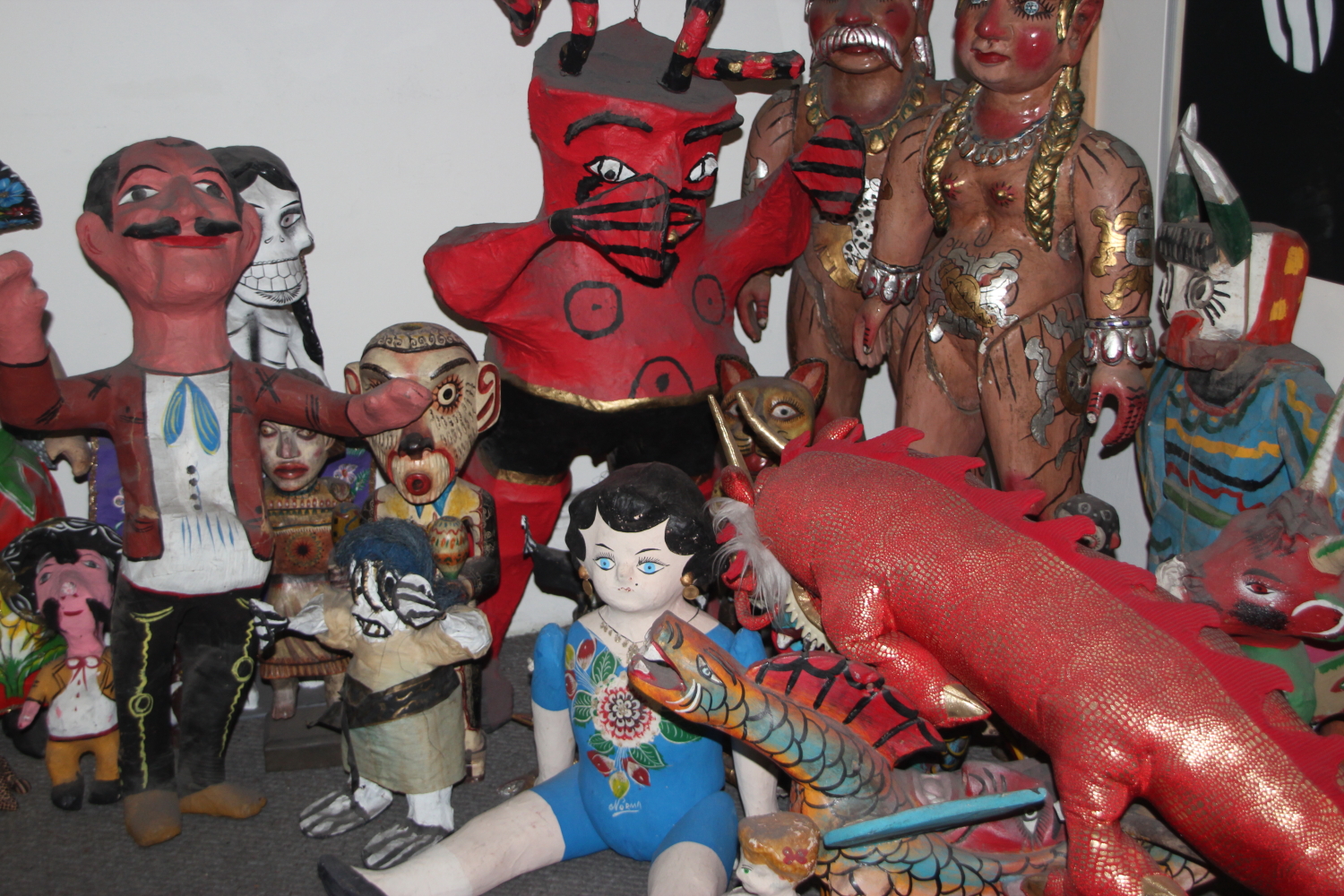
Studio corner
A: Initially, it was the fact that these folk-art figures opened up an entire new world to me. I had learned almost nothing about Mexico in school, a fact I found mystifying, considering Mexico is the United States’ southern neighbor.
When I started collecting, I was launched on a rich intellectual adventure with seemingly no end. The folk art figures had so much to teach and prompted many questions. Most were unanswerable, but still, I was curious: who made them, why, how, what did they represent, what did they reveal about the maker’s worldview, how did they fit in with historical and contemporary forces, etc.
Comments are welcome!
Travel photo of the month*
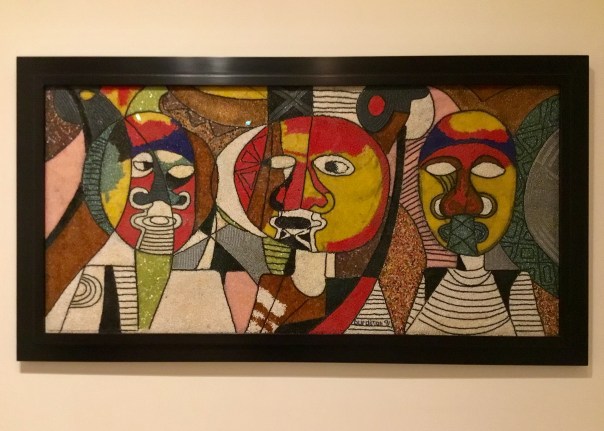
“The Three Wise Men,” Jimoh Buraimoh, Glass beads, plastic cylinders, cotton, epoxy, plywood, 1991
* Favorite travel and other photographs that have not yet appeared in this blog.
A: I saw this painting at the Baltimore Museum of Art and was intrigued by the intracacy and textures of the beads, cylinders, and other items used by Jimoh Buraimoh, a Nigerian modernist. The figures are his portrayal of the three men who traveled to England in 1960 to negotiate Nigeria’s independence. Buraimoh honors the nation’s founders with materials that glorify Yoruba heritage and artistic traditions. His title also associates the men with the three wise men of the Bible. I enjoy this work very much and couldn’t help being reminded of imagery by Picasso.
Comments are welcome!
Q: You have spoken about your pastel technique, which involves layering pigments on top of each other, up to 25 to 30 layers. When you do this are you putting the same colors on top of each other?

An early version of “Oracle,” soft pastel on sandpaper, 26″ x 20″

Finished
A: I do layer Rembrandt black soft pastels on top of each other to achieve the dark backgrounds in my “Black Paintings” and “Bolivianos” series. Black Rembrandts are the pastels I use most so I order them several dozen at a time. The 400 or 500 grit sandpaper requires at least four layers of pastel just to achieve even coverage. Over the next few months I add many more layers of black pastel to achieve the final rich look.
The figures and shapes in each pastel painting are a different story. Were you to x-ray them, you’d see many different colors underneath the final one. Sometimes subsequent colors are closely related to earlier ones. With each additional layer, I correct, refine, and strengthen my drawing so the objects depicted become more solid and/or three-dimensional.
In addition to the thousands of pastels I have to choose from, I mix and blend new colors directly on the sandpaper. As I proceed, I am searching for the ‘best’ colors, those that make the overall painting more resonant, more alive, and more exciting to look at. Of course, this is wholly subjective.
Comments are welcome!
Q: What’s on the easel today?
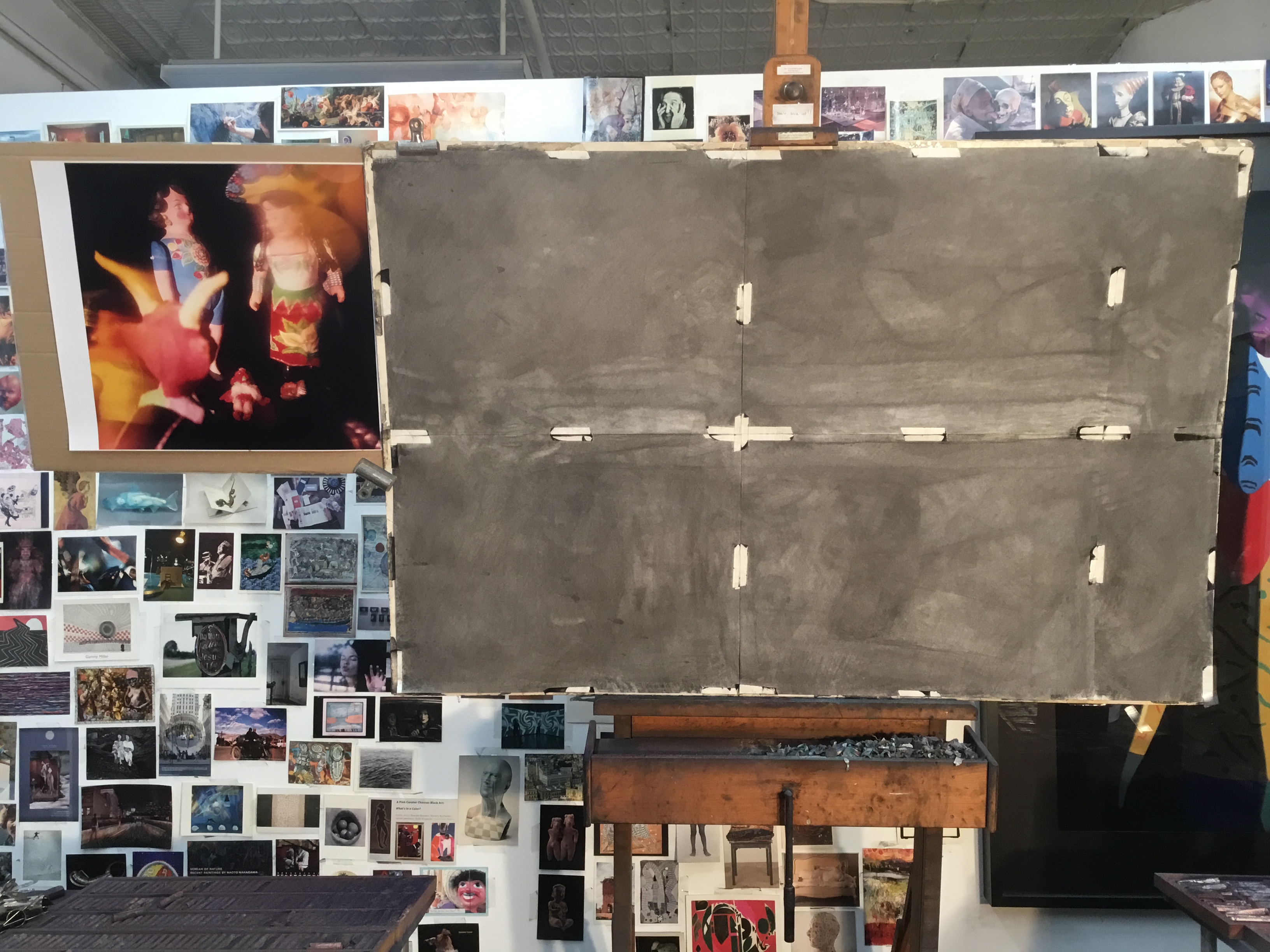
Preliminary drawing
A: I am ready to start a preliminary charcoal drawing as a study for my next pastel painting. It has been a while since I worked with the Mexican figures in the photo on the left. It’s like a reunion with dear friends!
Comments are welcome!
Q: What’s on the easel today?
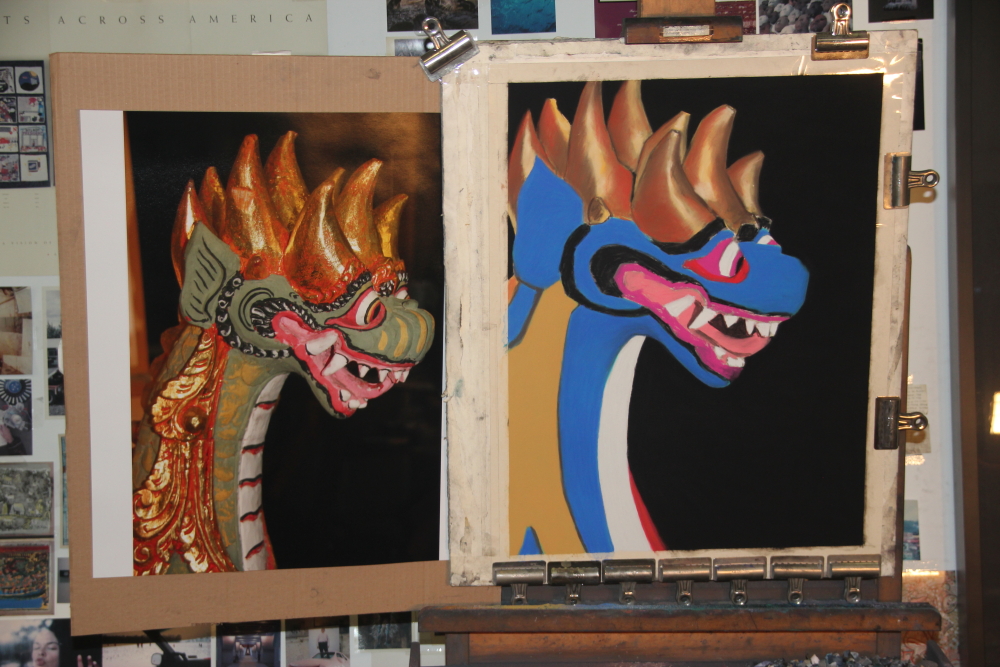
Work in progress
A: I have just started working on a small (20″ x 26″) pastel painting. The figure is a Balinese dragon I found last summer at “Winter Sun & Summer Moon” in Rhinebeck, New York.
Preferring to collect these figures while traveling in their countries of origin, I made an exception this time. My reasoning? I have been to Bali (in 2012) and at four feet tall and carved from solid wood, this dragon is quite heavy and would have been difficult to bring home.
Comments are welcome!
Q: What is the one painting that you never want to sell?

“No Cure for Insomnia,” pastel on sandpaper, 58″ x 38″
A: There are two: “Myth Meets Dream” and “No Cure for Insomnia.” Both are part of my “Domestic Threats” series and were breakthroughs at the time I made them. They are relatively early works – the first from 1993, the latter from 1999 – and were important in my artistic development.
“Myth Meets Dream” is the earliest pastel painting in which I depict Mexican figures. It includes two brightly painted, carved wooden animals from Oaxaca sent to me in 1992 by my sister-in-law. I have spoken about them before. These figures were the beginning of my ongoing fascination with Mexico.
“No Cure for Insomnia” includes a rare self-portrait and is set in my late aunt’s sixth-floor walkup on West 13th Street, where I lived when I moved to New York in 1997. My four years there were very productive.
Comments are welcome!
Q: Do you have any favorites among the Mexican and Guatemalan folk art figures that you depict in your work?

Idea for an upcoming pastel painting
A: I suppose it seems that way, since I certainly paint some figures more than others. My favorite characters change, depending on what is happening in my work. My current favorites are a figure I have never painted before (the Balinese dragon above) and several Mexican and Guatemalan figures last painted years ago. All will make an appearance in a pastel painting for which I am still developing preliminary ideas (above).
Comments are welcome!
Pearls from artists* # 165
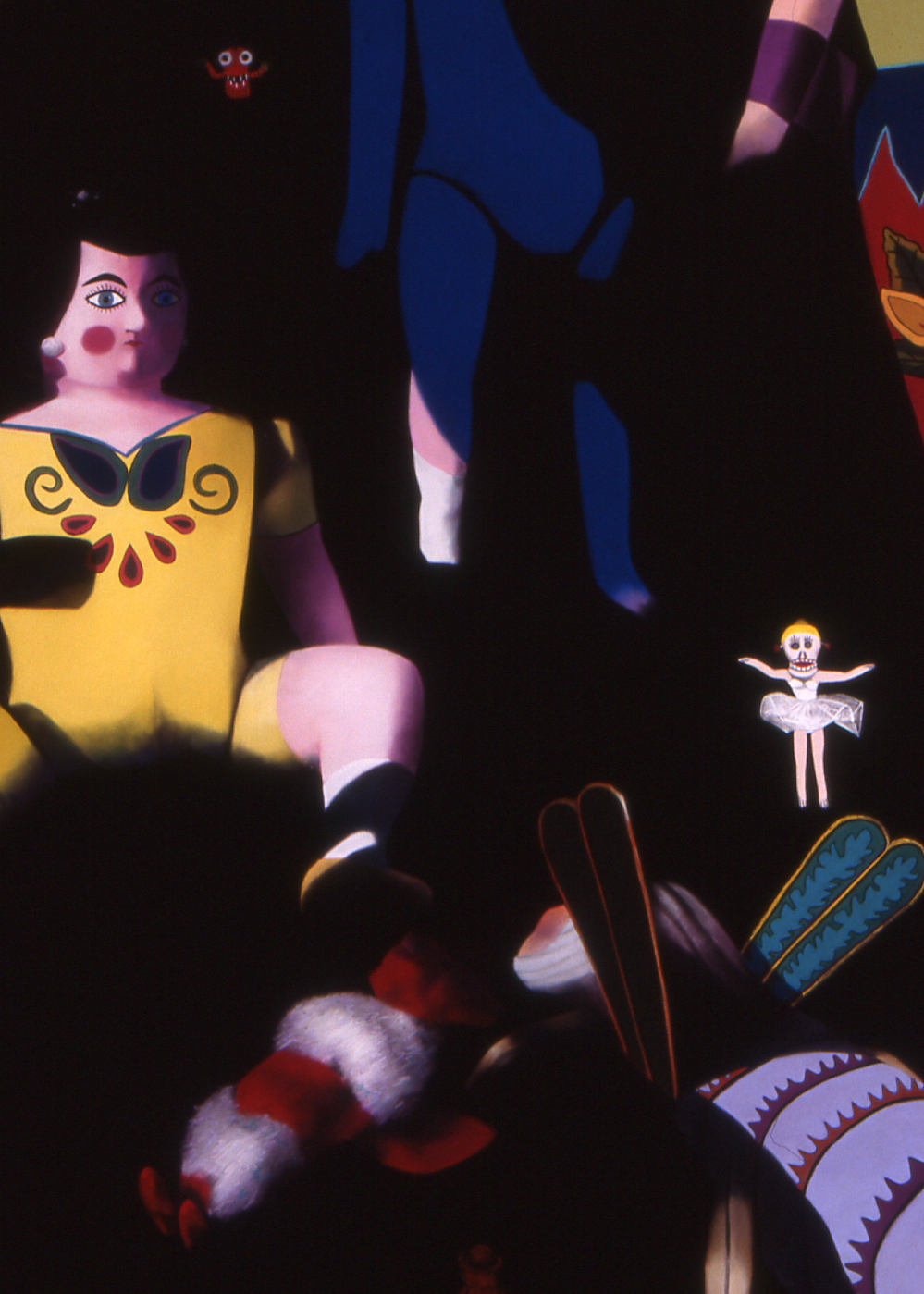
“The Space Between,” soft pastel on sandpaper, 58″ x 38″
* an ongoing series of quotations – mostly from artists, to artists – that offers wisdom, inspiration, and advice for the sometimes lonely road we are on.
When I have painted a fine picture I have not given expression to a thought! That is what they say. What fools people are! They would strip painting of all its advantages. A writer has to say almost everything in order to make himself understood, but in painting it is as if some mysterious bridge were set up between the spirit of the persons in the picture and the beholder. The beholder sees figures, the external appearance of nature, but inwardly he meditates; the true thinking that is common to all men. Some give substance to it in writing, but in so doing they lose the subtle essence. Hence, grosser minds are more easily moved by writers than by painters or musicians. The art of the painter is all the nearer to man’s heart because it seems to be more material. In painting, as in external nature, proper justice is done to what is finite and to what is infinite, in other words, to what the soul finds inwardly moving in objects that are known through the senses alone.
The Journal of Eugene Delacroix edited by Hubert Wellington
Comments are welcome!
Q: What’s on the easel today?
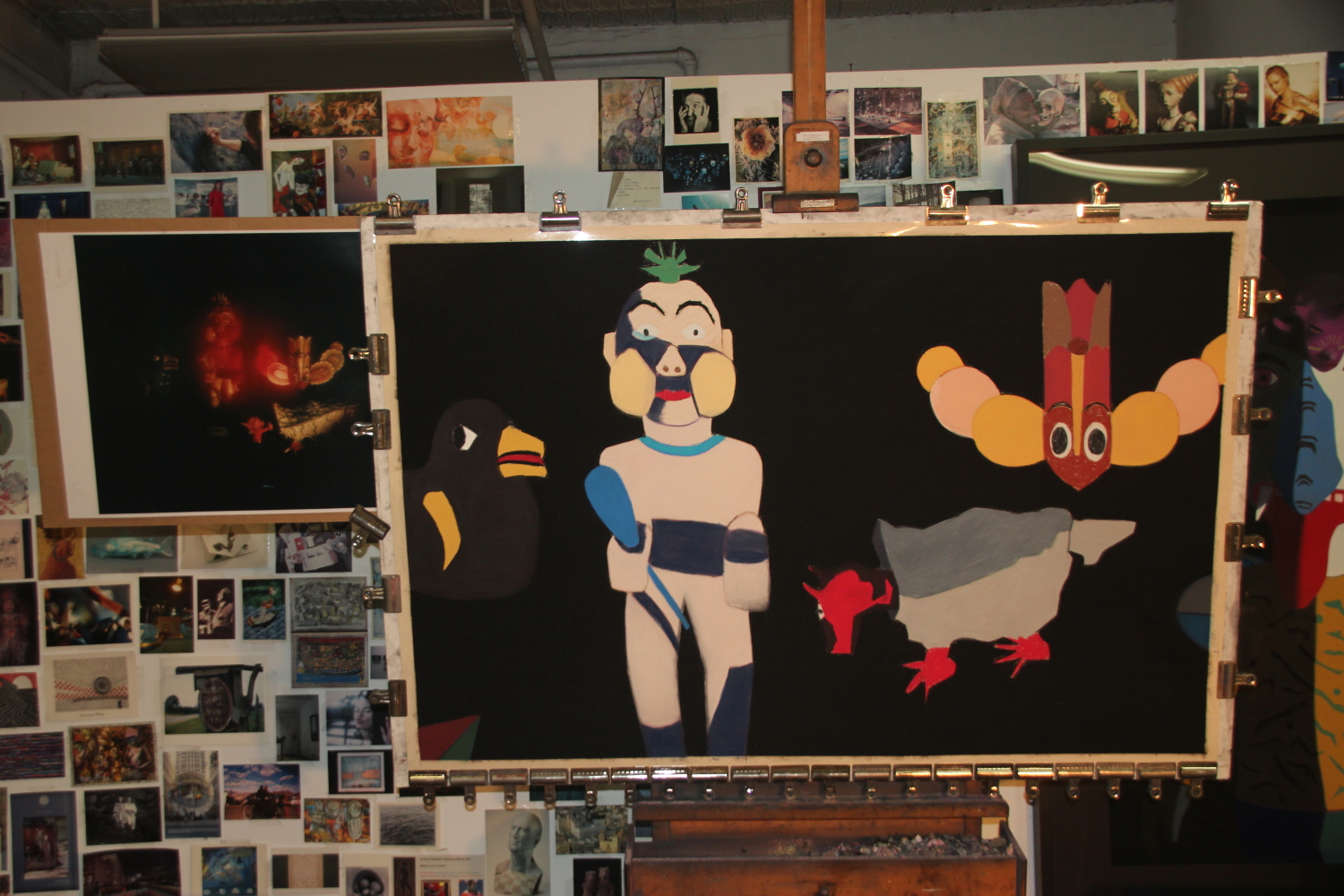
Work in progress
A: I am in the very early stages of a large pastel painting. I have never painted any of these figures before and they originated in different parts of the world. The bird (left) is from the Brooklyn Museum’s store, although it was hand carved in Guatemala. The standing figure is carved wood with beautiful painted details. It was a lucky find on a trip to Panajachel, Guatemala. The armadillo (red and grey) was made by one of my favorite Mexican folk artists (now deceased) and I believe it’s one of the last pieces he completed. It is a papier mâché figure that I found in a small shop in Mexico City. The figure on the upper right is a wooden mask bought from a talkative and talented artist at a hotel in Kandy, Sri Lanka. It depicts nagas (cobras), although you can’t tell that yet in the painting.
Comments are welcome!


 barbararachkoscoloreddust.com