Category Archives: New York, NY
Q: Would you talk about your first solo exhibition in a commercial gallery?

“Big Deal,” soft pastel on sandpaper, 58″ x 38″
A: Although I had exhibited in a number of non-profit galleries in Virginia, Washington, DC, Maryland, New Jersey, and New York, my first solo in a commercial gallery was at 479 Gallery, 520 Broadway, in July 1996. The previous summer I had entered a juried exhibition there. My work won first prize and I was awarded a solo show the following July.
This exhibition was soon followed by representation at an important New York gallery, Brewster Fine Arts, at 41 West 57th Street. I had my first two-person exhibition at Brewster in October 1996. The gallery specialized in art by Latin American artists. Besides myself, the sole non-Latina represented by Brewster was Leonora Carrington! I quickly began exhibiting alongside a group of illustrious artists: Leonora, Rufino Tamayo, Francisco Toledo, Francisco Zuniga, and other Latin American masters. I could hardly believe my good fortune!
Comments are welcome!
Q: When you’re not creating art what’s your next favorite creative activity?

Hudson Yards, NYC iPad Photo
A: I love taking photographs with my iPad Pro! It has a 12.9″ screen so I can see every detail of the image. It is equivalent to using an 8 x 10 view camera with the advantages of being relatively lightweight and portable; does not require a tripod, a hood, or other special equipment like individual film holders; and the image appears right side up on the screen. It’s a perfect camera!
I have owned and used many film and digital cameras, but my iPad Pro has been my favorite for several years now. It’s great for my specific needs. I take it all over the world!
Comments are welcome!
Q: With so many soft pastels to choose from, do you have a way of organizing them so that you can find the color you need?
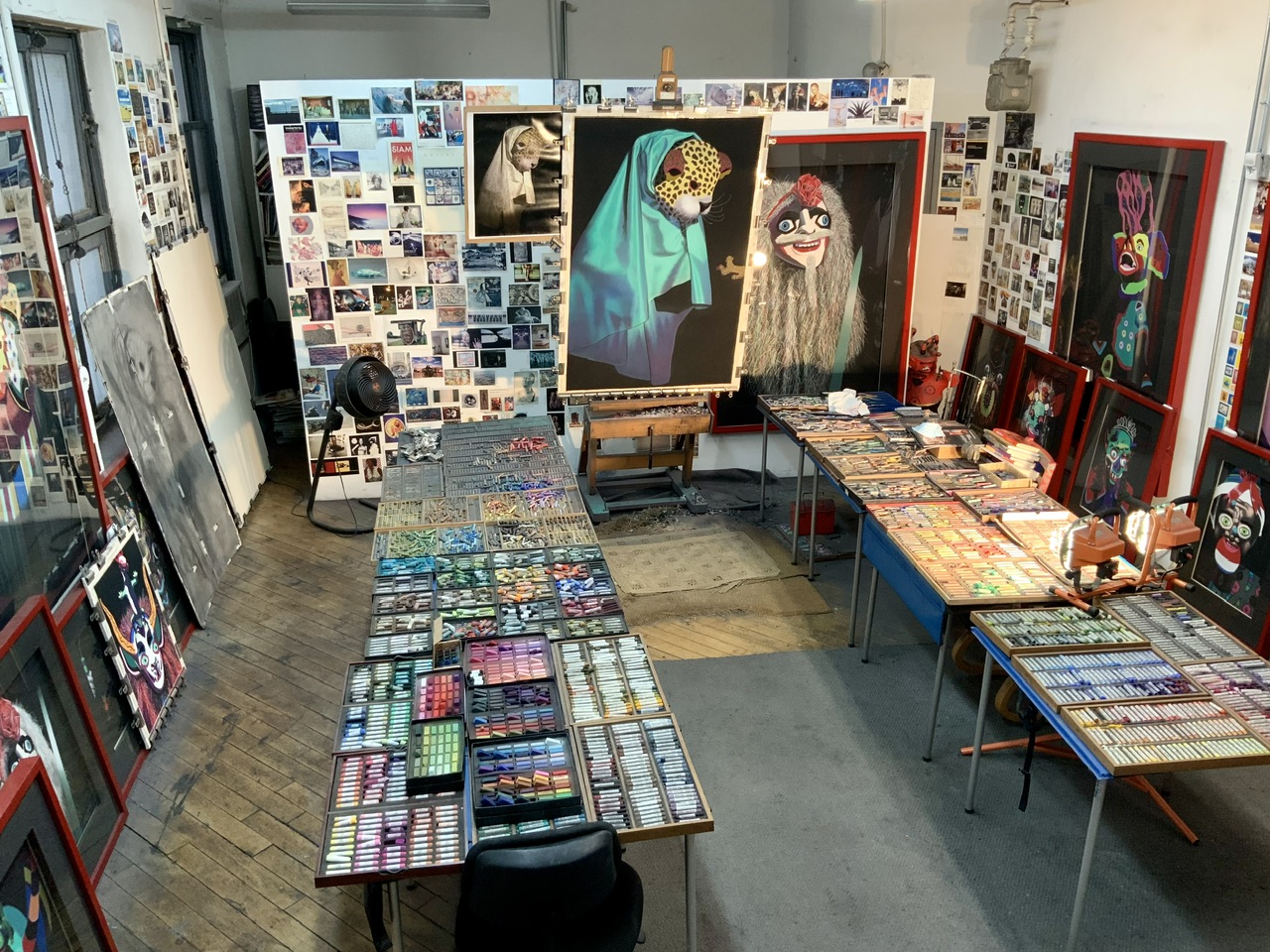
Barbara’s Studio
A: The arrangement of my pastels evolved organically. I keep them in their original trays. My oldest pastel sets are closer to the easel and the newest ones are the furthest away. After 37 years of experience working in pastel, I am well-acquainted with their individual properties. I know exactly where to find each color based on which manufacturer makes it.
Comments are welcome!
Pearls from artists* # 579

New York, NY
*an ongoing series of quotations – mostly from artists, to artists – that offers wisdom, inspiration, and advice for the sometimes lonely road we are on.
An empirical fact about our lives is that we do not and cannot know what will happen a day or a moment in advance. The unexpected awaits us at every turn and every breath. The future is a vast perpetually regenerated mystery and the more we live and know, the greater the mystery. When we drop the blinders of our preconceptions, we are virtually propelled by every circumstance into the present time and the present mind: the moment, the whole moment, and nothing but the moment. This is a state of mind taught and strengthened by improvisation, a state of mind in which the here and now is not some trendy idea but a matter of life and death, upon which we can learn to reliably depend. We can depend on the world being a perpetual surprise in general motion and a perpetual invitation to create.
Stephen Nachmanovitch in Free Play: Improvisation in Life and Art
Comments are welcome!
Pearls from artists* # 578

Hudson Yards, New York City
*an ongoing series of quotations – mostly from artists, to artists – that offers wisdom, inspiration, and advice for the sometimes lonely road we are on.
He [His Holiness Ngawang Tenzing Zangbo, the Sherpas’ Tengboche abbot and overseer of all Buddhist gompas in Nepal] said that he is not surprised to see Westerners flocking to Tibetan monasteries in Nepal. “In the West, there are too many distractions,” he said. “People long to come to these mountains. Here you can learn things through your heart.” He noted that Kathmandu also drew many Himalayan people because of its proximity to sacred places, but was confident that many lamas among them would return to remote areas and practice a wholesome religion free of urban temptations. He hopes that the spiritual boom will result in higher levels of religious life all around the region and not the further degradation of monastic life through materialism. He sounded as if it might be touch-and-go in some places.
Barbara Crossette in So Close to Heaven: The Vanishing Buddhist Kingdoms of the Himalayas
Comments are welcome!
Q: You make it look effortless when we know it is not. Would you explain how you started your blog 11 years ago? (Question from Colette C. McBratney via Facebook)
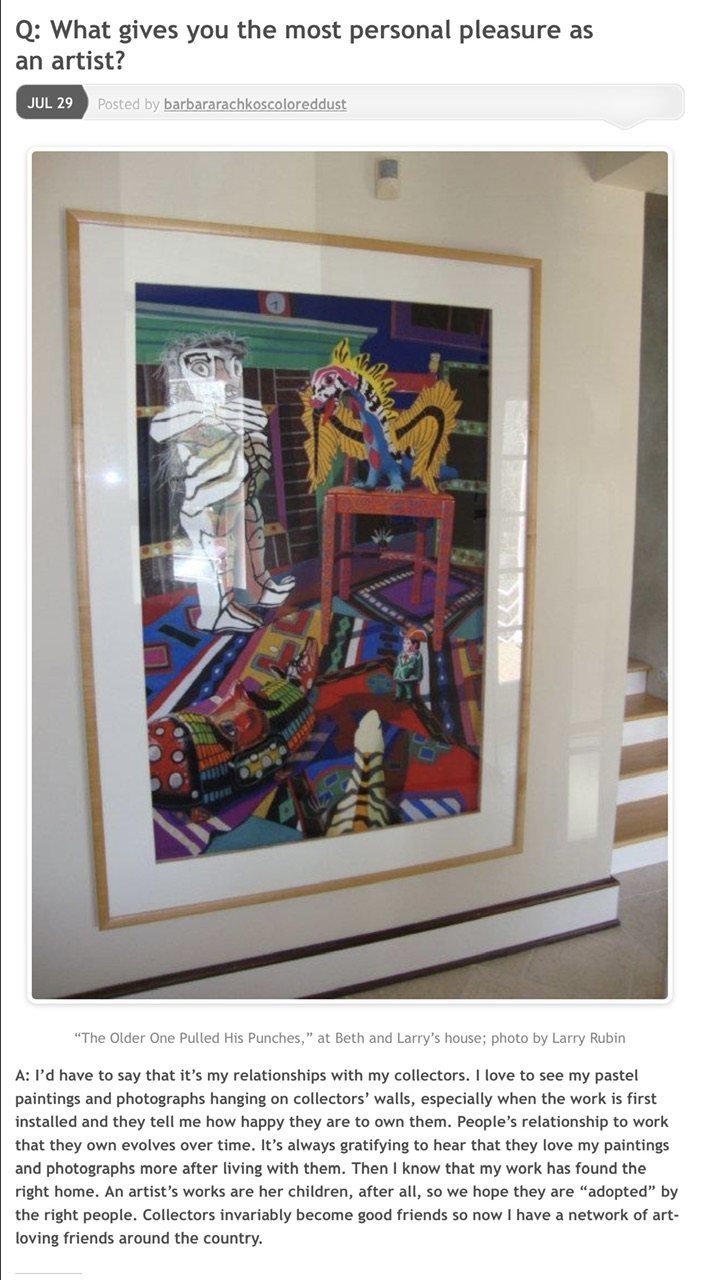
An Early Blog Post, Above
A: My blog turned 11 on July 15th. To learn how to set up, publish, and maintain a blog, I took a class at the International Center of Photography in New York. It was called “The Daily Blog” and that’s where I learned how to work with WordPress.
I decided to use a question and answer format because I had a backlog of material from interviews I had done over the years. During the class, which lasted five weeks, I published blog posts every day. Once the class ended, I cut back to a more manageable schedule of publishing posts twice a week.
Writing about my work quickly became an important part of my creative process. As most people probably know, I am very persistent so these days I just make sure to keep going!
Comments are welcome!
Q: How has the use of photography in your work changed over the decades?
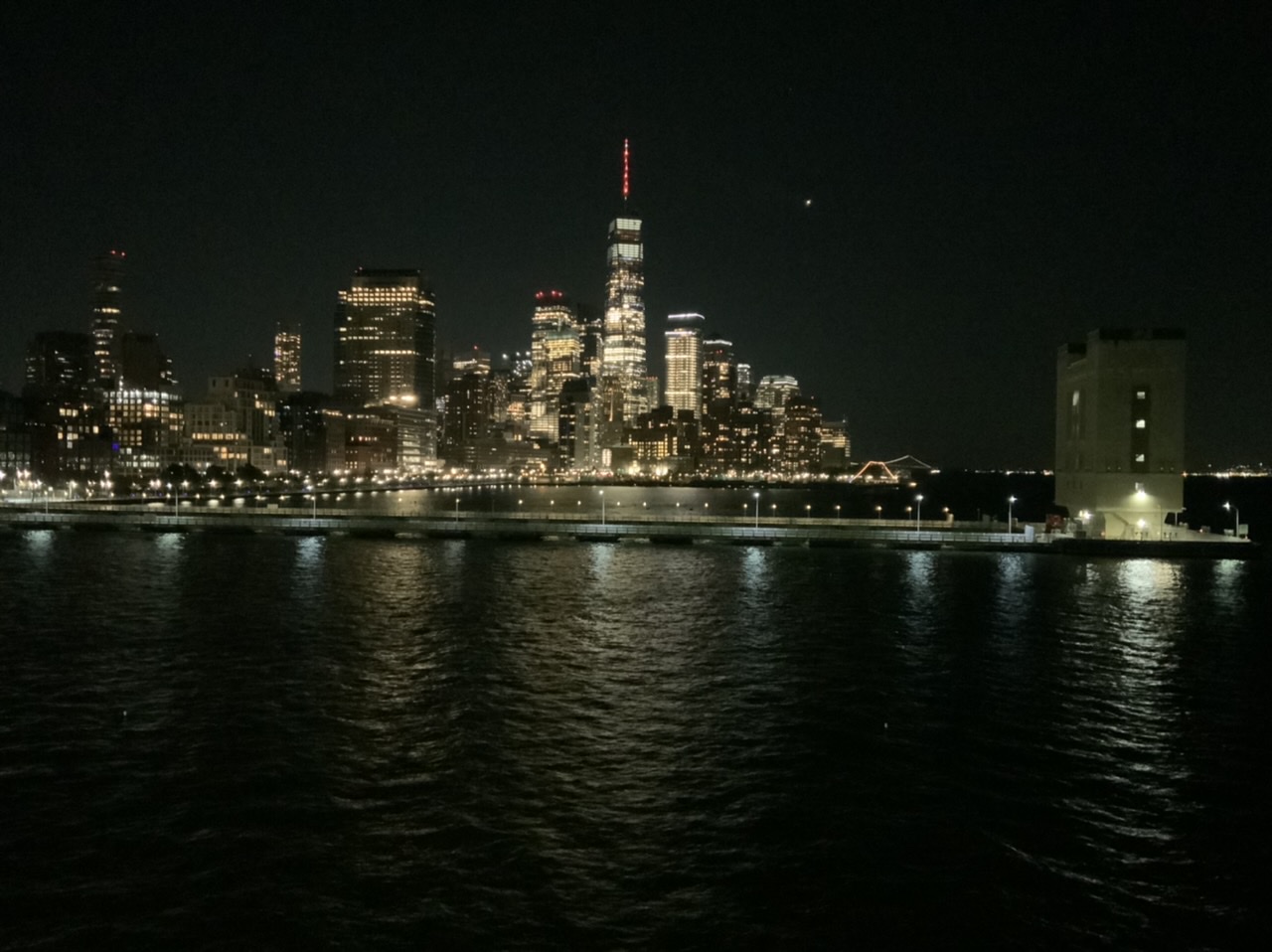
New York, NY
A: From the beginning in the mid-1980s I used photographs as reference material. My late husband, Bryan, would shoot 4” x 5” negatives of my elaborate setups using his Toyo-Omega view camera. In this respect Bryan was an integral part of my creative process as I developed the “Domestic Threats” pastel paintings. At that time I rarely picked up a camera, except to capture memories of our travels.
After Bryan was killed on 9/11, I inherited his extensive camera collection – old Nikons, Leicas, Graphlex cameras, and more. I wanted and needed to learn how to use them. Starting in 2002 I enrolled in a series of photography courses (about 10 over 4 years) at the International Center of Photography in New York. I learned how to use all of Bryan’s cameras and how to make my own big chromogenic prints in the darkroom.
Along the way I discovered that the sense of composition and color I had developed over many years as a painter translated well into photography. The camera was just another medium with which to express my ideas. Surprisingly, in 2009 I had my first solo photography exhibition at a gallery in New York. Bryan would have been so proud!
For several years now my camera of choice has been a 12.9” iPad Pro. It’s main advantage is that the large screen let’s me see every detail as I compose my photographs. I think of it as a portable, lightweight, and easy-to-use 8 x 10 view camera. My iPad is always with me when I travel and as I walk around exploring New York City.
It is a wonderful thing to be both a painter and a photographer! While pastel painting will always be my first love, photography has distinct advantages over my studio practice. Pastel paintings are labor-intensive, requiring months of painstaking work. Photography’s main advantage is speed. Photographs – from the initial impulse to hanging a print on a wall – can be made in minutes. Photography is instant gratification, allowing me to explore ideas much easier and faster than I ever could as a painter. Perhaps most importantly, composing photographs keeps my eye sharp whenever I am away from the studio. I credit photography as an important factor in the overall evolution of my work.
Comments are welcome!
Q: It must be tricky moving pastel paintings from your New York studio to your framer in Virginia. Can you explain what’s involved? (Question from Ni Zhu via Instagram)
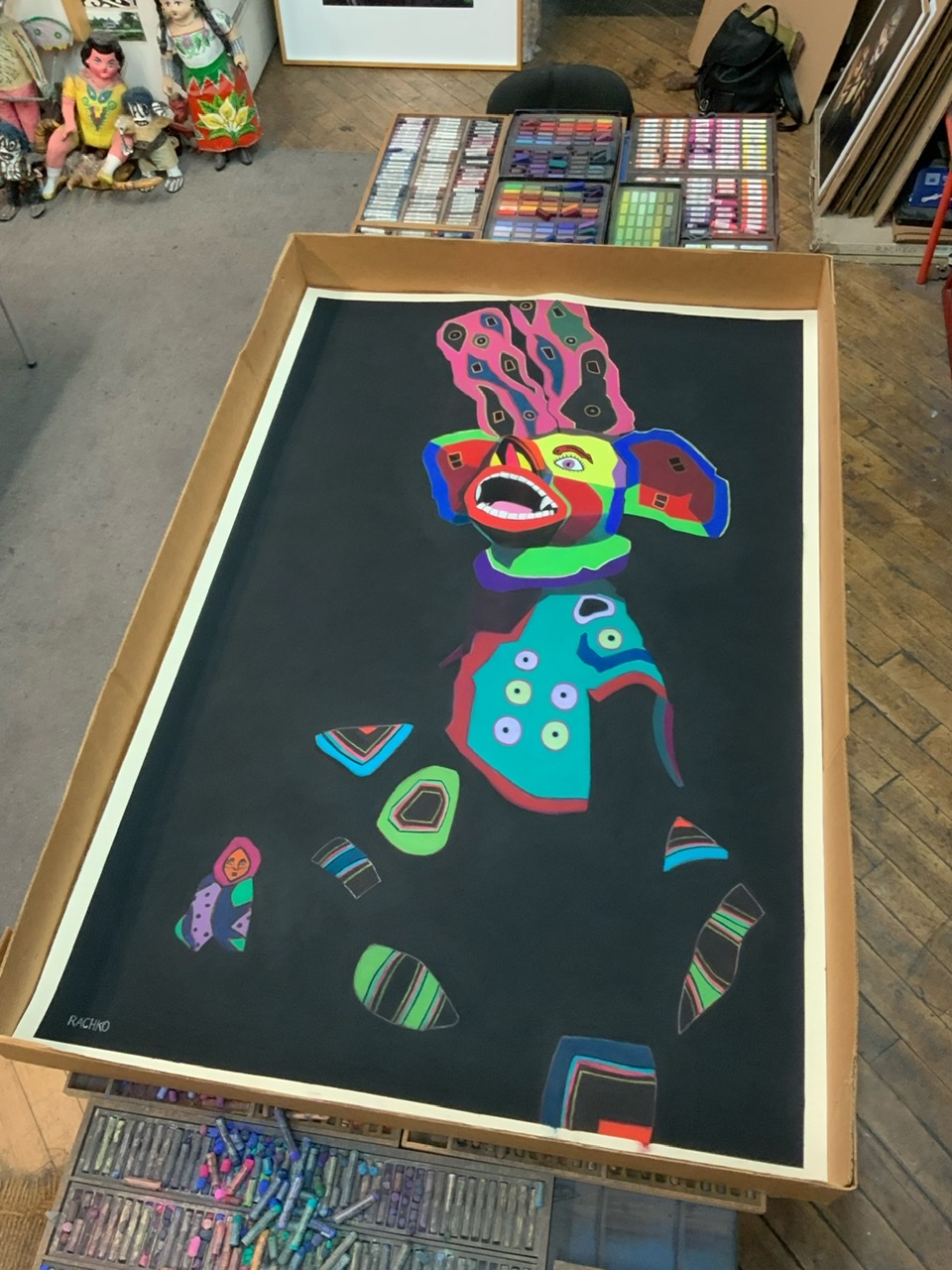
“Impresario” partially boxed for transport to Virginia
A: Well, I have been working with the same framer for three decades so I am used to the process.
Once my photographer photographs a finished, unframed piece, I carefully remove it from the 60” x 40” piece of foam core to which it has been attached (with bulldog clips) during the months I worked on it. I carefully slide the painting into a large covered box for transport. Sometimes I photograph it in the box before I put the cover on (see above).
My studio is in a busy part of Manhattan where only commercial vehicles are allowed to park, except on Sundays. Early on a Sunday morning, I pick up my 1993 Ford F-150 truck from Pier 40 (a parking garage on the Hudson River at the end of Houston Street) and drive to my building’s freight elevator. I try to park relatively close by. On Sundays the gate to the freight elevator is closed and locked so I enter the building around the corner via the main entrance. I unlock my studio, retrieve the boxed painting, bring it to the freight elevator, and buzz for the operator. He answers and I bring the painting down to my truck. Then I load it into the back of my truck for transport to my apartment.
I drive downtown to the West Village, where I live, and double park my truck. (It’s generally impossible to park on my block). I hurry to unload the painting, bring it into my building, and up to my apartment, all the while hoping I do not get a parking ticket. The painting will be stored in my apartment, away from extreme cold or heat, until I’m ready to drive to Virginia. On the day I go to Virginia, I load it back into my truck. Then I make the roughly 5-hour drive south.
Who ever said being an artist is easy was lying!
Comments are welcome!
Q: How do you determine what size to make your pastel paintings? (Question from Prince North via Facebook)

A: For three decades I have been making pastel paintings in two sizes: 26” x 20” and 58” x 38.” These sizes are dictated by practical considerations.
The smaller ones are because 28” x 22” sheets of acid-free sandpaper are what’s available. (I mask off an inch all around for mats so the paintings are 20″ x 26″). For large paintings I buy rolls of acid-free sandpaper that measure 54 inches wide by 30 feet. I cut this down to 40″ x 60″ for paintings and mask off an inch all around on these, too.
And why specifically make them 58” x 38”? This is the absolute largest size I can make and I prefer making big paintings!
Again, practical factors come into play: the size of my truck, the cost and size of mat board, and the weight of the frames.
My pastel paintings need to lie flat when they are moved. Framed paintings are 70” x 50,” the largest size that can fit flat in the back of my Ford F-150. 58” x 38” is the largest size that will fit in a 8 feet by 4 feet sheet of mat board. (60 inch wide mat board is available, but the cost goes up considerably). Lastly, I’ve never weighed them but my large framed paintings are already rather heavy. It takes two people to carry them.
Comments are welcome!


 barbararachkoscoloreddust.com