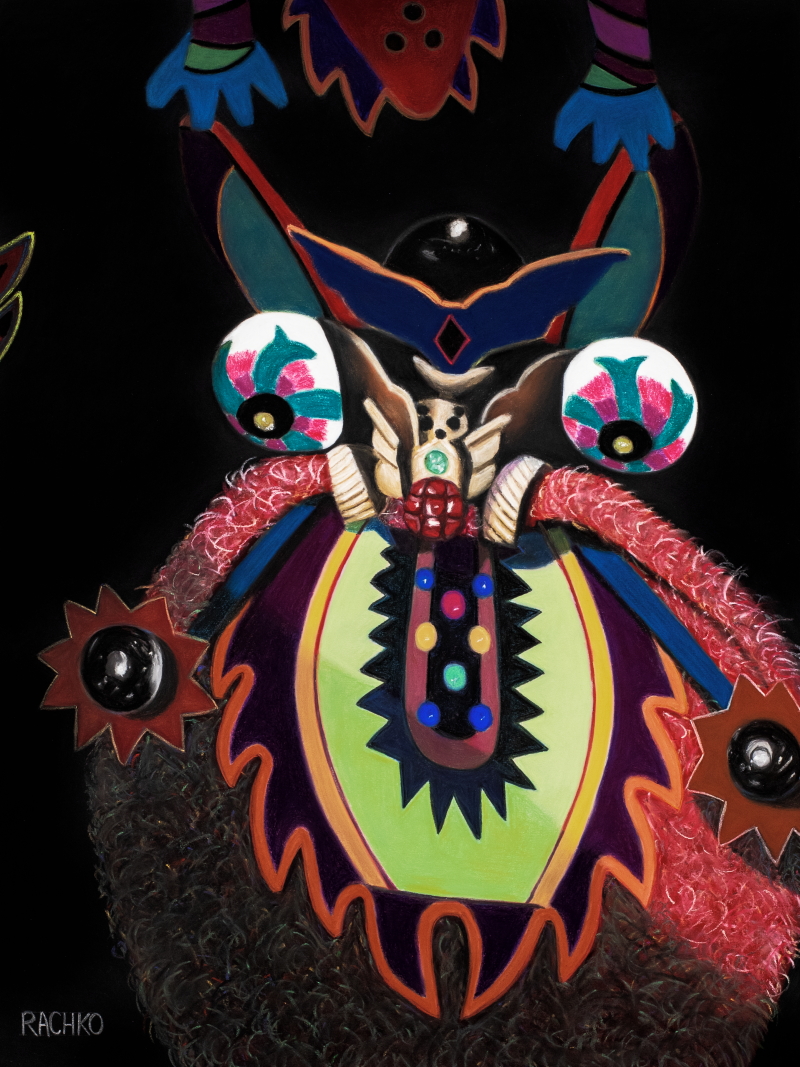
With “Apparition,” soft pastel on sandpaper, 58” x 38” image, 70” x 50” framed
A: I certainly do! I have been a painter for forty years, and for most of that time, my work has been shaped by foreign travel. At seventy-two, I find myself thinking about legacy — what I want to leave behind. Documenting my creative process on film has become an essential part of this objective.
In the “Bolivianos” series, I have been creating pastel-on-sandpaper paintings that transform the vivid masks of the Bolivian Carnival into universal archetypes. I first encountered these masks at a museum in La Paz in 2017.
Circumstances have aligned perfectly for an exciting next step: another trip to Bolivia and a new documentary. Our upcoming film will be a follow-up to the award-winning “Barbara Rachko: True Grit” (released in 2023), marking a deeper exploration of my thirty-five-year engagement with folk art from Mexico, Central America, and South America. (See https://youtu.be/JJWLy84kXI0?si=v7JHIq9ViYGgs76U)
In February 2026, I will return to Bolivia with a two-person film crew to experience Carnival firsthand — to immerse myself in its rhythm, history, and meaning. Recognized by UNESCO as a Masterpiece of the Oral and Intangible Heritage of Humanity, this festival offers an extraordinary window into Bolivia’s cultural soul.
Our film will chronicle my journey as essential research — a vital continuation of my creative inquiry over these past decades. With this trip and film, I hope to create my next body of pastel-on-sandpaper paintings, rich with color, spirit, and the enduring vitality of Oruro’s Carnival.
Basquiat X Warhol Exhibition at Fondation Louis Vuitton, Paris. Photo: Christine Marchal
*an ongoing series of quotations – mostly from artists, to artists – that offers wisdom, inspiration, and advice for the sometimes lonely road we are on.
… scientists are right there with artists in insisting art is fundamental to being human. Art is one of our oldest creations (humans invented paint long before the wheel), one of our earliest means of communication (we drew long, long, long before we could write), and one of our most universal urges (we all engage with art, whether preschoolers, Parisians, or Paleolithic cave dwellers). I began to notice that art – or what scientists dispassionately call “human-made two- or three-dimensional structures that remain unchanged: – was everywhere: hung over the register at the hardware store, spray-painted on a bakery window, cock-eyed in a dive-bar bathroom. As humans, we’ve filled our lives with art since practically forever. The earliest known painting keeps getting older, but the last time I checked, archaeologists had traced the oldest portrait to a cave in Indonesia, where around 45,000 years ago, artists put their finishing touches on a fat figure with purple testifies for a chin. In other words, before Neanderthals went extinct, before mammoths died out, before we figured out how to harvest food or heal bloody wounds, humans applied themselves to painting a portrait of a warty pig. “It is clear that the creation of beautiful and symbolic objects is a characteristic feature of the human way of life,” wrote the biologist J.Z. Young. “They are as necessary as food or sex.”
Bianca Booker in Get the Picture: A Mind-Bending Journey Among the Inspired Artists and Obsessive Art Fiends Who Taught Me How to See
*an ongoing series of quotations – mostly from artists, to artists – that offers wisdom, inspiration, and advice for the sometimes lonely road we are on.
For art to appear, we have to disappear. This may sound strange, but in fact it is a common appearance. The elementary case, for most people, is when our eye or ear is “caught” by something: a tree, a rock, a cloud, a beautiful person, a baby’s gurgling, spatters of sunlight reflected off some wet mud in the forest, the sound of a guitar wafting unexpectedly out of a window. Mind and sense are arrested for a moment, fully in the experience. Nothing else exists. When we “disappear” in this way, everything around us becomes a surprise, new and fresh. Self and environment unite. Attention and intention fuse. We see things just as we and they are, yet we are able to guide and direct them to be one just the way we want them. This lively and vigorous state of mind is the most favorable to the germination of original work of any kind. It has its roots in child’s play, and its ultimate flowering in full-blown artistic creativity.
Stephen Nachmanovitch in Free Play: Improvisation in Life and Art
*an ongoing series of quotations – mostly from artists, to artists – that offers wisdom, inspiration, and advice for the sometimes lonely road we are on.
What do we carry forward? My family lived in New Jersey near Manhattan until I was ten, and although I have enjoyed spending my adult life as a photographer in the American West, when we left New Jersey for Wisconsin in 1947 I was homesick.
The only palliative I recall, beyond my parents’ sympathy was the accidental discovery in a magazine of pictures by a person of whom I had never heard but of scenes I recognized. The artist was Edward Hopper and one of the pictures was of a woman sitting in a sunny window in Brooklyn, a scene like that in the apartment of a woman who had cared for my sister and me. Other views resembled those I recalled from the train to Hoboken. There was also a picture inside a second-floor restaurant, one strikingly like the restaurant where my mother and I occasionally had lunch in New York.
The pictures were a comfort but of course none could permanently transport me home. In the months that followed, however, they began to give me something lasting, a realization of the poignancy of light. With it, all pictures were interesting.
* an ongoing series of quotations – mostly from artists, to artists – that offers wisdom, inspiration, and advice for the sometimes lonely road we are on.
With the camera you interpret reality. Photography is not truth. The photographer interprets reality and, above all, constructs his own reality according to his own awareness or his own emotions. Sometimes it’s complicated because it’s a kind of schizophrenic phenomenon. Without the camera, you see the world in one way, with the camera, in another. Through the window, you’re composing, and even dreaming about, this reality as if, through the camera, you were synthesizing what you are with what you’ve learned of a certain place. Then you make your own image, your own interpretation. The same thing happens to a writer as to a photographer. It’s impossible to capture the truth of life.
Graciela Iturbide in Eyes to Fly With: Portraits, Self-Portraits, and Other Photographs
* an ongoing series of quotations – mostly from artists, to artists – that offers wisdom, inspiration, and advice for the sometimes lonely road we are on.
Dear Diary:
On a drifty Manhattan stroll
The kind that unearths magical treasures
I made a right turn off of Houston
Onto Bowery
And as it became Third Avenue
I came upon this old art store
That creaked hello
Its warped wooden shelves
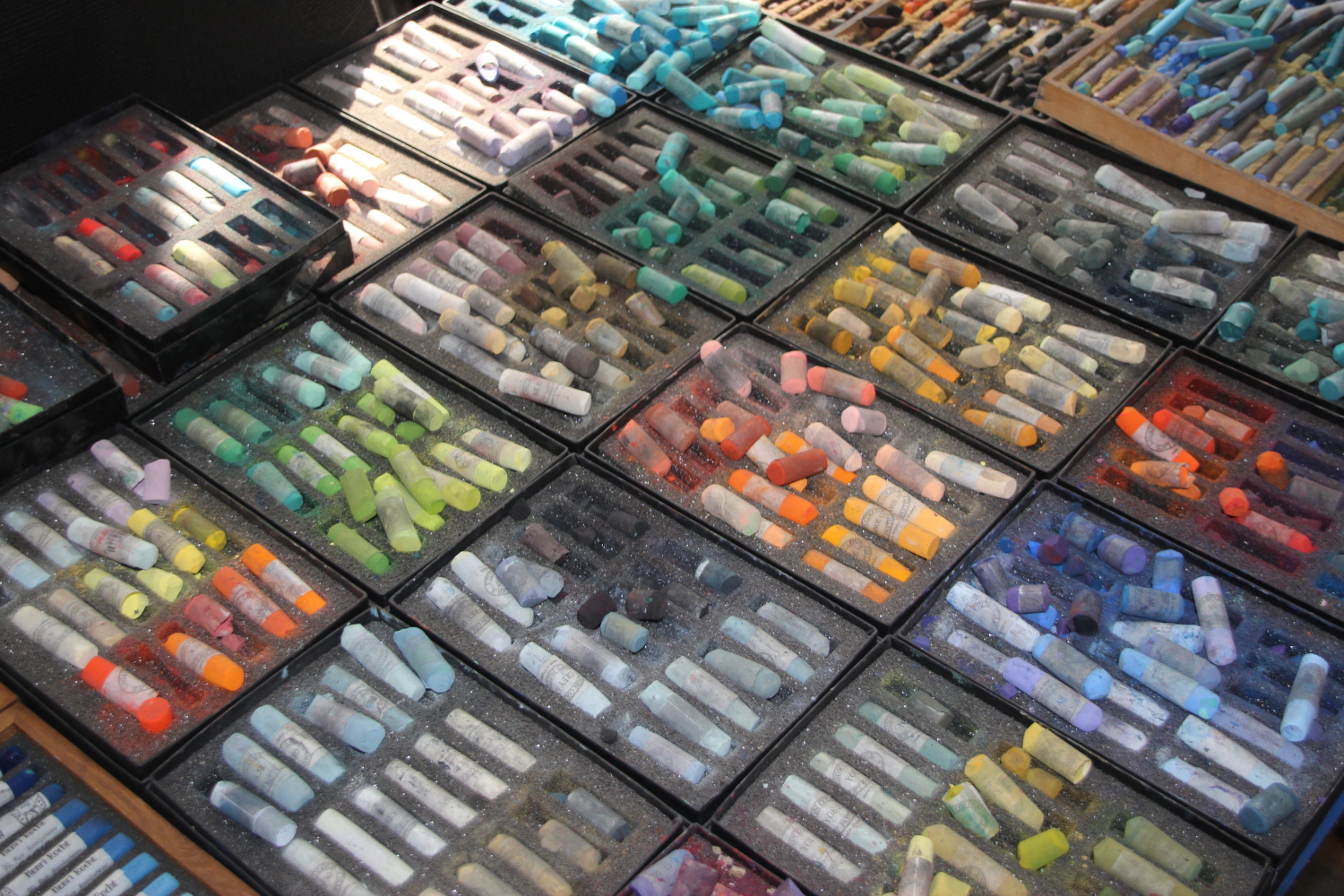
Held new paints
A little dusty from the old building
But whose colors were deeper
Than I’d ever seen before
And at the back of the store
Up a narrow stairway
Was a tiny room
And behind a long table stood three people
(Probably artists)
Who could get me any paper I desired
Paper with designs
To collage with
Hot press, cold press
100 gram, 600 gram paper
To draw and paint on
Any kind of paper I’d ever want
Templates from heaven
And over my right shoulder
Was a tall window
Overlooking the glorious city
That has held this little room
Tenderly in its arms
All these years
And as I hugged
My rolled up package of paper
And went back downstairs
The old stairs seemed to gently whisper
“Come back soon,
We’ll keep each other alive”
And stepping outside
Third Avenue seemed more spacious
And I took a deep breath
As the world
Kaleidoscoped
With possibilities
Lovingly wrapped up
By three kind artists
At the top of the world.
“Art Supplies From Heaven,“ by Judith Ellen Sanders, published in “Metropolitan Diary,” NY Times, April 6, 2014





 barbararachkoscoloreddust.com