Blog Archives
Pearls from artists* # 688

*an ongoing series of quotations – mostly from artists, to artists – that offers wisdom, inspiration, and advice for the sometimes lonely road we are on.
Many artists see their studio practice as a religion. Like any other faith, it has rituals, beliefs, devotions, visionaries, martyrs, and even miracles. Our souls have a need to position themselves in the giant scheme of the universe, and art, like spiritual conviction, helps us do that. It allows us to decipher and process the complexities of the world around us. It can make us better humans by telling stories and sharing points of view that stoke compassion, understanding, and empathy. It holds the potential to redeem both the maker and the viewer, transcending quotidian dullness by evoking a deep significance we had forgotten.
Kate Kretz in Art From Your Core: A Holistic Guide to Visual Voice
Comments are welcome!
Q: Do you ever use other people’s photographs as reference material for your paintings?

Some Reference Photos
A: For a number of reasons, I never use anyone else’s photographs as reference material. It seems wrong on many levels. Besides the fact that it is theft of intellectual property, it would mean I did not have the all-important experience of finding and making the photograph. Each reference photograph is the beginning of an idea for a future pastel painting. How each photograph even comes to exist – the travel and adventure behind it and the memories and stories that result – is an essential first step in my months- and even years-long creative process.
Comments are welcome!
Pearls from artists* # 644

Barbara’s Studio
*an ongoing series of quotations – mostly from artists, to artists – that offers wisdom, inspiration, and advice for the sometimes lonely road we are on.
Making the work you were born to make is a radical act of resistance in the current social climate. It refuses to hold money or power as its highest value. It takes as much time as it needs. It demands quiet and stillness. It involves deep reflection and reverence. It prioritizes uncool traits of curiosity, wonder, and earnestness. It shuns the superficial, contorting to reach far beyond it for the significant. It answers to no one but itself and has not been diluted by corporate committee. It doesn’t pander. It can tell stories that make people uncomfortable. And, despite all attempts to frame it as such, unlike most other activities, art is not a competitive sport.
Kate Kretz in Art From Your Core: A Holistic Guide to Visual Voice
Comments are welcome!
Pearls from artists* # 638

Barbara’s Studio
*an ongoing series of quotations – mostly from artists, to artists – that offers wisdom, inspiration, and advice for the sometimes lonely road we are on.
I was in the presence of a woman [Grace Hartigan] who had sacrificed everything, including her only child, to be what she was: an artist. The rewards had been few, beyond a life well-lived (not materially, but spiritually) and the recognition in her waning years that she had been honest about who she was and what she needed. A rare accomplishment for a woman of any generation, it was particularly so of hers, when servitude to family was the only goal toward which a “healthy” woman was to aspire. Grace was living proof that, on the contrary, a life dreamed could be a life lived. All it took was courage, commitment, and humor. I remember both of us laughing a lot that afternoon. Though the subject was serious, the stories Grace told were fantastic and the woman who recounted them was as wild as the twenty-six-year-old who had abandoned everything in 1948 to paint, though she wasn’t even sure how.
Mary Gabriel in Ninth Street Women
Comments are welcome!
Pearls from artists* # 597

Barbara’s Studio
*an ongoing series of quotations – mostly from artists, to artists – that offers wisdom, inspiration, and advice for the sometimes lonely road we are on.
From earliest childhood, the boys had been treated differently from their sister. They were allowed more freedom, encouraged to play outdoors and to engage in rough and tumble, and their lives were expanded early on when, at the age of seven, each was sent to St. Mary’s, the prep school of Stonyhurst College. It seemed as if the boys were being readied for adventure and excitement, but while their horizons were opening up, Leonora [Carrington] felt hers were being closed down – or more specifically, never explored. Her role, which was clear even when she was in the nursery, was to keep safe: not to rock any boats, not to take any chances. What they sought to teach her was that she should sit a certain way and behave a certain way: she should be supportive, helpful, polite. She should listen, especially to men, she should have traditional skills, such as playing music and speaking French. Drawing and painting, for which she showed altitude from an early age, were fine within reason. What harm could there be in Prim [Lenora] creating pictures? Especially if those pictures were of flowers and trees, family members and characters from fairy stories.
But art was Leonora’s secret weapon – and she hid it in plain sight, because her parents did not have the faintest idea where her talents might lead. Art, for them, was unthreatening and pretty. They had no idea that this skill their daughter was developing would be one the key to another life entirely; still less that art could never be a validation of the status quo, but meant a radical reappraisal of everything in the artists sight.
So what Leonora practiced in the nursery at Crookhey was the subversive silence of smoldering rebellion. Spared by the inherent unfairness that gave Pat, Gerard, and Arthur so much freedom; stoked by the growing realization that she had a talent that would lead, eventually, to Liberty. “I always painted, and I always knew it was what I would do,” she said many years later. As the Jesuits who educated her brothers at Stonyhurst might have said (but didn’t): show me a girl aged seven, and I will show you the woman.
Joanna Moorhead in Surreal Spaces: The Life and Art of Leonora Carrington
Comments are welcome!
Pearls from artists* # 557

*an ongoing series of quotations – mostly from artists, to artists – that offers wisdom, inspiration, and advice for the sometimes lonely road we are on.
It is true that art, while indebted to tradition, is usually at odds with it; art is about the thrill of mutiny. Young painters and sculptors are particularly unwilling to be hampered by the past, especially if that past is encased in the cement shoes of gender. But familiarity with tradition can be liberating for an artist because it provides a map illustrating the route other people have taken, which is especially valuable at the start of such a perilous journey. Male artists can inspire and instruct, surely. Artistic concerns are gender neutral. But there are social and personal issues a woman artist faces that cannot be found in the stories of men; these are the obstacles confronted and obstacles overcome. The poet Adrienne Rich wrote, “For spiritual values and a creative tradition to continue unbroken we need concrete artifacts, the work of hands, written words to read, images to look at, a dialogue with brave and imaginative women who came before us.” It’s instructive as well as comforting to know how other women have managed and what other women have dared. It’s also gratifying to find in their stories an occasional energizing dose of inspiration.
Mary Gabriel in Ninth Street Women
Comments are welcome!
Pearls from artists* # 542

*an ongoing series of quotations – mostly from artists, to artists – that offers wisdom, inspiration, and advice for the sometimes lonely road we are on.
Observing these objects and imagining their history broadened my perspective. In China, we were still living in a culturally impoverished era, but art had not abandoned us – its roots were deeply planted in the weathered soil. The stubborn survival of this indigenous artistic tradition demonstrated that our narrow-minded authoritarian state would never be able to remake our culture in its own image. From then on, when I wasn’t spending time with my parents, I was immersing myself in the world of antiques. The dealers found me perplexing, for I followed no prevailing tastes or conventional wisdom. Instead I was taken with obscure objects, and made a point of buying things that seemed to have little or no value; my hungry spirit was nourished as I imagined the stories lurking behind each piece. The observations and insights that came to me from the distant past spurred me on to make art of my own.
– Ai Weiwei in 1000 Years of Joys and Sorrows
This is exactly my experience with the folk art I collect!
Comments are welcome!
Pearls from artists* # 508
* an ongoing series of quotations – mostly from artists to artists – that offers wisdom, inspiration, and advice for the sometimes lonely road we are on.
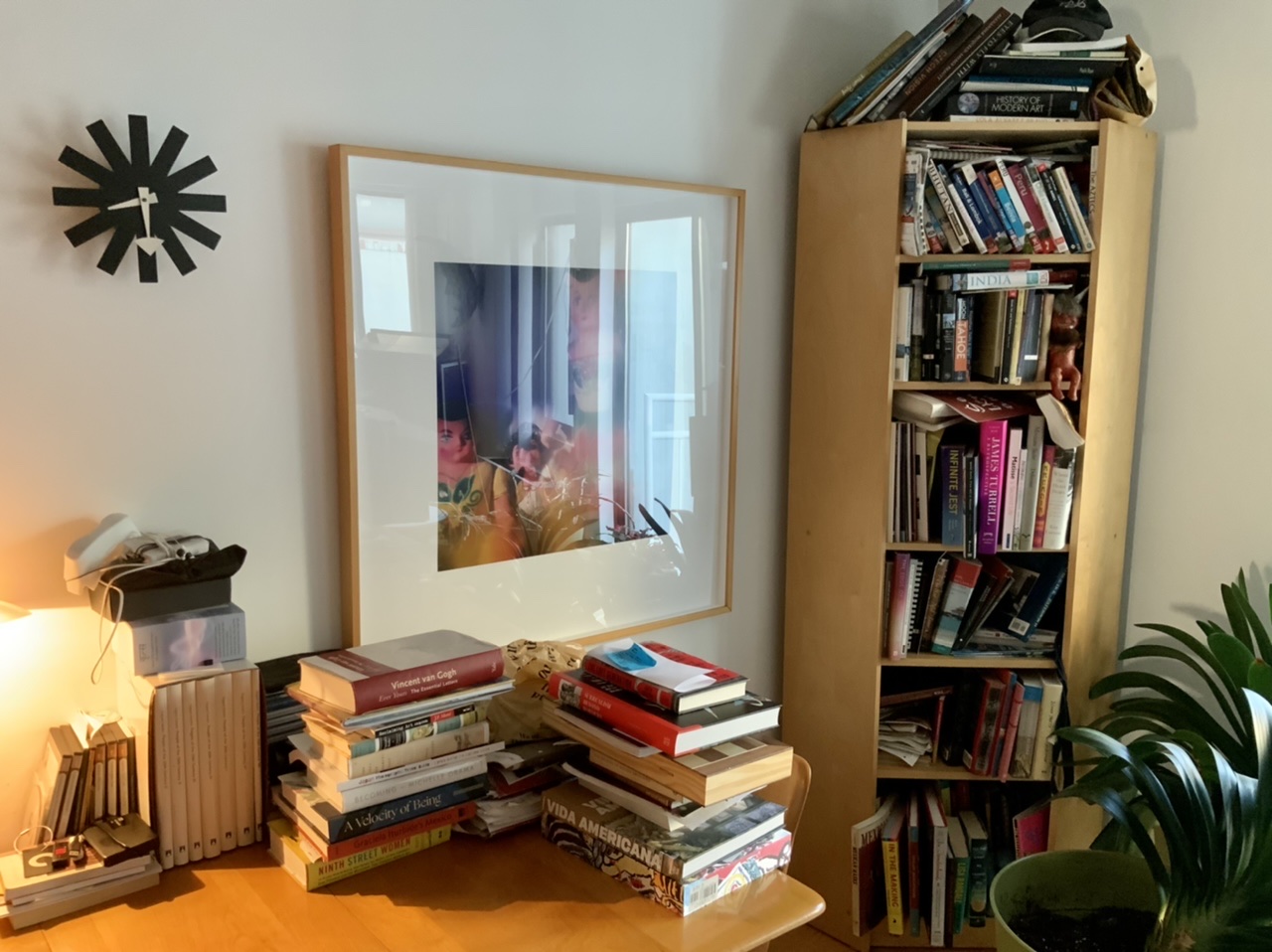
Wherever I’ve lived my room and soon
the entire house is filled with books;
poems, stories, histories, prayers of
all kinds stand up gracefully or are
heaped on shelves, on the floor, on
the bed. Strangers old and new offering
their words bountifully and thoughtfully,
lifting my heart.
But wait! I’ve made a mistake! How
could these makers of so many books
that have given so much to my life –
how could they possibly be strangers?
Mary Oliver in Upstream: Selected Essays
Comments are welcome!
Q: What makes you drawn to face masks?

A: For me a mask is so much more than a mask. It is almost a living thing with its own soul and with a unique history. I always wonder, who created this mask? For what purpose? Where has it been? What stories would it tell if it could? In my current “Bolivianos” series I feel as though I am creating portraits of living, or perhaps once living, beings.
In a way the masks are a pretext for a return to my early days as an artist. When I resigned my Naval commission to pursue art full time, I started out as a photo-realist portrait painter. The twist is that this time I do not have to satisfy a client’s request to make my subjects look younger or more handsome. I am joyfully free to respond only to the needs of the pastel painting before me on the easel.
Comments are welcome!
Pearls from artists* # 414
New York, NY
*an ongoing series of quotations – mostly from artists, to artists – that offers wisdom, inspiration, and advice for the sometimes lonely road we are on.
As we grow into our true artistic selves, we start to realize that the tools don’t matter, the story does. Your point of view and the way that you express yourself as a photographer are how you tell the stories that matter to you. And that, my friends, is therapeutic.
There’s a certain amount of Zen in that act. Peace and tranquility are hard to come by in today’s world. But through photography, we all have a chance to find both.
As photographers, we sometimes lose sight of the fact that our ability to use a camera gives us a chance to show everyone else who we are. Young photographers often obsess over doing something new. Older photographers, like Rick and I, realize that the real goal is in being you. So focus on being you not on being new for new’s sake. This is the path to both inner and outer success.
People will ask you what you photograph. I personally am often described as a bird photographer. But we are not what we do. It’s important to note the difference. And that is because people don’t care what you do. They care why you do it. If you are doing what you are meant to do, you will be able to articulate your own why.
Scott Bourne in Photo Therapy Motivation and Wisdom by Rick Sammon
Comments are welcome!


 barbararachkoscoloreddust.com