Blog Archives
Pearls from artists* # 665

*an ongoing series of quotations – mostly from artists, to artists – that offers wisdom, inspiration, and advice for the sometimes lonely road we are on.
We are wordlessly persuaded and taught outright to hide so much of what we have unearthed in our lives. But artists throughout the centuries have described the power of using anguish as a catalyst to fuel their creativity. In Greek epic poetry, ‘Kleos’ refers to immortal renown. Unlike present-day fame, this term referred exclusively to heroes who had surmounted a great obstacle or persevered through tremendous difficulties. There is a certain authority that comes from those who have endured hardship. They have earned the depth of their work.
Darkness contains a great deal of energy. We can use it for destruction or creativity. Only those who tolerate it are able to illuminate the shadowy corners, revealing the nefariousness that hopes to stay hidden. We cannot change our past, or any hell that we have been through. But art provides the means to exorcise the pain that has taken up residence in our body and fashion it into a form outside ourselves, in an infinitely affirmative gesture. The darkness we have passed through was not endured in vain if we mold it into a vision that lights the way out… for us, and for all the other souls who undoubtedly need it.
Kate Kretz in Art From Your Core: A Holistic Guide to Visual Voice
Comments are welcome!
Pearls from artists* # 623

*an ongoing series of quotations – mostly from artists, to artists – that offers wisdom, inspiration, and advice for the sometimes lonely road we are on.
At the time [the Renaissance], Bologna was unique in championing the professions of women. The home of Europe’s oldest university, which had supported female students since the thirteenth century, the city considered women artists as integral to its development. Praised by scholars, written about by biographers and adored by the locals, they were also supported by patrons of all social classes (from bankers to barbers), creating a varied culture of artistic patronage. (By contrast, in Florence and Naples, commissioning was reserved for select noble families.). Women were also encouraged to sign their work, as well as to paint self-portraits for the purpose of being known and, most importantly, remembered. No wonder scholars have recorded a staggering sixty-eight women artists working in the city between the fifteenth and sixteenth centuries.
These notable exceptions remind us that women have always been perfectly capable of being artists. But while there could have been an abundance of women working at this time, in reality female artists were an absolute rarity, seen as ‘tokens’ rather than pioneers. (After de Rossi’s death [in 1530], no female sculptor is mentioned in the city’s records for 200 years.). And little knowledge remains of those working during the Renaissance period. Most of what we know has been passed down by male scholars and through legal documents, rarely from the women themselves.
Katy Hessel in The Story of Art Without Men
Comments are welcome!
Q: Would you talk about how the Judas figures you depict in your pastel paintings function in Mexico?
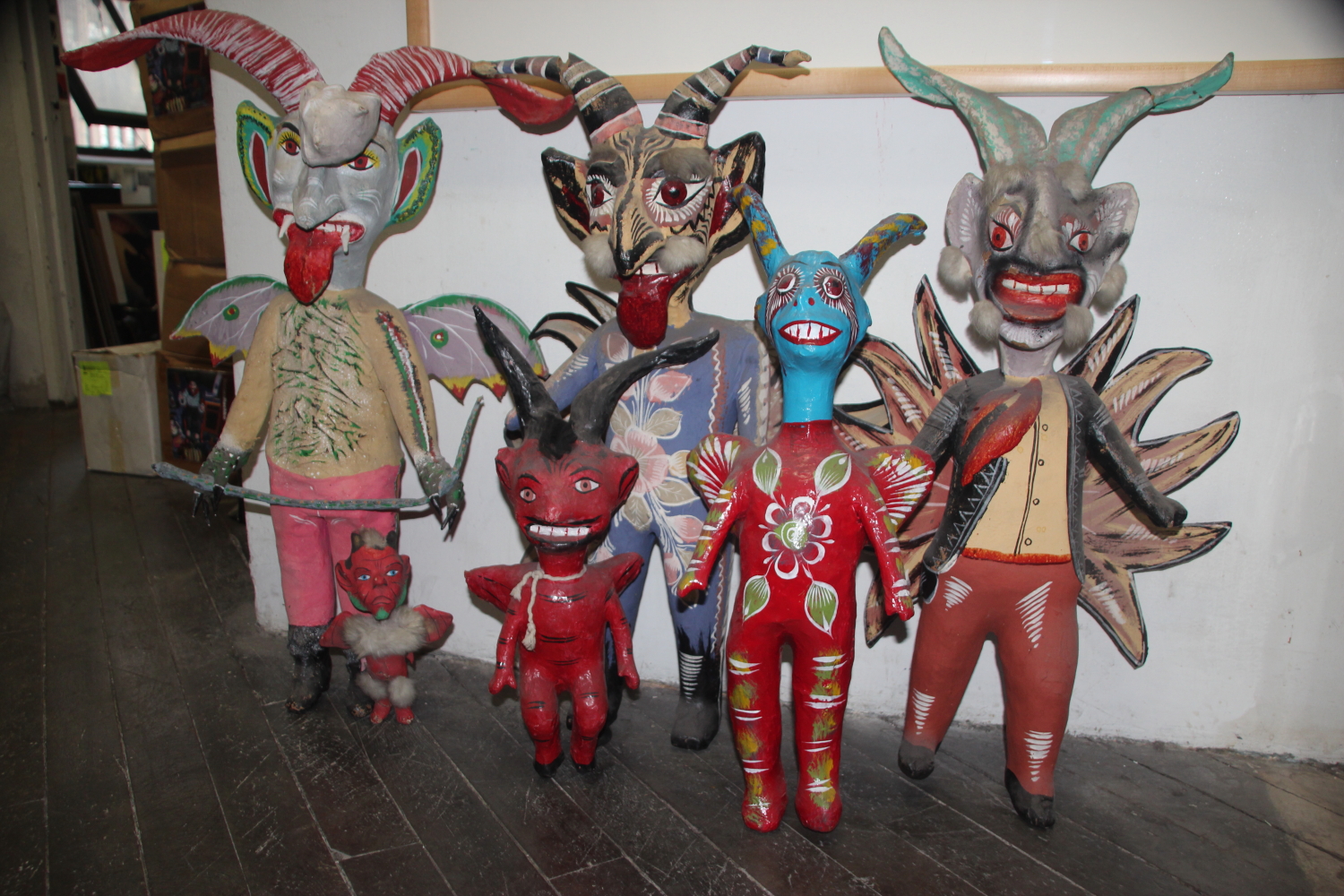
Some Judases
A: Here’s a good explanation from a website called “Mexican Folk Art Guide”:
“La quema de Judas or the Judas burning in Mexico is a celebration held on Sabado de Gloria (Holy Saturday). Papier mache figures symbolizing Judas Iscariot stuffed with fireworks are exploded in local plazas in front of cheerful spectators.
The Judases exploded in public spaces can measure up to 5 meters, while 30 cm ones can be found with a firework in their back to explode at home.
In Mexico la quema de Judas dates from the beginning of the Spanish colony when the Judas effigies were made with hay and rags and burned. Later as paper became available and the fireworks techniques arrived, thanks to the Spanish commerce route from the Philippines, the Judases were made out of cardboard, stuffed with fireworks, and exploded.
After the Independence War the celebration lost its religious character and became a secular activity. The Judas effigies were stuffed with candies, bread, and cigarettes to attract the crowds into the business [establishment] that sponsored the Judas.
Judas was then depicted as a devil and identified with a corrupt official, or any character that would harm people. In 1849 a new law stipulated that it was forbidden to relate a Judas effigy with any person by putting a name on it or dressing it in a certain way to be identified with a particular person.”
This is why whenever I bring home a Judas figure from Mexico, I feel like I have rescued it from a fire-y death!
Comments are welcome!


 barbararachkoscoloreddust.com