Blog Archives
Q: How important are the titles of your pastel paintings?
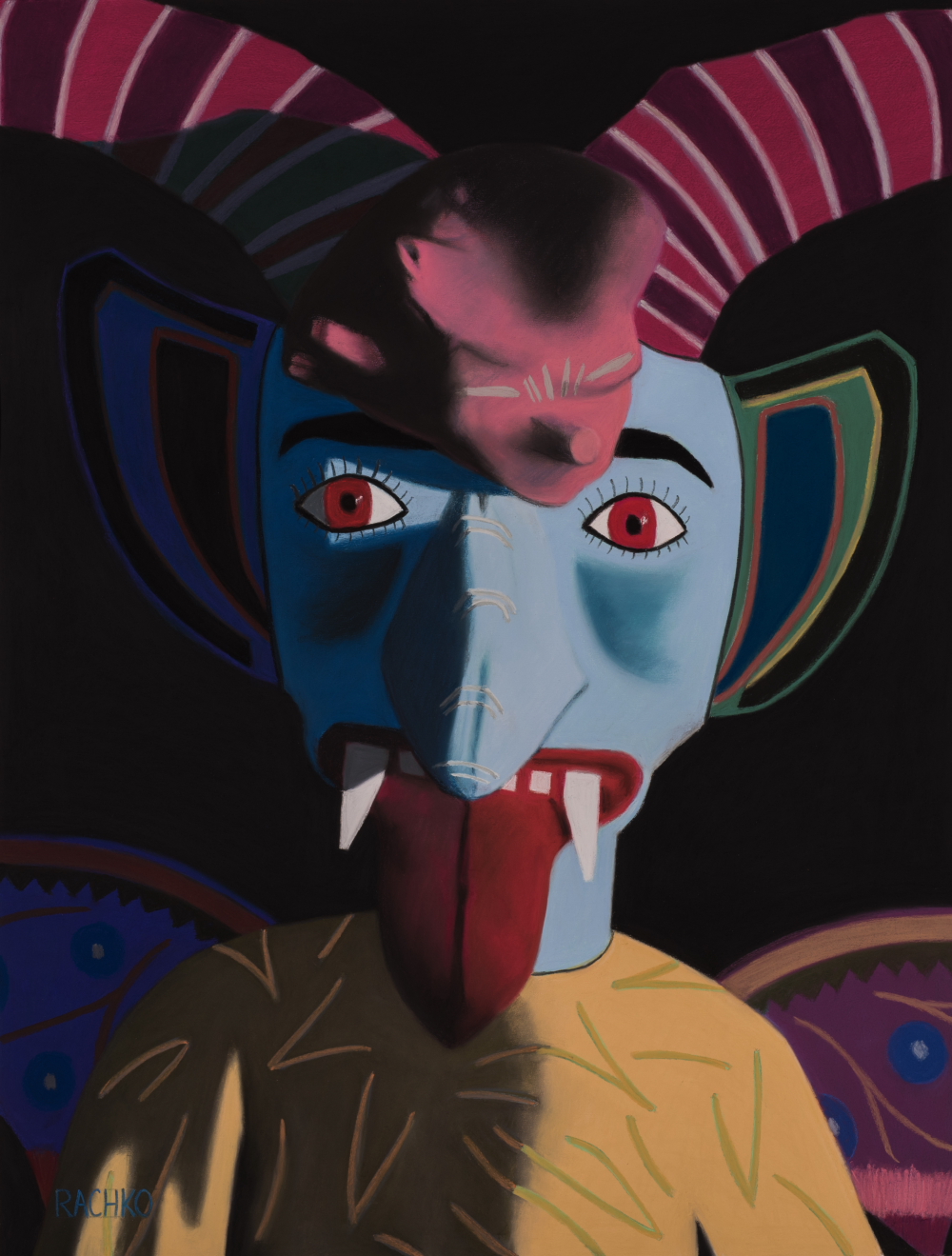
“Provocateur,” soft pastel on sandpaper, 26″ x 20″
A: I’d say they are important. Titles serve mainly as “a way in” for viewers, giving some clues about my thought processes while I am making a painting. Usually titles emerge only after I have been working on a painting for weeks or months. For me they are very much like mementos after a very interesting journey.
Comments are welcome!
Q: What do you think are the most important qualities in an artist?

“Big Deal,” soft pastel on sandpaper, 58″ x 38″
A: Two essentials immediately come to mind. I believe imagination and curiosity are very important qualities, not only for artists, but for anyone who hopes to look back on a well-lived life. As Lauren Bacall famously said, “Imagination is the highest kite one can fly.”
It is curiosity that keeps people laser-focused on a lifetime journey of learning. I’d venture to say that curiosity is the not-so-secret quality of accomplished people in every profession. We humans can never know enough!
Comments are welcome!
Pearls from artists* # 161

Whitney Museum
* an ongoing series of quotations – mostly from artists, to artists – that offers wisdom, inspiration, and advice for the sometimes lonely road we are on.
It is the artist’s innate sensitivity that makes him special and different from other professionals. Society expects the artist to be more compassionate and understanding in order to bring out that which will enlighten, inspire and encourage life in his work. His vocation should not just be for art’s sake.
Where the average person sees an old beat-up shark, the artist sees a symbol of beauty in aging and imagines bringing out those qualities that the shark has sheltered over the ages, by means of artistic creation. To the intelligent and sensitive artist, the homeless man lying on the street corner is a symbol that reminds us of what we, as a society, should be doing to better our living.
Sensitivity comes into play when leaves that appear to the general viewer to be uniformly green are seen by the sensitive artist to be different shades, tones, and subtle nuances of green. Without sensitivity, special and important characteristics of nature will be out of our sight and out of reach to the viewing layman. Only the obvious, the average and the common will reveal themselves to the insensitive artist. The endurance of certain works will depend on what the artist has captured with the help of his sensitivity and because of the ideas behind the work.
Samuel Adoquei in Origin of Inspiration: Seven Short Essays for Creative People
Comments are welcome!
Pearls from artists* # 158

“Dichotomy,” soft pastel on sandpaper, 38″ x 58″
* an ongoing series of quotations – mostly from artists, to artists – that offers wisdom, inspiration, and advice for the sometimes lonely road we are on.
It is the artist’s innate sensitivity that makes him special and different from other professionals. Society expects the artist to be more compassionate and understanding in order to bring out that which will enlighten, inspire and encourage life in his work. His vocation should not just be art for art’s sake.
Where the average person sees an old beat-up shark, the artist sees a symbol of beauty in aging and imagines bringing out those qualities that the shark has sheltered over the ages by means of artistic creation. To the intelligent and sensitive artist, the homeless man lying on the street corner is a symbol that reminds us of what we, as a society, should do to better our living.
Sensitivity comes into play when leaves that appear to the general viewer to be uniformly green are seen by the sensitive artist to be different shades, tones and nuances of green. Without sensitivity, special and important characteristics of nature will be out of sight and out of reach to the viewing layman. Only the obvious, the average and the common will reveal themselves to the insensitive artist. The endurance of certain works will depend on what the artist has captured with the help of his sensitivity and because of the ideas behind the work.
Samuel Adoquei in Origin of Inspiration: Seven Short Essays for Creative People
Comments are welcome!
Q: Why do you make art?

Barbara’s studio
A: This is an excellent question and one I like to revisit because with all the day-to-day frustrations and disappointments that are a normal part of an artist’s life, it is easy to forget what is important.
First, I make art because I have a gift and a desire to share it with others. To not develop, express, and share all that I have to say through my work is unthinkable.
Second, I make art because it is what gives my life direction and purpose. I believe that each human being has his or her own quest, driven by passion, to fulfill a certain duty. Recall Joseph Campbell’s, “The Hero’s Journey.” I need to make art in order to feel that I am living up to my highest potential.
Third, for inexplicable reasons (to me, anyway) soft pastel is an undervalued medium. I fell in love with pastel above all other media and hope to demonstrate that great art can be created with it. This is one of the drives that keeps me steadily working.
Comments are welcome!
Pearls from artists* # 148
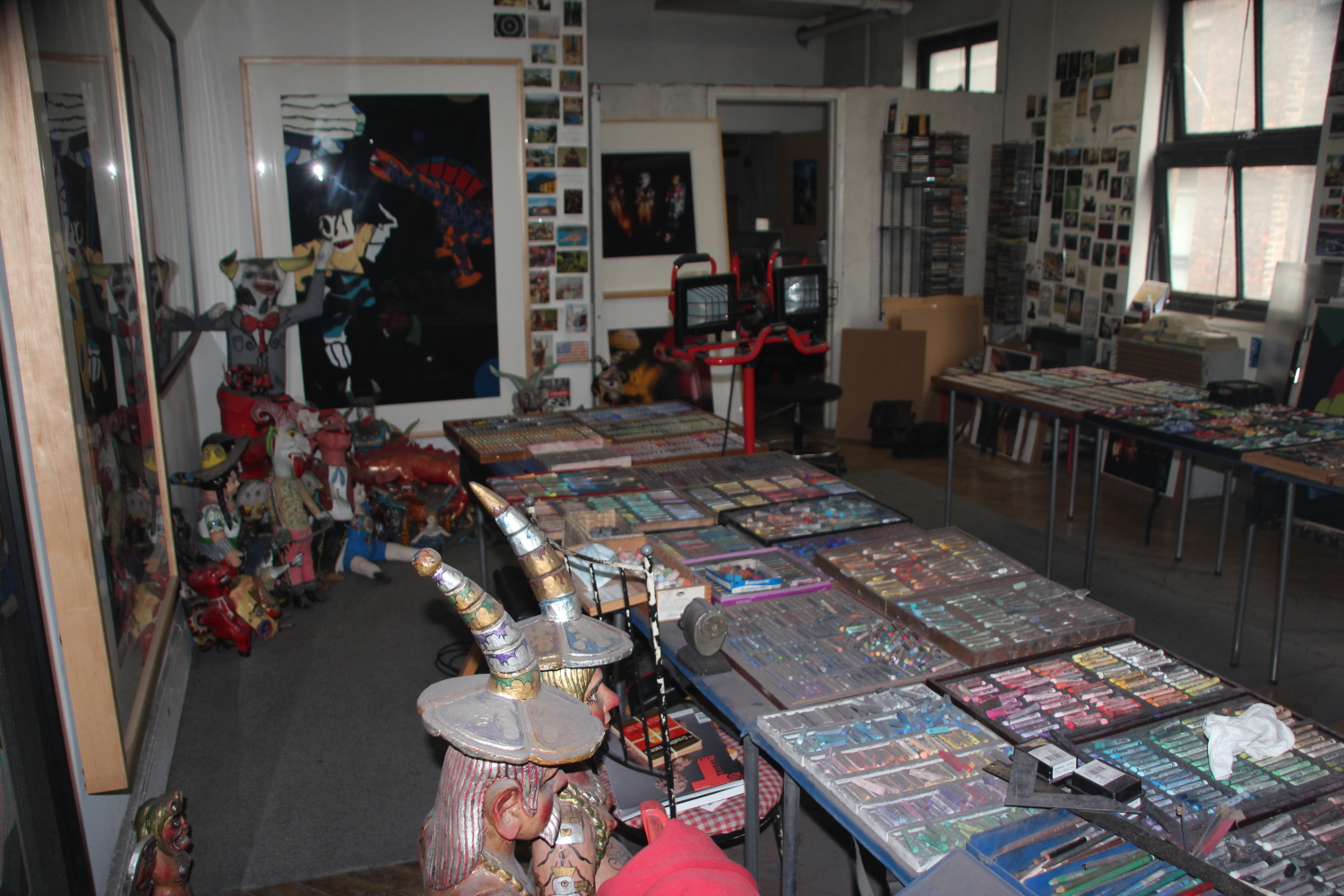
Barbara’s studio
* an ongoing series of quotations – mostly from artists, to artists – that offers wisdom, inspiration, and advice for the sometimes lonely road we are on.
I want Bob Iger, the head of Disney, to invest in my ideas. In fact … one of my ideas is … I love Walt Disney … I feel Disney should have an art fund that completely supports all of the arts. And I feel that there should be a responsibility, recruiters, constantly looking for new thinkers and connecting them directly to companies that already work. Why does the person who has the most genius idea or cultural understanding or can create the best art have to figure out how to become a businessman in order to become successful at expressing himself? I think it’s important for anyone that’s in power to empower.
Kanye West in Choice Quotes from Kanye’s Address at the School of the Art Institute of Chicago, in Hyperallergic, May 12, 2015
Comments are welcome!
Q: How do you know when a series has ended?

“A Promise, Meant to be Broken,” soft pastel on sandpaper, 58″ x 38″
A: I suppose it’s when there is nothing left to say within a particular body of work. The urgency to add something I haven’t tried vanishes. Usually I can’t even think of anything I haven’t tried.
I knew with certainty that the “Domestic Threats” series was finished while “A Promise Meant to be Broken” was still on my easel. It’s no accident that I included a self-portrait. This painting was my way of saying good-bye to an important body of work – literally turning my back on it – and summing up where the work had taken me.
For artists each series is a creative journey with a beginning, a middle, and an end. At a certain point it’s over. Then you build on what you’ve accomplished and move on to create something new. The connection between new work and old may not always be obvious, but one thing is certain: all the previous work laid the groundwork for what you make today.
Comments are welcome!
Pearls from artists* # 134

“Bryan,” soft pastel on sandpaper, 22″ x 28″, 1988
* an ongoing series of quotations – mostly from artists, to artists – that offers wisdom, inspiration, and advice for the sometimes lonely road we are on.
You never want to forget your roots. Going back to your roots is very important so you don’t get carried away from something essential. Otherwise, you move farther and farther away from the hands-on approach to making art. It is very important to go back to the beginnings at all times. You spiral back.
Conversations with Meredith Monk by Bonnie Marranca
Comments are welcome!
Q: So much of the art one sees in New York is ugly, but your art is consistently beautiful. Is beauty important to you?
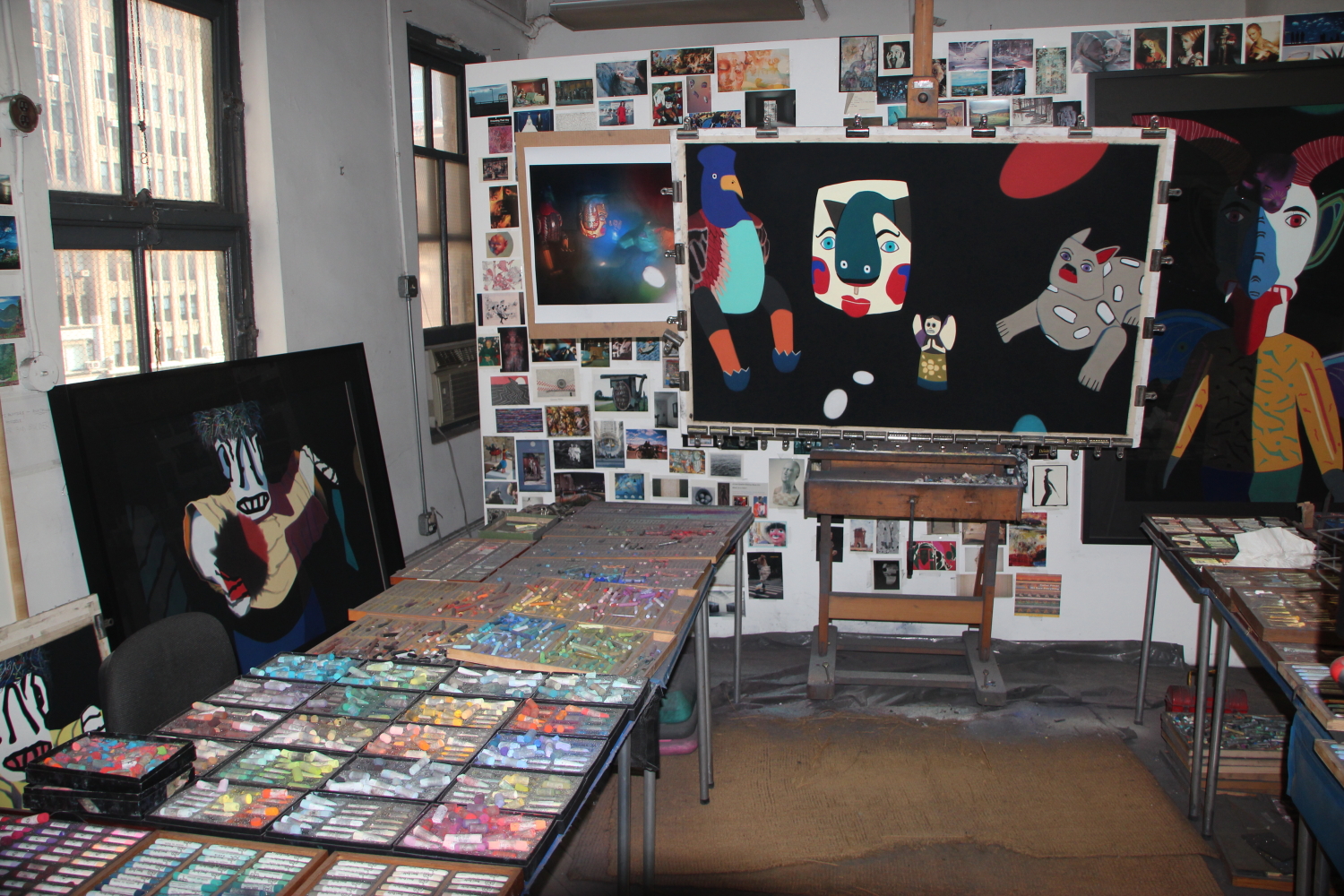
Barbara’s studio
A: Yes, beauty is extremely important. In some art circles it is not fashionable to say so, but I completely agree with the photographer, Robert Adams, who writes, “… the goal of art is Beauty.” I’ll leave it to others to decide if this quality is reached in my pastel paintings, but I certainly strive towards it.
Comments are welcome!
Q: How important is the feedback of your audience? Do you ever think about who will enjoy your Art when you conceive it?

Painting, subject, reference photo
A: I can’t say that I think at all about audience reaction while I’m creating a painting in my studio. Although, of course I want people to respond favorably to the work.
Generally, I’m thinking about technical problems – making something that is exciting to look at, well-composed, vibrant, up to my exacting standards, etc. When I finish a painting, it is the best thing I am capable of making at that moment in time.
I think about a painting and look at it for so long and with such intensity, that it could hardly have turned out any differently. There is an inevitability to the whole lengthy process that goes all the way back to when I first laid eyes on the folk art figures in a dusty shop in a third world country. Looking at a newly-finished painting on my easel I often think, “Of course! I was drawn to this figure so that it could serve this unique function in this painting.”
Comments are welcome!


 barbararachkoscoloreddust.com