Blog Archives
Q: Did you formally study art? (Question from “Cultured Focus Magazine”)

A: My bachelor’s degree in Psychology is from the University of Vermont. I did not formally study art, unless you want to count the several years-worth of drawing and painting classes I took at the Art League School in Alexandria, VA. I never went to art school so do not have a bachelor’s or master’s degree in art.
Much later, in the early 2000s, I was compelled to study photography at the International Center of Photography in New York. This is a rather long story.
On September 11, 2001, my husband Bryan Jack, a high-ranking federal government employee, a brilliant economist and a budget analyst at the Pentagon, was on his way to present his monthly guest lecture in economics at the Naval Postgraduate College in Monterey, CA. He was a passenger on the plane that departed from Dulles Airport and was high-jacked and crashed into the Pentagon.
Losing Bryan on 9/11 was the biggest shock of my life, devastating in every way imaginable. We were soulmates and newly married. I have lived with his loss every single day for more than twenty years now. Life has never been the same.
In the summer of 2002 I was beginning to feel ready to get back to work. Learning about photography and cameras became essential avenues to my well-being.
My first challenge was learning how to use Bryan’s 4 x 5 view camera. Bryan had always taken the 4 x 5 negatives from which I derived the reference photos that were essential tools for making pastel paintings. I enrolled in a one-week view camera workshop at the International Center of Photography in New York. Surprisingly, it was very easy. I had derived substantial technical knowledge just from watching Bryan for many years.
After the view camera workshop, I decided to throw myself into learning this new medium, beginning with Photography I. I spent the next few years taking many classes at ICP and learning as much as I could. Eventually, I learned how to use Bryan’s extensive collection of film cameras, to properly light the setups that served as subject material for my “Domestic Threats” pastel paintings, and to make my own large chromogenic prints in a darkroom.
Then in October 2009 I was invited to present a solo photography exhibition at a gallery in New York. Continuing to make art after Bryan’s death had seemed like such an impossibility. I remember thinking how proud he would have been to know I became a good photographer.
Comments are welcome!
Q: What’s on the easel today?
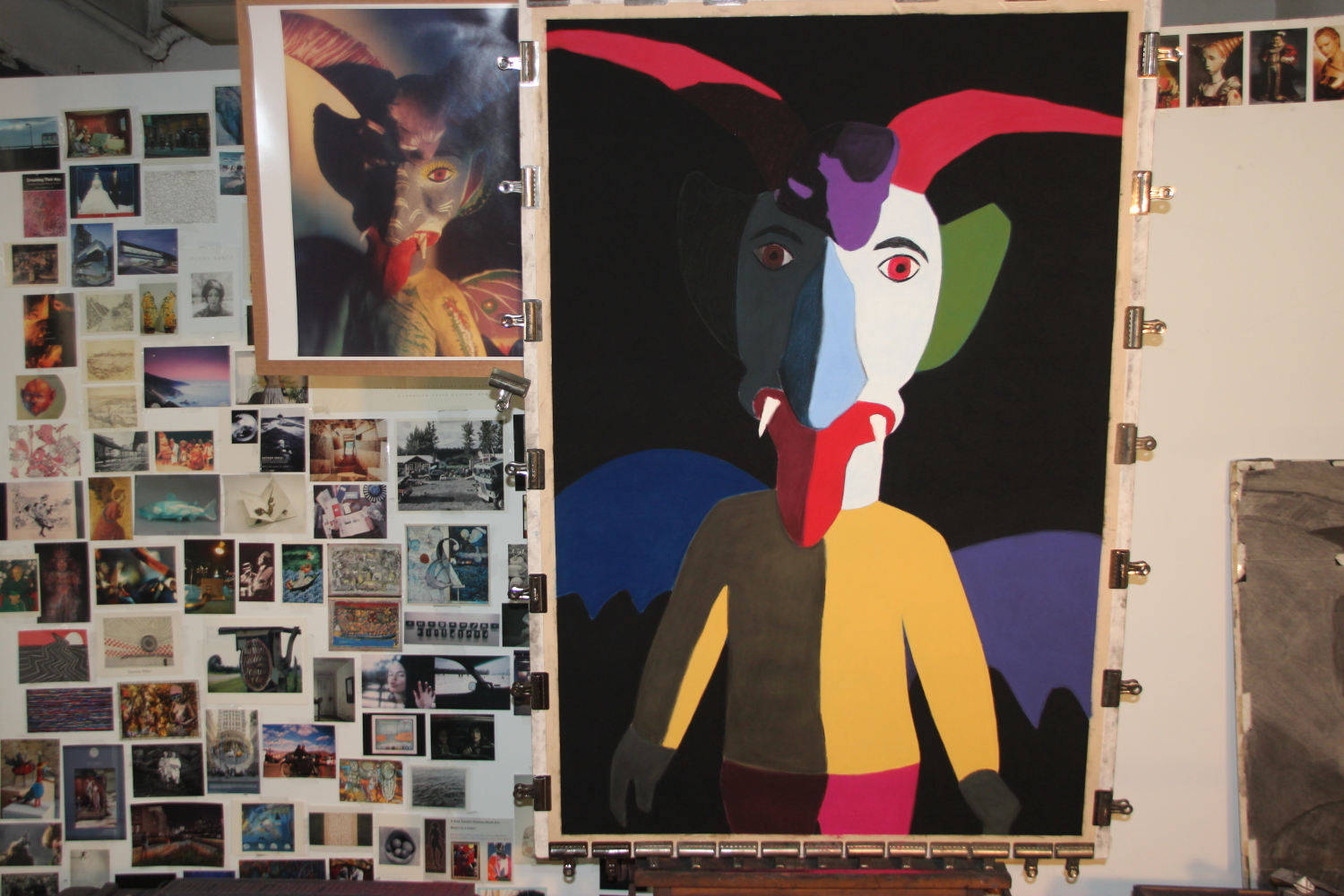
Work in progress, 58″ x 38″
A: Today is a day off to let my fingers heal. When I start a new painting, I need to rub my fingers against raw sandpaper in order to blend the pastel. With each layer the tooth of the paper gets filled up and becomes smooth, but until then my fingers suffer. Here is what I’ve been working on.
This pastel-on-sandpaper painting is an experiment, an attempt to push myself to work with bigger and bolder imagery. The photograph clipped to the easel is one of my favorites. It depicts a Judas that Bryan and I found in a dusty shop in Oaxaca. Among the Mexican and Guatemalan folk art pieces that I’ve collected are five papier mâché Judases. This particular one is unusual because it has a cat’s head attached at the forehead (the purple shape in the painting). They are not made to last. In some Mexican towns large Judases are hung from church steeples, loaded with fireworks, and burned in effigy. This takes place at 10:00 a.m. on the Saturday morning before Easter. Mexico is primarily a Catholic nation, of course, so effigy burning is done as symbolic revenge against Judas for his betrayal of Christ. The Judas in the photo is small and meant for private burning by a family (rather than in public at a church) so by bringing it back to New York I rescued it from a fire-y death! In sympathy with Mexican tradition, I began this painting last Saturday (the day before Easter) at 10 a.m.
Comments are welcome!
Q: Your relationship with photography has changed considerably over the years. How did you make use of photography in your first series of pastel-on-sandpaper paintings, “Domestic Threats”?
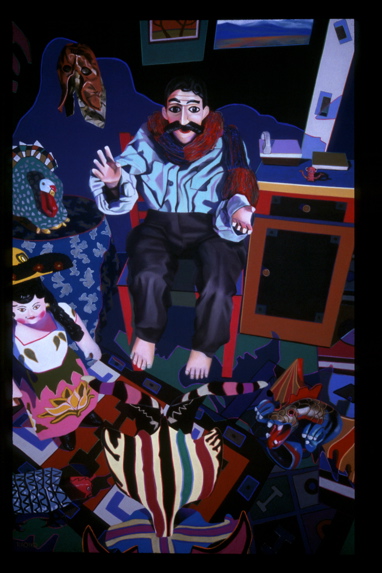
“Truth Betrayed by Innocence,” 2001, 58″ x 38″, the last pastel painting for which Bryan photographed the setup
A: When my husband, Bryan, was alive I barely picked up a camera, except to photograph sights encountered during our travels. Throughout the 1990s and beyond (ending in 2007), I worked on my series of pastel-on-sandpaper paintings called, “Domestic Threats.” These were realistic depictions of elaborate scenes that I staged in our 1932 Sears house in Alexandria, Virginia, and later, in a New York sixth floor walk-up apartment, using the Mexican masks, carved wooden animals, and other folk art figures that I found on our trips to Mexico. I staged and lit these setups, while Bryan photographed them using his Toyo-Omega 4 x 5 view camera. We had been collaborating this way almost from the beginning (we met on February 21, 1986). Having been introduced to photography by his father at the age of 6, Bryan was a terrific amateur photographer. He would shoot two pieces of 4 x 5 film at different exposures and I would select one, generally the one that showed the most detail in the shadows, to make into a 20 x 24 photograph. The photograph would be my starting point for making the pastel painting. Although I work from life, too, I could not make a painting without mostly looking at a reference photo. After Bryan was killed on 9/11, I had no choice but to study photography. Over time, I turned myself into a skilled photographer.
Comments are welcome!
Q: Can you talk about the studios you have worked in over the years?

Studio entrance
A: From the beginning in the mid-1980’s I had a studio. My first one was in the spare bedroom of the Alexandria, Virginia, house that I shared with Bryan and that I still own. For about three years in the 1990s I had a studio on the third floor of the Torpedo Factory Art Center, a building in Alexandria that is open to the public; people come in and watch the artists work. In 1997 an opportunity to move to New York arose and I didn’t look back. By then I was showing in a good 57th Street gallery, Brewster Arts Ltd. (the gallery focused exclusively on Latin American artists; I was thrilled with the company I was in; the only fellow non-Latina represented by owner, Mia Kim, was Leonora Carrington), and I had managed to find a New York agent, Leah Poller, with whom to collaborate. I looked at one other space before finding my West 29th Street studio, where I still work. It was and continues to be my oasis in a chaotic city, a place to make art, to read, and to think. I feel more calm the moment I walk in.
Comments are welcome!
Q; When did you start pursuing art as a serious profession?
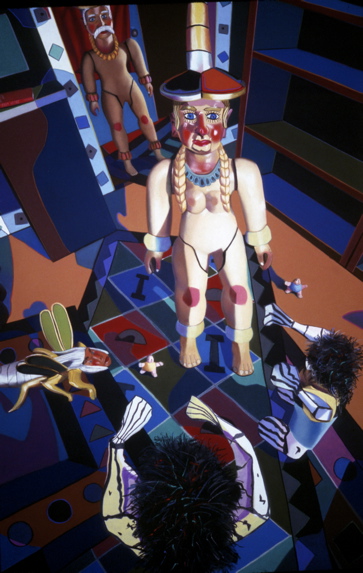
“Answering the Call,” 58″ x 38,” soft pastel on sandpaper
A: In the mid-1980s I was in my early 30s, a lieutenant on active duty in the Navy, working a soul-crushing job as a computer analyst on the midnight shift in a Pentagon basement. It was literally and figuratively the lowest point of my life. Remembering the joyful Saturdays of my youth when I had studied with a local New Jersey painter, I enrolled in a drawing class at the Art League School in Alexandria, Virginia. Initially I wasn’t very good, but it was wonderful to be around other women and a world away from the “warrior mentality” of the Pentagon. I was having fun! Soon I enrolled in more classes and became a very motivated full-time art student who worked nights at the Pentagon. As I studied and improved my skills, I discovered my preferred medium – soft pastel on sandpaper. Although I knew I had found my calling, for more than a year I agonized over whether or not to leave the Navy. Once I did decide, there was another delay. The Navy was experiencing a manpower shortage so Congress had enacted a stop-loss order, which prevented officers from resigning. I could only do what was allowed under the order. I submitted my resignation effective exactly one year later: on September 30, 1989. With Bryan’s (my late husband) support, I left the Navy that day. So I think of myself as having been a professional artist beginning on October 1, 1989. I should mention that I remained in the Navy Reserve for the next 14 years, working mainly at the Pentagon two days every month and two weeks each year (commuting between New York and Washington, DC after I moved in 1997). Finally on November 1, 2003, I officially retired as a Navy Commander.
Comments are welcome!


 barbararachkoscoloreddust.com