Blog Archives
Q: What do you see when you look back at your early efforts?
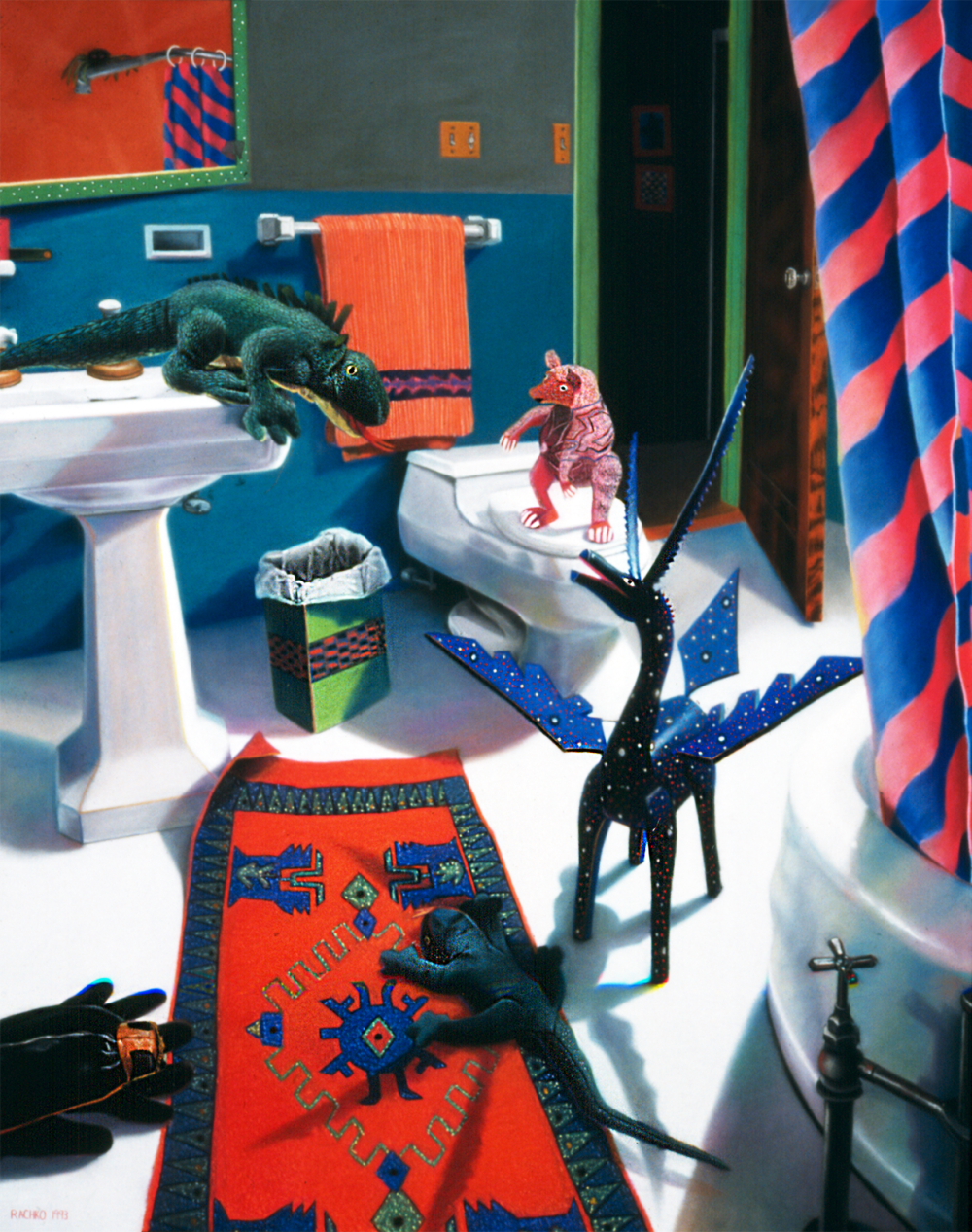
“Myth Meets Dream,” soft pastel on sandpaper, 47″ x 38,” 1993
A: I see continuity in subject matter and in medium, surely. For thirty-three years I have been inspired by foreign travel and research. In addition, I remain devoted to pushing the limits of what soft pastel can do and to promoting its merits as a fine art medium.
Here and there I see details I would render differently now; not exactly mistakes, but things that maybe could be done better. Fortunately, I think, all of my work is framed behind glass or plexiglas, making it extremely difficult to attempt revisions.
Perhaps most important of all, I see the long personal road that has advanced my work to its present state. Each gain has been hard-fought.
Comments are welcome!
Pearls from artists* # 342

New York, NY
*an ongoing series of quotations – mostly from artists, to artists – that offers wisdom, inspiration, and advice for the sometimes lonely road we are on.
I work either way, you see – assisted or unassisted – because that is what you must do in order to live a fully creative life. I work steadily, and I always thank the process. Whether I am touched by grace or not, I thank creativity for allowing me to engage at all.
Because either way, it’s all kind of amazing – what we get to do, what we get to attempt, what we sometimes get to commune with.
Gratitude, always.
Always, gratitude.
Elizabeth Gilbert in Big Magic: Creative Living Beyond Fear
Comments are welcome!
Pearls from artists* # 191
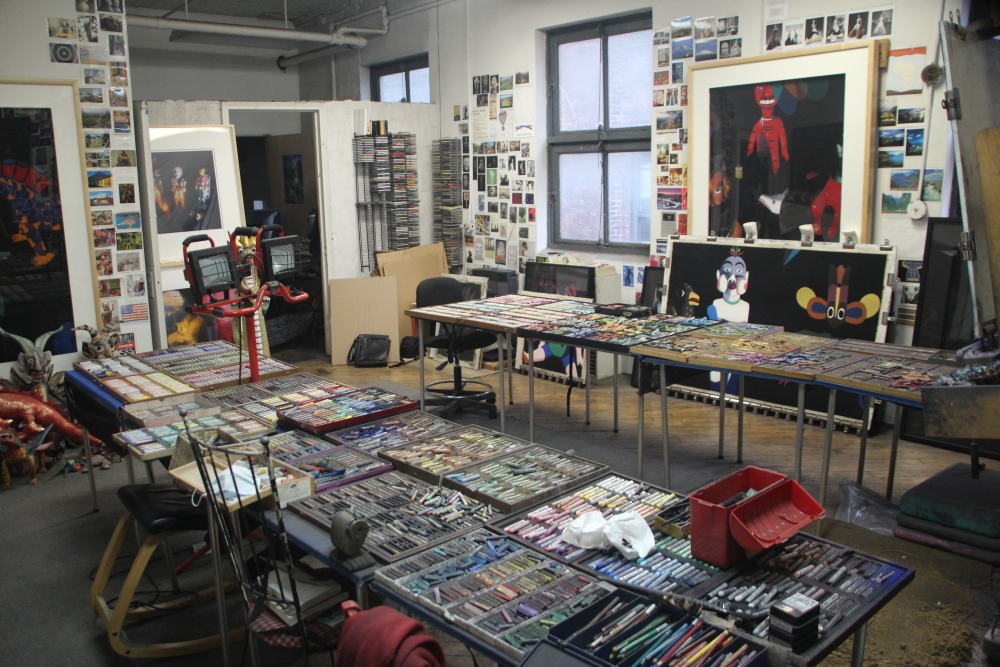
Barbara’s studio
* an ongoing series of quotations – mostly from artists, to artists – that offers wisdom, inspiration, and advice for the sometimes lonely road we are on.
“Do you understand what this is? Jacob Kahn asked me, his strong voice rising. “Do you begin to understand what you are going to be doing to yourself? You understand now what Picasso did, yes? Even Picasso, the pagan, had to do this. At times there is no other way. Do you understand me, Asher Lev? This is not a toy. This is not a child scrawling on a wall. This is a tradition; it is a religion, Asher Lev. You are entering a religion called painting. It has its fanatics and rebels. And I will force you to master it. Do you hear me? No one will listen to what you have to say unless they are convinced you have mastered it. Only one who has mastered a tradition has a right to attempt to add to it or rebel against it. Do you understand me, Asher Lev?”
My Name is Asher Lev by Chaim Potok
Comments are welcome!
Pearls from artists* # 181

“Epiphany,” soft pastel on sandpaper, 38″ x 58″
* an ongoing series of quotations – mostly from artists, to artists – that offers wisdom, inspiration, and advice for the sometimes lonely road we are on.
It takes courage to face the unfamiliar, to espouse the different; courage to fight one’s own prejudices only less than those of others. Was it not a little child who first dared call the emperor naked? It took great fortitude for Kepler to adhere to his new notion of infinity (as the second focus of a parabola), for, as he said, “The idea seems absurd, but I can find no flaw in it”; just as it did for Galileo to murmur among his inquisitors, “Yet the world does move.” Most of us will never achieve great imaginative insights; we might at least attempt to be tolerant of those offered by others.
The Biological Basis of Imagination by R.W. Gerard in The Creative Process edited by Brewster Ghiselin
Comments are welcome!
Pearls from artists* # 126

Self-portrait with “Blue Misterioso”
* an ongoing series of quotations – mostly from artists, to artists – that offers wisdom, inspiration, and advice for the sometimes lonely road we are on.
Photography is an elegiac art, a twilight art. There is no subject the photographer might attempt that could not be touched with pathos. All photogrpahs are memento mori. To take a photograph is to participate in another person’s (or thing’s) mortality, vulnerability, mutability. precisely by slicing out this moment and freezing it, all photographs testify to time’s relentless melt.
Photography by Susan Sontag in Anthology: Selected Essays from Thirty Years of The New York Review of Books, edited by Robert S. Silvers and Barbara Epstein
Comments are welcome!
Q: Can you describe your entire body of work in six words or less?
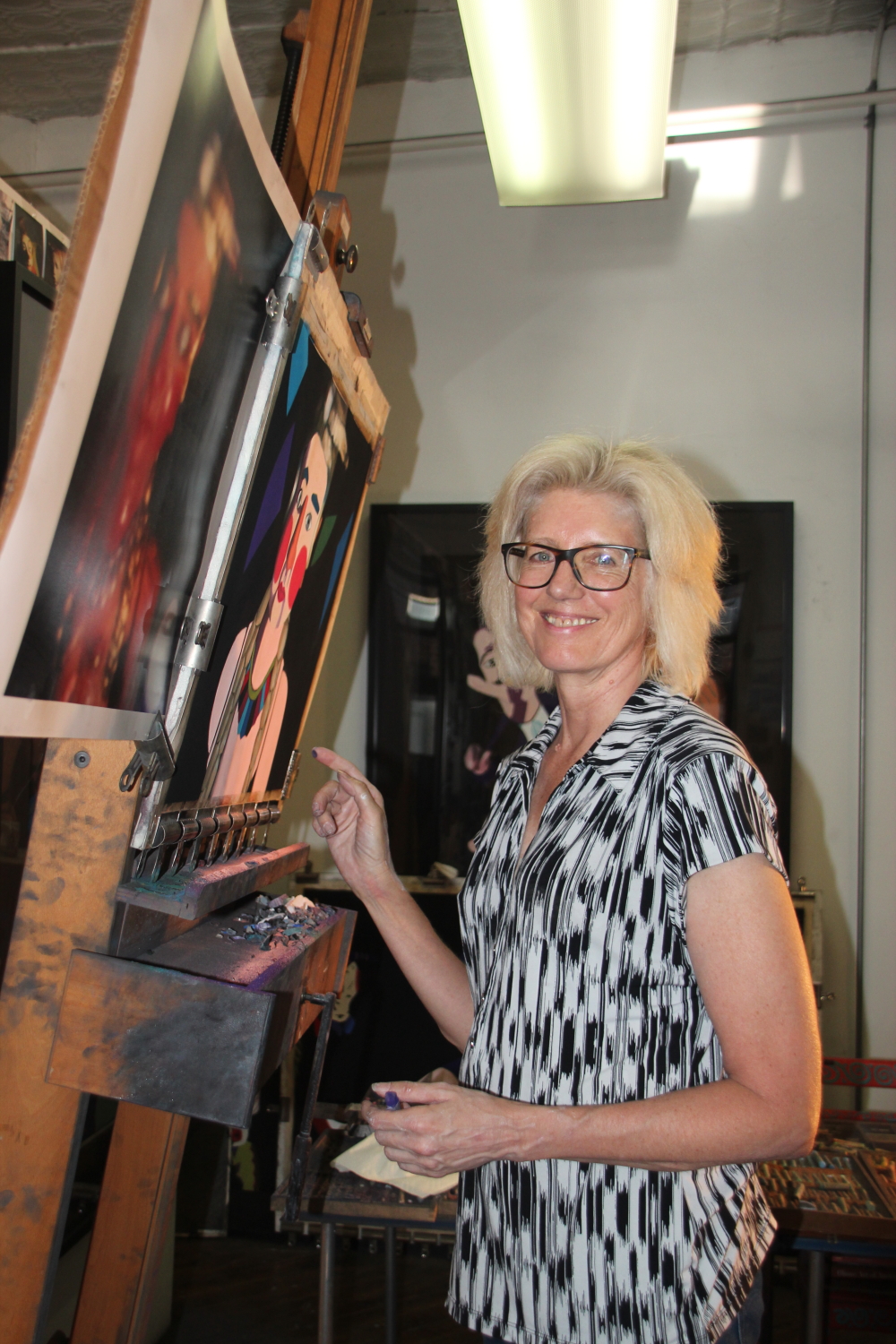
In the studio, Photo: Britta Konau
A: Only if I forget what it took to get me to this point! I remember all too well the long periods of study, hard work, self-doubt, self-nurturing, disappointments, setbacks, risks, focus, drive, discipline, joy, detours, fallow periods, rejections, perseverance, etc. that have gone into sustaining an art career for nearly thirty years. There are no blueprints and few role models for a successful artist’s life. (Even the meaning of “success” as an artist is difficult to define). I invite others, who surely can be more objective, to attempt a summation of my entire body of work in a few words.
Comments are welcome!
Q: Do you have any advice for a young painter or someone just starting out as an artist?
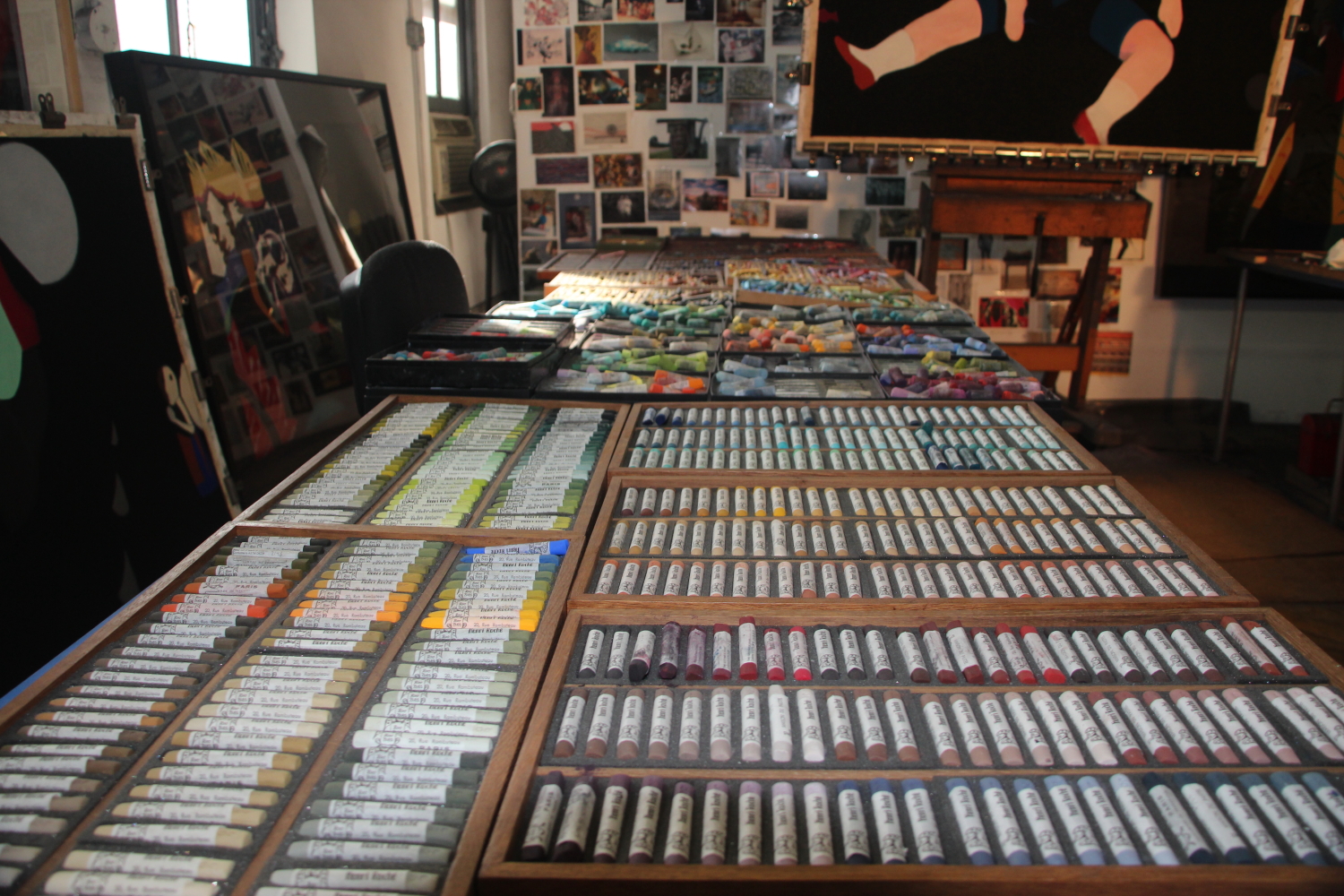
Studio
A: As artists each of us has at least two important responsibilities: to express things we are feeling for which there are no adequate words and to communicate to a select few people, who become our audience. By virtue of his or her own uniqueness, every human being has something to say. But self-expression by itself is not enough. As I often say, at it’s core art is communication. Without this element there is no art. When artists fail to communicate, perhaps they haven’t mastered their medium sufficiently so are unsuccessful in the attempt, or they may be being self-indulgent and not trying. Admittedly there is that rare and most welcome occurrence when an artistic statement – such as a personal epiphany – happens for oneself alone.
Most importantly, always listen to what your heart tells you. It knows and speaks the truth and becomes easier to trust as you mature. If you get caught up in the art world, step back and take some time to regain your bearings, to get reacquainted with the voice within you that knows the truth. Paint from there. Do not ever let a dealer or anyone else dictate what or how you should paint.
With perhaps the singular exception of artist-run cooperative galleries, be very suspicious of anyone who asks for money to put your work in an exhibition. These people are making money from desperate and confused artists, not from appreciative art collectors. With payment already in hand there is no financial incentive whatsoever for these people to sell your paintings and they won’t.
Always work in a beautiful and special place of your own making. It doesn’t need to be very large, unless you require a large space in which to create, but it needs to be yours. I’m thinking of Virginia Woolf’s “a room of one’s own” here. A studio is your haven, a place to experiment, learn, study, and grow. A studio should be a place you can’t wait to enter and once you are there and engaged, are reluctant to leave.
Be prepared to work harder than you ever have, unrelentingly developing your special innate gifts, whether you are in the mood to do so or not. Most of all remember to do it for love, because you love your medium and it’s endless possibilities, because you love working in your studio, and because you feel most joyously alive when you are creating.
Comments are welcome!
Pearls from artists* # 60
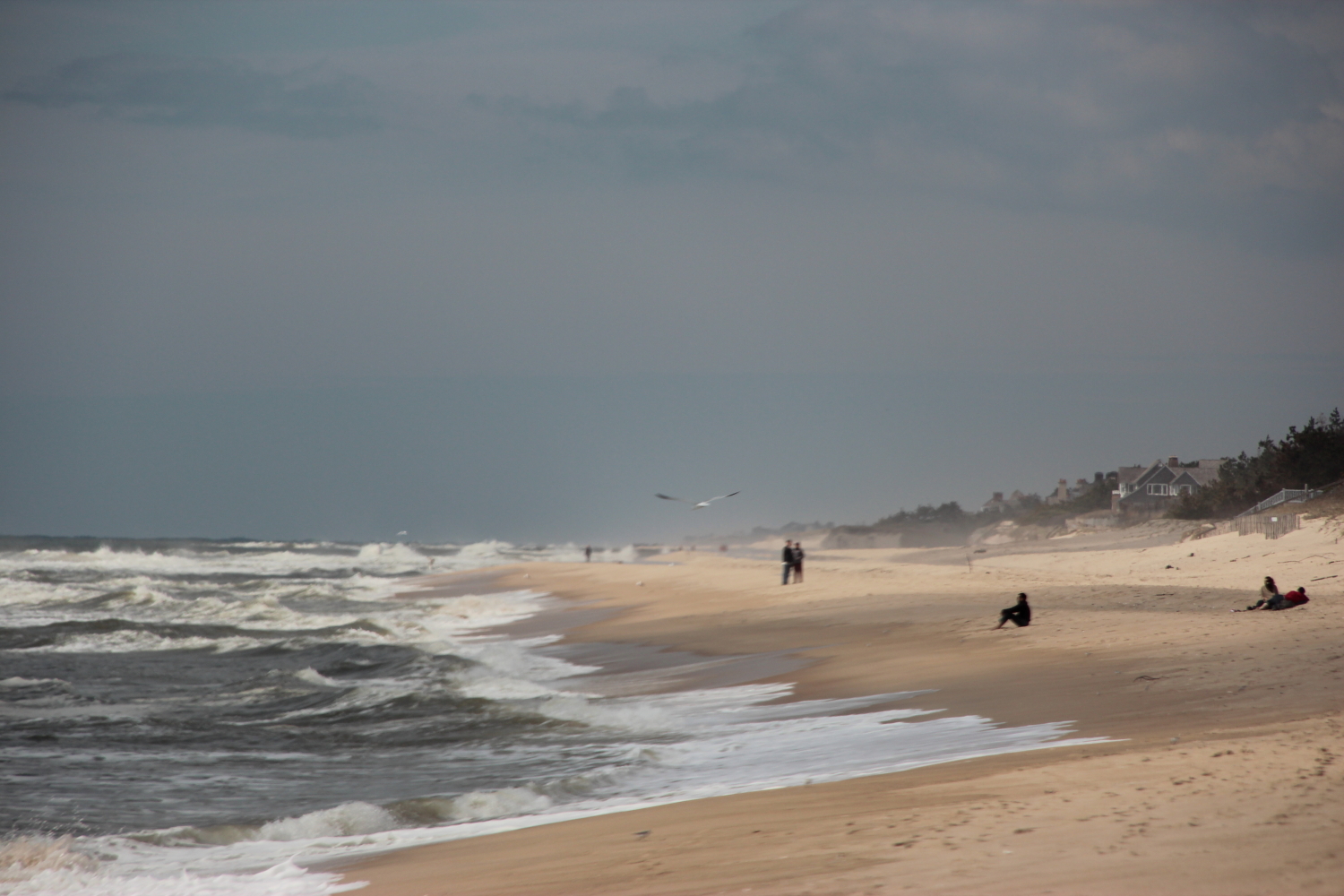
East Hampton, NY
* an ongoing series of quotations – mostly from artists, to artists – that offers wisdom, inspiration, and advice for the sometimes lonely road we are on.
For an artist, it is a driven pursuit, whether we acknowledge this or not, that endless search for meaning. Each work we attempt poses the same questions. Perhaps this time I will see more clearly, understand something more. That is why I think that the attempt always feels so important, for the answers we encounter are only partial and not always clear. Yet at its very best, one work of art, whether produced by oneself or another, offers a sense of possibility that flames the mind and spirit, and in that moment we know this is a life worth pursuing, a struggle that offers the possibility of answers as well as meaning. Perhaps in the end, that which we seek lies within the quest itself, for there is no final knowing, only a continual unfolding and bringing together of what has been discovered.
Dianne Albin quoted in Eric Maisel’s The Van Gogh Blues
Comments are welcome!
Q: What’s on the easel today?
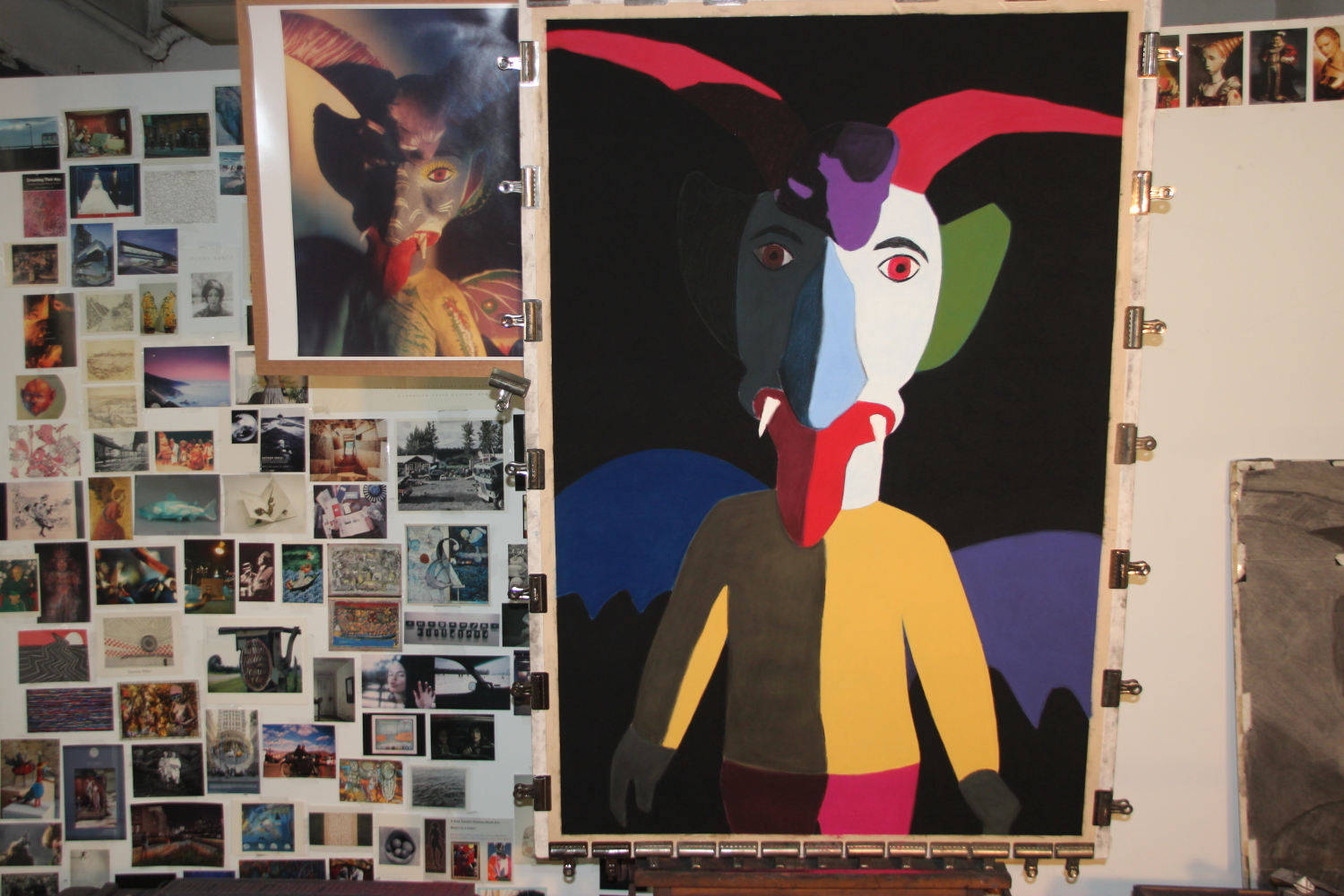
Work in progress, 58″ x 38″
A: Today is a day off to let my fingers heal. When I start a new painting, I need to rub my fingers against raw sandpaper in order to blend the pastel. With each layer the tooth of the paper gets filled up and becomes smooth, but until then my fingers suffer. Here is what I’ve been working on.
This pastel-on-sandpaper painting is an experiment, an attempt to push myself to work with bigger and bolder imagery. The photograph clipped to the easel is one of my favorites. It depicts a Judas that Bryan and I found in a dusty shop in Oaxaca. Among the Mexican and Guatemalan folk art pieces that I’ve collected are five papier mâché Judases. This particular one is unusual because it has a cat’s head attached at the forehead (the purple shape in the painting). They are not made to last. In some Mexican towns large Judases are hung from church steeples, loaded with fireworks, and burned in effigy. This takes place at 10:00 a.m. on the Saturday morning before Easter. Mexico is primarily a Catholic nation, of course, so effigy burning is done as symbolic revenge against Judas for his betrayal of Christ. The Judas in the photo is small and meant for private burning by a family (rather than in public at a church) so by bringing it back to New York I rescued it from a fire-y death! In sympathy with Mexican tradition, I began this painting last Saturday (the day before Easter) at 10 a.m.
Comments are welcome!


 barbararachkoscoloreddust.com