Category Archives: Studio
Q: What’s on the easel today?

Work in progress!
A: I continue working on two 58” x 38” pastel paintings. The one on the left does not yet have a title. On the right is “Apparition.” I hope to finish this one soon.
Comments are welcome!
Pearls from artists* # 620

Barbara’s Studio
*an ongoing series of quotations – mostly from artists, to artists – that offers wisdom, inspiration, and advice for the sometimes lonely road we are on.
A painting lives by companionship, expanding and quickening in the eyes of the sensitive observer. It dies by the same token. It is therefore a risky and unfeeling act to send it out into the world.
Mark Rothko in The Artist’s Reality: Philosophies of Art
Comments are welcome!
Q: You seem very disciplined. Do you ever have a day when you just can’t get excited about going to the studio to work?

Signing “Narcissist”
A: That happens occasionally, but I usually still go to the studio to work. You know the expression, “99% of life is just showing up”? Well, of course I have to show up at my studio to accomplish anything so I still try to keep fairly regular studio hours – 6 to 7 hours a day, 4 or 5 days a week. And that’s not to mention all the other work – answering email, checking social media, writing blog posts, etc. – which I tend to do at lunchtime, in the evenings, and on my days off from the studio.
When you are an artist there is always work to do and for some of it, no one else can do it because no one else knows the work from the inside the way the maker does. I like what Twyla Tharp says in her book, “The Creative Habit.” In order to progress an artist needs good work habits that become a daily routine. And Chuck Close used to say, “Inspiration is for amateurs,” meaning a professional works whether she’s in the mood or not. I completely agree so I keep working and slowly moving ahead.
As Tchaikovsky wrote in a letter to a friend:
We must always work, and a self-respecting artist must not fold his hands on the pretext that he is not in the mood. If we wait for the mood, without endeavoring to meet it halfway, we easily become indolent and apathetic. We must be patient, and believe that inspiration will come to those who can master their disinclination. A few days ago I told you I was working every day without any real inspiration. Had I given way to my disinclination, undoubtedly I should have drifted into a long period of idleness. But my patience and faith did not fail me, and today I felt that inexplicable glow of inspiration of which I told you; thanks to which I know beforehand that whatever I write today will have power to make an impression, and to touch the hearts of those who hear it.
Quoted in Eric Maisel’s A Life in the Arts: Practical Guidance and Inspiration for Creative and Performing Artists.
Comments are welcome!
Q: What’s on the easel today?

Work in progress!
A: A 58” x 38” pastel painting in the early stages.
Comments are welcome!
Pearls from artists* # 617
*an ongoing series of quotations – mostly from artists, to artists – that offers wisdom, inspiration, and advice for the sometimes lonely road we are on.
Artists’ pigments, like printers’ inks, have many uses apart from the creation of art. The advertising artist, the illustrator, the portraitist, the stylist, and the decorator all employ the plastic and pictorial devices of the artist. Yet their chief preoccupation, the purpose and function of their effort, is other than the creation of art. It is the commercial artist’s job to enhance the desirability of marketable goods. The illustrator vies with the written word in the description of places or facts and the reporting of events. The portraitist must flatter his patron, while the stylist and decorator adorn his figure, streamline his gadgets, and embellish his property. There may be a resemblance to the outward appearance of art. But the intrinsic relationship is no closer here than that which exists between the composition of birthday greetings, recipes, or advertising copy and the creations of the poet, though the identical phrase and syntax may be used in both.
Mark Rothko in The Artist’s Reality: Philosophies of Art
Comments are welcome!
Pearls from artists* # 616
*an ongoing series of quotations – mostly from artists, to artists – that offers wisdom, inspiration, and advice for the sometimes lonely road we are on.
This may be the most important piece of advice I can give you: The Internet is nothing like a cigarette break. If anything, it’s the opposite. One of the most difficult practical challenges facing writers in this age of connectivity is the fact that the very instrument on which most of us write is also a portal to the outside world. I once heard Ron Carlson say that composing on a computer is like writing in an amusement park. Stuck for a nanosecond? Why feel it? With the single click of a key we can remove ourselves and take a ride on a log flume instead.
By the time we return to work – if, indeed, we return to our work at all – we will be further away from our deepest impulses rather than closer to them. Where were we? Oh, yes. We were stuck. We were feeling uncomfortable and lost. We have gained nothing in the way of waking-dream time. Our thoughts have not drifted, but rather, have ricocheted from one bright and shiny thing to another.
Dani Shapiro in Still Writing: The Perils and Pleasures of a Creative Life
Comments are welcome!
Q: Do you have any rituals that you do before beginning a day’s work in the studio?

The Studio!
A: When I arrive at the studio in the morning it’s rare for me to immediately start working. Usually I read something art-related – books written by artists, about creativity, etc. At the moment I’m reading The Artist’s Reality: Philosophies of Art by Mark Rothko. As usual I am struggling to understand aspects of the art business and figure out what I need to do next to get my work seen and collected by a wider audience. The Artist’s Reality reminds me why I decided to make art in the first place. It helps reconnect with temporarily forgotten parts of myself and is a much-needed reminder of what I love about being an artist, especially in light of the business side that is becoming so complex and demanding of attention now.
Balancing the creative and business aspects of being an artist is a continual struggle. Both are so important. An artist needs an appreciative audience – very few artists devote their lives to art-making so that the work will remain in a closet – but I also believe this (from a note I wrote years ago and tacked to the studio wall): “Just make the work. None of the rest matters.”
Comments are welcome!
Pearls from artists* # 614

*an ongoing series of quotations – mostly from artists, to artists – that offers wisdom, inspiration, and advice for the sometimes lonely road we are on.
The artist has accepted his fate with open eyes, and I do not believe that he wishes any charity in relation to his self-assumed sacrifice. He wants nothing but the understanding and love of what he does. There can be no other rewards. The foregoing therefore is not in the spirit of asking for a charitable contribution, but rather the clearing of the way for what is really the motivating factor for this strange phenomenon: the creation of art.
Mark Rothko in The Artist’s Reality: Philosophies of Art
Comments are welcome!
Q: What’s on the easel today?

Work in progress
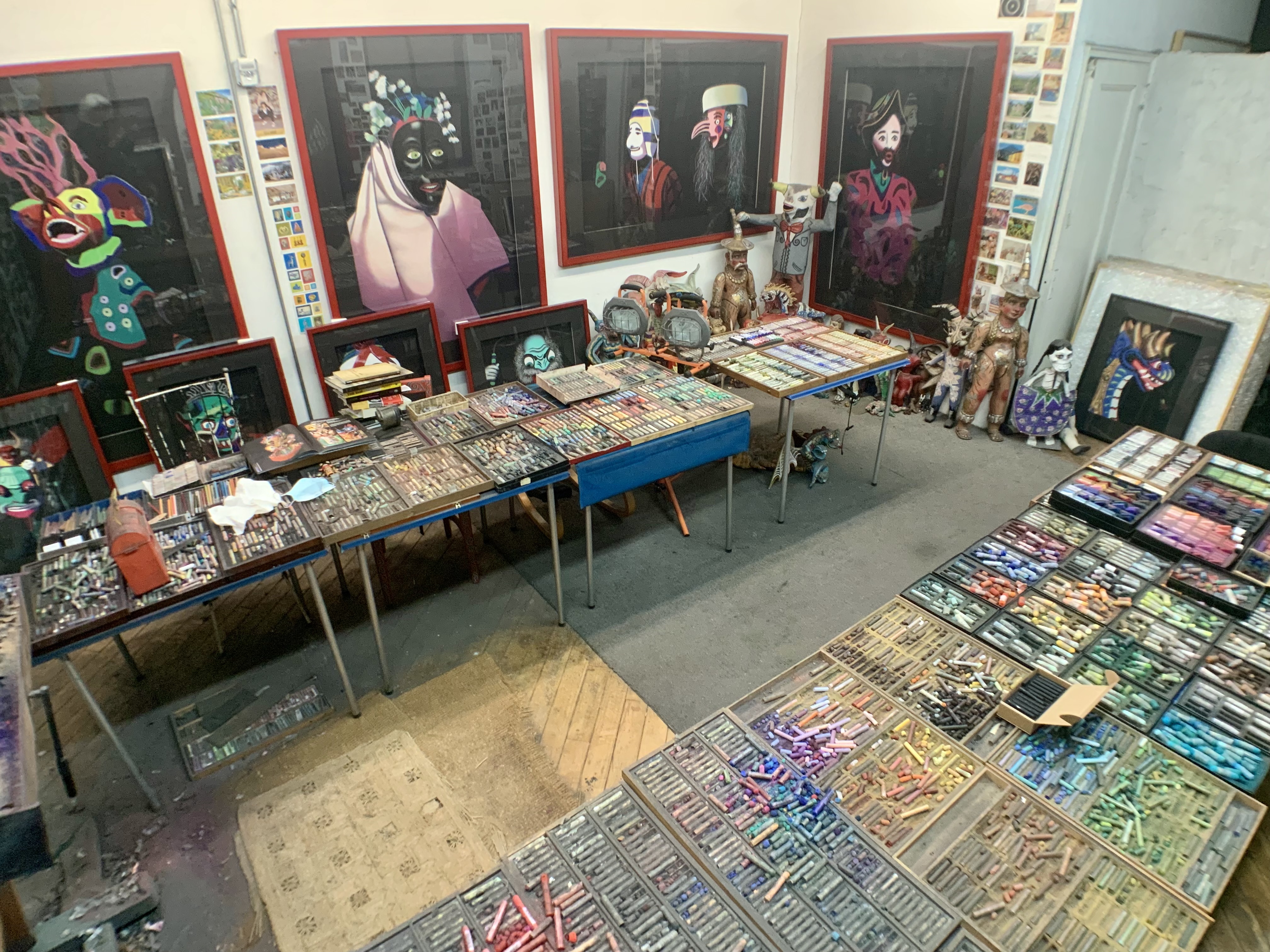
A: This is my second day working on a new “Bolivianos” pastel painting. Next I will layer black Rembrandt soft pastels for the background. It usually takes 4 or 5 layers just to cover the 400 grit sandpaper.
Comments are welcome!
Pearls from artists* # 611
Barbara’s Studio
*an ongoing series of quotations – mostly from artists, to artists – that offers wisdom, inspiration, and advice for the sometimes lonely road we are on.
This common participation in the Trinity of Line, Form, and Color has founded a promiscuous fellowship which, while promoting the respect for skill, promotes to a far greater degree the misunderstanding of art. For skill in itself is but a sleight of hand. In a work of art one does not measure its extent but counts himself happiest when he is unaware of its existence in the contemplation of the result. Among those who decorate our banks and hotels you will find many who can imitate the manner of any master, living or dead, far better than the master could imitate himself, but they have no more knowledge of his soul than they have knowledge of their own. We will know how little skill avails, how ineffective are its artifices in filling the lack of true artistic motivation. His “less is more,” is Robert Browning’s famous evaluation of this problem in comparing the imperfections of Raphael’s art to the impecability of Del Sarto’s, “I should rather say that it will be more difficult to improve the mind of the master who makes such mistakes than to repair the work he has spoilt,” Leonardo wrote. Neither Giotto nor Goya exhibited half the skill of Coreggio or Sargent, either in the complexity of their undertaking or the apparent virtuosity of execution. The artist must have the particular skill to achieve his particular ends. If he has more, we are fortunate not to know it, for the exhibition of excess would only mar his art. You may be sure that the artist whose method is muddled betrays less his technical inadequacy than the incoherence of his own intentions.
Mark Rothko in The Artist’s Reality: Philosophies of Art
Comments are welcome!


 barbararachkoscoloreddust.com