Category Archives: Pearls from Artists
Pearls from artists* # 603

With friends in Alexandria, VA
*an ongoing series of quotations – mostly from artists, to artists – that offers wisdom, inspiration, and advice for the sometimes lonely road we are on.
The annals of art and science are full of studies of men and women who, desperately stuck on an enigma, have worked until they reached their wit’s end, and then suddenly made their longed-for creative leap of synthesis while doing errands or dreaming. The ripening takes place when their attention is directed elsewhere.
Insights and breakthroughs often come during periods of pause or refreshment after great labors. There is a prepatory period of accumulating data, followed by some essential but unforeseeable transformation. William James remarked in the same vein that we learn to swim in winter and skate in summer. We learn that which we do not concentrate on, the part that has been exercised and trained in the past but that is now lying fallow. Not doing can sometimes be more productive than doing.
Stephen Nachmanovitch in Free Play: Improvisation in Life and Art
Comments are welcome!
Pearls from artists* # 602
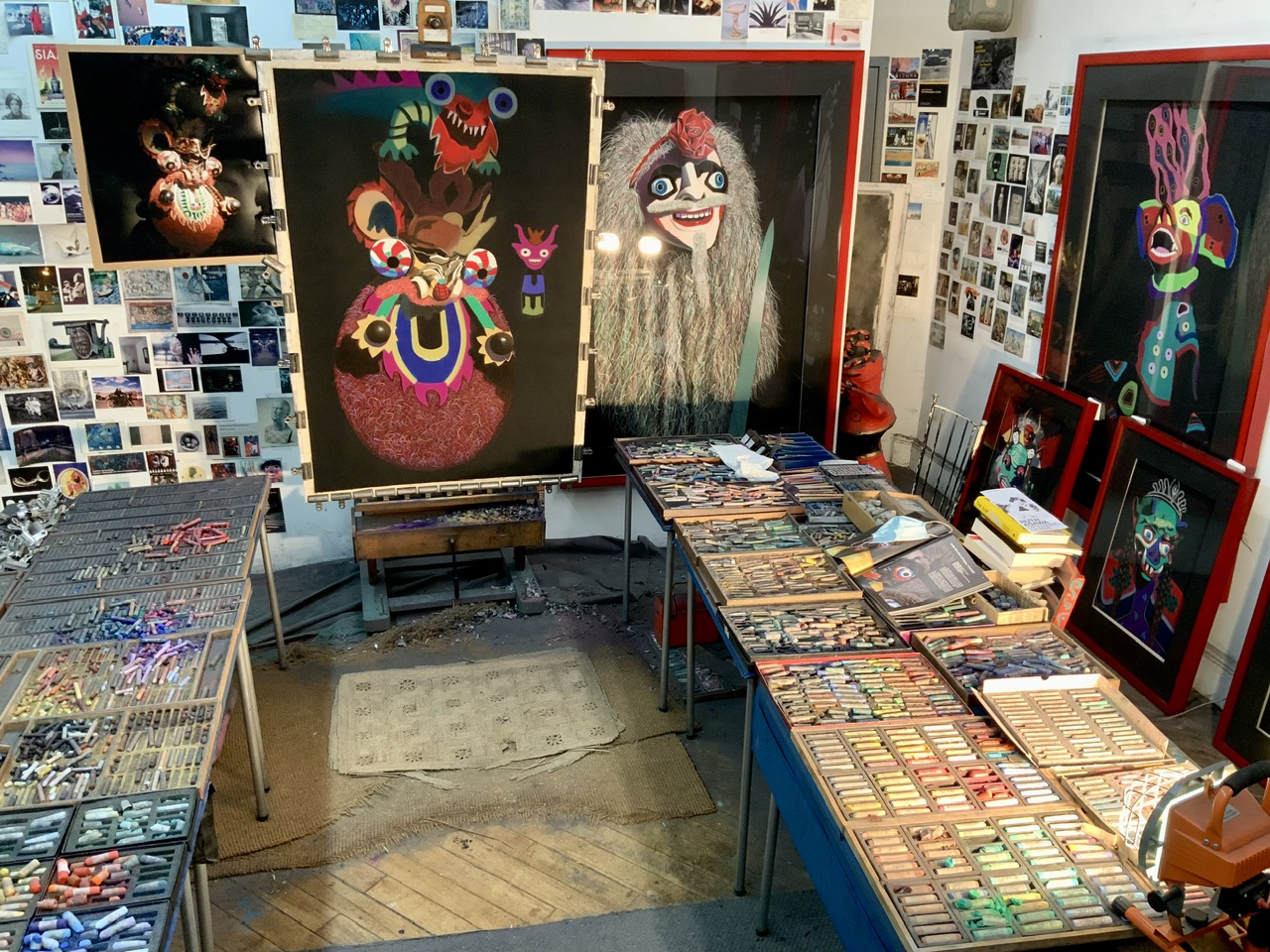
Barbara’s Studio
*an ongoing series of quotations – mostly from artists, to artists – that offers wisdom, inspiration, and advice for the sometimes lonely road we are on.
Anyone who studies an instrument, sport, or other art form must deal with practice, experiment, and training. We learn only by doing. There is a gigantic difference between the projects we imagine doing or plan to do and the ones we actually do. It is like the difference between a fantasied romance and one in which we really encounter another human being with all his or her complexities. Everyone knows this, yet we are inevitably taken aback by the effort and patience needed in the realization. A person may have great creative proclivities, glorious inspirations, and exalted feelings, but there is no creativity unless creations actually come into existence.
Stephen Nachmanovitch in Free Play: Improvisation in Art and Life
Comments are welcome!
Pearls from artists* 601

Along the Seine, Paris
*an ongoing series of quotations – mostly from artists, to artists – that offers wisdom, inspiration, and advice for the sometimes lonely road we are on.
The central construct of café life in Paris introduced [Jack] Youngerman to contemporary political and cultural debates. He would take with him to New York this particular way of being alone but with people. It would infuse Coenties Slip with its unique template of influence by osmosis; the collective solitude model unique to the geographic makeup of that corner of New York. In Paris, “at any time, you can go out and be part of the city, you can see passersby, you can get out of your personal loneliness, without having to make conversation with another person. That’s something I want to do almost every day.” For Youngerman , it felt vital for art making.
Prudence Peiffer in The Slip: The New York Street that Changed American Art Forever
Comments are welcome!
Pearls from artists* # 600
*an ongoing series of quotations – mostly from artists, to artists – that offers wisdom, inspiration, and advice for the sometimes lonely road we are on.
I am always between two currents of thought: first the material difficulties, turning round and round and round to make a living; and second, the study of color. I am always hoping to make a discovery here, to express the feelings of two lovers by a marriage of two complementary colors, their mingling and their opposition, the mysterious vibrations of kindred tones. To express the thought behind a brow by radiance of a bright tone against a somber background. To express hope by some star, the eagerness of a soul by a sunset glow.
Vincent van Gogh quoted by Stephen Nachmanovitch in “Free Play: Improvisation in Life and Art
Comments are welcome!

Pearls from artists* # 598
*an ongoing series of quotations – mostly from artists, to artists – that offers wisdom, inspiration, and advice for the sometimes lonely road we are on.
For art to appear, we have to disappear. This may sound strange, but in fact it is a common appearance. The elementary case, for most people, is when our eye or ear is “caught” by something: a tree, a rock, a cloud, a beautiful person, a baby’s gurgling, spatters of sunlight reflected off some wet mud in the forest, the sound of a guitar wafting unexpectedly out of a window. Mind and sense are arrested for a moment, fully in the experience. Nothing else exists. When we “disappear” in this way, everything around us becomes a surprise, new and fresh. Self and environment unite. Attention and intention fuse. We see things just as we and they are, yet we are able to guide and direct them to be one just the way we want them. This lively and vigorous state of mind is the most favorable to the germination of original work of any kind. It has its roots in child’s play, and its ultimate flowering in full-blown artistic creativity.
Stephen Nachmanovitch in Free Play: Improvisation in Life and Art
Comments are welcome!
Pearls from artists* # 597

Barbara’s Studio
*an ongoing series of quotations – mostly from artists, to artists – that offers wisdom, inspiration, and advice for the sometimes lonely road we are on.
From earliest childhood, the boys had been treated differently from their sister. They were allowed more freedom, encouraged to play outdoors and to engage in rough and tumble, and their lives were expanded early on when, at the age of seven, each was sent to St. Mary’s, the prep school of Stonyhurst College. It seemed as if the boys were being readied for adventure and excitement, but while their horizons were opening up, Leonora [Carrington] felt hers were being closed down – or more specifically, never explored. Her role, which was clear even when she was in the nursery, was to keep safe: not to rock any boats, not to take any chances. What they sought to teach her was that she should sit a certain way and behave a certain way: she should be supportive, helpful, polite. She should listen, especially to men, she should have traditional skills, such as playing music and speaking French. Drawing and painting, for which she showed altitude from an early age, were fine within reason. What harm could there be in Prim [Lenora] creating pictures? Especially if those pictures were of flowers and trees, family members and characters from fairy stories.
But art was Leonora’s secret weapon – and she hid it in plain sight, because her parents did not have the faintest idea where her talents might lead. Art, for them, was unthreatening and pretty. They had no idea that this skill their daughter was developing would be one the key to another life entirely; still less that art could never be a validation of the status quo, but meant a radical reappraisal of everything in the artists sight.
So what Leonora practiced in the nursery at Crookhey was the subversive silence of smoldering rebellion. Spared by the inherent unfairness that gave Pat, Gerard, and Arthur so much freedom; stoked by the growing realization that she had a talent that would lead, eventually, to Liberty. “I always painted, and I always knew it was what I would do,” she said many years later. As the Jesuits who educated her brothers at Stonyhurst might have said (but didn’t): show me a girl aged seven, and I will show you the woman.
Joanna Moorhead in Surreal Spaces: The Life and Art of Leonora Carrington
Comments are welcome!
Pearls from artists* # 596

Film still from “Barbara Rachko: True Grit,” Directed by Jennifer Cox, Moto Films LLC
*an ongoing series of quotations – mostly from artists, to artists – that offers wisdom, inspiration, and advice for the sometimes lonely road we are on.
Being an artist is very hard work. Not only do you have to constantly develop your discipline, but if you have a desire to make a living, you have to be a good businessperson.
Agents, business managers, etc., etc., are not the authors of your career. They make suggestions. They are a part of your research team. You are the author. You are the center of your career. You have to run the show. I hope your show is about more than gold digging. I hope your show is about becoming the most engaging, enchanting, magical person that you can be – through your art. Art is ultimately transcendent. That’s a fact.
Anna Deavere Smith in Letters to a Young Artist: Straight-Up Advice on Making a Life in the Arts – For Actors, Performers, Writers, and Artists of Every Kind
Comments are welcome!
Pearls from artists* # 595

Film still from “Barbara Rachko: True Grit,” directed by Jennifer Cox, Moto Films LLC
*an ongoing series of quotations – mostly from artists, to artists – that offers wisdom, inspiration, and advice for the sometimes lonely road we are on.
One of the great paradoxes of the writing life is that our words – chosen carefully, so thoughtfully, with deep focus and concentration – those words once on the page go dead on us. Language is ours only when we are forming sentences, moving elements around, grappling with punctuation, speaking words aloud, feeling them on our lips. While we are shaping a scene into something we can hear and touch and see, that scene lives and breathes. We are inside language like painters, we are working in our medium: the tempera, the thin line, the wet oil on canvas, still in process, still alive.
But once we commit – once those words dry like paint, are affixed to the page – it becomes nearly impossible to see them. This? We think to ourselves. Our most loathsome critic emerges with a swirl of her cape. Really? What the hell is this? The sentences appear to have been written in another language – a dark dream language, tucked into some musty, inaccessible corner of our psyche. Attempting to discern its meaning is a bit like looking at our own face in the mirror. It is at once so familiar as to be invisible, and so intimate that we turn away, baffled, ashamed.
Can we ever see ourselves, really? Can we read ourselves?
It is a powerful conundrum because without the ability to see our writing afresh we cannot do the necessary work. How do we know whether a problem lies with the work, or with our inability to enter it? We need clarity, but not coldness. Openness, but not attachment. We want optimism, but that optimism must not go hand in hand with discernment. We’re not looking for a cheerleader, nor a fault-finding judge. We want to read ourselves with equanimity.
Dani Shapiro in Still Writing: The Pleasures and Perils of a Creative Life
Comments are welcome!
Pearls from artists* # 594
*an ongoing series of quotations – mostly from artists, to artists – that offers wisdom, inspiration, and advice for the sometimes lonely road we are on.
The creative artist and poet and saint must fight the actual (as opposed to ideal) gods of our society – the god of conformism as well as the gods of apathy, material success, and exploitive power. These are the “idols” of our society that are worshipped by multitudes of people.
Stephen Nachmanovitch in Free Play: Improvisation in Life and Art
Comments are welcome!



