Category Archives: Pastel Painting
Q: Are you certain that the art materials you use are light- and color-fast?
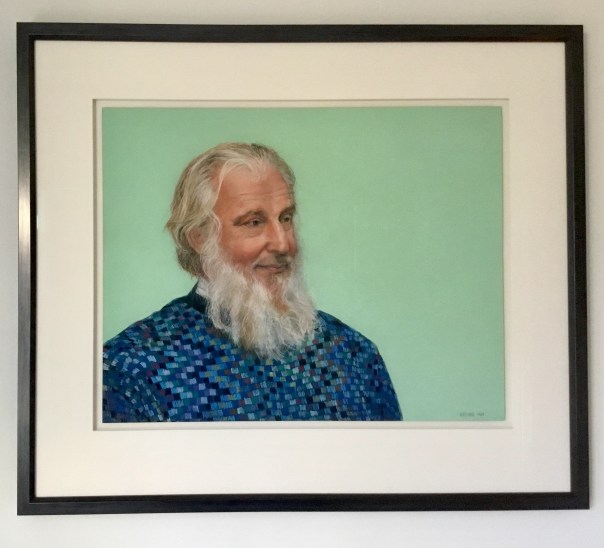
“John,” Soft Pastel on Sandpaper, 22” x 26” (image), 1989.
A: Yes, I am. Recently I came into possession of a pastel portrait that I had not seen in thirty years. How fantastic to report that it looks exactly the same as in 1989 when I made It!
Comments are welcome!
Pearls from artists* # 351

Barbara at work on “The Orator”
*an ongoing series of quotations – mostly from artists, to artists – that offers wisdom, inspiration, and advice for the sometimes lonely road we are on.
That art is apolitical does not mean that artists themselves can be excused from the political responsibilities that fall on others. It means rather that as a manifestation of eternal psychic force, each work of art goes farther and deeper than the limited perspective of any individual mind, including that of its author.
No artist can predict how his work will affect the world… The artist invests his entire personality into the work, but he does so as a means of expressing a vision that is transpersonal. Everything that makes him what he is informs the work, but the final result transcends all personal contingencies.
J.F. Martel in Reclaiming Art in the Age of Artifice: A Treatise, Critique, and Call to Action
Comments are welcome!
Q: What’s on the easel today?
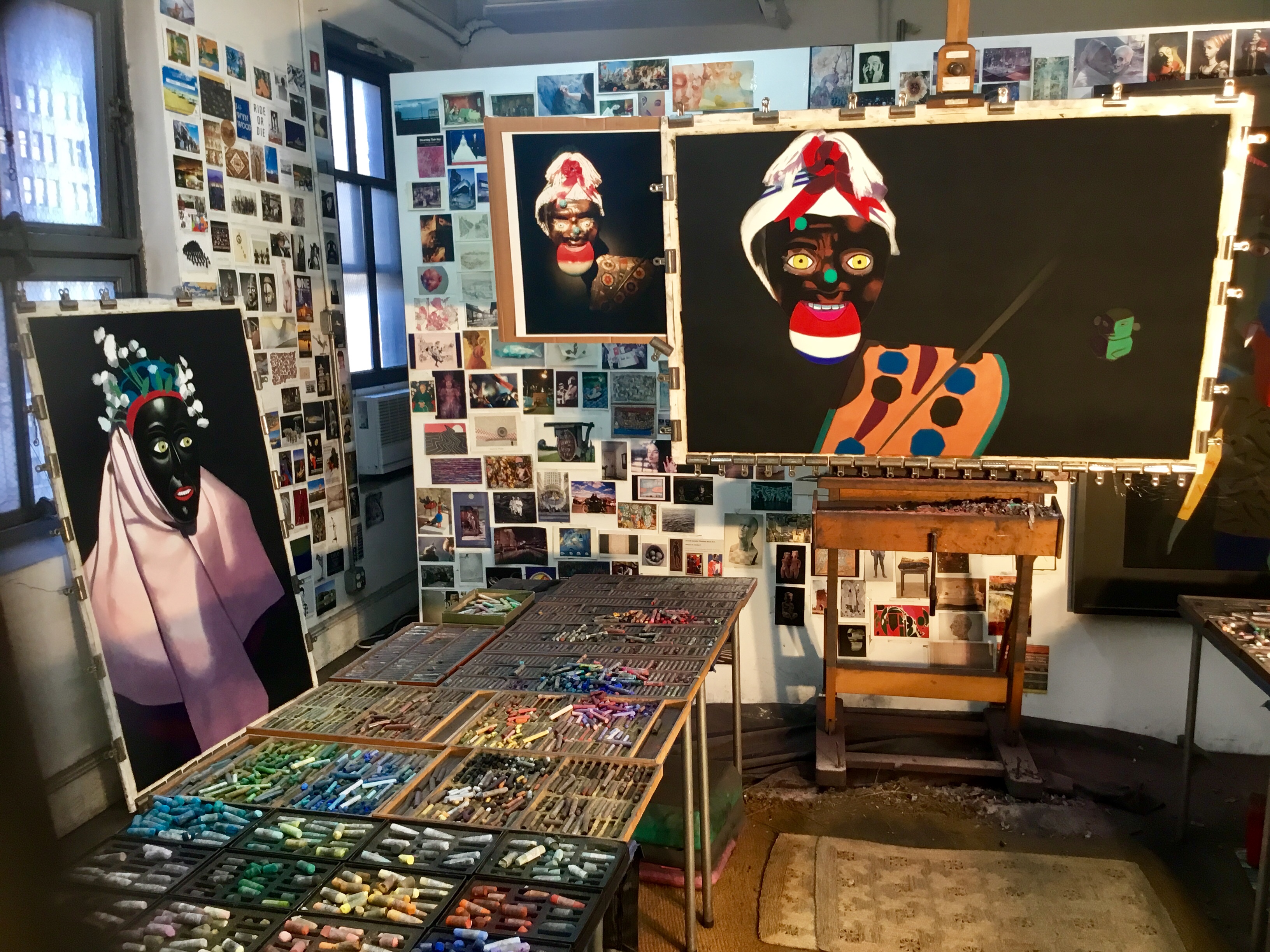
Works in progress
A: I have two large (38” x 58” and 58” x 38”) untitled pastel paintings in progress.
Comments are welcome!
Q: What does a pastel feel like in your hand?
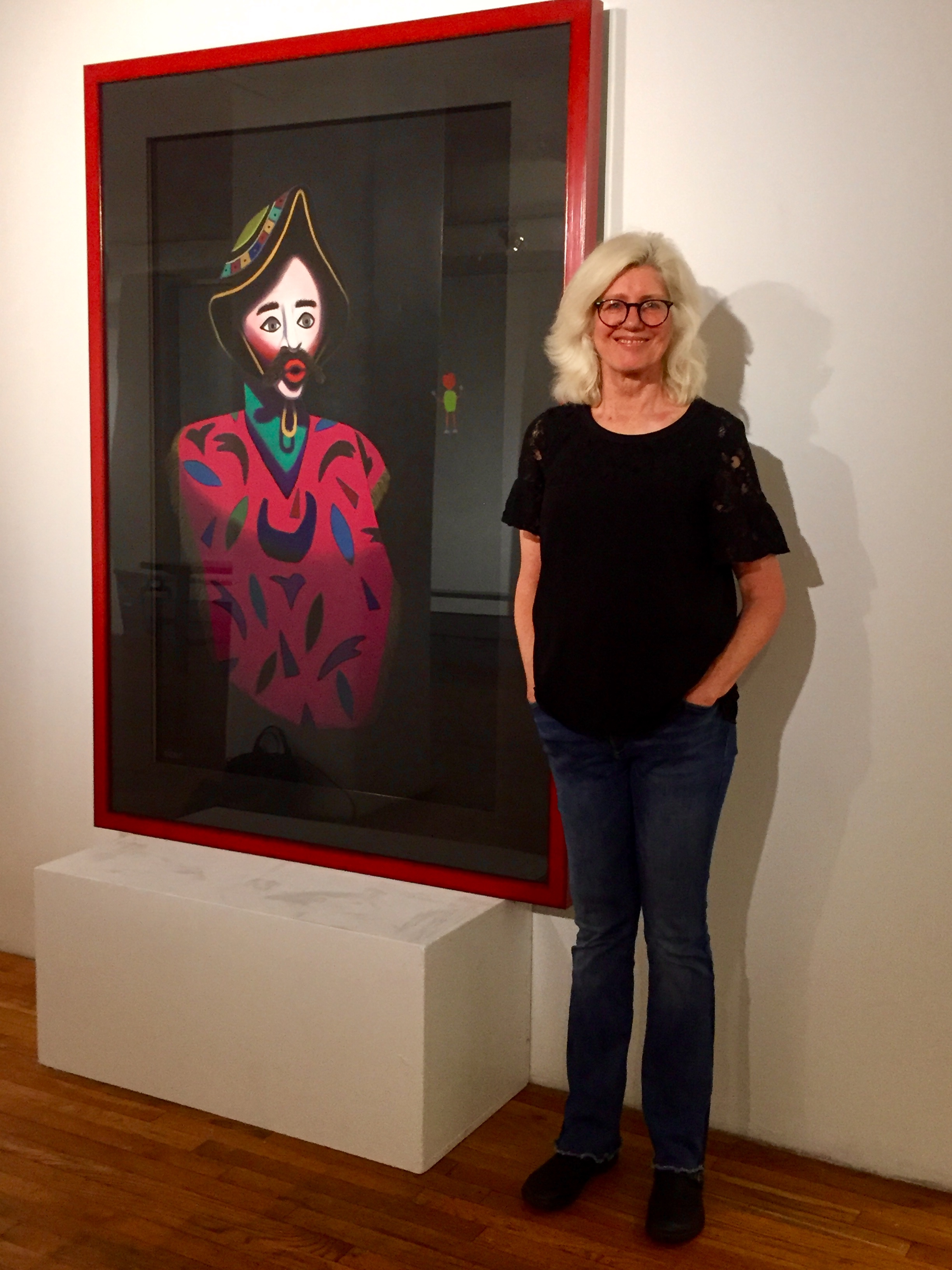
With “Prophecy,” 70” x 50,” at Westbeth Gallery
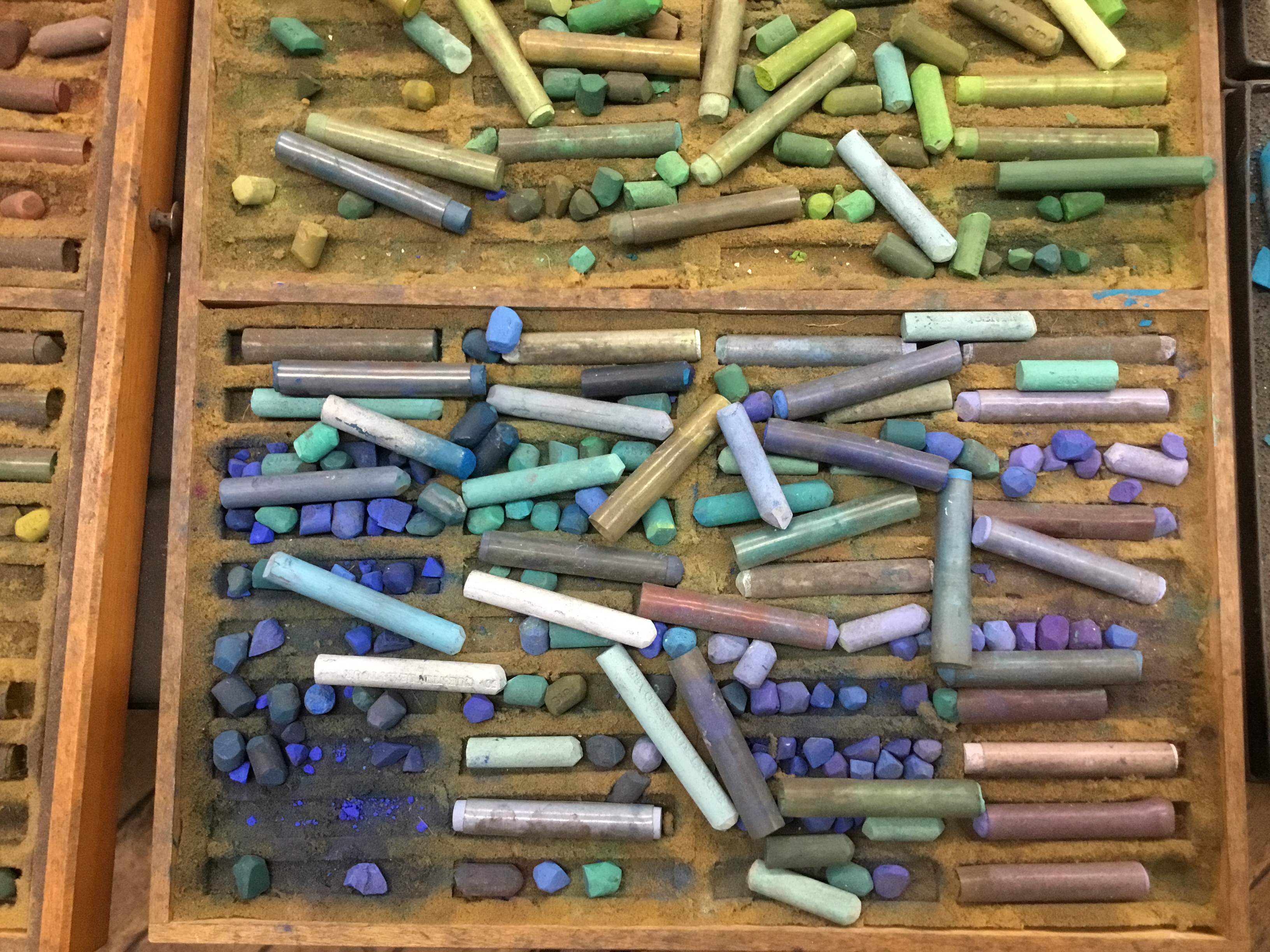
A: Each manufacturer uses distinct binders to hold the raw pigment together to form a pastel stick. Due mainly to this binder, each pastel feels slightly different. Rembrandts are medium-hard and I generally use them for the first few layers. The black backgrounds of my pastel paintings are achieved by layering lots of Rembrandt black.
I enjoy using Unison because they feel “buttery” as I apply them to the sandpaper. If you’ve been to my studio, you know that I use just about every soft pastel there is! Believe it or not, no two are the same color.
Each pastel has its own qualities and some are harder or more waxy than others. Henri Roche has the widest range of colors and they’re gorgeous! I want them to show so I use them for the final layer, the ‘icing on the cake.”
Comments are welcome!
Q: What made you fall in love with soft pastel versus another medium?
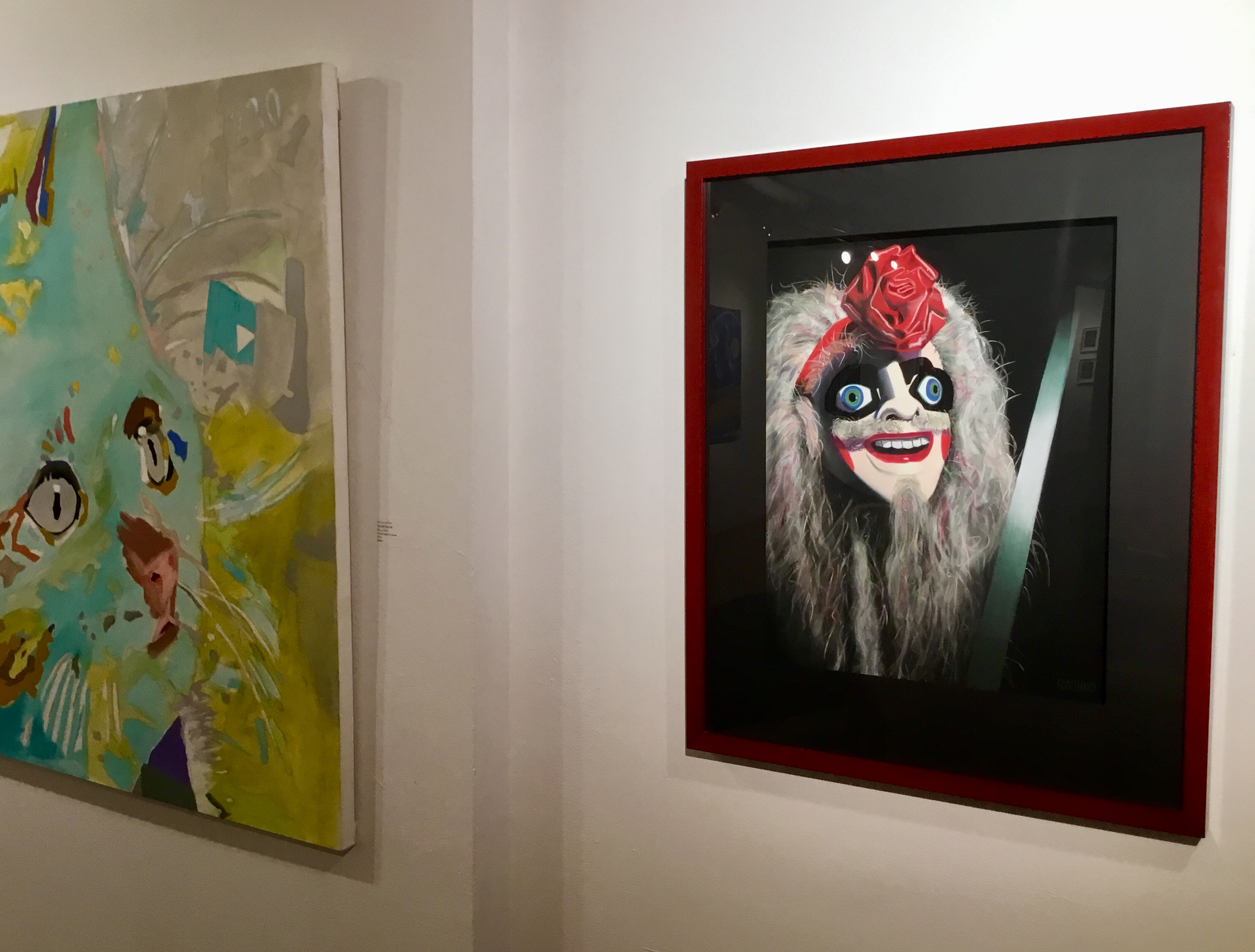
“The Champ” in “Worlds Seen & Unseen” at Westbeth Gallery, NYC
A: I like to get my hands right into my work. In other words, I don’t like brushes or anything else to intervene between my hands and what I’m working on.
I work with 400 or 500 grit Uart sandpaper so the downside is that I rub my fingertips raw from blending layers of soft pastel onto sandpaper. I’ve tried using rubber gloves (they make my fingers sweat and wear out fast), cotton gloves (they leave bits of lint on the paper), using a blending stump (it leaves lint on the paper), etc., but nothing works as well as my own fingers. So sore fingertips are an unavoidable occupational hazard. I sometimes take days off from the studio just so that my hands can heal.
I adore color and love looking at the thousands of pastels in my studio! After working with this medium for more than thirty years, I still love what I am able to accomplish and I am still pushing it to do new things. The colors are rich, intense, velvety. No other medium is as sensuous or as satisfying.
Comments are welcome!
Q: What’s on the easel today?
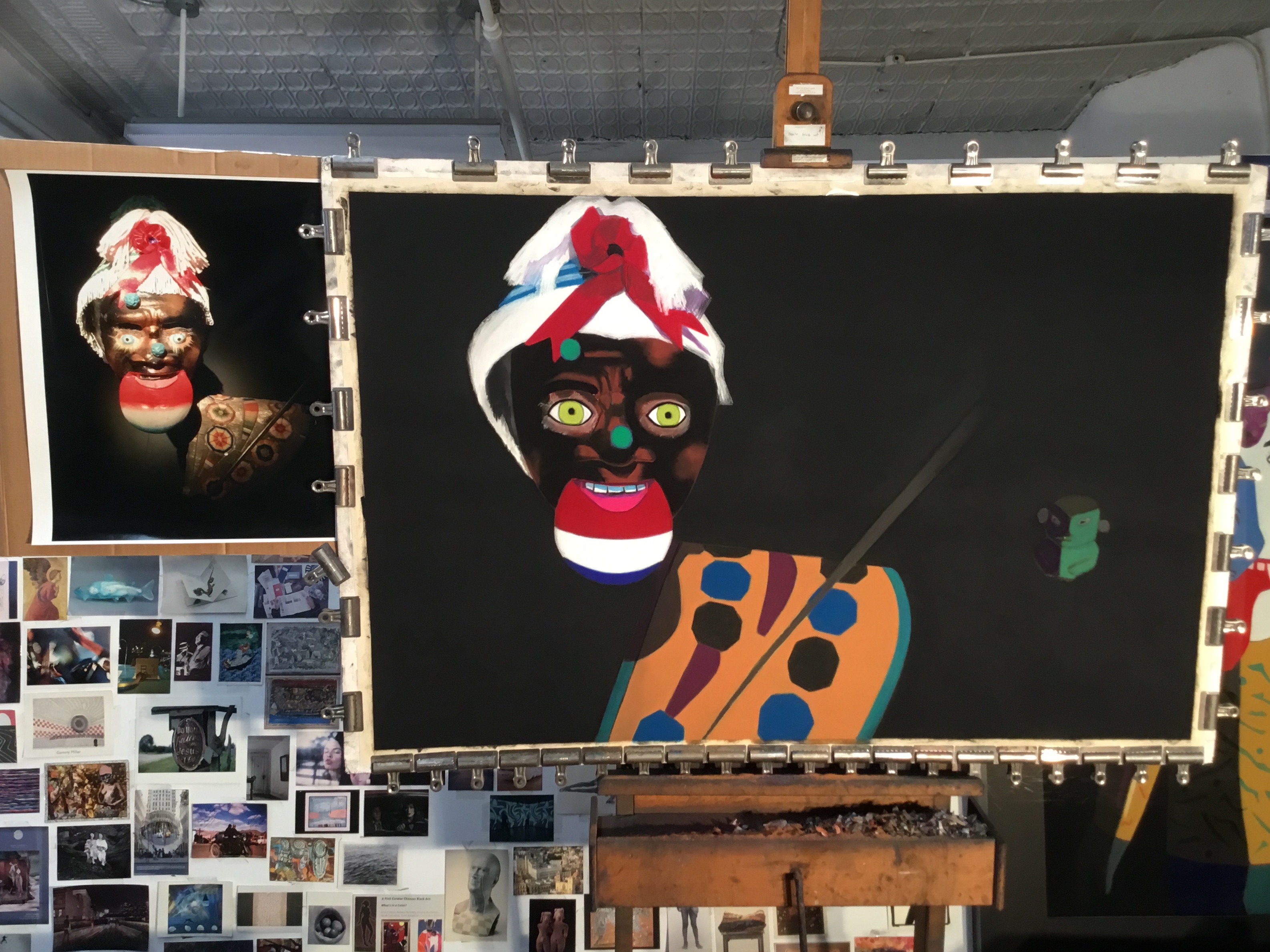
Work in progress
A: I continue slowly working on an untitled 38” x 58” pastel painting, number nine in the “Bolivianos” series. It still has a long way to go.
Comments are welcome!
Q: What do you see when you look back at your early efforts?

“Myth Meets Dream,” soft pastel on sandpaper, 47″ x 38,” 1993
A: I see continuity in subject matter and in medium, surely. For thirty-three years I have been inspired by foreign travel and research. In addition, I remain devoted to pushing the limits of what soft pastel can do and to promoting its merits as a fine art medium.
Here and there I see details I would render differently now; not exactly mistakes, but things that maybe could be done better. Fortunately, I think, all of my work is framed behind glass or plexiglas, making it extremely difficult to attempt revisions.
Perhaps most important of all, I see the long personal road that has advanced my work to its present state. Each gain has been hard-fought.
Comments are welcome!
Start/Finish of “Viceroy,” Soft Pastel on Sandpaper, 26” x 20”
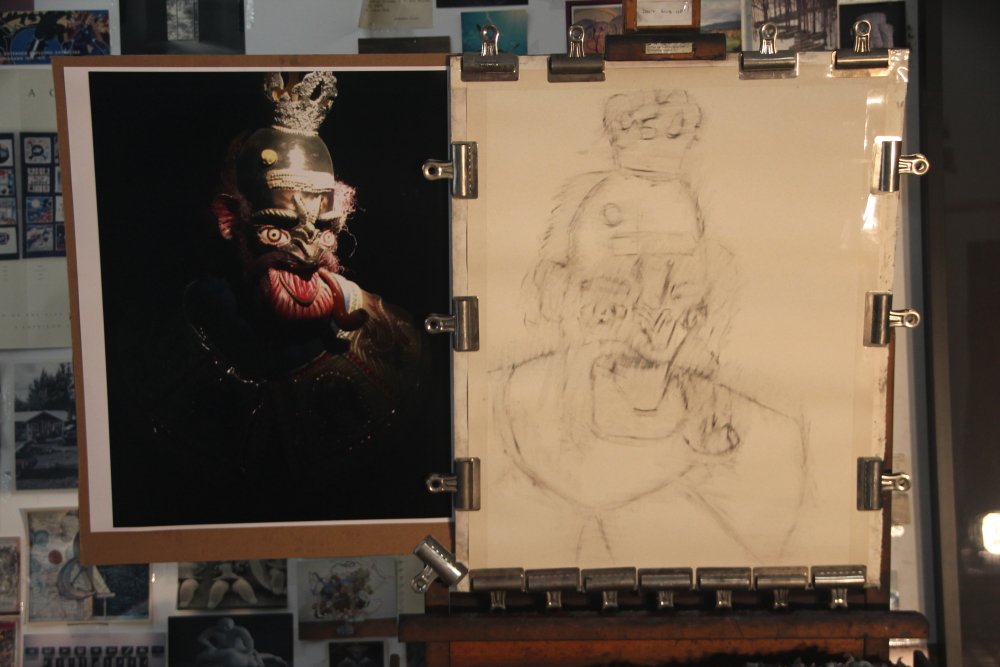
Start: erased charcoal drawing

Finished
Comments are welcome!
Q: In the “Bolivianos” series you are exclusively depict masks. What drew you to them?

Source material for “The Champ”
A: For me a mask is so much more than a mask. It is a living thing with its own mind, its own soul, and with a unique history. With this series I feel as though I am creating portraits of living beings.
These images are a return to my early days because I began as a photo-realist portrait painter. So I am reconnecting with a first love, except with a welcome twist. This time I do not have to satisfy a portrait client’s request to make my subject look younger or more handsome. I am free to respond only to what the work needs.
Comments are welcome!
Pearls from artists* # 338
Pastels
*an ongoing series of quotations – mostly from artists, to artists – that offers wisdom, inspiration, and advice for the sometimes lonely road we are on.
Beauty without symbolic depth results in ornament. Symbol without beauty results in psychoanalysis. Only when the two meet can we speak of art. The artistic works that combine the two elements most compellingly are what are called the classics. In his magisterial book The Analogical Imagination, the theologian David Tracy defines the classic as a work exhibiting a permanent “excess of meaning.” We speak of classics as “timeless,” he says, not because they belong to time, but because they are perpetually timely; their relevance never wanes, and each generation, each percipient, must interpret them anew. According to Tracy, we know we are dealing with a classic when a work makes us realize that our general outlook on life is not as complete as we thought it was, that “something else might be the case.” In the light that the classic emanates, things suddenly seem less clear-cut than they used to seem – we find ourselves in the presence of something greater than we are, something potentially infinite. Classics take us to the apex of the numinous, the point of what Werner Herzog calls “ecstatic truth.”
J.F. Martel in Reclaiming Art in the Age of Artifice: A Treatise, Critique, and Call to Action
Comments are welcome!



