Blog Archives
Pearls from artists* # 689

*an ongoing series of quotations – mostly from artists, to artists – that offers wisdom, inspiration, and advice for the sometimes lonely road we are on.
This is what I wish someone had told me years ago:
The art world is not a meritocracy. Like the world at large, it is a system based on hoarded capital and exploited labor. This system owes you nothing, even if you have extraordinary talent, work tremendously hard, never give up, and do all the right things. There are no ‘extra points’ for effort, earnestness, dedication, or sacrifice.
(We ALL think WE are going to be the exception.)
Unless you have fantastic connections or pedigree, after you build and maintain the basics of making strong work and getting the word out, a great deal depends on luck. Many of the artists you admire are likely living difficult lives you might not be willing to live, making sacrifices you might not be willing to make. Many who appear to support themselves with their work are in fact, partially or fully supported by spouses, family money, or jobs they do not discuss. They keep these jobs secret because some art world players refuse to validate your work if you are not ‘seriously committed’ enough to be a full-time artist. (Of course, artists who were not born wealthy need validation from these very players to be ABLE to create full-time.)
Kate Kretz in Art From Your Core: A Holistic Guide to Visual Voice
Comments are welcome!
Pearls from artists* # 686
*an ongoing series of quotations – mostly from artists, to artists – that offers wisdom, inspiration, and advice for the sometimes lonely road we are on.
HM: I’ve never met many people; I’ve never much sought out older painters, first because I didn’t want to disturb them and then because what an artist says is so insignificant, I find, compared to what he does. The same phrases can so easily fit different things when you’re talking about the visual arts.
You can’t describe them. All you can do is create a kind of analogy using words. But even then the words have to reach the same part of the spectator that’s ready and waiting for them.
Henri Matisse in Chatting With Matisse: The Lost 1941 Interview, Henri Matisse with Pierre Courthion, edited by Serge Guilbault
Comments are welcome!
Pearls from artists* # 663

*an ongoing series of quotations – mostly from artists, to artists – that offers wisdom, inspiration, and advice for the sometimes lonely road we are on.
”No one has made a list of places where the extraordinary may happen and where it may not. Still, there are indications. Among crowds, in drawing rooms, among easements and comforts and pleasures, it is seldom seen. It is more likely to stick to the risk-taker than the ticket-taker. It isn’t that it would disparage comforts, or the set routines of the world, but that its concern is directed to another place. Its concern is the edge, and a making of a form out of the formlessness that is beyond the edge.”
– Mary Oliver
…Mary Oliver was right. Masterpieces are not conceived at cocktail parties, clubs, or on crowded beaches. If you want to summon your muse and set the stage for astonishing things to happen, silence is the most essential prerequisite. It is where the real alchemy of art happens. You need to calm yourself in that fragile place that exists parallel to this one. When some intruder from the underworld of quotidian life smashes through, demanding our focus, all the glittering magic scatters, and flies away.
Kate Kretz in Art From Your Core: A Holistic Guide to Visual Voice
Comments are welcome!
Pearls from artists* # 661

*an ongoing series of quotations – mostly from artists, to artists – that offers wisdom, inspiration, and advice for the sometimes lonely road we are on.
Curiosity and wonder are essential to the art life. Curiosity drives us to look beneath the rocks that others pass by. Wonder helps us recognize the infinite potential of what we find there, so we might spin it into something remarkable. The concepts and visuals that attract me will likely not grab you, but therein lies the beauty. Your job is to keep excavating the things that intrigue you, feeding your head with new ideas. The objective is to build a singular mental stockpile of elements that make up your visual voice. Your brain then makes connections that others would never make because they have assembled a vastly different stockpile of ideas, images, experiences, concepts, beliefs, and concerns.
Kate Kretz in Art From Your Core: A Holistic Guide to Visual Voice
Comments are welcome!
Pearls from artists* # 630

With Margaret Anderson, Naoshima, Kagawa, Japan
*an ongoing series of quotations – mostly from artists, to artists – that offers wisdom, inspiration, and advice for the sometimes lonely road we are on.
Fresh experiences can lead to new tastes and a life that feels longer, Julie contended. Remember when you were little and an hour-long car ride felt like a lifetime? “I think it’s because, truly, everything’s new. When you experience new things, time slows down a little bit,” she told me. “When you go on trips – which is my favorite thing to do – everything is new, and you feel young again. And reinvigorated with new ideas, new perspectives, a new understanding of yourself.”
Julie Curtiss quoted in Get The Picture: A Mind-Bending Journey Among the Inspired Artists and Obsessive Art Fiends Who Taught Me How to See by Bianca Bosker
Comments are welcome!
Pearls from artists* # 581

With recent “Bolivianos”
*an ongoing series of quotations – mostly from artists, to artists – that offers wisdom, inspiration, and advice for the sometimes lonely road we are on.
The essence of style is this: We have something in us, about us; it can be called many things, but for now let’s call it our original nature. We are born with our original nature, but on top of that, as we grow up, we accommodate to the patterns and habits of our culture, family, physical environment, and the daily business of the life we have taken on. What we are taught solidifies as “reality.” Our persona, the mask we show the world, develops out of our experience and training, step by step from infancy to adulthood. We construct our world through the actions of perception, learning, and expectation. We construct our “self” through the same actions of perception, learning, and expectation. World and self interlock and match each other, step by step and shape by shape. If the two constructions, self and world, mesh, we grow from child to adult becoming “normally adjusted individuals.” If they do not mesh so well, we may experience feelings of inner division, loneliness, or alienation.
If we should happen to become artists, our work takes on, to a certain extent, the style of the time: the clothing in which we are dressed by our generation, our country and language, our surroundings, the people who have influenced us.
But somehow, even when we are grown up and “adjusted,” everything we do and are – our handwriting, the vibrato of our voice, the way we handle the bow or breathe into the instrument, our way of using language, the look in our eyes, the pattern of whirling fingerprints on our hand – all these things are symptomatic of our original nature. They all show the imprint of our own deeper style or character.
Stephen Nachmanovitch in Free Play: Improvisation in Life and Art
Comments are welcome!
Pearls from artists* # 556
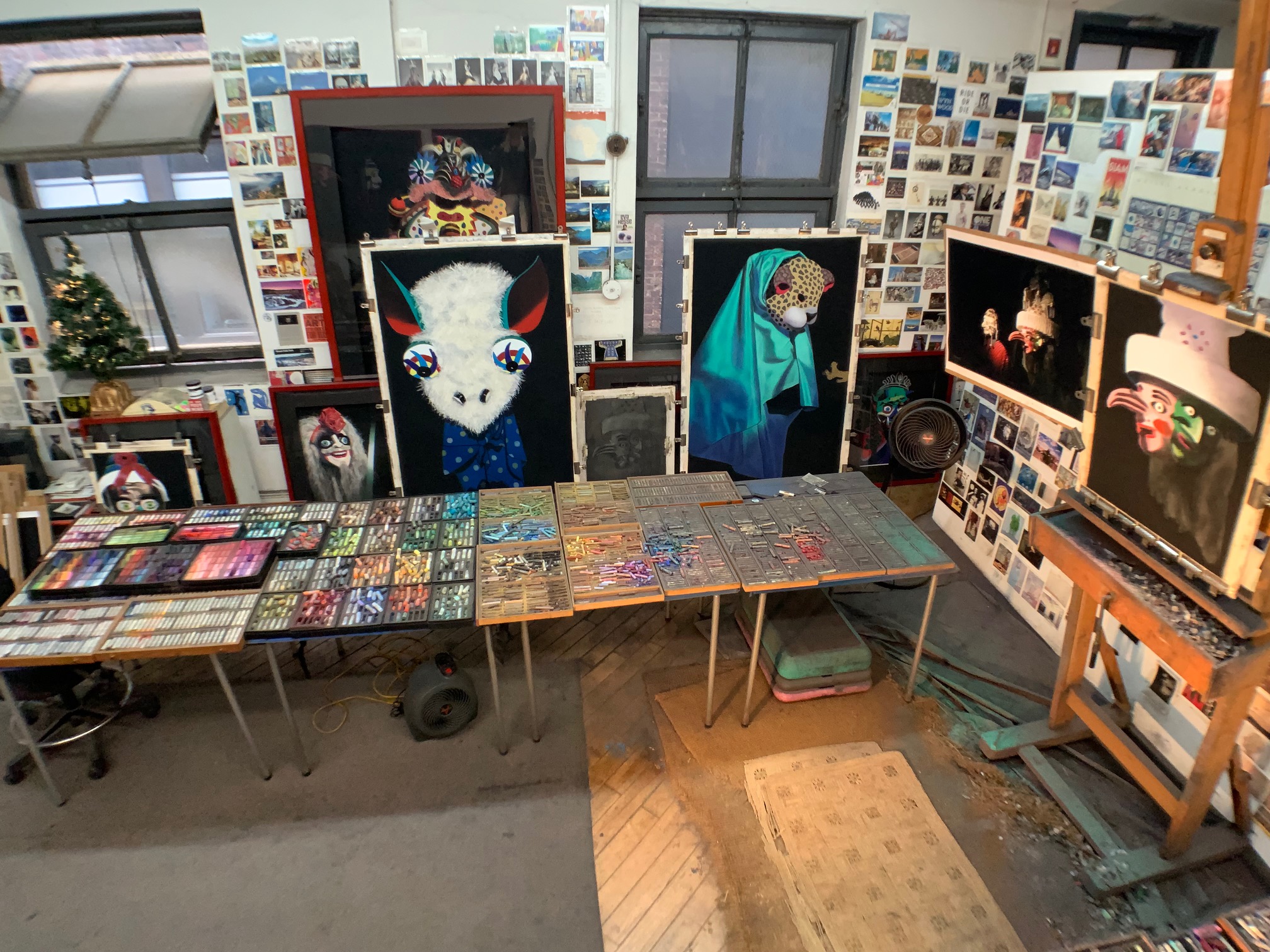
Barbara’s Studio
*an ongoing series of quotations – mostly from artists, to artists – that offers wisdom, inspiration, and advice for the sometimes lonely road we are on.
The painter Paul Klee exclaimed in his diary, “Am I God? I have accumulated so many great things in me!” But we also remember these other words of Klee… “He who strives will never enjoy this life peacefully.” The lucky artist may be the one who, while in human measure a god, has nevertheless found satisfactory ways of escaping the relentless firing of his synapses.
Eric Maisel in A Life in the Arts: Practical Guidance and Inspiration for Creative and Performing Artists
Comments are welcome!
Q: What advice would you give to a young artist with potential?

Barbara’s studio (since April 1997)
A: I last answered this question in my blog more than ten years ago and I would say similar things now to what I said then.
Be sure that you love your process unconditionally because there is no relationship between how hard you will work and how much money you will earn, period. Indeed, with inflation and rapidly evolving ways of doing business, it seems to cost more money every year to be an artist. As I’ve said often, be prepared to work very, very hard. Really it’s all about making the most of your gifts as an artist. If you don’t feel a deep responsibility to developing your talents as far as possible, you won’t have what it takes to keep going. Countless artists quit and no one can blame them. You absolutely must love your materials and your creative process and be willing to do whatever it takes to continue making art.
This is not a life for slackers!
Comments are welcome!
Pearls from artists* # 528

*an ongoing series of quotations – mostly from artists, to artists – that offers wisdom, inspiration, and advice for the sometimes lonely road we are on.
There are so many good reasons to stop complaining if you want to live a more creative life.
First of all, it’s annoying. Every artist complains, so it’s a dead and boring topic. (From the volume of complaints that emerges from the professional creative class, you would think these people had been sentenced to their vocations by an evil dictator, rather than having chosen their line of work with a free will and open heart).
Second, of course it’s difficult to create things; if it wasn’t difficult, everyone would be doing it, and it wouldn’t be special or interesting.
Third, nobody ever really listens to anybody else’s complaints, anyhow, because we’re all too focused on our own holy struggle, so basically, you’re just talking to a brick wall.
Fourth, and most important, you’re scaring away inspiration. Every time you express a complaint about how difficult and tiresome it is to be creative, inspiration takes another step away from you, offended. It’s almost like inspiration puts up its hands and says, “Hey, sorry buddy! I didn’t realize my presence was such a drag. I’ll take my business elsewhere.”
Elizabeth Gilbert in Big Magic: Creative living Beyond Fear
Comments are welcome!
Pearls from artists* # 520
*an ongoing series of quotations – mostly from artists, to artists – that offers wisdom, inspiration, and advice for the sometimes lonely road we are on.
Ondaatje: Do you think success and failure can distort the lessons an artist is able to learn?
Murch: There’s that wonderful line of Rilke’s, “The point of life is to fail at greater and greater things.” Recognizing that all of our achievements are doomed, in one sense – the earth will be consumed by the sun in a billion years or so – but in another sense the purpose of our journey is to go farther each time. So you’re trying things out in every film you make, with the potential of failure. I think we’re always failing, in Rilke’s sense – we know there’s more potential that we haven’t realized. But because we’re trying, we develop more and more talent, or muscles, or strategies to improve, each time.
In The Conversation: Walter Murch and the Art of Editing Film by Michael Ondaatje
Comments are welcome!


 barbararachkoscoloreddust.com