Blog Archives
Q: What’s on the easel today?

Work in progress
A: I am planning my next pastel painting and the photo above shows a preliminary charcoal sketch for it. I’m continuing to study the effects of scaling my work up or down. This piece will be a smaller, 26” x 20,” version of “The Orator,” 38” x 58” (image), 50” x 70” (framed), from 2017.
Comments are welcome!
Q: Can you explain how you choose colors? (Question from Maria Cox via Instagram)

A: I am wild about color! As I work to create a pastel painting, I apply a color, back up from my easel to see how it interacts with and affects the rest of the painting, and then I make revisions. This process necessitates countless color changes and hundreds of hours during months of work. I apply pastel using a meticulous layering process. Were you to x-ray one of them, the earlier, discarded versions of a pastel painting would be visible. All the while I carefully fine-tune and refine how the colors and shapes interact with each other.
The goal is to make an exciting painting that no one, especially me as the maker, has ever seen before. I have no desire to repeat myself, to make art that resembles work by any other artist, or to be forced into a niche.
I try to select intense, vibrant colors that are exciting to look at, that work well in relationship to each other, and that will grab the viewer. Sometimes I deliberately choose colors for their symbolic meanings. For example, I selected a dark purple for the alternating triangles (the ones with the pink dots above) in “Overlord” because purple denotes royalty.
I have been working with soft pastel for 37 years so I have a fairly intricate science of color at my disposal. No doubt, many unconscious factors are at play, too. More on that in future posts.
Comments are welcome!
Q: What’s on the easel today?
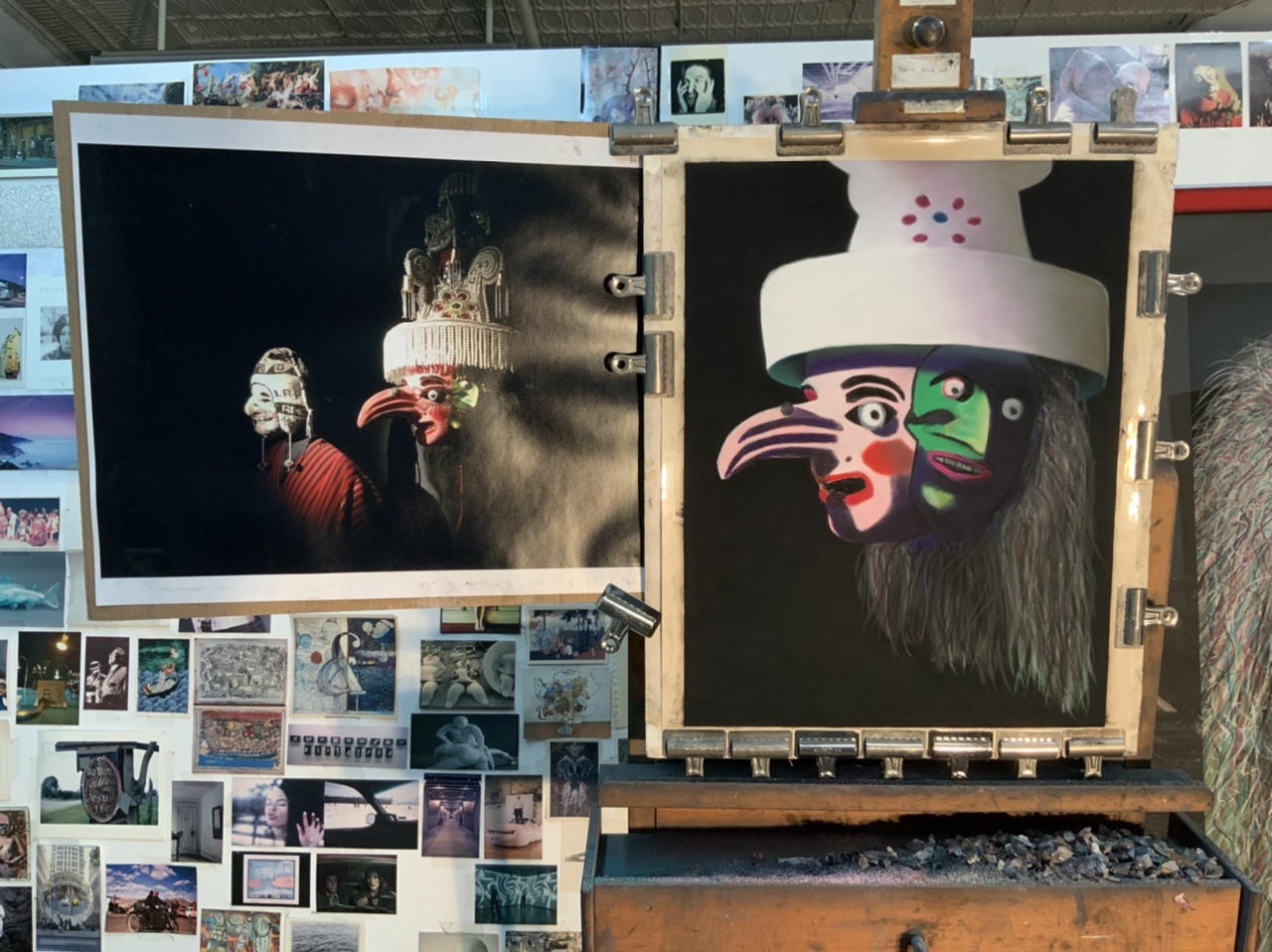
Work in progress
A: I recently began a 26” x 20” pastel painting tentatively titled, “Shadow.”
Comments are welcome!
Q: What does it feel like when you dop off a pastel painting at your Virginia framer’s shop? Are you sorry to see it go? (Question from Caroline Golden)
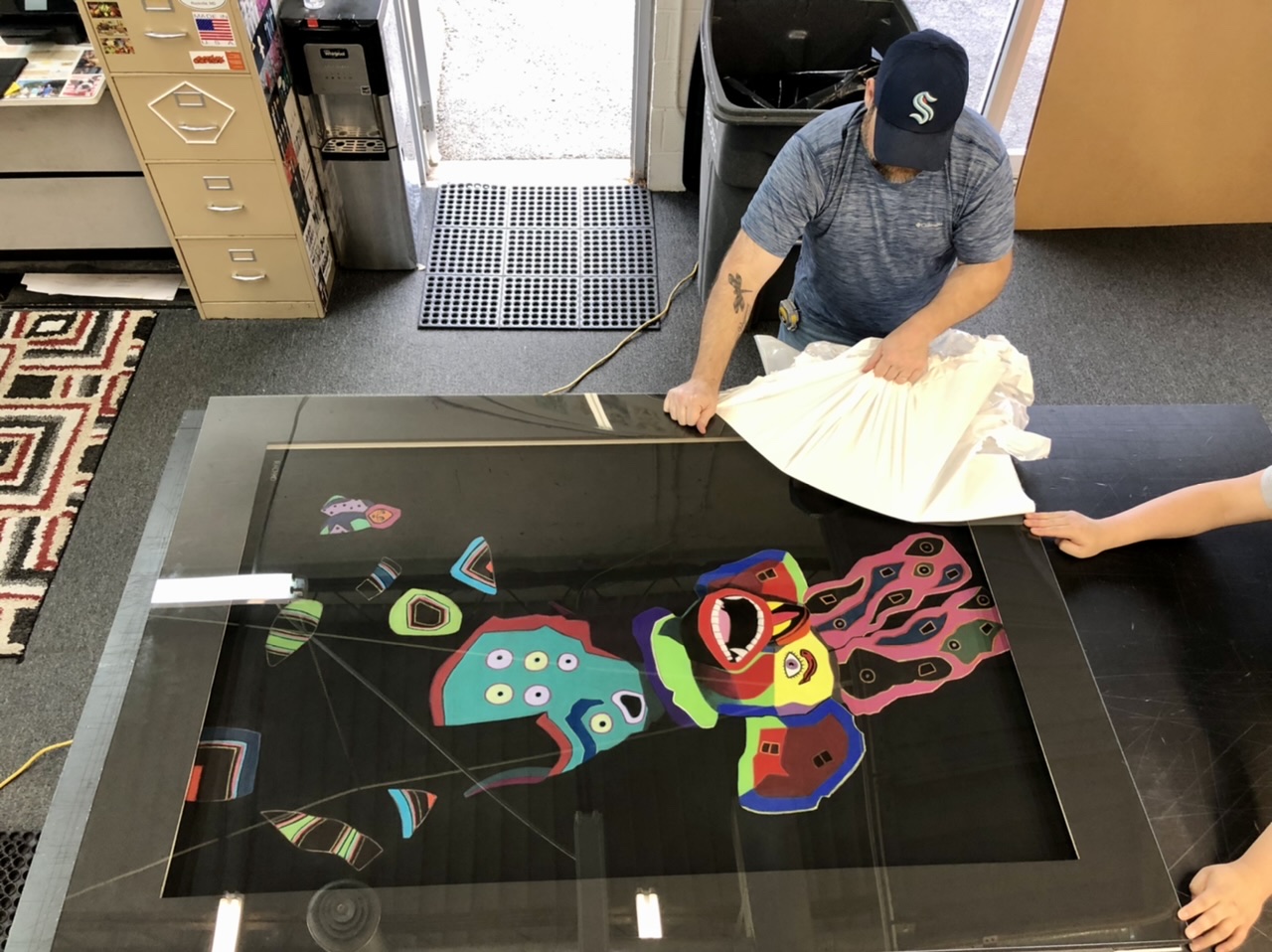
A: Actually, just the opposite since I have been looking at it on my easel for more than three months. Typically, I’m glad to say goodbye – temporarily – because I know when I pick it up in a month, I will have gained some distance and can begin to see and think about it more objectively. I can start reflecting on how this pastel painting relates to my overall body of work.
Comments are welcome!
Q: Would you speak about someone who made a difference in your professional life?
A: The first person who comes to mind is my favorite aunt, Teddie. In 1997 she was headed to northern California to attend a three-year-plus silent Tibetan Buddhist retreat at her teacher’s center. Teddie offered me her West 13th Street 6th-floor walkup apartment to live in while she was away. At the time I was based in Alexandria, VA and had just had my first solo exhibition at an important West 57th Street gallery, Brewster Fine Arts. I was becoming increasingly frustrated with the limited Washington, DC art scene, had outgrown everything it had to offer, and felt New York pulling me towards new and exciting professional adventures.
Teddie, recognizing my talent and ambition, made it possible for me to afford to move to New York. She had practiced Tibetan Buddhism for 35 years and was soon to become a Buddhist lama. She had an extraordinary mind and thought deeply about life. We used to talk for hours. Teddie was 7 years older and seemed more like a sister than an aunt. Indeed, she was my first soul mate. (I have been extremely fortunate to have had two such relationships in my life. The other was my late husband, Bryan).
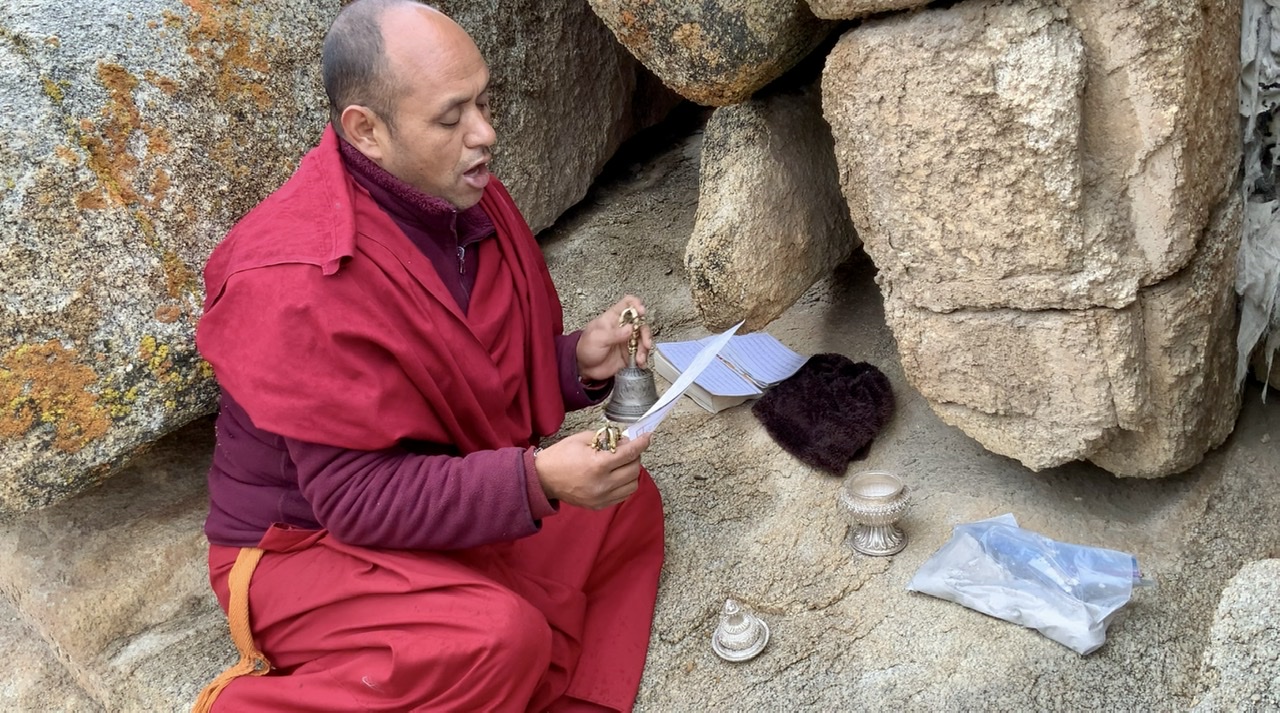
Unfortunately, dear Aunt Teddie died at the age of 67 of breast cancer. Recently, on September 25 I honored her life in a short ceremony on a mountain cliff in Leh, Ladakh (India). A Tibetan Buddhist monk recited prayers as he placed her ashes among the rocks.
Comments are welcome!
Q: To what extent will the world of art change in the post-COVID period – both in terms of what is created and also the business of art? (Question from artamour)
A: We all still wonder how the art world will change post-COVID. (Will there ever be a time when we can say we are post-COVID?). I know that I will continue refining and developing my art practice and seeking out new business opportunities. I have been an artist long enough to know that I will always follow my own path (each pastel painting points to the next one) regardless of what is going on in the larger world. How could I not do so? In large part due to an extensive social media program carried out by my two able assistants, the COVID period has been a personal boon. I completed a short documentary film about my life and work. It is in post-production now. I gained representation with three new international galleries. My blog is attracting approximately 1,000 – 2,000 new subscribers every month and I continue receiving requests for interviews from around the world.
Comments are welcome!
Q: What’s on the easel today?
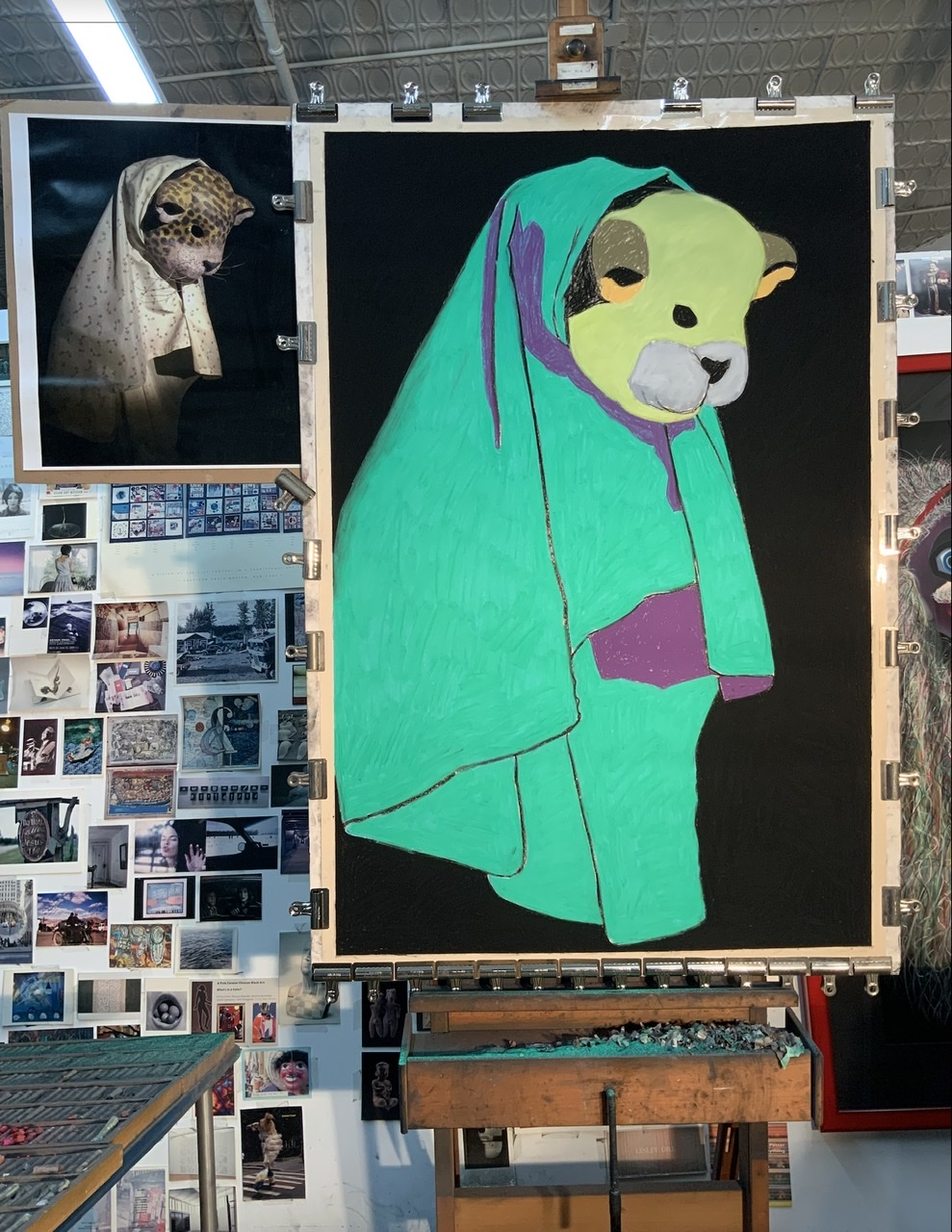
A: I started a new 58” x38” pastel painting. This is how it looks after the first day.
Comments are welcome!
Q: What’s on the easel today?


A: Here is a preliminary charcoal drawing in preparation for my next ”Bolivianos” pastel painting. With the most recent works I have been experimenting with scale. This will be a 58” x 38” version of ”Schemer,” 2019, 26” x 20.”
Comments are welcome!
Q: What’s on the easel today?

A: I’ve started a new 58” x 38” pastel painting.
Comments are welcome!
Q: How would you describe the inside of your studio?

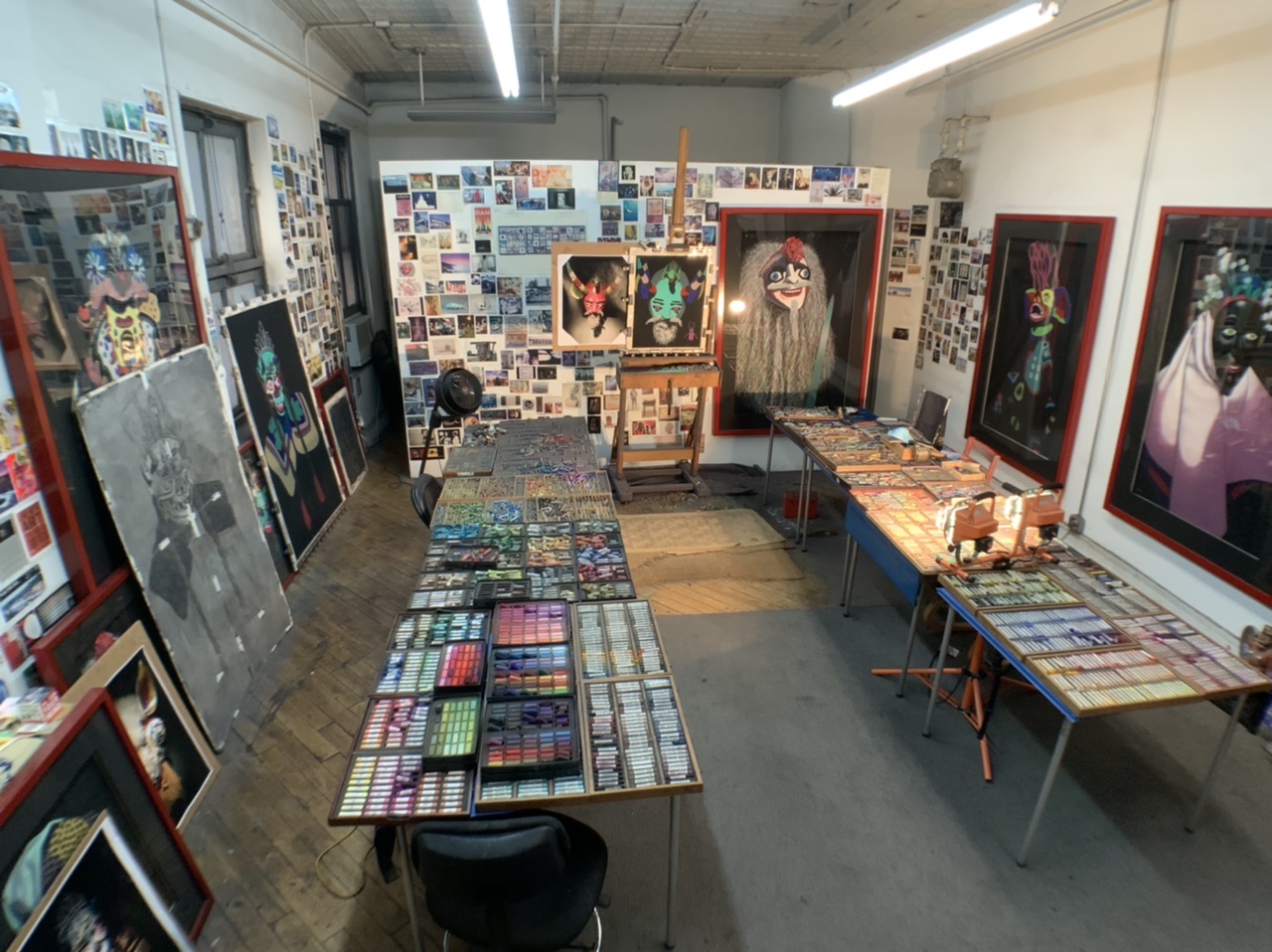
A: My studio is an oasis in a chaotic city, a place to make art, to read, and to think. I love to walk in the door every morning because it is my absolute favorite place in New York! Even after thirty-six years, I still find the entire process of making a pastel painting completely engaging. I try to push my pastel techniques further every time I work in the studio.
There’s one more thing about my studio: I consider it my best creation because it’s a physical environment that anyone can walk into and occupy, as compared to my artworks, which are 2D paintings hanging flat on a wall. It has taken 25 years to get it the way it is now. I believe my studio is the best reflection of my growth as an artist. It changes and evolves as I change over the decades.
Comments are welcome!


 barbararachkoscoloreddust.com