Blog Archives
Q: How do you think your recent trip to Bolivia will affect your work?
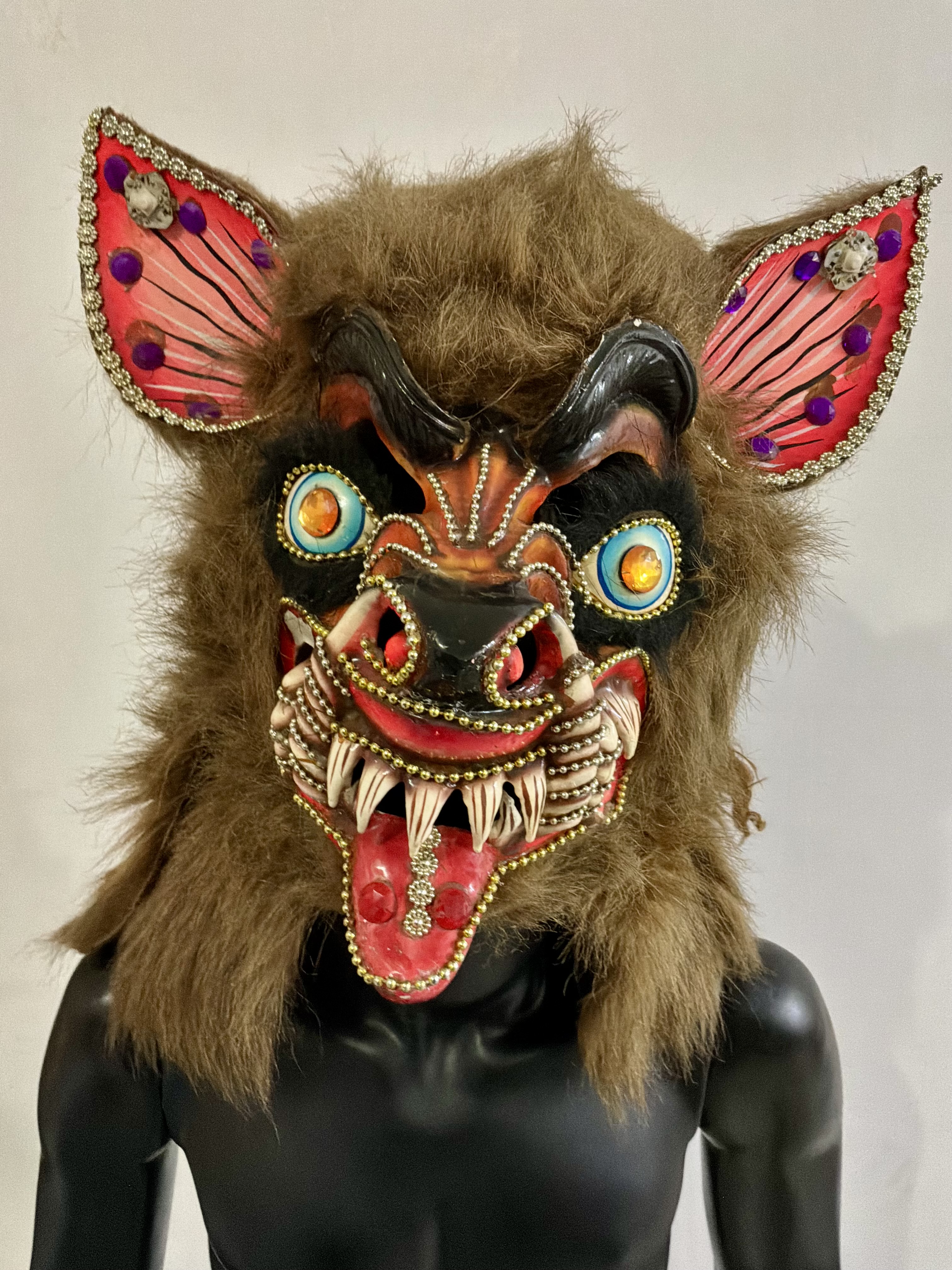
Reference photo from my trip to Bolivia
A: I have been back in the United States for one month and I know from past trips that there is always a long gestation period as I reflect on colorful new experiences, new sights, sounds, etc. My three and a half-weeks in Bolivia were non-stop, intense, and just full of so many high points. Bolivia is a fascinating country with profound cultural riches, and exceptionally warm and welcoming people. I experienced new friendships and events that were way beyond anything I could have imagined. In short, there’s a lot to process!
In the immediate aftermath, back in the studio I am deliberately selecting more vibrant colors and bumping up the contrast and drama in the painting on my easel (“Gatecrasher”) as I attempt to reflect some of what I saw and experienced in Oruro during Carnaval. I have begun to plan a pastel painting based on the mask pictured above, which I photographed in La Paz. We shall see what new work is created over the coming months and years. For now, it’s exciting to be reenergized and to have new subject matter with which to work. And, at this early date, I can barely conceive what our new Bolivia documentary will be like!
Comments are welcome!
Pearls from artists* # 677

Barbara’s Studio
*an ongoing series of quotations – mostly from artists, to artists – that offers wisdom, inspiration, and advice for the sometimes lonely road we are on.
… in Japan, in the native Shinto religion of the land, where the rites are extremely stately, musical, and imposing, no attempt has been made to reduce their “affect images” to words. They have been left to speak for themselves – as rites, as works of art – through the eyes to the listening heart. And that, I would say, is what we, in our own religious rites, had best be doing, too. Ask an artist what his picture “means,” and you will not soon ask such a question again. Significant images render insights beyond speech, beyond the kinds of meaning speech defines. And if they do not speak to you, that is because you are not ready for them, and words will only serve to make you think you have understood, thus cutting you off altogether. You don’t ask what a dance means, you enjoy it. You don’t ask what the world means, you enjoy it. You don’t ask what you mean, you enjoy yourself; or at least, so you do when you are up to snuff.
Joseph Campbell in Myths to Live By
Comments are welcome!
Pearls from artists* # 632

*an ongoing series of quotations – mostly from artists, to artists – that offers wisdom, inspiration, and advice for the sometimes lonely road we are on.
”The mind once stretched by a new idea, never returns to its original dimensions.” – Ralph Waldo Emerson ((1803 – 1882)
Ralph Waldo Emerson was more prescient than he can ever have realized. It was not until the 1960s that neuroscientist Marian Diamond discovered that exposure to enriched environments increased brain matter, specifically in the brain’s outer cortex. Prior to her landmark research, scientists believed that the brain remained static until it started to decline in older age. Diamond was the first to observe the brain’s neuroplasticity, yet her findings were disputed and rejected for many years. Today she is considered one of the founders of modern neuroscience.
Museums are the ultimate enriched environments, or super-enriched spaces, that are good for body, mind, and soul. Museums are dedicated to arousing our curiosity; engaging us in discovery and learning; and evoking our reflection, wonder, and awe. Artists (and Emerson) have known intuitively what scientists are now proving with rigorous research: aesthetic experiences affect us in extraordinary ways. In short, our brains are wired for art.
The Museum and the Mind by Susan Magsamen in Museum, May/June 2024
Comments are welcome!
Pearls from artists* # 562

“Shadow,” soft pastel on sandpaper, 26” x 20,” in progress
*an ongoing series of quotations – mostly from artists, to artists – that offers wisdom, inspiration, and advice for the sometimes lonely road we are on.
Jung observed that complexes could affect groups of people en masse. He saw that certain moments seemed to be expressions of a collective shadow, a bursting forth of a mass psychosis; the repressed side of a whole group coming alive; a tribal Mr. Hyde. He saw this madness first-hand in Germany in the 1930s and wrote about it. But every era carries some measure of collective shadow.
One could argue that no moment in time has seen more of the reality of human darkness than ours. Having witnessed the Holocaust and faced the threat of nuclear war in the twentieth century, and now facing the environmental impact of fossil fuels and plastics in the twenty-first century, we are undoubtedly aware of more of humanity’s potential for destruction than any of our ancestors ever were. Such a view does not come from a moralizing stance. Our era has made forced witnesses of us all.
The shadow is about where we put the Devil – where do we allow darkness to be housed? Racism and bigotry offer the relief of foisting our group’s shadow onto another whom we view as lesser. Doing so enables us not to look at or feel our shadow, and not see our own worst selves. But this collective shadow of our modern culture is also bigger and wider than group-to-group projections. There are culture-wide or civilization expressions of the collective shadow.
Jung saw the widespread loss of connection to the inner life and to a lived spirituality as one of the primary illnesses of our time. He observed that people were no longer animated by the traditional religions… For Jung, this meant that we’ve lost the old way but not yet found the new, and are sitting in a spiritual vacuum.
Into that vacuum, without our awareness, has slipped our fascination with human technology. Observe people closely today and you’ll notice that we have an almost magical faith in our devices. People see their computers and phones as all-knowing and expect them to function perfectly all the time, and view pharmaceuticals as magic cure-alls. Where we used to put God, we now have put technology. Where spirit was, we have unconsciously placed human genius.
Gary Bobroff in Carl Jung: Knowledge in a Nutshell
Comments are welcome!
Pearls from artists* # 543

*an ongoing series of quotations – mostly from artists, to artists – that offers wisdom, inspiration, and advice for the sometimes lonely road we are on.
Although the struggles that I faced involved me as an individual, I didn’t feel alone. I was forbidden to travel, but this forced immobility didn’t adversely affect my work; instead it gave me sustenance. For me, inspiration comes from resistance – without that, my efforts would be fruitless. Having a real – and powerful – adversary was my good fortune, making freedom all the more tangible – freedom comes from all the sacrifices you make to achieve it. Limitations come only from a fear inside the heart, and art is the antidote to fear. I did not need sympathy, for courage itself is an aesthetic feeling, and it’s only when true feeling is transformed into something broadly understood that art can avoid drying up.
Ai Weiwei in 1000 Years of Joys and Sorrows
Comments are welcome!
Pearls from artists* # 450

*an ongoing series of quotations – mostly from artists, to artists – that offers wisdom, inspiration, and advice for the sometimes lonely road we are on.
All the journeys that have transpired in my life have been animated by interest. Something or someone has stopped me in my tracks. Interest, that thing that cannot really be faked, is an invitation to adventure. It has always been disorienting to do but I have to act on these interests. Somehow I know that in order to keep on working as an artist, I have to keep on changing. And this means that when interest is piqued, I must follow or die. And I know that I will have to hang on tight for the ride. These rides have changed me irrevocably.
The primary tool in a creative process is interest. To be true to one’s interest, to pursue it successfully, one’s body is the best barometer. The heart races. The pulse soars. Interest can be your guide. It always points you in the right direction. It defines the quality, energy and content of your work. You cannot feign or fake interest or choose to be interested in something because it is prescribed. It is never prescribed. It is discovered. When you sense this quickening you must act immediately. You must follow that interest and hold tight.
… If the interest is genuine and large enough and if it is pursued with tenacity and generosity, the boomerang effect is resounding. Interest returns volley to affect your life and inevitably alter it. You must be available and attentive to the doors that open unexpectedly. You cannot wait. The doors close fast. It will change your life. It will give you adventures you never expected. You must be true to it and it will be true to you.
Anne Bogart in A Director Prepares: Seven Essays on Art and Theatre
Comments are welcome!
Pearls from artists* # 404

“Broken,” soft pastel on sandpaper, 38″ x 58″ image, 50″ x 70″ framed
* an ongoing series of quotations – mostly from artists, to artists – that offers wisdom, inspiration, and advice for the sometimes lonely road we are on.
Before we can even think of ecological rescue, global disarmament, or economic reform, we must find a way back to what science fiction writers call our homeworld. The term encompasses more than the biosphere; it also includes our homes, our places of work, our communities, families, friends, and lovers. It includes our technologies and tools, the physical body, the sensible soul, and the unconscious psyche. We need a faith to restore our capacity to feel, to affect and be affected with the same passionate intensity as our forebears, whose powers of feeling astound us so in the records and art of the past. The death of affect, to borrow a phrase from JG Ballard, is the true catastrophe of our spectral age, our spiritual Hiroshima. It makes questions such as whether life’s riddles are answered at the Vatican, in Tibet, or by the Large Hadron Collider utterly meaningless, since it removes the ground we need to pose such questions in the first place. Neither religion nor science can give us back the ground. Only the imagination can. Only art can mend the rupture of the soul and the world, the body and the earth.
J.F. Martel in Reclaiming Art in the Age of Artifice: A Treatise, Critique, and Call to Action
Comments are welcome!


 barbararachkoscoloreddust.com