Category Archives: An Artist’s Life
Pearls from artists* # 179
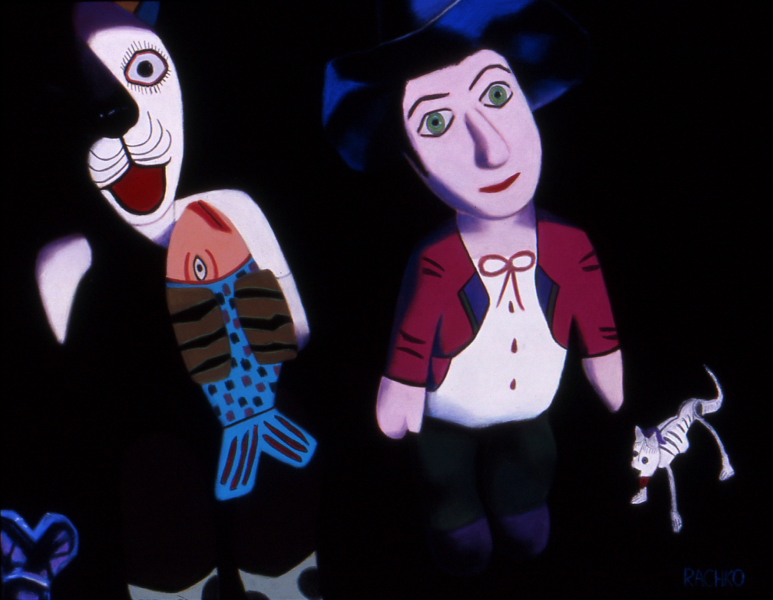
“Offering,” soft pastel on sandpaper, 20″ x 26″
* an ongoing series of quotations – mostly from artists, to artists – that offers wisdom, inspiration, and advice for the sometimes lonely road we are on.
Michael Kimmelman: You studied art in school. You started collecting early.
David Bowie: Yeah, I collected very early on. I have a couple of Tintorettos, which I’ve had for many, many years. I have a Rubens. Art was, seriously, the only thing I’ve ever wanted to own. It has always been for me a stable nourishment. I use it. It can change the way that I feel in the mornings. The same work can change me in different ways, depending on what I’m going through. For instance, somebody I like very much is Frank Auerbach. I think there are some mornings that if we hit each other a certain way – myself and a portrait by Auerbach – the work can magnify the kind of depression I’m going through. It will give spiritual weight to the angst. Some mornings I’ll look at it and go: “Oh, God, Yeah! I know!” But that same painting, on a different day, can produce in me the incredible feeling of the triumph of trying to express myself as an artist. I can look at it and say: “My God, Yeah! I want to sound like that looks.”
“At Heart an Artist with Many Muses,” by Michael Kimmelman, The New York Times, Friday, January 15, 2016
Comments are welcome!
Q: How many pastel paintings do you have in progress now?
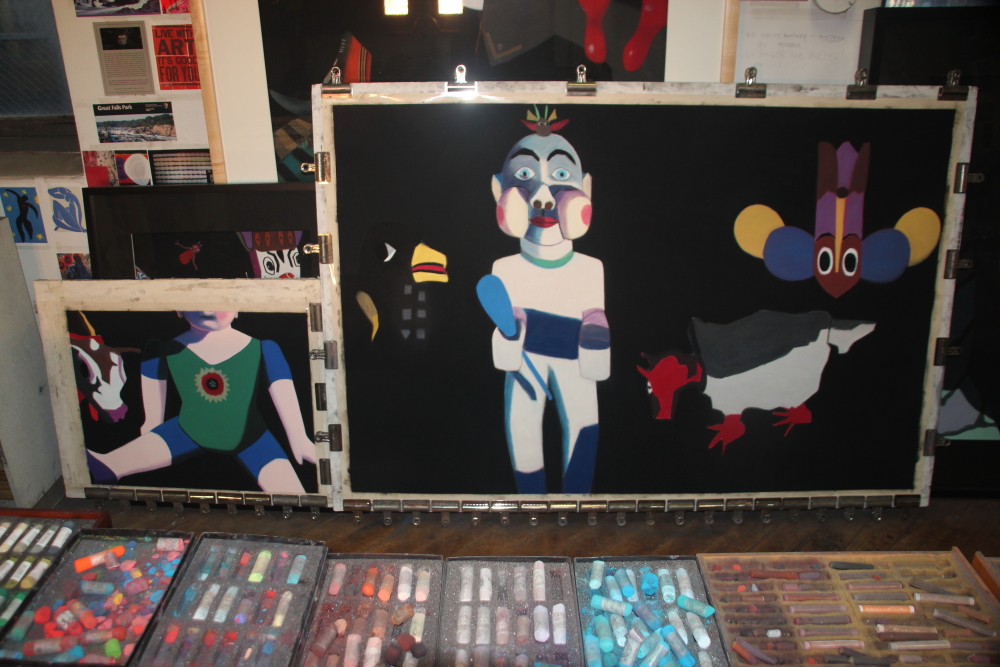
Work in progress
A: Making pastel-on-sandpaper paintings is a slow and meticulous process. I work full-time in my studio so that in a good year I can produce five finished pieces. Typically two are in progress at a time so that I can switch off when problems develop.
A downside to looking at a painting for months is that there comes a point when I can’t see the flaws any more. Then it’s definitely time to take a break.
When I put a painting that has been resting back onto my easel, I see it with fresh eyes again. Areas that need work immediately stand out. Problem areas become easily resolvable because I have continued to think about them while the painting was out of my sight.
Comments are welcome!
Pearls from artists* 178
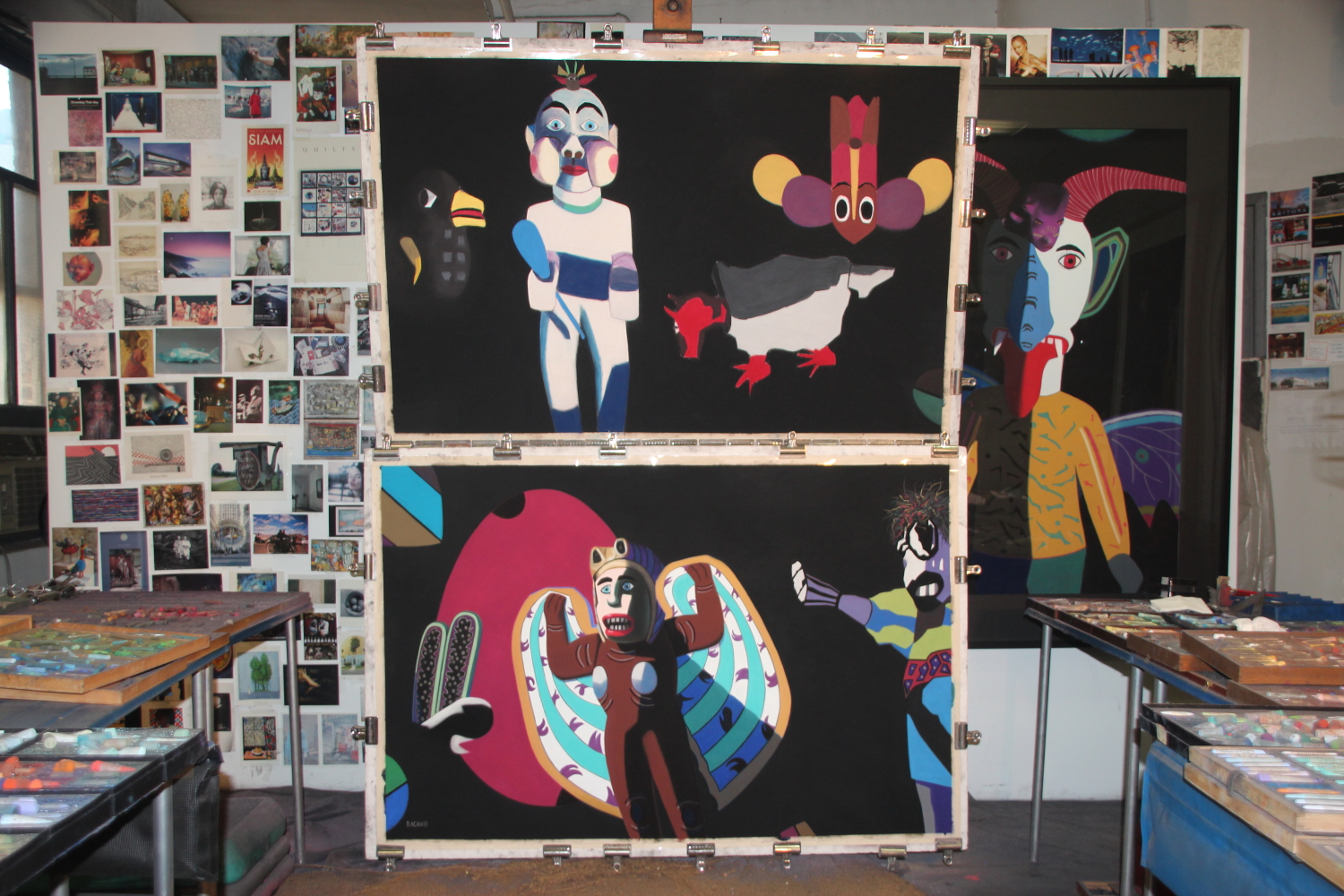
Barbara’s studio with recent works in progress
* an ongoing series of quotations – mostly from artists, to artists – that offers wisdom, inspiration, and advice for the sometimes lonely road we are on.
Most individuals have never had enough time, and they’ve never had enough resources, and they’ve never had enough support or patronage or reward… and yet they still persist in creating. They persist because they care. They persist because they are called to be makers, by any means necessary.
…The essential ingredients for creativity remain exactly the same for everybody: courage, enchantment, permission, persistence, trust – and those elements are universally accessible. Which does not mean that creative living is always easy; it merely means that creative living is always possible.
Elizabeth Gilbert in Big Magic: Creative Living Beyond Fear
Comments are welcome!
Q: What are some of your work habits? Do you sit most of the day?
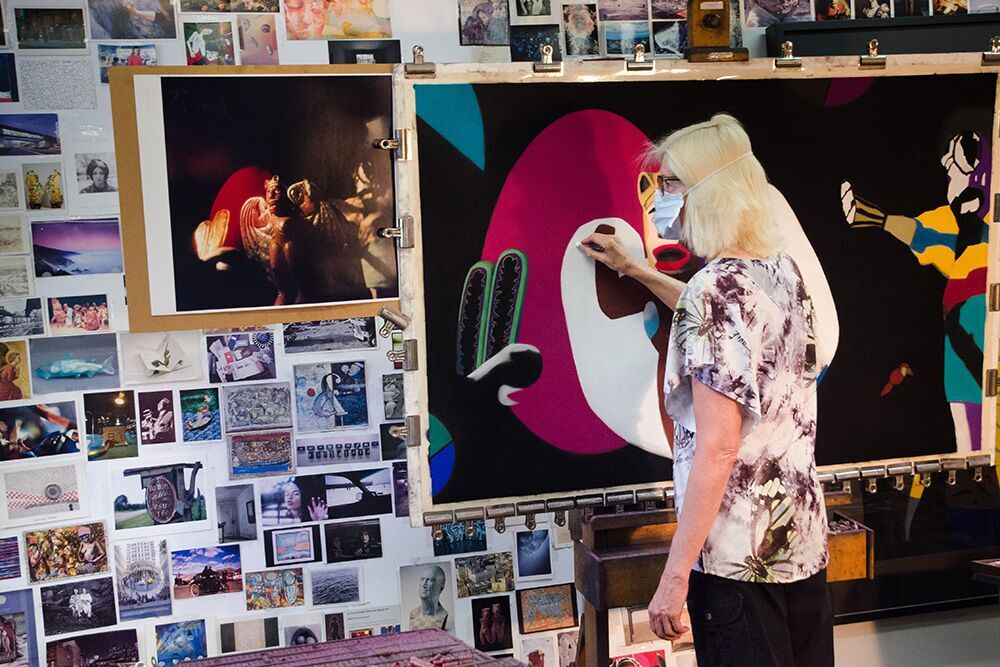
Barbara at work, Photo: Marianne Barcellona
A: No, I never sit while working. I enjoy the physicality of art-making and prefer to stand at my easel so I can back up to see how a painting looks from a distance. I like being on my feet all day and getting some exercise.
In order to accomplish anything, artists need to be disciplined. I work five days a week, taking Wednesdays and Sundays off, and spend seven hours or more in the studio. Daylight is necessary so I work more hours in summer, fewer in winter. I deliberately don’t have a clock on the wall – art-making is independent of timetables – but I tend to work in roughly two-hour blocks before taking a break.
Studio hours are sacrosanct and exclusively for creative work. I keep my computer and mobile devices out of the studio. Art business activities – answering email, keeping up with social media, sending jpegs, writing blog posts, doing interviews, etc. – are mostly accomplished at home in the evenings and on days off.
Comments are welcome!
Pearls from artists* # 177
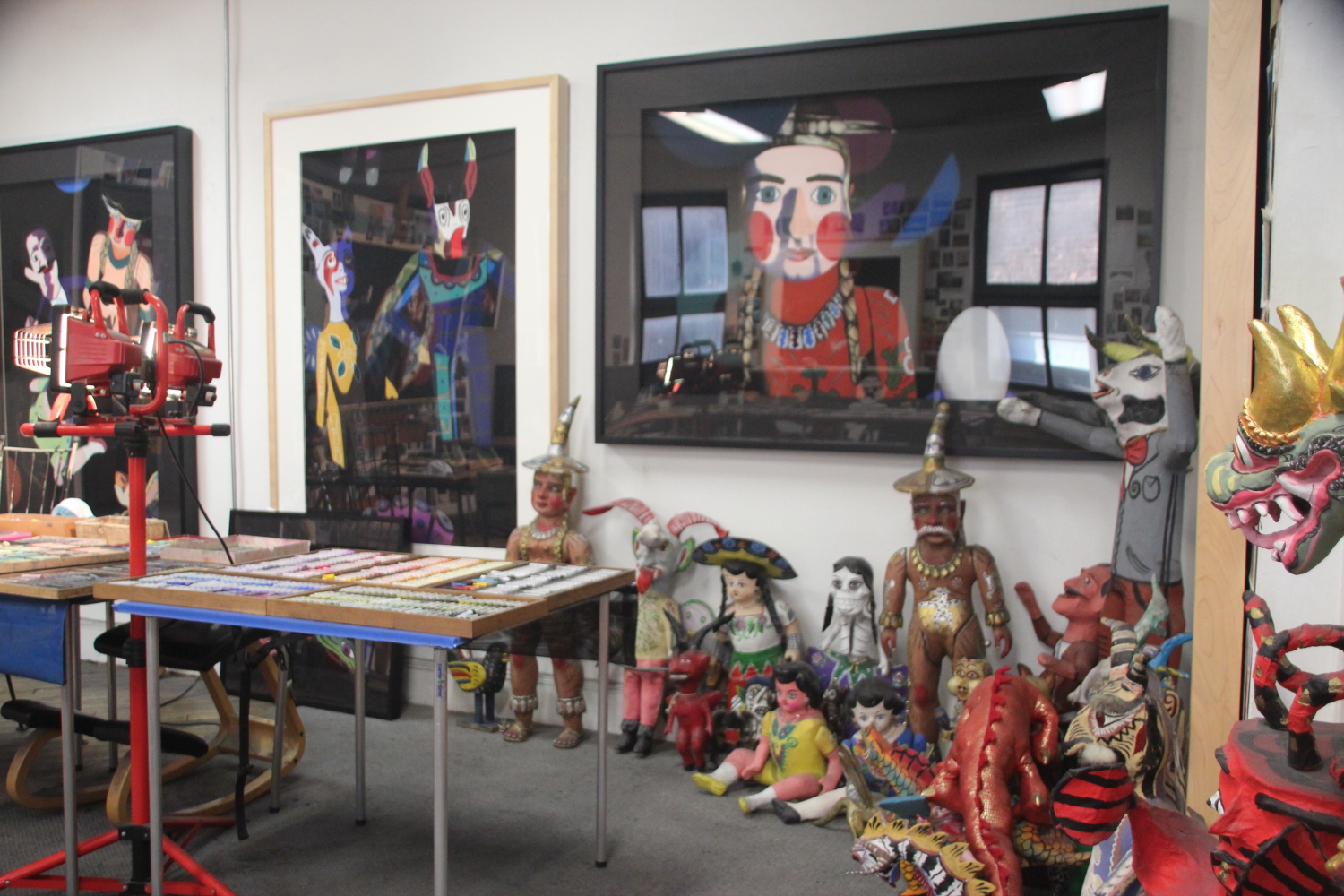
Barbara’s studio
* an ongoing series of quotations – mostly from artists, to artists – that offers wisdom, inspiration, and advice for the sometimes lonely road we are on.
Everyone but a lunatic has a reason for what he does. Yes, in that sense I am a determinist. But I believe, with Kant, that the mind is self-determined. That is, I believe intensely in the creative freedom of the mind. That is indeed absolutely essential to man’s security in a chaotic world of change. He is faced all the time with unique complex problems. To sum them up for action is an act of creative imagination. He fits the different elements together in a coherent whole and invents a rational act to deal with it. He requires to be free, he requires his independence and solitude of mind, he requires his freedom of mind and imagination. Free will is another matter – it is a term, or rather a contradiction in terms, which leads to continual trouble. The will is never free – it is always attached to an object, a purpose. It is simply the engine in the car – it can’t steer. It is the mind, the reason, the imagination that steers.
Joyce Carey in The Paris Review Interviews: Writers at work 1st Series, edited and with an introduction by Malcolm Cowley
Comments are welcome!
Q: What’s on the easel today?
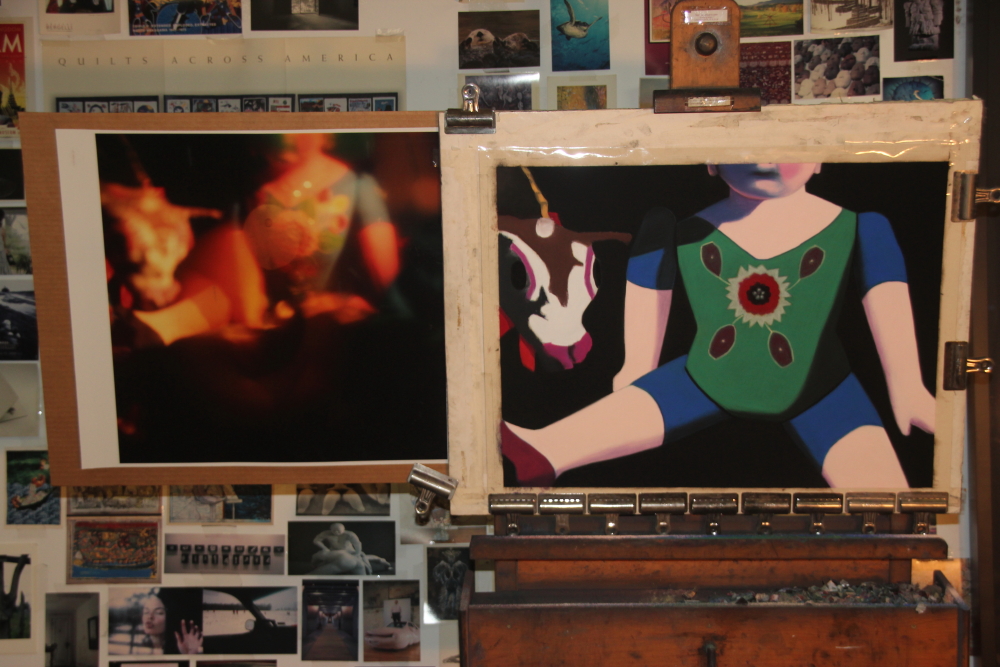
Work in progress
A: I am at work on a small (20″ x 26″) pastel-on-sandpaper painting tentatively called, “Duo.” My previous painting, “Charade,” was a breakthrough of sorts; at least I hope so, because it was such an ordeal to complete!
That’s why I am giving myself a break and making a relatively simple piece now. It’s a way of resting and also of re-filling the well.
Recently something happened that broke my heart: I had to put my beloved cat to sleep. When I look at this image I am reminded of Kit Kat, who was always by my side. He and I were another “Duo” alluded to in the title of this painting.
Comments are welcome!
Pearls from artists* # 176
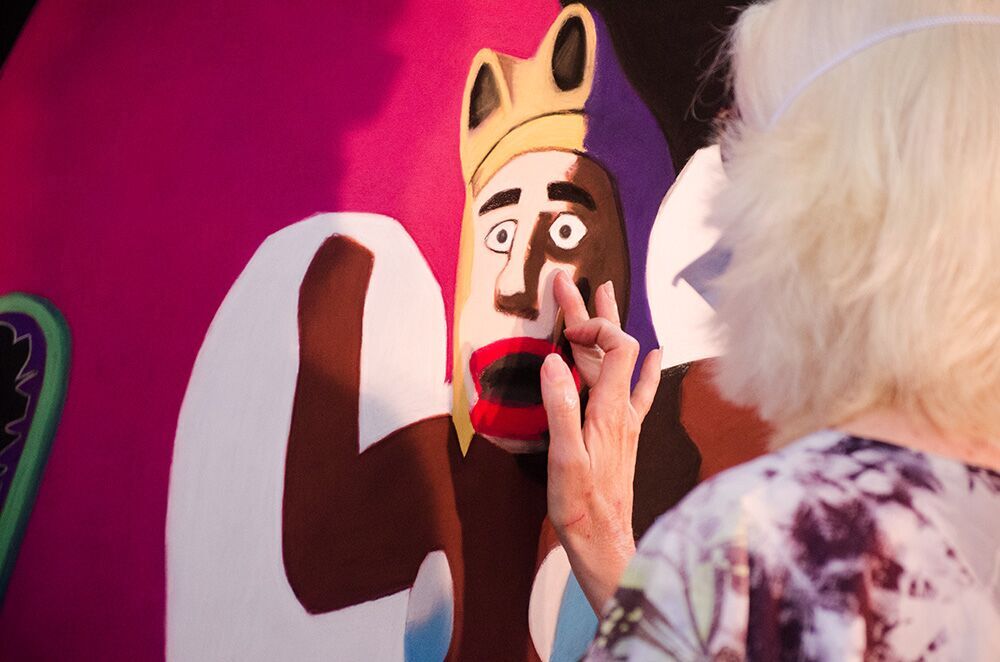
Working on “Charade,” Photo: Marianne Barcellona
* an ongoing series of quotations – mostly from artists, to artists – that offers wisdom, inspiration, and advice for the sometimes lonely road we are on.
I don’t demand a translation of the unknown. I don’t need to understand what it all means, or where ideas are originally conceived, or why creativity plays out as unpredictably as it does. I don’t need to know why we are sometimes able to converse freely with inspiration, when at other times we labor hard in solitude and come up with nothing. I don’t need to know why an idea visited you today and not me. Or why it visited us both. Or why it abandoned us both.
None of us can know such things, for these are among the great enigmas.
All I know for certain is that this is how I want to spend my life – collaborating to the best of my ability with forces of inspiration that I can neither see, nor prove, nor command, nor understand.
It’s a strange line of work, admittedly.
I cannot think of a better way to pass my days.
Elizabeth Gilbert in Big Magic: Creative Living Beyond Fear
Comments are welcome!
Pearls from artists* # 175
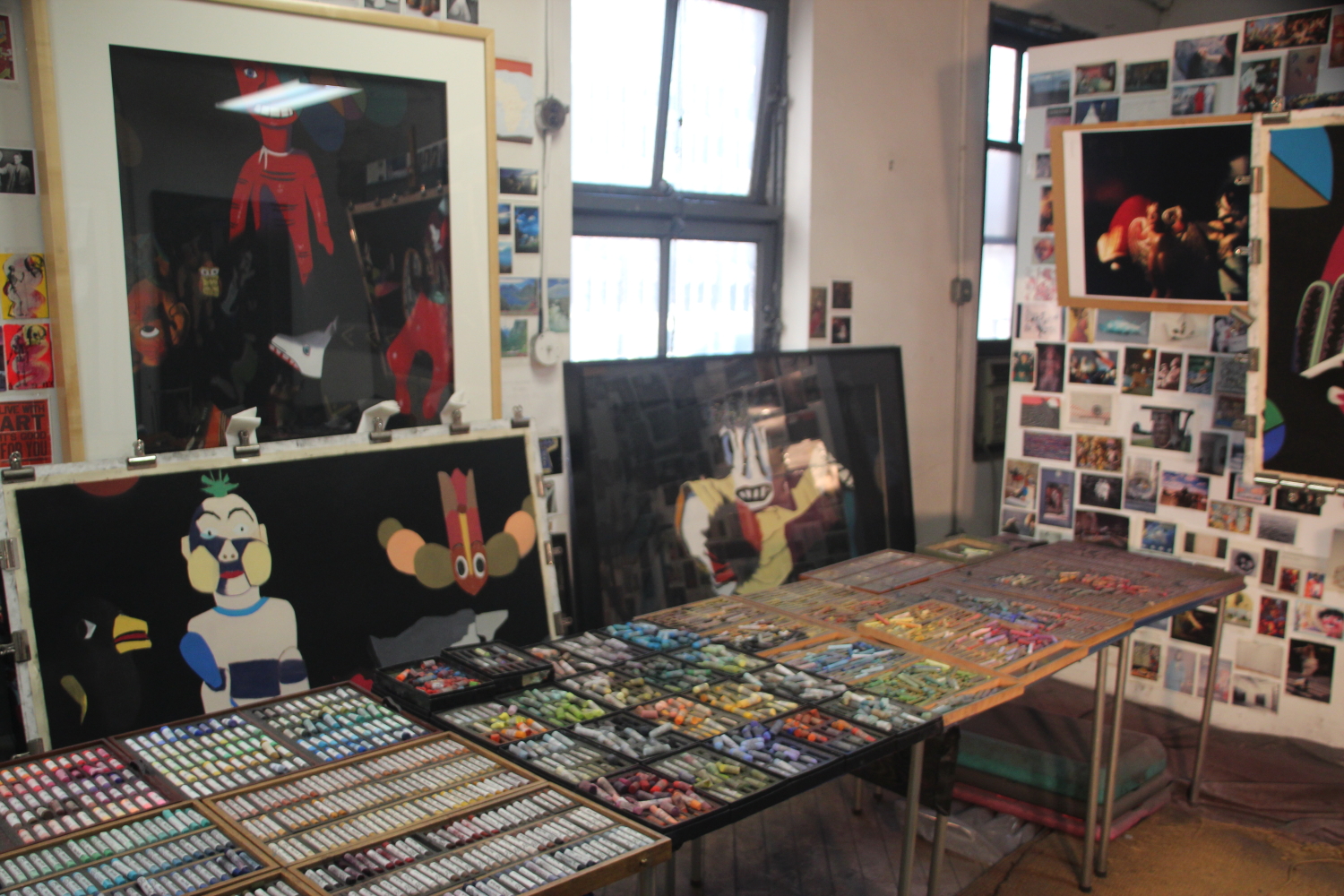
Barbara’s studio
* an ongoing series of quotations – mostly from artists, to artists – that offers wisdom, inspiration, and advice for the sometimes lonely road we are on.
I know this is a sentimental cliché, but I do feel toward my books very much as a parent must toward his children. As soon as someone says, “I did like your short stories, but I don’t like your novels,” or, “Of course, you only really came into your own with Anglo-Saxon Attitudes” – then immediately I want to defend all my other books. I feel this especially about Hemlock and Anglo-Saxon Attitudes – one child a bit odd but exciting, the other competent but not really so interesting. If people say they like one book and not the other, then I feel they can’t have understood the one they don’t like.
Angus Wilson in The Paris Review Interviews: Writers at Work 1st Series, edited and with an introduction by Malcolm Cowley
Comments are welcome!
Q: Do you use a sketchbook?

Hudson Yards, NYC
A: I used to use a sketchbook early on, when I was just beginning to find my way as an artist. Sketching on location helped to crystalize my ideas about art, about technique, and about what I hoped to accomplish in the near term. These days I spend so many hours in the studio – it’s my day job – that I often need a mental and physical break from using my eyes and from looking at and composing images.
What I do instead is to walk around New York (and elsewhere) with a camera. Photography for me sometimes serves as an alternative to sketching. It’s a way to continue to think about art, to experiment, and to contemplate what makes an arresting image without actually having to be working in the studio.
Comments are welcome!
Pearls from artists* # 174
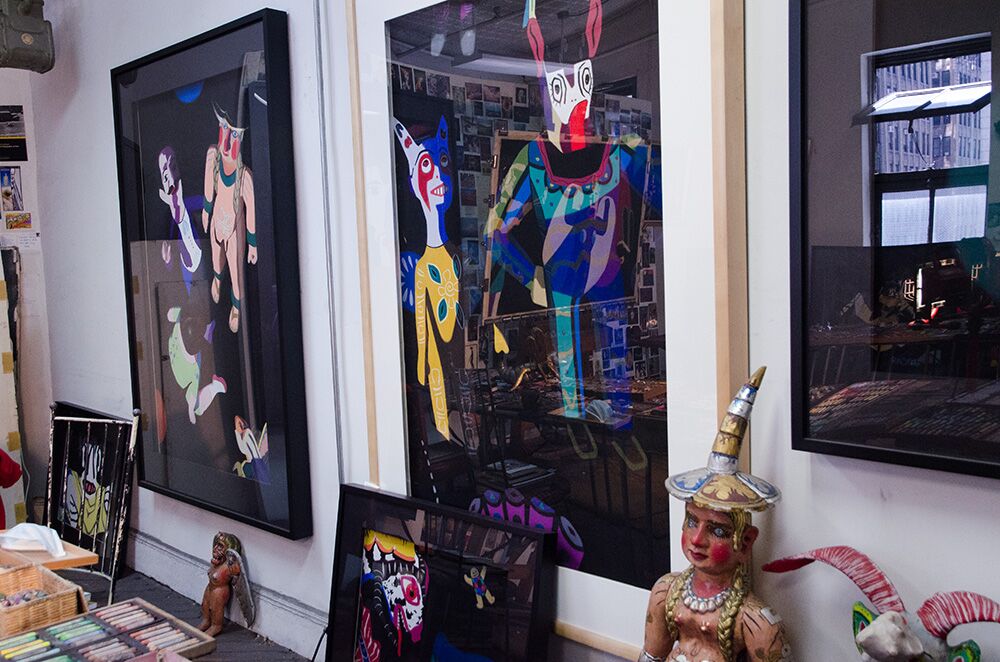
Barbara’s studio, Photo: Marianne Barcellona
* an ongoing series of quotations – mostly from artists, to artists – that offers wisdom, inspiration, and advice for the sometimes lonely road we are on.
If you are older, trust that the world has been educating you all along. You already know so much more than you think you know. You are not finished; you are merely ready. After a certain age, no matter how you’ve been spending your time, you have very likely earned a doctorate in living. If you’re still here – if you have survived this long – it is because you know things. We need you to reveal to us what you know, what you have learned, what you have seen and felt. If you are older, chances are strong that you may already possess absolutely everything you need to possess in order to live a more creative life – except the confidence to actually do your work. But we need you to do your work.
Whether you are young or old, we need your work in order to enrich and inform our own lives.
Elizabeth Gilbert in Big Magic: Creative Living Beyond Fear
Comments are welcome!


 barbararachkoscoloreddust.com