Blog Archives
Q: When did you begin drawing and painting? (Question from “Cultured Focus Magazine”)

A: This is a long story because my path to becoming a professional artist has been unusually circuitous.
I grew up in a blue collar family in suburban New Jersey. My parents were both first-generation Americans and no one in my family had gone to college. I was a smart kid, who showed some artistic talent in kindergarten and earlier. At the age of 6, my sister, my cousin, and I enrolled in Saturday morning painting classes at the studio of a local artist. I continued the classes for about 8 years and became a fairly adept oil painter.
At the age of 15 my father decided that art was not a serious pursuit – he called it a hobby, not a profession – and abruptly stopped paying for my Saturday morning lessons. Unfortunately, there were no artists or suitable role models in my family. So with neither financial nor moral support to pursue art, I turned my attention to very different interests.
Cut to ten years later. When I was 25, I earned my private pilot’s license and spent the next two years amassing other flying licenses and ratings, culminating in a Boeing-727 flight engineer’s certificate.
At 29, I joined the Navy. By then I was an accomplished civilian pilot with thousands of flight hours so I expected to fly jets. However, in the early 1980s women were not allowed in combat. There were very few women Navy pilots and those few were restricted to training male pilots. There were no women pilots landing on aircraft carriers.
In the mid-1980s I was in my early 30s, a lieutenant on active duty in the Navy, working a soul-crushing job as a computer analyst on the midnight shift in a Pentagon basement. It was literally and figuratively the lowest point of my life. I was completely bored and miserable.
Remembering the joyful Saturdays of my youth when I had taken art classes with a local New Jersey painter, I enrolled in a drawing class at the Art League School in Alexandria, Virginia. Initially I wasn’t very good, but it was wonderful to be around other women and a world away from the mentality of the Pentagon. I was having fun again! I enrolled in more classes and became a very motivated full-time art student who worked nights at the Pentagon. As I studied and improved my skills, I quickly discovered my preferred medium – soft pastel on sandpaper.
Although I knew I had found my calling, for more than a year I agonized over whether or not to leave the financial security of a Navy paycheck. Finally I did make up my mind and resigned my commission, effective on September 30, 1989. With Bryan’s (my then boyfriend’s) support, I left the Navy to devote my time to making art.
I’m probably one of the few people who can name THE day I became a professional artist! That day was October 1, 1989. Fortunately, I have never needed another job. I remained in the Navy Reserve for the next 14 years, working primarily at the Pentagon for two days each month and two weeks each year. I commuted by train to Washington, DC after I moved to Manhattan in 1997. Finally on November 1, 2003, I officially retired as a Navy Commander.
Life as a self-employed professional artist is endlessly varied, fulfilling, and interesting. I have never regretted my decision to pursue art full-time.
Comments are welcome!
Q: What was the first painting you ever sold?
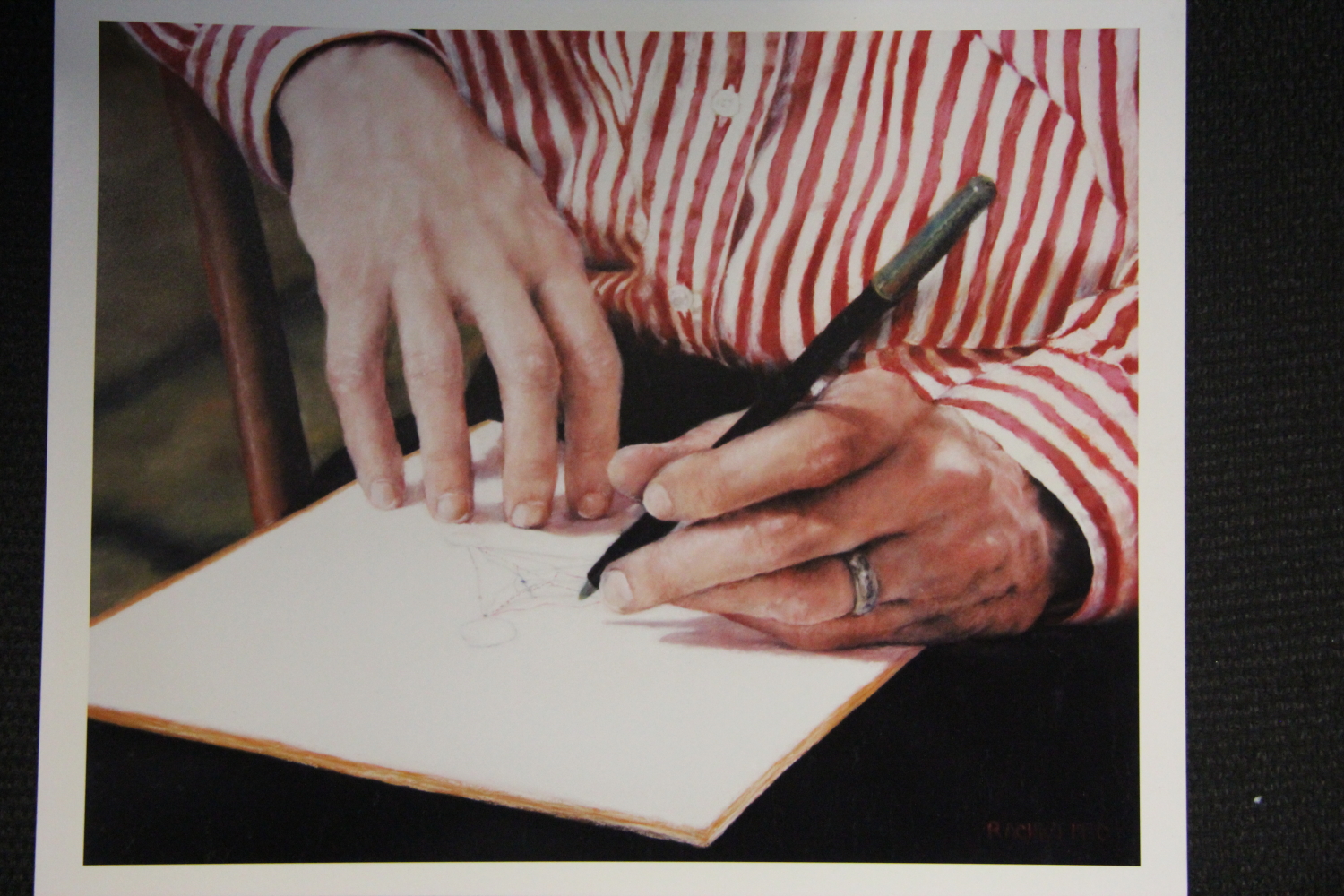
“Bryan’s Ph.D.”, 11″ x 13 1/2″, soft pastel on sandpaper
A: I believe my first sale was “Bryan’s Ph.D.” I made it in 1990 as one of several small paintings created to improve my skills at rendering human hands in pastel. I had recently left the Navy and was building a career as a portrait artist. Bryan, my late husband, was often my model for these studies, not only because it was convenient, but because he had such beautiful hands.
In 1990 Bryan was working on his Ph.D. in economics at the University of Maryland. In this painting he is drawing a diagram that illustrates a theoretical point about “international public goods,” the subject of his research. He was sitting in an old wooden rocking chair in our backyard in Alexandria, VA. I still own the chair and the house. I photographed his hands close-up and then created the painting. I don’t remember which of Bryan’s cameras I used, but it was one that took 35 mm film; perhaps his Nikon F-2. Somewhere I must still have the negative and the original reference photo.
“Bryan’s Ph.D.” is 11″ x 13 1/2″ and it sold for $500 at a monthly juried exhibition at The Art League in Alexandria. I have not seen it since 1990. (Above is a photograph of “Bryan’s Ph.D.” from my portfolio book).
Not long ago the owner contacted me, explaining that she had received the painting as a gift from her now ex-husband. She was selling it because it evoked bitter memories of her divorce. Her phone call was prompted by uncertainty about the painting’s value now. She had a likely buyer and needed to know what price to charge.
I was saddened because I have so many beautiful memories of this particular painting and of an idyllic time in my life with Bryan. He was on a leave of absence from the Pentagon to work on his dissertation, while I was finished with active duty. At last I was a full time artist, busily working in the spare bedroom that we had turned into my first studio.
My conversation with the owner was a reminder that once paintings are let out into the world, they take on associations that have nothing to do with the personal circumstances surrounding their creation. In short, what an artist creates solely out of love, stands a good chance of not being loved or appreciated by others. This is one reason to only sell my work to people I select personally. I ended the telephone conversation hoping that “Bryan’s Ph.D.” fares better in its new home.
Comments are welcome!
Q: How important is the feedback of your audience? Do you ever think about who will enjoy your Art when you conceive it?

Painting, subject, reference photo
A: I can’t say that I think at all about audience reaction while I’m creating a painting in my studio. Although, of course I want people to respond favorably to the work.
Generally, I’m thinking about technical problems – making something that is exciting to look at, well-composed, vibrant, up to my exacting standards, etc. When I finish a painting, it is the best thing I am capable of making at that moment in time.
I think about a painting and look at it for so long and with such intensity, that it could hardly have turned out any differently. There is an inevitability to the whole lengthy process that goes all the way back to when I first laid eyes on the folk art figures in a dusty shop in a third world country. Looking at a newly-finished painting on my easel I often think, “Of course! I was drawn to this figure so that it could serve this unique function in this painting.”
Comments are welcome!


 barbararachkoscoloreddust.com