Blog Archives
Q: Does your work look different to you on days when you are sad, happy, etc.?

Barbara’s Studio
A: I am much more critical on days when I am sad so that the faults, imperfections, and things I wish I had done better stand out. Fortunately, all of my work is framed behind plexiglas so I can’t easily go back in to touch up perceived faults. I am reminded of the expression, “Always strive to improve, whenever possible. It is ALWAYS possible!” However, I’ve learned that re-working a painting is a bad idea. You are no longer deeply involved in making it and the zeitgeist has changed. The things you were concerned with are gone: some are forgotten, others are less urgent.
For most artists our work is autobiography. Art is personal. When I look at a completed pastel painting, I usually remember exactly what was happening in my life as I created it. Each piece is a snapshot – maybe a time capsule, if anyone could decode it – that reflects and records a particular moment. When I finally pronounce a piece finished and sign it, that’s it, THE END. It’s as good as I can make it at that point in time. I’ve incorporated everything I was thinking about, what I was reading, how I was feeling, what I valued, art exhibitions I visited, programs that I heard on the radio or watched on television, music that I listened to, what was going on in New York, in the country, and in the world.
It is still a mystery how this heady mix finds its way into the work. During the time that I spend on it, each particular painting teaches me everything it has to teach. A painting requires months of looking, reacting, correcting, searching, thinking, re-thinking, revising. Each choice is made for a reason and together these decisions dictate what the final piece looks like. On days when I’m sad I tend to forget that. On happier days I remember that the framed pastel paintings that you see have an inevitability to them. If all art is the result of one’s having gone through an experience to the end, as I believe it is, then the paintings could not, and should not, look any differently.
Comments are welcome.
Q: Would you say there is a unifying quality to all of the work you have produced in the last thirty years?
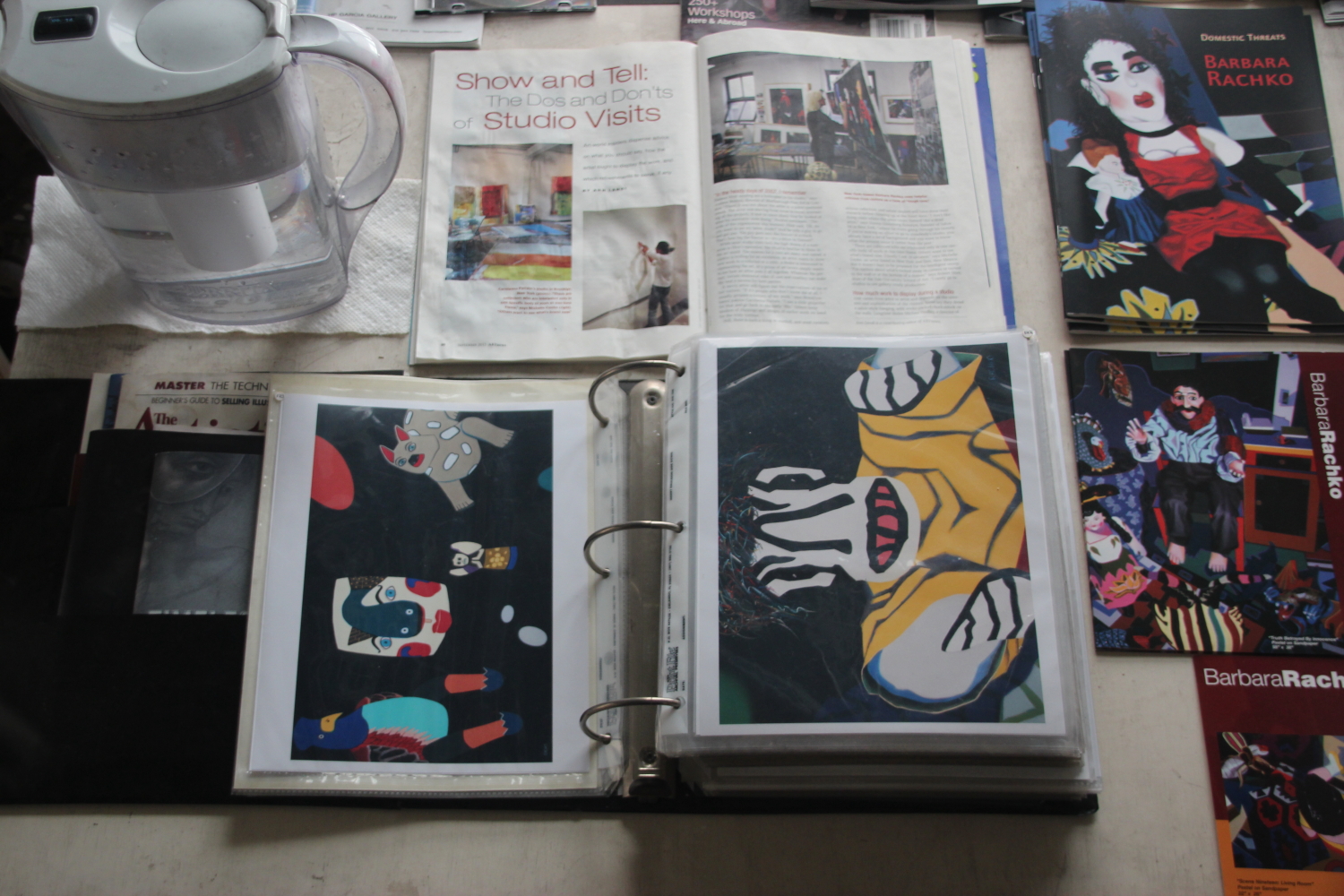
Barbara’s portfolio book
A: Yes, I can think of several. Whether making pastel paintings or printing photographs in the darkroom, I have always been concerned with quality and craftsmanship and never pronounce a work finished until it is the best thing I can make.
Although I started out as a maker of photorealist portraits in pastel, for twenty-odd years I have worked with Mexican folk art as my primary subject matter, treating these objects very differently in three separate series: “Black Paintings,” “Domestic Threats,” and “Gods and Monsters.” The first two are pastel-on-sandpaper paintings while the last is comprised of chromogenic photographs (c-prints). A few years ago I also started making “Teleidoscopes” using an iPad app to photograph my Mexican and Guatemalan folk art collection. This last one is just for fun; I do not offer them for sale.
Soft pastel is my first love and the two series of pastel paintings are my best-known work. My technique for using pastel continues to evolve in intriguing ways. I doubt I can ever learn all there is to know not only about color, but also about this medium. Pastel is endlessly fascinating, which is why I have never wanted to switch to anything else.
Comments are welcome!
Q: You have been a working artist for nearly thirty years. Considering your entire body of work, is there any particular painting that you love or hate?

Barbara’s studio
A: With very few exceptions, I generally love all of my paintings equally. I do not hate any of them. Each was the best I could make at that particular stage in my development as an artist and as a person. I am a perfectionist with high standards – this is my life’s work. I am devoted to becoming the best artist I can be. I have never pronounced a work “finished” until it is the absolute best that I can make.
Comments are welcome!
Q: How do you feel about accepting commissions?

“Reunion,” soft pastel on sandpaper, 38″ x 58″, 1990
A: By the time I left the Navy in 1989 to devote myself to making art, I had begun a career as a portrait painter. I needed to make money, this was the only way I could think of to do so, and I had perfected the craft of creating photo-realistic portraits in pastel. It worked for a little while.
A year later I found myself feeling bored and frustrated for many reasons. I didn’t like having to please a client because their concerns generally had little to do with art. Once I ensured that the portrait was a good (and usually flattering) likeness, there was no more room for experimentation, growth, or creativity. I believed (and still do) that I could never learn all there was to know about soft pastel. I wanted to explore color and composition and take this under-appreciated medium as far as possible. It seemed likely that painting portraits would not allow me to accomplish this. Also, I tended to underestimate the amount of time needed to make a portrait and charged too small a fee.
So I decided commissioned portraits were not for me and made the last one in 1990 (above). I feel fortunate to have the freedom to create work that does not answer to external concerns.
Comments are welcome!
Q: Your pastel-on-sandpaper paintings are very labor intensive. Do you typically have just one in progress at any given time?

Works in progress, soft pastel on sandpaper, 58″ x 38″
A: For many years I always worked on one at a time because I have only one or two ideas – never more than that – about what I will make next. Also, I believe that “all art is the result of one’s having gone through an experience to the end.” (It’s on a note taped to the wall near my easel). So I would work on one painting at a time until all of the problems in it were resolved. Each piece that I undertake represents an investment of several months of my life and after nearly three decades as an artist, I know that once I start a piece I will not abandon it for any reason. When it is the best painting that I can make – when adding or subtracting anything would be a diminishment – I pronounce it “finished.” In the past I would start the next one only when the completed piece was out of my sight and at the frame shop.
But a few years ago I began working on two pastel paintings at a time. When I get stuck – or just need a break from looking at the same image day after day (I am in my studio 5 days a week) – I switch to the other one. This helps me work more efficiently. The two paintings interact with each other; they play off of each other and one suggests solutions that help me to resolve problem areas in the other. I’m not sure exactly how this happens – maybe putting a piece aside for awhile alerts my unconscious to begin working deeply on it – but having two in progress at the same time is my preferred way of working now.
A note about the painting on the left above, which was previously called, “Judas.” I happen to be reading “Cloud Atlas,” by David Mitchell and came across the word “judasing” used as a verb meaning, “doing some evil to a person who profoundly trusted you.” I’d never heard the word before, but it resonated with an event in my personal life. So the new title of my painting is “Judasing.” This is a good reminder that work and life are inextricably (and inexplicably) woven together and that titles can come from anywhere!
Comments are welcome!


 barbararachkoscoloreddust.com