Blog Archives
Pearls from artists* # 624

Machu Picchu (Peru), June 2016
*an ongoing series of quotations – mostly from artists, to artists – that offers wisdom, inspiration, and advice for the sometimes lonely road we are on.
If we were speaking from the point of view of the historian, and if we desired to know as concretely as possible how those peoples of the past or present conceived of their world, we should have to turn to their philosophy to find how they thought about their world, and to their sciences to analyze the atomic factors that contributed to those thoughts, and to their applied arts for the understanding of how this notion appeared when necessarily vulgarized to the common denominator of intelligence. But we would have to turn to their art to understand how they “felt about their world,” to know how their notions of reality found expression in their sensual perception of the world. And we know, of course, how those expressions can differ by simply examining Christian art, which consciously discarded the reality of its predecessor, Greek Hellenistic art.
Mark Rothko in The Artist’s Reality: Philosophies of Art
Comments are welcome!
Pearls from artists* # 577

In the Studio
*an ongoing series of quotations – mostly from artists, to artists – that offers wisdom, inspiration, and advice for the sometimes lonely road we are on.
What is the popular conception of the artist? Gather a thousand descriptions and the resulting composite is the portrait of a moron: he is held to be childish, irresponsible, and ignorant or stupid in everyday affairs.
The picture does not necessarily involve censure or unkindness. These definitions are attributed to the artist’s preoccupation with his particular kind of fantasy and to the unworldly nature of the fantastic itself. The bantering tolerance granted to the absentminded professor is extended to the artist. Biographers contrast the artless news of his judgments with the high attainment of his art, and while his naïveté or rascality are gossiped about, they are viewed as signs of Simplicity and Inspiration, which are the Handmaidens of Art. And if the artist is inarticulate and lacking in the usual repositories of fact and information, how fortunate, it is said, that nature has contrived to divert him from all worldly distractions so he may be single-minded in regards to his special office.
Mark Rothko in The Artist’s Reality: Philosophies of Art, edited and with an introduction by Christopher Rothko
Comments are welcome!
Pearls from artists* # 501

* an ongoing series of quotations – mostly from artists, to artists – that offers wisdom, inspiration, and advice for the sometimes lonely road we are on.
When I talk about “creative living” here, please understand that I am not necessarily talking about pursuing a life that is professionally or exclusively devoted to the arts. I’m not saying that you must become a poet who lives on a mountaintop in Greece, or that you must perform at Carnegie Hall, or that you must win the Palme d’Or at the Cannes Film Festival. (Though if you want to attempt any of these feats, have at it. I love to watch people swing for the bleachers.) No, when I refer to “creative living,” I am speaking more broadly. I’m talking about living a life that is driven more strongly by curiosity than by fear.
... A creative life is an amplified life. It’s a bigger life, a happier life, an expanded life, and a hell of a lot more interesting life. Living in this manner – continually and stubbornly bringing forth the jewels that are hidden within you – is a fine art, in and of itself.
Elizabeth Gilbert in Big Magic: Creative Living Beyond Fear
Comments are welcome!
Pearls from artists* # 423

“Epiphany,” soft pastel on sandpaper, 38″ x 58″
* an ongoing series of quotations – mostly from artists, to artists – that offers wisdom, inspiration, and advice for the sometimes lonely road we are on.
I’ve mentioned that Kenneth Clark, the British art historian, said you could take the four best paintings of any artist in history and destroy the rest and the artist’s reputation would still be intact. This is because in any artist’s life there are moments when everything goes right. The artist is so in tune with his or her inner vision that there is no restriction. The divine is being expressed. Each mark becomes like a note of music in a divine order.
That experience, that prayer of expression, transcends its material and becomes spiritual. The experience is overwhelming, the joys it communicates explosive.
When on another occasion we can’t find that spiritual level of experience, and so can’t repeat it, the frustration can be cruel and the separation painful. Here lies the myth of the suffering artist. It isn’t the art making when it goes well that has any suffering in it. That is the union with the beloved. It’s the loss that causes the suffering. And the problem isn’t something we can necessarily control. We are instruments, conduits for that expression. It comes through us by grace.
The idea that we “make” art is perhaps a bit misleading. The final product is at its best the result of a collaboration with spirit. We may be separated from a flow within our spirit for weeks. We continue to paint because there is no knowing at what precise moment it will return. And when it does we need our faculties alert and our skills honed. Then the poetry is everywhere.
Ian Roberts in Creative Authenticity: 16 Principles to Clarify and Deepen Your Artistic Vision
Comments are welcome!
Pearls from artists* # 98
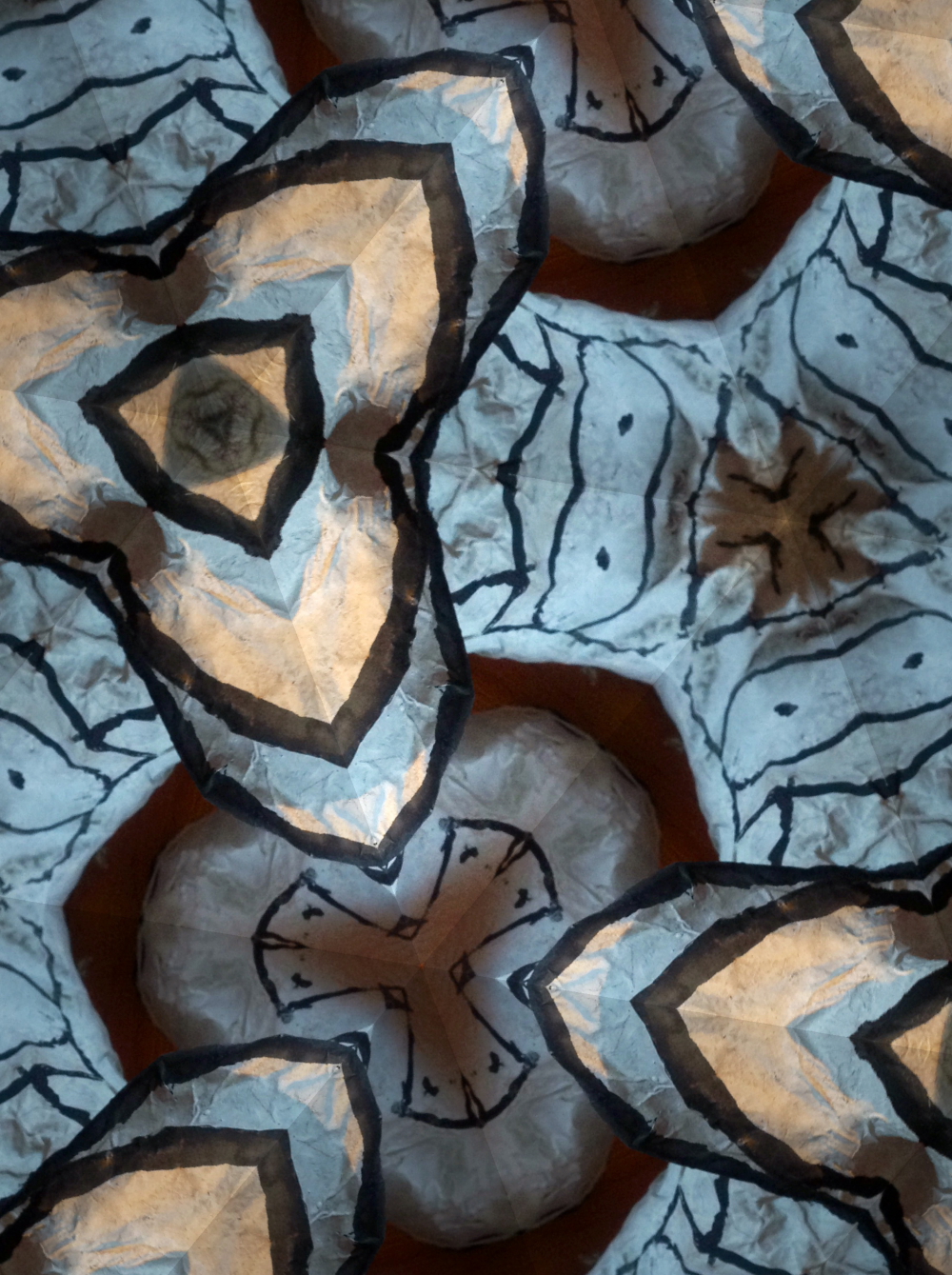
Teleidoscope
* an ongoing series of quotations – mostly from artists, to artists – that offers wisdom, inspiration, and advice for the sometimes lonely road we are on.
A work of art can start you thinking about some aesthetic or philosophical problem; it can suggest some new method, some fresh approach to fiction. But the relationship between reading and writing is rarely so clear-cut…
To be truthful, some writers stop you dead in your tracks by making you see your own work in the most unflattering light. Each of us will meet a different harbinger of personal failure, some innocent genius chosen by us for reasons having to do with what we see as our own inadequacies. The only remedy to this I have found is to read a writer whose work is entirely different from another, though not necessarily more like your own – a difference that will remind you of how many rooms there are in the house of art.
Francine Prose in Reading Like a Writer: A Guide for People Who Love Books and for Those Who Want to Write Them
Comments are welcome!


 barbararachkoscoloreddust.com