Blog Archives
Pearls from artists* # 76

Cabo San Lucas, Mexico
* an ongoing series of quotations – mostly from artists, to artists – that offers wisdom, inspiration, and advice for the sometimes lonely road we are on.
What stops us in our tracks? I am rarely stopped by something or someone I can instantly know. In fact, I have always been attracted to the challenge of getting to know what I cannot instantly categorize or dismiss, whether an actor’s presence, a painting, a piece of music, or a personal relationship. It is the journey towards the object of attraction that interests me. We stand in relation to one another. We long for the relationships that will change our vistas. Attraction is an invitation to an evanescent journey, to a new way of experiencing life or perceiving reality.
An authentic work of art embodies intense energy. It demands response. You can either avoid it, shut it out, or meet it and tussle. It contains attractive and complicated energy fields and a logic all its own. It does not create desire or movement in the receiver, rather it engenders what James Joyce labeled ‘aesthetic arrest.’ You are stopped in your tracks. You cannot easily walk by it and go on with your life. You find yourself in relation to something that you cannot readily dismiss.
Anne Bogart in A Director Prepares: Seven Essays on Art and Theater
Comments are welcome!
Pearls from artists* # 53
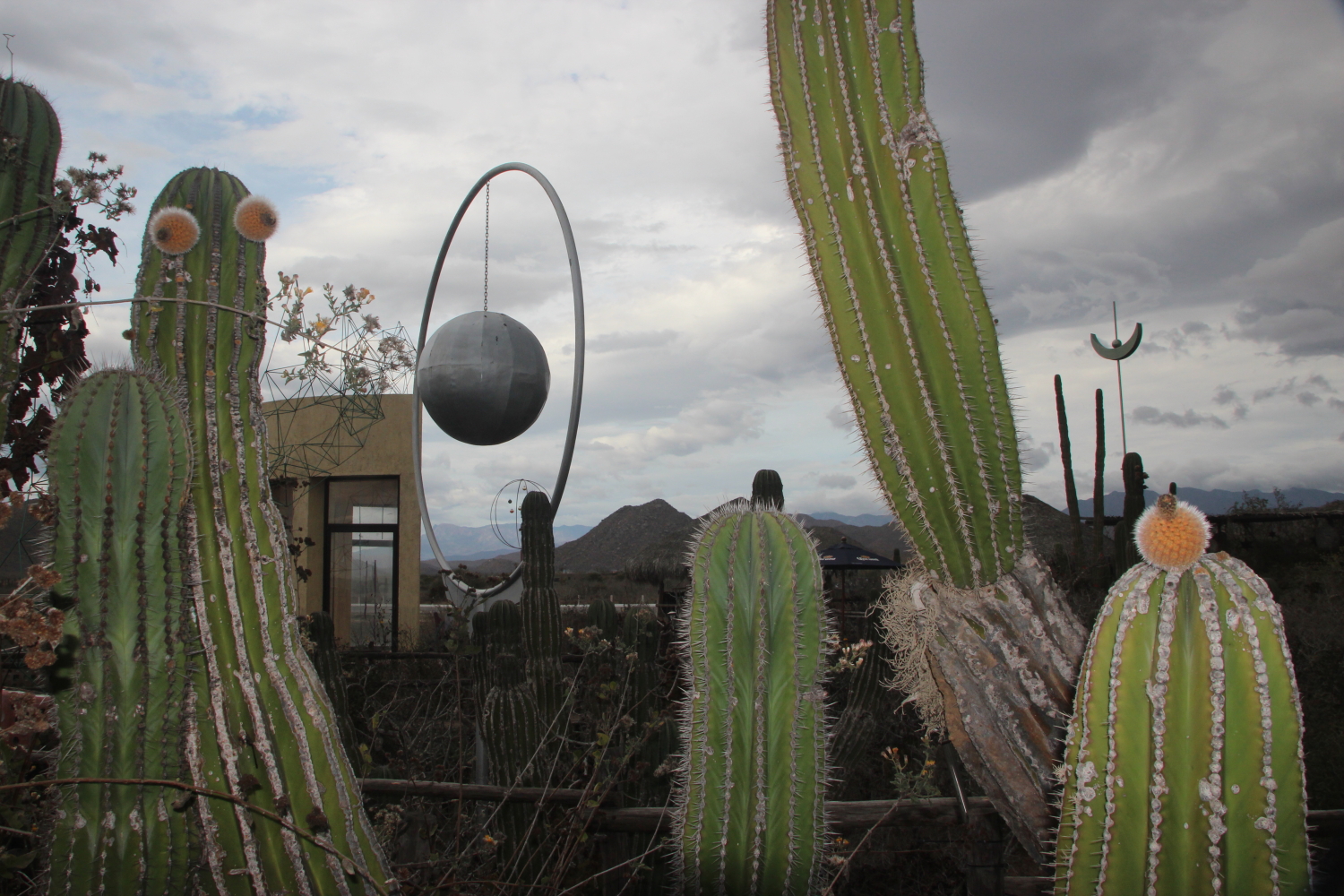
“Art and Beer,” a roadside bar and sculpture garden in Baja del Sur, Mexico
* an ongoing series of quotations – mostly from artists, to artists – that offers wisdom, inspiration, and advice for the sometimes lonely road we are on.
We do treat books surprisingly lightly in contemporary culture. We’d never expect to understand a piece of music on one listen, but we tend to believe we’ve read a book after reading it just once. Books and music share more in terms of resonance than just a present-tense correlation of heard note to read word. Books need time to draw us in, it takes time to understand what makes them, structurally, in thematic resonance, in afterthought, and always in correspondence with the books which came before them , because books are produced by books more than by writers; they’re a result of all the books that went before them. Great books are adaptable; they alter with us as we alter in life, they renew themselves as we change and re-read them at different times in our lives. You can’t step into the same story twice – or maybe it’s that stories. books, art can’t step into the same person twice, maybe it’s that they allow for our mutability, are ready for us at all times, and maybe it’s this adaptability, regardless of time, that makes them art, because real art (as opposed to more transient art, which is real too, just for less time) will hold us at all our different ages like it held all the people before us and will hold all the people after us, in an elasticity and with a generosity that allow for all our comings and goings. Because come then go we will, and in that order.
Ali Smith in Artful
Comments are welcome!
Q: How do you decide on the titles for your pastel paintings?

“Stigmata,” soft pastel on sandpaper, 28″ x 48″
A: Usually a title suggests itself over the course of the months I spend on a painting. Sometimes it comes from a book I’m reading, from a piece of music, a film, bits of overheard conversation. A title can come from anywhere, but finding the best one is key. I like what Jean Cocteau says about this:
One title alone exists. It will be, so it is. Time conceals it from me. How discover it, concealed by a hundred others? I have to avoid the this, the that. Avoid the image. Avoid the descriptive and the undescriptive. Avoid the exact meaning and the inexact. The soft, the hard. Neither long nor short. Right to catch the eye, the ear, the mind. Simple to read and to remember. I had announced several. I had to repeat them twice and the journalists still got them wrong. My real title defies me. It enjoys its hiding place, like a child one keeps calling, and whom one believes drowned in the pond.
Once I have the best title, I make sure it fits the painting exactly. How I do that is difficult to explain. It’s an intuitive process that involves adjusting colors, shapes, and images so that they fit the painting’s meaning, i.e., the meaning hinted at by the title.
Comments are welcome!
Q: Do you listen to music while you work?

A corner of the studio
A: I always have the stereo on when I work in my studio, either tuned in to WBGO (the Newark-based jazz station), WNYC (for news and talk radio; Leonard Lopate, Fresh Air, etc.), WFMU (Fordham University’s radio station, to learn what college kids are listening to) and other local radio stations. I still listen to cd’s, I read the lyrics and the liner notes, and I prefer to listen to music the way artists intended it, meaning that I listen to entire albums from start to finish instead of jumping around between single tracks by different artists. When it comes to music, I’m interested in everything: jazz (especially classic jazz artists like Thelonious Monk, Miles Davis, John Coltrane, Art Blakely, etc.), blues, classical, pop, rock, world music (especially artists from Brazil, Cuba, and any country in Africa), electronic, indy, experimental, ancient music, etc. You name it, I probably listen to it, and if I don’t, I’m eager to learn all about it. When I’m working, certain artists are better to listen to at particular points in a painting. For example, one of my favorite artists to start a new painting with is Lady Gaga. The beat, her energy, and sheer exuberance are perfect when I’m standing in front of my easel with a blank piece of sandpaper in front of me. Gaga’s music gets me moving and working fast, putting down colors instinctively without thinking about them, just feeling everything.
It’s a different story when I am at my apartment and am shooting a photo setup. Then I might or might not listen to music. Lately it’s more about working fast (I shoot 24 images in about 15 minutes), choosing a variety of interesting vantage points, getting surprising effects, etc.
Comments are welcome!
Pearls from artists* # 17

Boat hull
* an ongoing series of quotations – mostly from artists, to artists – that offers wisdom, inspiration, and advice for the sometimes lonely road we are on.
The better you know yourself, the more you will know when you are playing to your strengths and when you are sticking your neck out. Venturing out of your comfort zone may be dangerous, yet you do it anyway because our ability to grow is directly proportional to an ability to entertain the uncomfortable.
… Another thing about knowing who you are is that you know what you should not be doing, which can save you a lot of heartaches and false starts if you catch it early on.
I was giving a lecture to students at Vassar not long ago. Working with the students’ autobiographies, I invited a dance student, a music student who brought his saxophone, and an art student to join me on stage. I asked the dancer to improvise some movement from a tuck position on the floor. I asked the saxophone player to accompany the dancer. And I asked the art student to assign colors to what they were doing. I admit I was constructing a three-ring circus in the lecture hall. But my goal was to bring the three students together by forcing them to work off the same page, and also to free them to discover how far they could go improvising on this simple assignment.
When I asked the art student to read out loud his color impressions, everyone in the hall was taken aback. He droned on and on about himself, feelings he’d had, stories about friends. Not a word about color. Finally I heard “limpid blue” come out of his mouth. I waved my arms, signaling him to stop reading.
“Do you realize,” I said, “that you’ve just recited about five hundred words in an assignment about color? You’ve covered everything under the sun, and ‘limpid blue’ is the first time you’ve mentioned a color. I’m not convinced you want to be a painter.”
As far as I was concerned, this young man was in “DNA denial.” I gave him a painterly exercise and he gave me a text heavy response. A young man with painting in his genes would be rattling off colors immediately. Instead, his vivid use of language – limpid blue does not come in tubes – suggested that he really ought to be a writer.
It would be presumptious of me to think I had him pegged for a writer, not a painter, after that brief encounter. But if I got him to reexamine what he’s built for, then he was a step or two ahead of most people.
Twyla Tharp, The Creative Habit: Learn it and Use it for Life
Comments are welcome.
Q: Does your work look different to you on days when you are sad, happy, etc.?
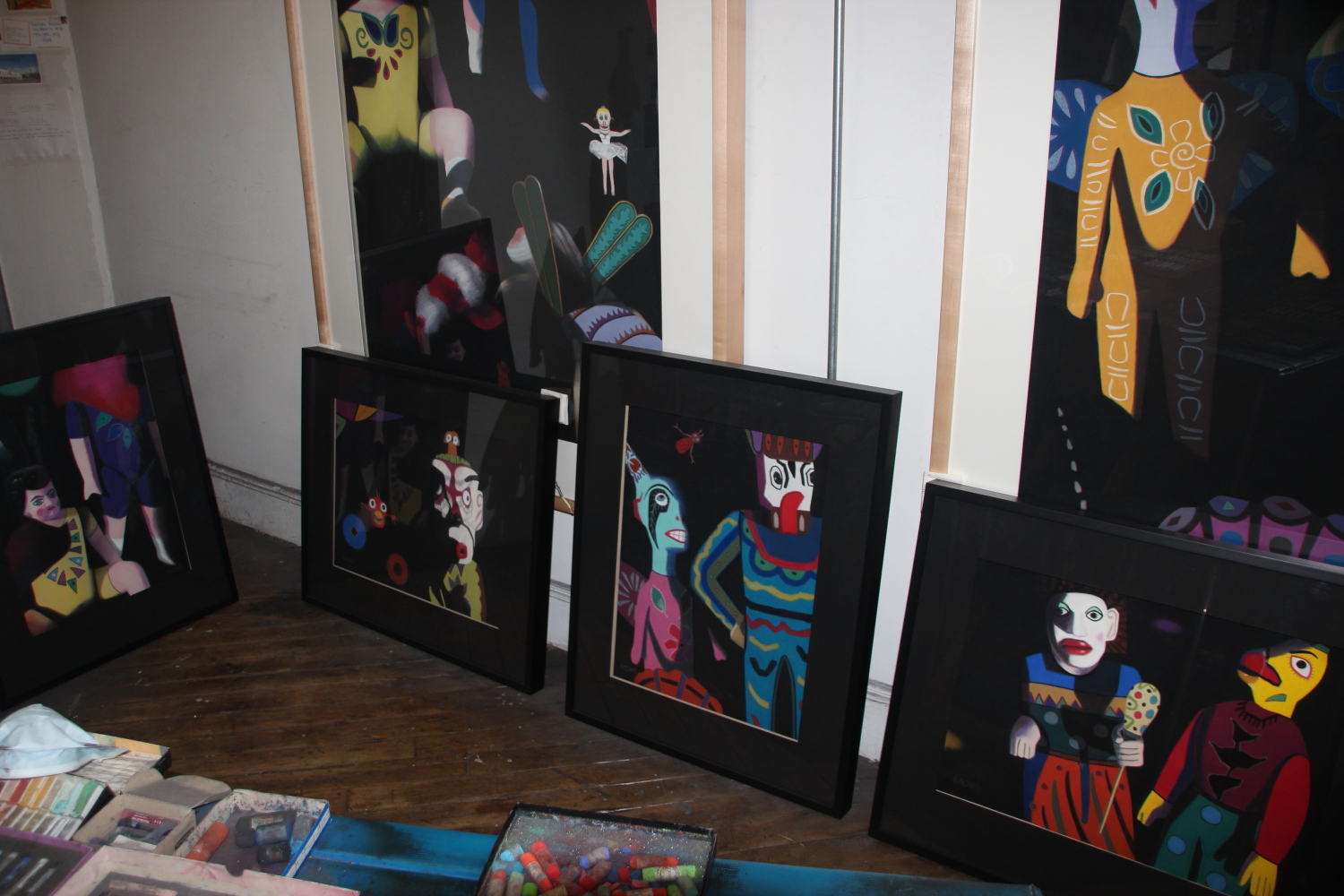
Recent work
A: I’m more critical on days when I am sad so that the faults, imperfections, and things I wish I had done better stand out. Fortunately, all of my work is framed behind plexiglas so I can’t easily go back in to touch up newly-perceived faults. It reminds me of the expression, “Always strive to improve, whenever possible. It is ALWAYS possible!” However, I’ve learned that re-working a painting is a bad idea. You are no longer deeply involved in making it and the zeitgeist has changed. The things you were concerned with are gone: some are forgotten, others are less urgent. For most artists the work is autobiography. Everything is personal. When I look at a completed pastel painting, I usually remember exactly what was happening in my life as I worked on it. Each piece is a snapshot – maybe even a time capsule, if anyone could decode it – that reflects and records a particular moment. When I finally pronounce a piece finished and sign it, that’s it, THE END. It’s as good as I can make it at that point in time. I’ve incorporated everything I was thinking about, what I was reading, how I was feeling, what I valued, art exhibitions I visited, programs that I heard on the radio or watched on television, music that I listened to, what was going on in New york, in the country, in the world, and so on. It is still a mystery how this heady mix finds its way into the work. During the time that I spend on it, each particular painting teaches me everything it has to teach. A painting requires months of looking, reacting, correcting, searching, thinking, re-thinking, revising. Each choice is made for a reason and as an aggregate these decisions dictate what the final piece looks like. On days when I’m sad I tend to forget that. On happier days I remember that the framed pastel paintings that you see have an inevitability to them. If all art is the result of one’s having gone through an experience to the end, as I believe it is, then the paintings could not, and should not, look any differently.
Comments are welcome.
Q: What do your collectors have in common?
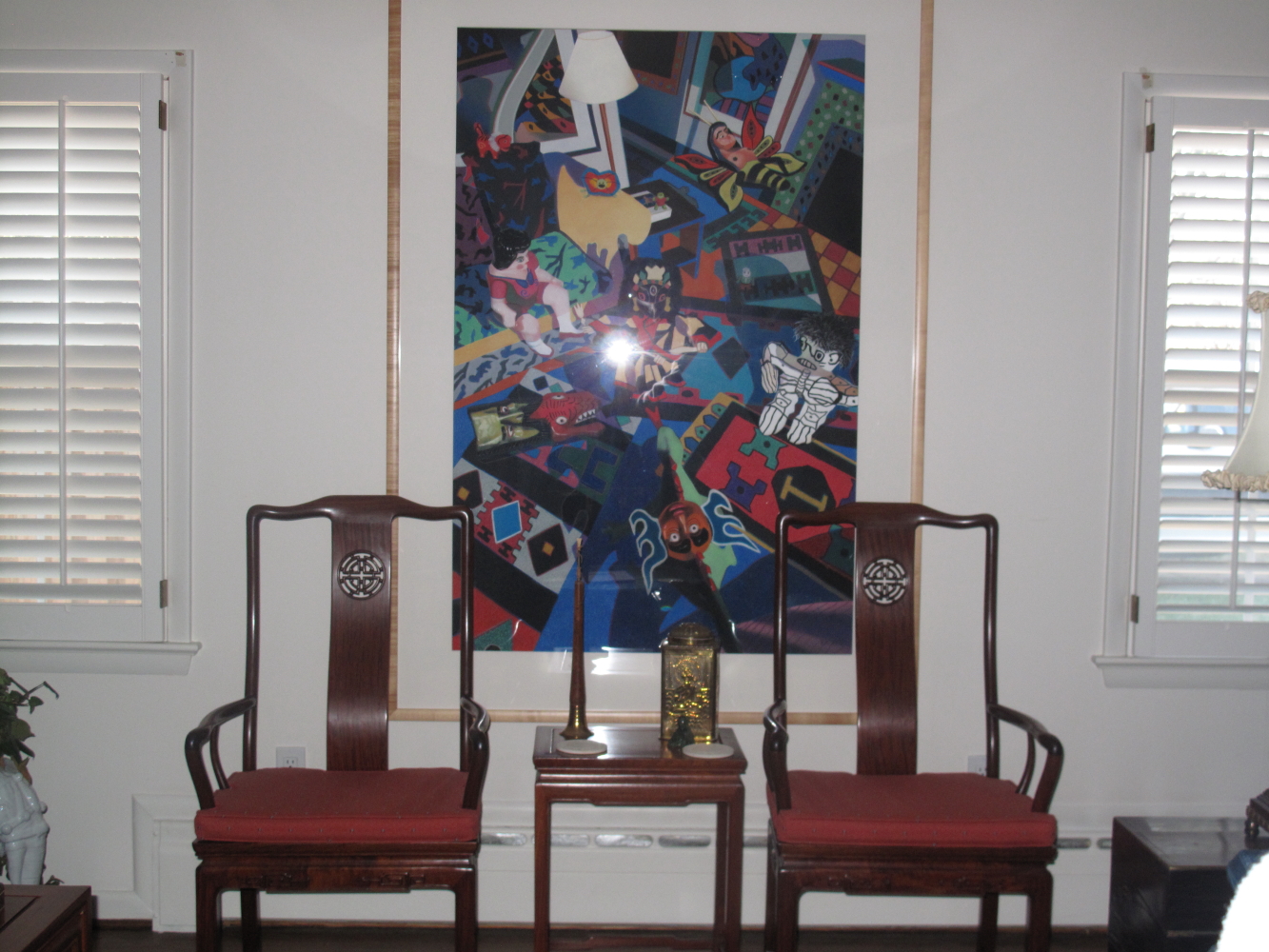
“She Braced Herself for Their Show of Force” at Jim and Judy’s; photo by Judy Bexfield
A: Collectors of my work typically range in age from about 40 to 70, they are college graduates with advanced degrees, they often don’t have kids, which is why they have disposable income and time to pursue their interests in art and culture. When I meet them (presuming my work was sold through a gallery or other third party), we usually have much to talk about – art, art history, photography, cinema, film history, dance, drama, music, travel, archaeology, Mexico, Central and South America, Bali – the list goes on and on.


 barbararachkoscoloreddust.com