Blog Archives
Q: You read books on Friedrich Nietzsche and other philosophers. How has philosophy and your personal experience shaped the latest series, Bolivianos? (Question from Vedica Art Studios and Gallery)
A: It’s difficult to pinpoint how philosophy specifically shaped my work because my curiosity spans so many subjects. Some critics have described me as a Renaissance woman, remarking on my wide-ranging and voracious reading. It’s true—I’m genuinely interested in practically everything!
In pursuit of making art, I have undertaken in-depth studies of numerous intriguing fields: drawing, color, composition, gross anatomy, art and art history, the art business, film history, photography, psychology, mythology, literature, philosophy, religion, music, jazz history, and archaeology—particularly ancient Mesoamerica (Olmec, Zapotec, Mixtec, Aztec, and Maya) and South America (the Inca and their ancestors).
Since the early 1990s, my inspiration and subject matter have come primarily from international travel to remote parts of the globe, especially Mexico, Central America, and South America. Travel is by far the best education! By visiting distant destinations, I have developed a deep reverence for people and cultures around the world. People everywhere are connected by our shared humanity.
These travels, supplemented by extensive research at home, are essential parts of my creative process. Research can be solitary and demanding, but I truly enjoy it. I want to know as much as possible, and this curiosity generates ideas for new work, propelling me into unexplored creative realms.
Foreign travel always expands our ways of thinking. This rich mixture of creative influences continually evolves and finds its way into my pastel paintings. Working, learning, evolving, and growing—I am perpetually curious and can hardly imagine a better way to spend my time on Earth!
Comments are welcome!
Q: What’s on the easel today?

Work in progress
A: I recently returned from a trip to the South of France so I have not been working in my studio as much as usual. Here is the latest progress on “Showman,” soft pastel on sandpaper, 26” x 20”.
Comments are welcome!
Q: What’s on the easel today?

Pastel painting in progress
A: Here is the latest progress on “Showman,” soft pastel on sandpaper, 26” x 20”.
Comments are welcome!
Q: What’s on the easel today?

Work in progress
A: This is the latest progress on “Apparition,” soft pastel on sandpaper, 58” x 38”.
Comments are welcome!
Q: How do you document your work?
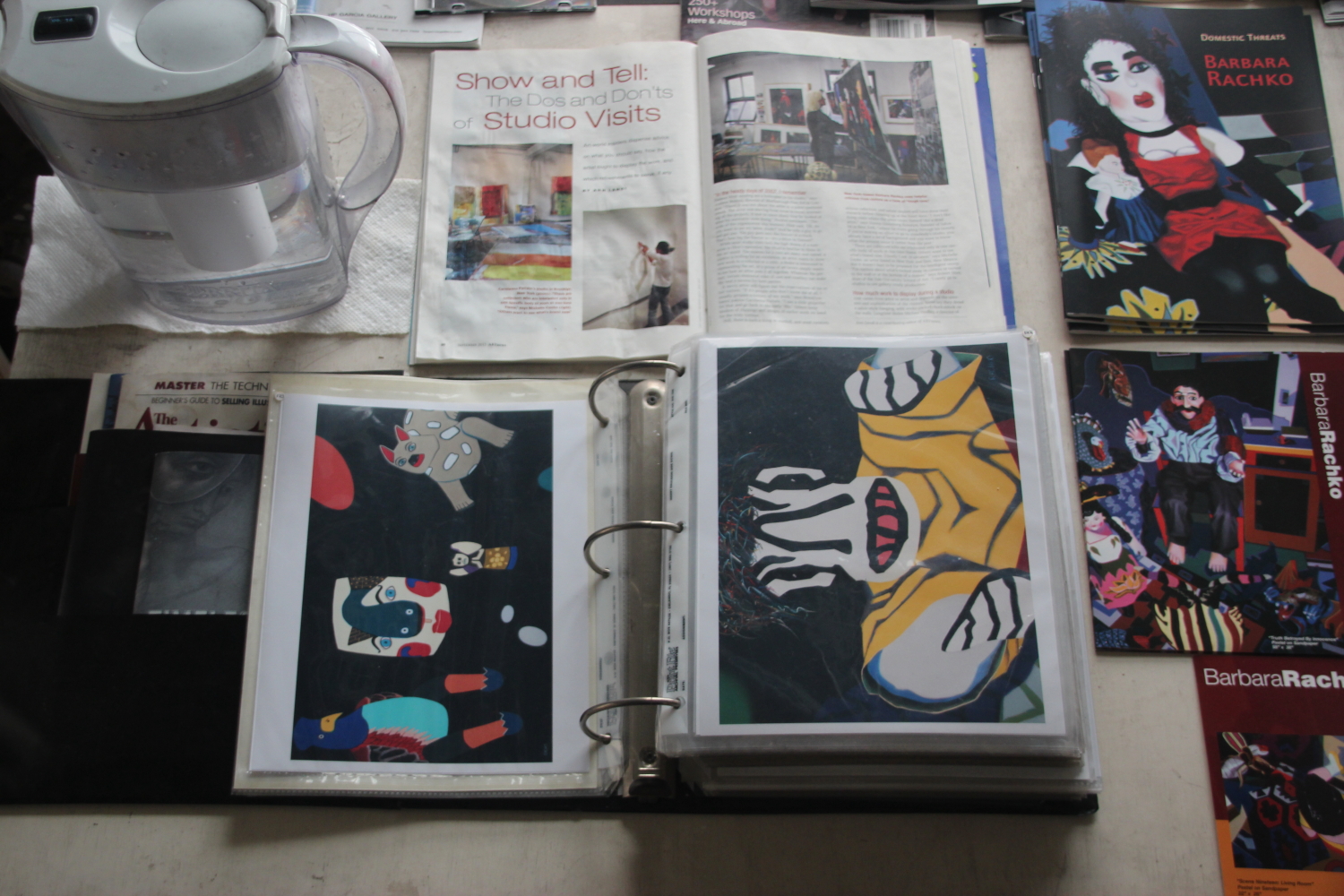
Barbara’s portfolio book
A: I have been a professional artist for thirty years so some things have changed and some haven’t. I have a portfolio book of 8 x 10 photographs of all my pastel paintings. Since my process is slow and meticulous, the latest, “Troublemaker,” is pastel painting number 124.
I have always gotten my work professionally photographed. Until 2001 my husband Bryan was my photographer and since then I have hired three people. To document older work I have slides, 4 x 5 transparencies, and color and black and white 4 x 5 negatives. I continued with slides and film longer than many artists, but finally switched to digital files a few years ago when buying film and processing it became difficult.
Comments are welcome!
Q: What artists influenced the creation of your latest pastel-on-sandpaper painting?

“Incognito,” 38″ x 58,” soft pastel on sandpaper
A: As I continue to evolve my studio practice, I study and learn from various artists, living and long gone, who have mastered visual art and many other disciplines. I cannot point to any particular artists that directly influenced “Incognito” or any other specific paintings.
With “Pearls from artists,” published every Wednesday in this blog, I quote passages from books I am reading that resonant with ideas regarding my work. Readers can perhaps infer some of my influences from those posts.
Comments are welcome!
Pearls from artists* # 21

Apartment building, New York City
* an ongoing series of quotations – mostly from artists, to artists – that offers wisdom, inspiration, and advice for the sometimes lonely road we are on.
It is the beginning of a work that the writer throws away.
A painting covers its tracks. Painters work from the ground up. The latest version of a painting overlays earlier versions, and obliterates them. Writers, on the other hand, work from left to right. The discardable chapters are on the left. The latest version of a literary work begins somewhere in the work’s middle, and hardens toward the end. The earlier version remains lumpishly on the left; the work’s beginning greets the reader with the wrong hand. In those early pages and chapters anyone may find bold leaps to nowhere, read the brave beginnings of dropped themes, hear a tone since abandoned, discover blind alleys, track red herrings, and laboriously learn a setting now false.
Several delusions weaken the writer’s resolve to throw away work. If he has read his pages too often, those pages will have a necessary quality, the ring of the inevitable, like poetry known by heart; they will perfectly answer their own familiar rhythms. He will retain them. He may retain those pages if they possess some virtues, such as power in themselves, though they lack the cardinal virtue, which is pertinence to, and unity with, the book’s thrust. Sometimes the writer leaves his early chapters in place from gratitude; he cannot contemplate them or read them without feeling again the blessed relief that exalted him when the words first appeared – relief that he was writing anything at all. That beginning served to get him where he was going, after all; surely the reader needs it, too, as groundwork. But no.
Every year the aspiring photographer brought a stack of his best prints to an old, honored photographer, seeking his judgment. Every year the old man studied the prints and painstakingly ordered them into two piles, bad and good. Every year the old man moved a certain landscape print into the bad stack. At length he turned to the young man: “You submit this same landscape every year, and every year I put it in the bad stack. Why do you like it so much?” The young photographer said, “Because I had to climb a mountain to get it.”
Annie Dillard, The Writing Life
Comments are welcome!


 barbararachkoscoloreddust.com