Blog Archives
Pearls from artists* # 680

“Sacrificial” (on the wall) and “Trickster” (on the floor)
*an ongoing series of quotations – mostly from artists, to artists – that offers wisdom, inspiration, and advice for the sometimes lonely road we are on.
What makes a work transcendent and powerful is a personal intensity, an ‘extra’ quality. Yet that intensity is exclusive to each artist: extra strangeness, subtlety, causticity, bravado, sensuality, rawness, grandiosity, succinctness, mystery, vulnerability, truth, etc. For an individual artist to infuse an object or an experience with their own ‘extra’ quality requires not only skill or ideas, but the profound benevolence of consistently delivering in spades.
It is this passion and genuine feeling, specific to each creator, that lives on in the art as a gift. It is wrapped up in the work, forever suspended in time. The artist says,
Here… everything I possessed in this moment is embodied in this object… All skills I have painstakingly learned, all of the knowledge I possess, the joy and pain I have felt and all the experiences I have lived. I spun these into the perfect, most sublime form, and packed it up, but for you to unwrap anytime you need sustenance. It will nourish, comfort, and surround you, because you have chosen it.
Each viewer selects which works of art speak to them… which embodied feelings, concepts, and knowledge they value. An empathic connection is forged through the art object or experience. What is love, but to say to someone, ‘you are truly seen and understood?’ Art offers this as well, by reaching out to puncture through the membrane of our emotional isolation, to articulate how we feel in the moments when we cannot find words. It tells the artist and viewer alike, ‘You are not alone. You are not alone in how your brain works. You are not alone in the pain you feel. You are not alone in what you notice or appreciate, or in how much love you have to give.’
Pour that love into an art object. It can handle all the devotion you pack into it, and more.
Kate Kretz in Art From Your Core: A Holistic Guide to Visual Voice
Comments are welcome!
Pearls from artists* # 646

Signing “Apparition,” soft pastel on sandpaper, 58” x 38”
*an ongoing series of quotations – mostly from artists, to artists – that offers wisdom, inspiration, and advice for the sometimes lonely road we are on.
We are the sum of our unique, individual life experiences. The trials we have faced, the causes we fight for, the fears that haunt us, the oddities of our minds; all of these and more become the food for our spirit. The universe does not need repetition from the past; another pretty, but pointless nude, sunlit but stale impressionist landscape, or old and cold minimalist cube. It needs you. It needs you to strip away all that clouds your genuine sense of self. It needs you to unearth and unabashedly own your messy, honest, and magnificent truth. And it needs you to deepen and shape that truth into an authentic core, one that will nourish you and your work for a lifetime.
Kate Kretz in Art From Your Core: A Holistic Guide to Visual Voice
Comments are welcome!
Q: Would you describe your current work in a few sentences?
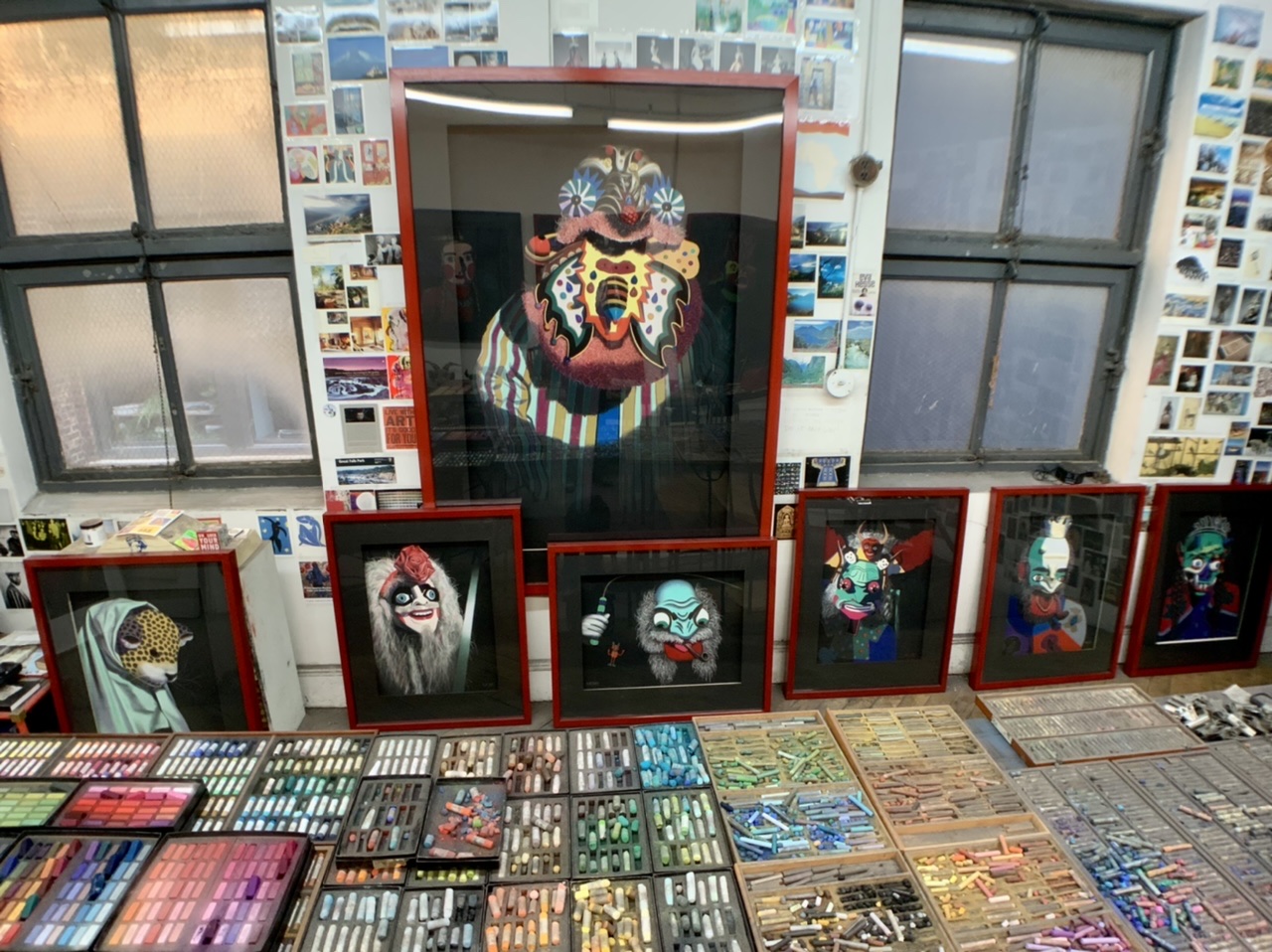
A: Of course, my art practice continually evolves and so does my thinking about its meaning. Using my own iPad photographs of Bolivian Carnival masks from Oruro as source material, for the past five years I have been slowly building a rogue’s gallery of beautiful, if somewhat misunderstood, characters probably best described as oddballs and misfits. For me, the paintings have a deeper meaning as archetypes of the collective unconscious. Creating this series is an act of genuine love. It is my hope that the ”Bolivianos” pastel paintings convey my deep respect and compassion for people around the world.
Comments are welcome!
Pearls from artists* # 450

*an ongoing series of quotations – mostly from artists, to artists – that offers wisdom, inspiration, and advice for the sometimes lonely road we are on.
All the journeys that have transpired in my life have been animated by interest. Something or someone has stopped me in my tracks. Interest, that thing that cannot really be faked, is an invitation to adventure. It has always been disorienting to do but I have to act on these interests. Somehow I know that in order to keep on working as an artist, I have to keep on changing. And this means that when interest is piqued, I must follow or die. And I know that I will have to hang on tight for the ride. These rides have changed me irrevocably.
The primary tool in a creative process is interest. To be true to one’s interest, to pursue it successfully, one’s body is the best barometer. The heart races. The pulse soars. Interest can be your guide. It always points you in the right direction. It defines the quality, energy and content of your work. You cannot feign or fake interest or choose to be interested in something because it is prescribed. It is never prescribed. It is discovered. When you sense this quickening you must act immediately. You must follow that interest and hold tight.
… If the interest is genuine and large enough and if it is pursued with tenacity and generosity, the boomerang effect is resounding. Interest returns volley to affect your life and inevitably alter it. You must be available and attentive to the doors that open unexpectedly. You cannot wait. The doors close fast. It will change your life. It will give you adventures you never expected. You must be true to it and it will be true to you.
Anne Bogart in A Director Prepares: Seven Essays on Art and Theatre
Comments are welcome!
Pearls from artists* # 425

Gladstone, NJ
*an ongoing series of quotations – mostly from artists, to artists – that offers wisdom, inspiration, and advice for the sometimes lonely road we are on.
And yet books were faithful companions for Vincent, an important source of sustenance during his times of melancholy: he periodically re-read his favourites, finding new meaning in the text and illustrations each time. Van Gogh read in at least two ways: first “breathlessly,’ and then ‘by careful exploration.’ But we could add a third and a fourth way: thirdly as an artist, and fourthly from the perspective of the writer he perhaps knew himself to be. To Vincent, reading books meant above all to ‘seek in them the artist who made them,’ as he wrote to his sister Willemien. He sought to open an internal dialogue with other writers as artists, and meditated on their words, stopping to consider and reconsider a phrase to make it resonate within him He did this in more than one language – internalizing words, ruminating, bending them to his will, and finally assigning them to a fate of his choosing, over the years. Remarkably several Prefaces by French Naturalist novelists such as Zola, De Goncourts or Maupassant (today considered genuine manifestos) were among the pages that truly challenged and engaged his mind. In them he found the freedom that he was seeking in painting – the ‘confirmation’ of his own ideas, inspiration and encouragement. The work of the illustrators of his favorite books and magazines equally attracted him and had a lingering effect on him, on which he paused to reflect repeatedly, extracting inspiration indirectly.
Mariella Guzzoni in Vincent’s Books: Van Gogh and the Writers Who Inspired Him
Comments are welcome!
Pearls from artists* # 18

West Village
* an ongoing series of quotations – mostly from artists, to artists – that offers wisdom, inspiration, and advice for the sometimes lonely road we are on.
Those who would make art might well begin by reflecting on the fate of those who preceded them: most who began, quit. It’s a genuine tragedy. Worse yet, it’s an unnecessary tragedy. After all, artists who continue and artists who quit share an immense field of common emotional ground. (Viewed from the outside, in fact, they’re indistinguishable). We’re all subject to a familiar and universal progression of human troubles – troubles we routinely survive, but which are (oddly enough) routinely fatal to the art-making process. To survive as an artist requires confronting these troubles. Basically, those who continue to make art are those who have learned how to continue – or more precisely, have learned how to not quit.
But curiously, while artists always have a myriad of reasons to quit, they consistently wait for a handful of specific moments to quit. Artists quit when they convince themselves that their next effort is already doomed to fail. And artists quit when they lose the destination for their work – for the place their work belongs.
Virtually all artists encounter such moments. Fear that your next work will fail is a normal, recurring, and generally healthy part of the art-making cycle. It happens all the time: you focus on some new idea in your work, you try it out, run with it for awhile, reach a point of diminishing returns, and eventually decide it’s not worth pursuing further. Writers even have a phrase for it – “the pen has run dry” – but all media have their equivalents. In the normal artistic cycle this just tells you that you’ve come full circle, back to that point where you need to begin cultivating the next new idea. But in artistic death it marks the last thing that happens: you play out an idea, it stops working, you put the brush down… and thirty years later you confide to someone over coffee that, well, yes, you had wanted to paint when you were much younger. Quitting is fundamentally different from stopping. The latter happens all the time. Quitting happens once. Quitting means not starting again – and art is all about starting again.
David Bayles and Ted Orland, Art & Fear
Comments are welcome!


 barbararachkoscoloreddust.com