Blog Archives
Q: Over your 40-year career as an artist, you have managed to keep presentation, technical, subject matter, conceptual consistencies in your art practice and work. How do you manage to filter out inspirations that might be luring at that moment but do not support your art practice? For example, you master pastel works. There must have been moments when you might have been inspired to make oil works. How do you keep such inspirations aside. (Question from Vedica Art Studios and Gallery)

A: About thirty-five years ago, when my pastel paintings were becoming larger—around 60” x 40”—I had to choose between transitioning to oil on canvas or continuing with pastel. Framing was the main concern. I wasn’t certain large pastels could be framed, and even if they could, the cost might be prohibitive. However, I had already fallen in love with pastel and knew no other medium could offer such vibrant colors or velvety textures. Determined, I resolved the framing issue (art-making is fundamentally problem-solving), committed myself fully to soft pastel, and have continued inventing and refining techniques ever since.
My goal from the beginning has always been improvement as an artist. If an activity doesn’t contribute to my growth—as a person or as an artist—I typically don’t pursue it. Time and energy are finite resources, so I try to use them wisely.
Comments are welcome!
Q: Many of the world’s cultures have a mask tradition. Is there something special about Bolivian masks that first attracted you to them?

Bolivian Carnival Mask
A: My subject matter emerges directly from my travels. I visited Bolivia in 2017. What I especially liked then – and now – about Bolivian Carnival masks, is that they include additional textures – feathers, fur, costume jewelry, sequins, fabric, etc. that add to their physical presence. Masks from most of the other countries I’ve visited tend to be made of wood and/or paper mache and nothing else. In my view such masks are not as dramatic nor do they offer much expressive potential. They feel dead. They lack a certain “soulfulness.”
Furthermore, textures are challenging to render in soft pastel. For more than three decades I have been striving to improve my pastel techniques. By now I have a vast repertoire from which to select. As was true in my earlier series, with “Bolivianos” an important personal goal is to keep adding to the repertoire.
It takes months to create a pastel painting, which means I need masks that will hold my attention every day over the course of three or four months. I never want to be bored in the studio. If I am bored while making the work, those feelings will be directly transferred and I will make a boring pastel painting, something I hope never to do! The masks need to have a really strong ‘presence.’ Then as I slowly make a pastel painting, one that is exciting to work on from start to finish, I can transform my subject into something surprising and powerful that has never existed before!
Comments are welcome!
Pearls from artists* # 439

New York Harbor
* an ongoing series of quotations – mostly from artists, to artists – that offers wisdom, inspiration, and advice for the sometimes lonely road we are on.
Art is a way of preserving experiences, of which there are many transient and beautiful examples, and that we need help containing. There is an analogy to be made with the task of carrying water and the tool that helps us do it. Imagine being out in a park on a blustery April day. We look up at the clouds and feel moved by their beauty and grace. They feel delightfully separate from the day-to-day bustle of our lives. We give our minds to the clouds, and for a time we are relieved of our preoccupations and placed in a wider context that stills the incessant complaints of our egos. John Constable’s cloud studies invite us to concentrate, much more than we would normally, on the distinctive textures and shapes of individual clouds, to look at their variations in colour and at the way they mass together. Art edits down complexity and helps us to focus, albeit briefly, on the most meaningful aspects. In making his cloud studies, Constable didn’t expect us to become deeply concerned with meteorology. The precise nature of a cumulonimbus is not the issue. Rather, he wished to intensify the emotional meaning of the soundless drama that unfolds daily above our heads, making it more readily available to us and encouraging us to afford it the central position it deserves.
Alain de Botton and John Armstrong in Art as Therapy
Comments are welcome!
Q: Your work is unlike anyone else’s. There is such power and boldness in your pastels. What processes are you using to create such poignant and robustly colored work?

Barbara working on an interview. Photo: Maria Cox
A: For thirty-three years I have worked exclusively in soft pastel on sandpaper. Pastel, which is pigment and a binder to hold it together, is as close to unadulterated color as an artist can get. It allows for very saturated color, especially using the self-invented techniques I have developed and mastered. I believe my “science of color” is unique, completely unlike how any other artist works. I spend three to four months on each painting, applying pastel and blending the layers together to mix new colors on the paper.
The acid-free sandpaper support allows the buildup of 25 to 30 layers of pastel as I slowly and meticulously work for hundreds of hours to complete a painting. The paper is extremely forgiving. I can change my mind, correct, refine, etc. as much as I want until a painting is the best I can create at that moment in time.
My techniques for using soft pastel achieve rich velvety textures and exceptionally vibrant color. Blending with my fingers, I painstakingly apply dozens of layers of pastel onto the sandpaper. In addition to the thousands of pastels that I have to choose from, I make new colors directly on the paper. Regardless of size, each pastel painting takes about four months and hundreds of hours to complete.
I have been devoted to soft pastel from the beginning. In my blog and in numerous interviews online and elsewhere, I continue to expound on its merits. For me no other fine art medium comes close.
My subject matter is singular. I am drawn to Mexican, Guatemalan, and Bolivian cultural objects—masks, carved wooden animals, papier mâché figures, and toys. On trips to these countries and elsewhere I frequent local mask shops, markets, and bazaars searching for the figures that will populate my pastel paintings. How, why, when, and where these objects come into my life is an important part of the creative process. Each pastel painting is a highly personal blend of reality, fantasy, and autobiography.
Comments are welcome!
Travel photo of the month*
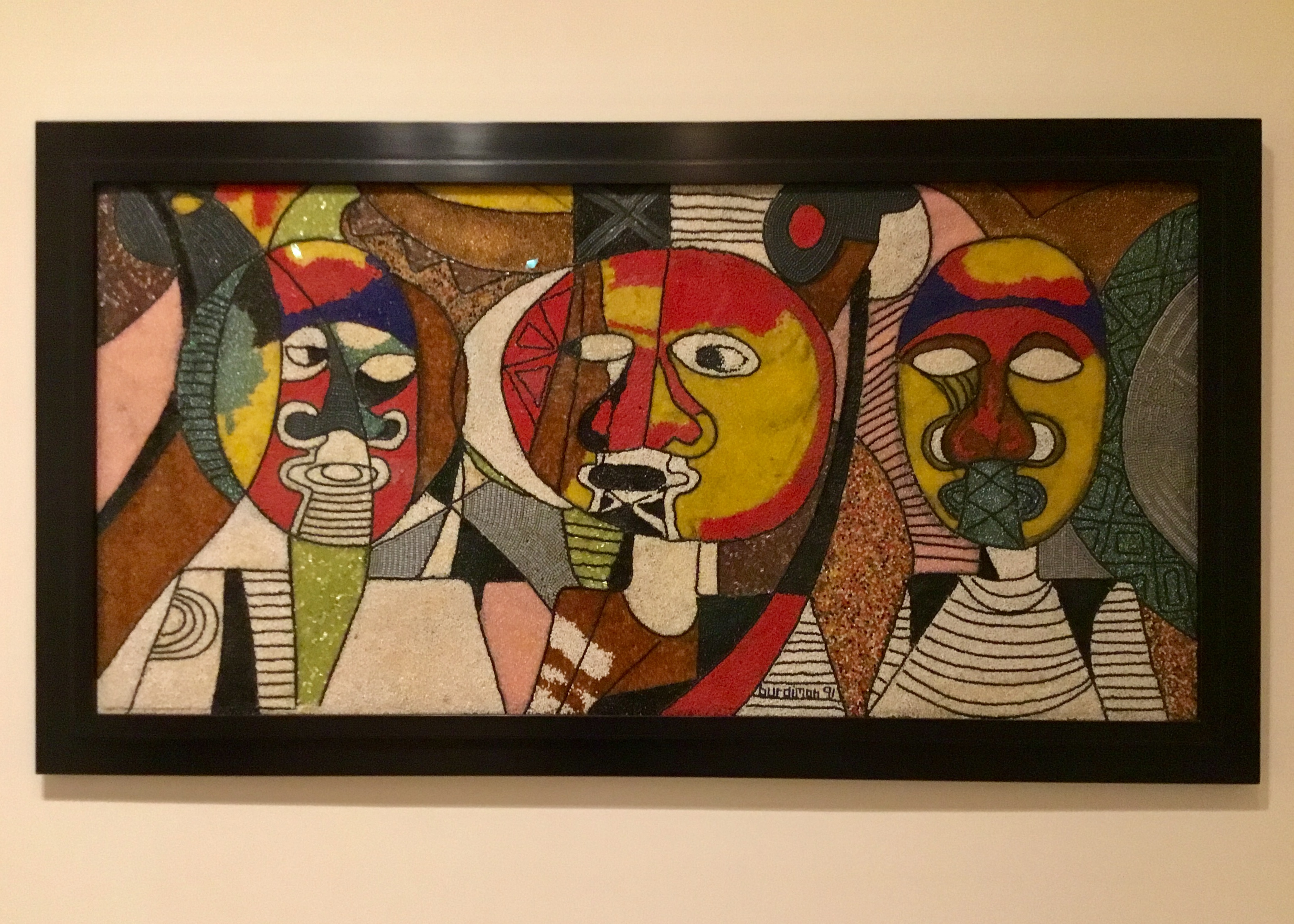
“The Three Wise Men,” Jimoh Buraimoh, Glass beads, plastic cylinders, cotton, epoxy, plywood, 1991
* Favorite travel and other photographs that have not yet appeared in this blog.
A: I saw this painting at the Baltimore Museum of Art and was intrigued by the intracacy and textures of the beads, cylinders, and other items used by Jimoh Buraimoh, a Nigerian modernist. The figures are his portrayal of the three men who traveled to England in 1960 to negotiate Nigeria’s independence. Buraimoh honors the nation’s founders with materials that glorify Yoruba heritage and artistic traditions. His title also associates the men with the three wise men of the Bible. I enjoy this work very much and couldn’t help being reminded of imagery by Picasso.
Comments are welcome!


 barbararachkoscoloreddust.com