Blog Archives
Pearls from artists* # 497
*an ongoing series of quotations – mostly from artists, to artists – that offers wisdom, inspiration, and advice for the sometimes lonely road we are on.
Peter Jensen: Would you say there’s any kind of statement you’re making in the things which you write?
Ursula K. LeGuin: Of course, I suppose in everything I write I am making some sort of statement, but I don’t know just what the statement is. Which I can’t say I feel guilty about. If you can say exactly what you mean by a story, then why not just say it in so many words? Why go to all the fuss and feathers and make up a plot and characters? You say it that way, because it’s the only way you can say it.
Ursula K. LeGuin: The Last Interview and Other Conversations, edited and with an introduction by David Streitfeld
Comments are welcome!
Pearls from artists* # 340

Lower Manhattan
* an ongoing series of quotations – mostly from artists, to artists – that offers wisdom, inspiration, and advice for the sometimes lonely road we are on.
What, do you suppose, are the lives of those who raise themselves above the level of the common herd? A continual struggle. A writer, for instance, must struggle against the laziness which he shares with the ordinary man when it comes to writing, because his genius demands to be heard, it is not merely of an empty desire for fame that he obeys, it is a matter of conscience. Let those who work coldly and calmly keep silence, for they have no conception of what it means to work under the spur of inspiration – the dread, the terror of rousing the sleeping lion whose roaring moves us to the very depth of our being. To sum up: be strong, simple, and true; here is an aim for every moment of the day, and it is always useful.
The Journal of Eugene Delacroix, edited by Hubert Wellington
Comments are welcome!
Pearls from artists* # 209

“So What?”, soft pastel on sandpaper, 20″ x 26″
* an ongoing series of quotations – mostly from artists, to artists – that offers wisdom, inspiration, and advice for the sometimes lonely road we are on.
For a young painter, life is difficult. If he’s sincere, if he’s entirely taken up with what he’s researching, he can’t do painting that flatters art lovers. If he’s concerned with success, he works with just the one idea: pleasing people and selling. He loses the support of his own conscience and is dependent on how others are feeling. He neglects his gifts and eventually loses them.
For us, the problem was simple: the buyer simply didn’t exist. We were working for ourselves. We were in a trade that offered no hope at all. So we had fun with any little thing. I suppose people shipwrecked on a desert island must find it very jolly – all their problems have ceased to exist. Nothing left to do but have a laugh, tell jokes, and play jokes. Painters? How could they ever expect to sell anything?
Chatting with Henri Matisse: The Lost 1941 Interview, Henri Matisse with Pierre Courthion, edited by Serge Guilbaut, translated by Chris Miller
Comments are welcome!
Q: Do you have any favorites among the Mexican and Guatemalan folk art figures that you depict in your work?

Idea for an upcoming pastel painting
A: I suppose it seems that way, since I certainly paint some figures more than others. My favorite characters change, depending on what is happening in my work. My current favorites are a figure I have never painted before (the Balinese dragon above) and several Mexican and Guatemalan figures last painted years ago. All will make an appearance in a pastel painting for which I am still developing preliminary ideas (above).
Comments are welcome!
Q: How do you know when a series has ended?

“A Promise, Meant to be Broken,” soft pastel on sandpaper, 58″ x 38″
A: I suppose it’s when there is nothing left to say within a particular body of work. The urgency to add something I haven’t tried vanishes. Usually I can’t even think of anything I haven’t tried.
I knew with certainty that the “Domestic Threats” series was finished while “A Promise Meant to be Broken” was still on my easel. It’s no accident that I included a self-portrait. This painting was my way of saying good-bye to an important body of work – literally turning my back on it – and summing up where the work had taken me.
For artists each series is a creative journey with a beginning, a middle, and an end. At a certain point it’s over. Then you build on what you’ve accomplished and move on to create something new. The connection between new work and old may not always be obvious, but one thing is certain: all the previous work laid the groundwork for what you make today.
Comments are welcome!
Pearls from artists* # 115
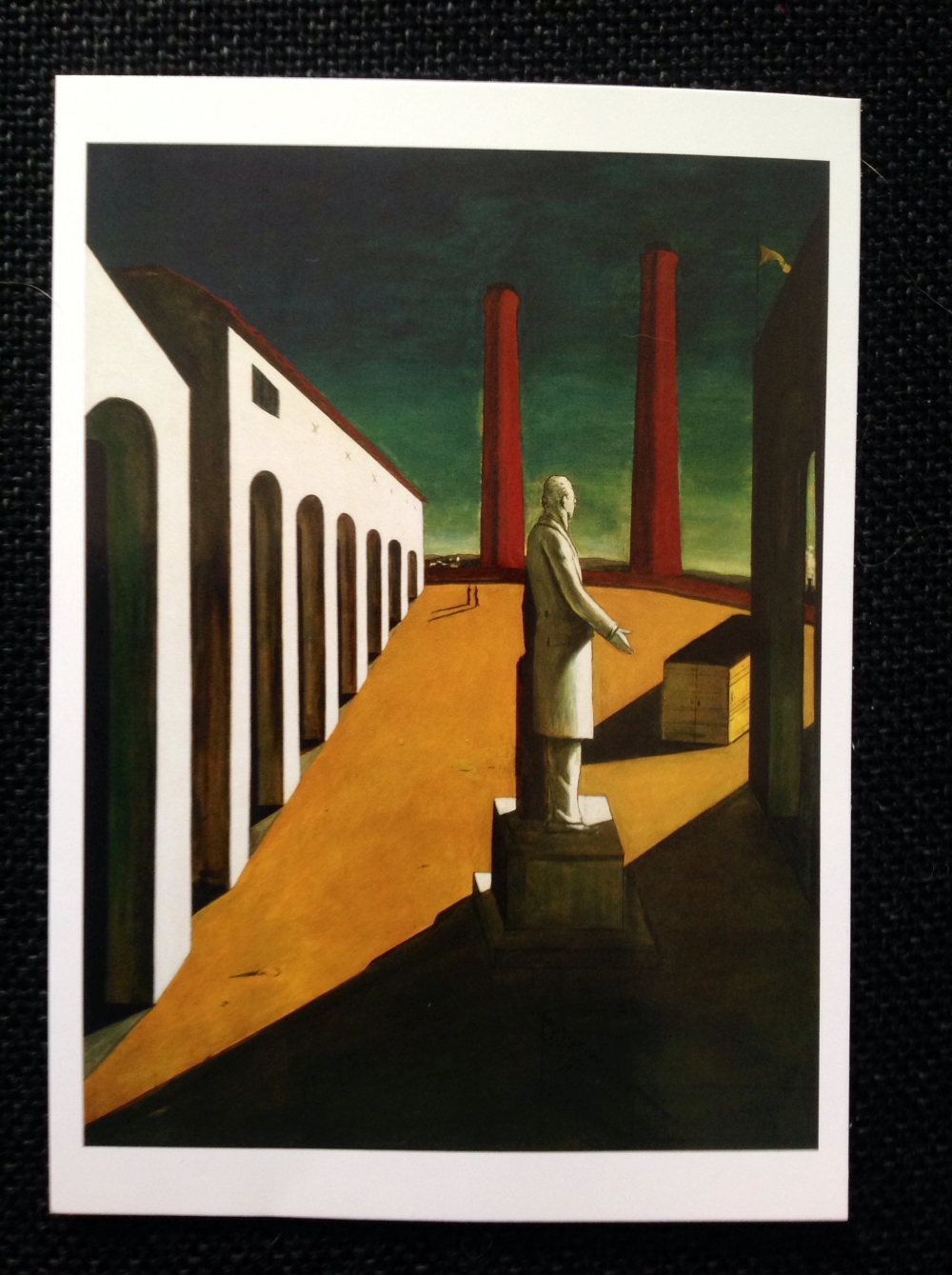
Giorgio de Chirico, “The Enigma of a Day,” oil on canvas, 6′ 1 1/4 x 55,” MoMA
* an ongoing series of quotations – mostly from artists, to artists – that offers wisdom, inspiration, and advice for the sometimes lonely road we are on.
THE DISQUIETING MUSES
From Two de Chiricos
[On Giorgio de Chirico]
Boredom sets in first, and then despair.
One tries to brush it off. It only grows.
Something about the silence of the square.
Something is wrong; something about the air,
It’s color; about the light, the way it goes.
Something about the silence of the square.
The muses in their fluted evening wear,
Their faces blank, might lead one to suppose
Something about the silence of the square.
Something about the buildings standing there.
But no, they have no purpose but to pose.
Boredom sets in first, and then despair.
What happens after that, one doesn’t care.
What brought one here – the desire to compose
Something about the silence of the square.
Or something else, of which one’s not aware,
Life itself, perhaps – who really knows?
Boredom sets in first and then despair…
Something about the silence of the square.
Mark Strand in Art and Artists: Poems, edited by Emily Fragos
Comments are welcome!


 barbararachkoscoloreddust.com