Blog Archives
Pearls from artists* # 636

*an ongoing series of quotations – mostly from artists, to artists – that offers wisdom, inspiration, and advice for the sometimes lonely road we are on.
Some artists will rework a piece for half a lifetime before they know it is finished. An improviser may have to practice for years before being able to play a totally spontaneous minute of music in which every detail is right for its own fleeting moment. The great scientists and scholars are not those who publish or perish at any cost, but rather those who are willing to wait until the pieces of the puzzle come together in nature’s own design. The fruits of improvising, composing, writing, inventing, and discovering may flower spontaneously, but they arise from soil that we have prepared, fertilized, and tended in the faith that they will ripen in nature’s own time.
Stephen Nachmanovitch in Free Play: Improvisation in Life and Art
Comments are welcome!
Pearls from artists* # 418
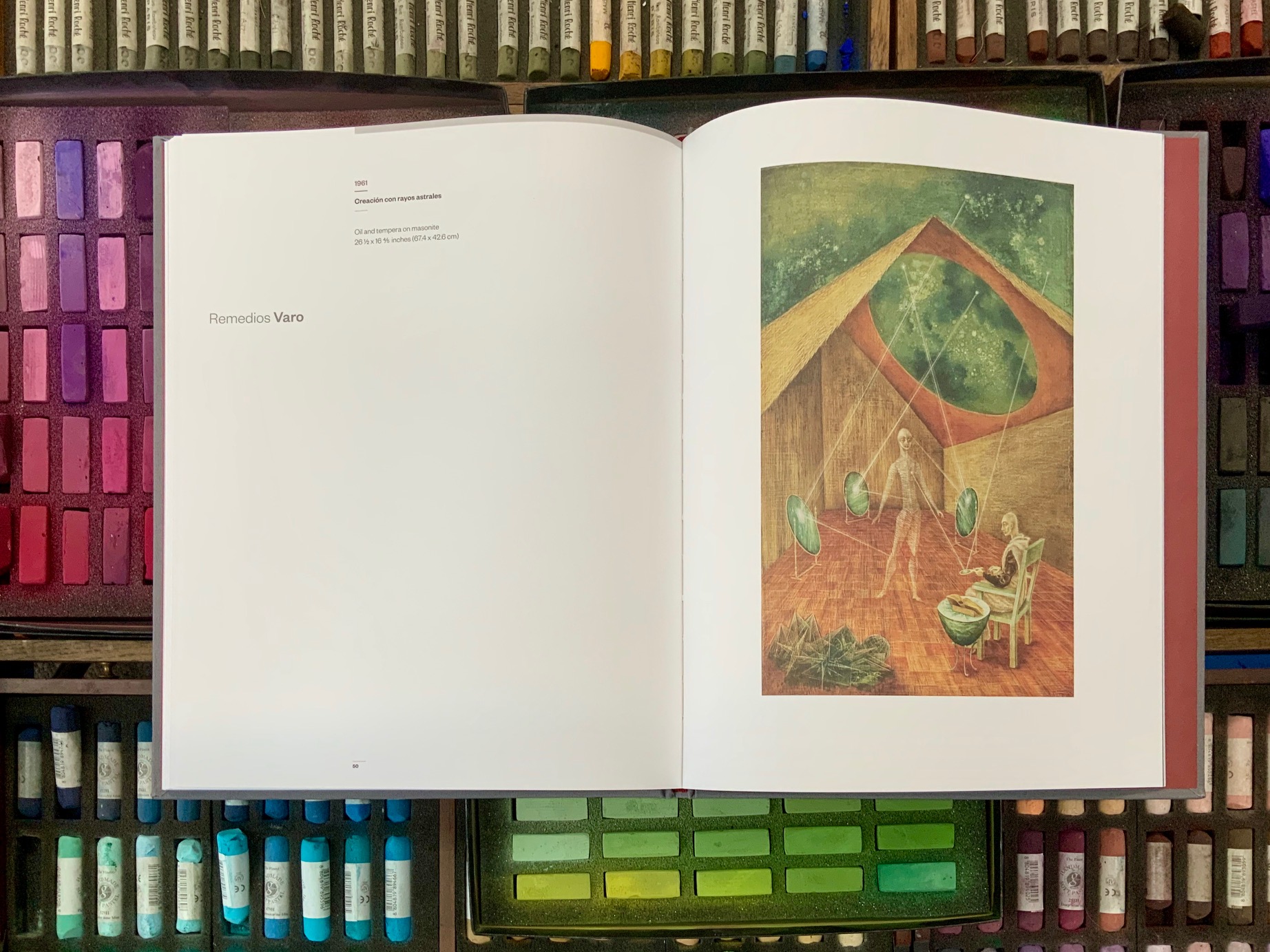
A Remedios Varo Plate from “Science and Surrealism”
*an ongoing series of quotations – mostly from artists, to artists – that offers wisdom, inspiration, and advice for the sometimes lonely road we are on.
… both Surrealism’s birth and infancy coincided with probably the most momentous period in the history of physics. The first Surrealist text, written by Andre Breton and Philippe Soupault and titled Magnetic Fields, deployed the spontaneous technique of ‘automatic writing,’ which supposedly allowed direct access to unconscious material. It appeared in 1920 but was written in the previous year, coinciding with the expedition led by the English astrophysicist, Arthur Eddington, to observe the solar eclipse from the island of Principe off the west coast of Africa. It was this journey that proved predictions set out in Einstein’s General Theory of Relativity (1916) about the gravitational deflection of light by the sun. Eddington’s experiment led not only to Einstein’s instant, mythic status as the ‘new Copernicus’ and the swift popularization of Relativity, but more specifically its appearance in the early theoretical writings of Surrealism’s principle spokesman, Breton, which helped lay the foundations of the movement. Breton’s subsequent manifesto texts of 1924 and 1929, extending his discussion of what he deemed the narrow, restrictive logic of Western though, can be situated within the same historical context that bore the revolutionary discoveries of quantum mechanics, culminating in 1927.
“Sibylline Strangeness: Surrealism and Modern Physics,” by Gavin Parkinson in Science in Surrealism, published by Gallery Wendy Norris
Comments are welcome!
Pearls from artists* # 391

“Schemer,” Soft Pastel on Sandpaper, 26” x 20,” packed up for transport to the framer
*an ongoing series of quotations – mostly from artists, to artists – that offers wisdom, inspiration, and advice for the sometimes lonely road we are on.
Charles Baudelaire once wrote that the frenzy of the artist
is the fear of not going fast enough, of letting the phantom escape before the synthesis has been extracted and pinned down; it is that terrible fear which takes possession of all great artists and gives them such a passionate desire to become masters of every means of expression so that the orders of the brain may never be perverted by the hesitations of the hand and that finally… ideal execution, may become as unconscious and spontaneous as is digestion for a healthy man after dinner.
Mary Gabriel in Ninth Street Women
Comments are welcome!
Q: What is it about soft pastel that you find so intriguing that you use it as your primary fine art medium?

Some of Barbara’s pastels
A: For starters it’s the medium that I fell in love with many years ago. I recently read this article online, “What is Pastel?” by Mike Mahon, and will quote it because it neatly sums up what I love about working with pastel.
Pastel is the most permanent of all media when applied to conservation ground and properly framed. Pastel has no liquid binder that may cause it to oxidize with the passage of time as oftentimes happens with other media.
In this instance, Pastel does not refer to pale colors, as the word is commonly used in cosmetic and fashion terminology. The pure, powdered pigment is ground into a paste with a minimum amount of gum binder, rolled into sticks and dried. The infinite variety of colors in the Pastel palette range from soft and subtle to hard and brilliant.
An artwork is created by stroking the stick of dry pigment across an abrasive ground, embedding the color in the “tooth” of the ground. If the ground is completely covered with Pastel, the work is considered a Pastel painting; whereas, leaving much of the ground exposed produces a Pastel sketch. Techniques vary with individual artists. The Pastel medium is favored by many artists because it allows a spontaneous approach. There is no drying time, therefore, no change in color occurs after drying as it does in other media.
Did you know that a particle of Pastel pigment seen under a microscope looks like a diamond with many facets? It does! Therefore, Pastel paintings reflect light like a prism. No other medium has the same power of color or stability.
Historically, Pastel can be traced back to the 16th century. Its invention is attributed to the German painter, Johann Thiele. A Venetian woman, Rosalba Camera, was the first to make consistent use of Pastel. Chardin did portraits with an open stroke, while La Tour preferred the blended finish. Thereafter, a galaxy of famous artists—Watteau, Copley, Delacroix, Millet, Manet, Renoir, Toulouse Lautrec, Vuillard, Bonnard, Glackens, Whistler, Hassam, William Merritt Chase—used Pastel for a finished work rather than for preliminary sketches.
Pastels from the 16th century exist today, as fresh as the day they were painted. Edgar Degas was the most prolific user of Pastel and its champion. His protégé, Mary Cassat, introduced Pastel to her friends in Philadelphia and Washington, and thus to the United States. In the Spring of 1983, Sotheby Parke Bernet sold at auction, two Degas Pastels for more than $3,000,000 each! Both Pastels were painted about 1880.
Note: Do not confuse Pastel with “colored chalk.” Chalk is a porous, limestone substance impregnated with dyes, whereas, Pastel is pure pigment—the same as is used in other permanent painting media.
Today, Pastel paintings have the stature of oil and watercolor as a major fine art medium. Many of our most renowned, living artists have distinguished themselves in Pastel and have enriched the art world with this beautiful medium.
So knowing all this, I often wonder, why don’t more artists use pastel? Is it because framing is a big issue? Works on paper need to be framed and pastel paintings have unique problems (see my April 27, 2013 blog post). Second only to the cost of maintaining a studio in New York City, frames are my single largest business expense. Sometimes I am grateful that pastel is a very slow medium. I typically finish 4 or 5 paintings in a year, which means I only have to pay for 4 or 5 frames!
Comments are welcome!
Q: Your “Gods and Monsters” series consists of tableaux of Mexican and Guatemalan figures that are photographed in a way that blurs certain elements to abstraction while others are in clear focus. Can you please speak more about this work?

Untitled chromogenic print, 24″ x 24″, edition of 5
A: When I depict the Mexican and, more recently, Guatemalan figures in my pastel-on-sandpaper paintings, they are hard-edged, vibrant, and in-your-face. That’s a result of the way I work in pastel. I slowly and meticulously build up layers of pigment, blend them with my fingers, continually refine and try to find the best, most eye-popping colors. It’s a very slow process that takes months of hard work. An aside… One frustration I have as an artist – I am hardly unique in this – is that my audience only sees the finished piece and they look at it for perhaps ten seconds. They rarely think about how their ten-second experience took me months to create!
In 2002 when I began photographing these figures, I wanted to take the same subject matter and give it an entirely different treatment. So these images are deliberately soft focus, dreamy, and mysterious. I use a medium format camera and shoot film. I choose a narrow depth of field. I hold gels in front of the scene to blur it and to provide unexpected areas of color. Even as a photographer I am a colorist.
I want this work to surprise me and it does, since I don’t usually know what images I will get. Often I don’t even look through the viewfinder as I position the camera and the gels and click the shutter. I only know what I’ve shot after I’ve seen a contact sheet, usually the next day.
The “Gods and Monsters” series began entirely as a reaction to my pastel paintings. The latter are extremely meticulous and labor intensive. At a certain point in the process I know more or less what the finished painting will look like, but there are still weeks of slow, laborious detail work ahead. So my photographic work is spontaneous, serendipitous, and provides me with much-needed instant gratification. I find it endlessly intriguing to have two diametrically opposed ways of working with the same subject.
Comments are welcome!


 barbararachkoscoloreddust.com