Blog Archives
Q: You’re also known for being remarkably consistent with your blog and writing. How do you keep that rhythm? (Question from “Pastel, Passion, and Perseverance: An Interview with Barbara Rachko” in .ART Odyssey: Healing)
A page from the interview
A: It’s become habit. I started in 2012 and now I post twice a week.
On Wednesdays, I quote from a book I’m reading, paired with a photo. On Saturdays, I rotate: one week “What’s on the Easel,” another a travel photo, and twice a month a short reflection. Only two posts a month require real writing, so it’s sustainable. Consistency has been everything.
Comments are welcome!
Pearls from artists* # 644

Barbara’s Studio
*an ongoing series of quotations – mostly from artists, to artists – that offers wisdom, inspiration, and advice for the sometimes lonely road we are on.
Making the work you were born to make is a radical act of resistance in the current social climate. It refuses to hold money or power as its highest value. It takes as much time as it needs. It demands quiet and stillness. It involves deep reflection and reverence. It prioritizes uncool traits of curiosity, wonder, and earnestness. It shuns the superficial, contorting to reach far beyond it for the significant. It answers to no one but itself and has not been diluted by corporate committee. It doesn’t pander. It can tell stories that make people uncomfortable. And, despite all attempts to frame it as such, unlike most other activities, art is not a competitive sport.
Kate Kretz in Art From Your Core: A Holistic Guide to Visual Voice
Comments are welcome!
Pearls from artists* # 632

*an ongoing series of quotations – mostly from artists, to artists – that offers wisdom, inspiration, and advice for the sometimes lonely road we are on.
”The mind once stretched by a new idea, never returns to its original dimensions.” – Ralph Waldo Emerson ((1803 – 1882)
Ralph Waldo Emerson was more prescient than he can ever have realized. It was not until the 1960s that neuroscientist Marian Diamond discovered that exposure to enriched environments increased brain matter, specifically in the brain’s outer cortex. Prior to her landmark research, scientists believed that the brain remained static until it started to decline in older age. Diamond was the first to observe the brain’s neuroplasticity, yet her findings were disputed and rejected for many years. Today she is considered one of the founders of modern neuroscience.
Museums are the ultimate enriched environments, or super-enriched spaces, that are good for body, mind, and soul. Museums are dedicated to arousing our curiosity; engaging us in discovery and learning; and evoking our reflection, wonder, and awe. Artists (and Emerson) have known intuitively what scientists are now proving with rigorous research: aesthetic experiences affect us in extraordinary ways. In short, our brains are wired for art.
The Museum and the Mind by Susan Magsamen in Museum, May/June 2024
Comments are welcome!
Q: How would you describe the inside of your studio?

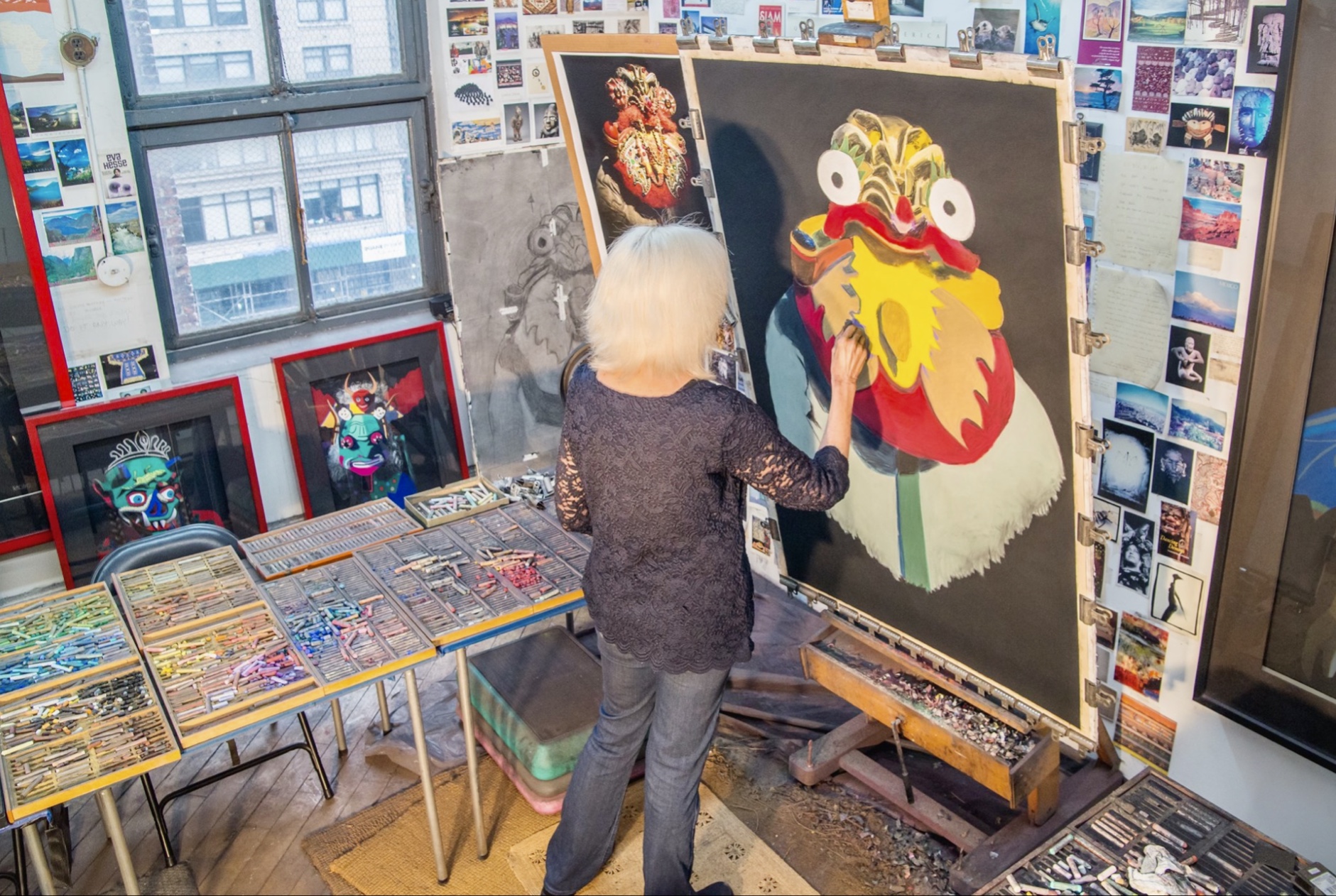
A: My studio is an oasis in a chaotic city, a place to make art, to read, and to think. I love to walk in the door every morning because it is my absolute favorite place in New York! Even after thirty-six years, I still find the entire process of making a pastel painting completely engaging. I try to push my pastel techniques further every time I work in the studio.
There’s one more thing about my studio: I consider it my best creation because it’s a physical environment that anyone can walk into and occupy, as compared to my artworks, which are 2D paintings hanging flat on a wall. It has taken 25 years to get it the way it is now. I believe my studio is the best reflection of my growth as an artist. It changes and evolves as I change over the decades.
Comments are welcome!
Pearls from artists* # 480

*an ongoing series of quotations – mostly from artists, to artists – that offers wisdom, inspiration, and advice for the sometimes lonely road we are on.
Walter Murch: As I’ve gone through life, I’ve found that your chances for happiness are increased if you wind up doing something that is a reflection of what you loved when you were between nine and eleven years old.
Michael Ondaatje: Yes – something that had and still has the feeing of a hobby, a curiosity.
M: At that age, you know enough of the world to have opinions about things, but you’re not old enough yet to be overly influenced by the crowd or by what other people are doing or what you think you “should” be doing. If what you do later on ties into that reservoir, in some way, then you are nurturing some essential part of yourself. It’s certainly been true in my case. I’m doing now, at fifty-eight, almost exactly what excited me when I was eleven.
But I went through a whole late-adolescent phase when I thought: Splicing sounds together can’t be a real occupation, maybe I should be a geologist or teach art history.
The Conversations: Walter Murch and the Art of Editing Film by Michael Ondaatje
Comments are welcome!
Pearls from artists* # 449
*an ongoing series of quotations – mostly from artists, to artists – that offers wisdom, inspiration, and advice for the sometimes lonely road we are on.
I learned about the Japanese word irimi while studying Aikido, a Japanese martial art. Simply translated, irimi means ,’to enter’ but it can also be translated ‘choose death.’ When attacked you always have two options: to enter, irimi, or to go around, ura. Both when accomplished in the right manner, are creative. To enter or to ‘choose death’ means to enter fully with the acceptance, if necessary, of death. The only way to win is to risk everything and be fully willing to die. If this is an extreme notion to Occidental sensibilities, it does make sense in creative practice. To achieve the violence of decisiveness, one has to ‘choose death’ in the moment by acting fully and intuitively without pausing for reflection about whether it is the right decision or if it is going to provide the winning solution.
It is also valuable to know when to use ura, or going around. There is a time for ura, going around, and there is a time for irimi, entering. And these times can never be known in advance. You must sense the situation and act immediately. In the heat of creation, there is no time for reflection; there is only connection to what is happening. The analysis, the reflection and the criticism belong before and after, never during, the creative act.
Anne Bogart in “A Director Prepares: Seven Essays on Art and Theater”
Comments are welcome!
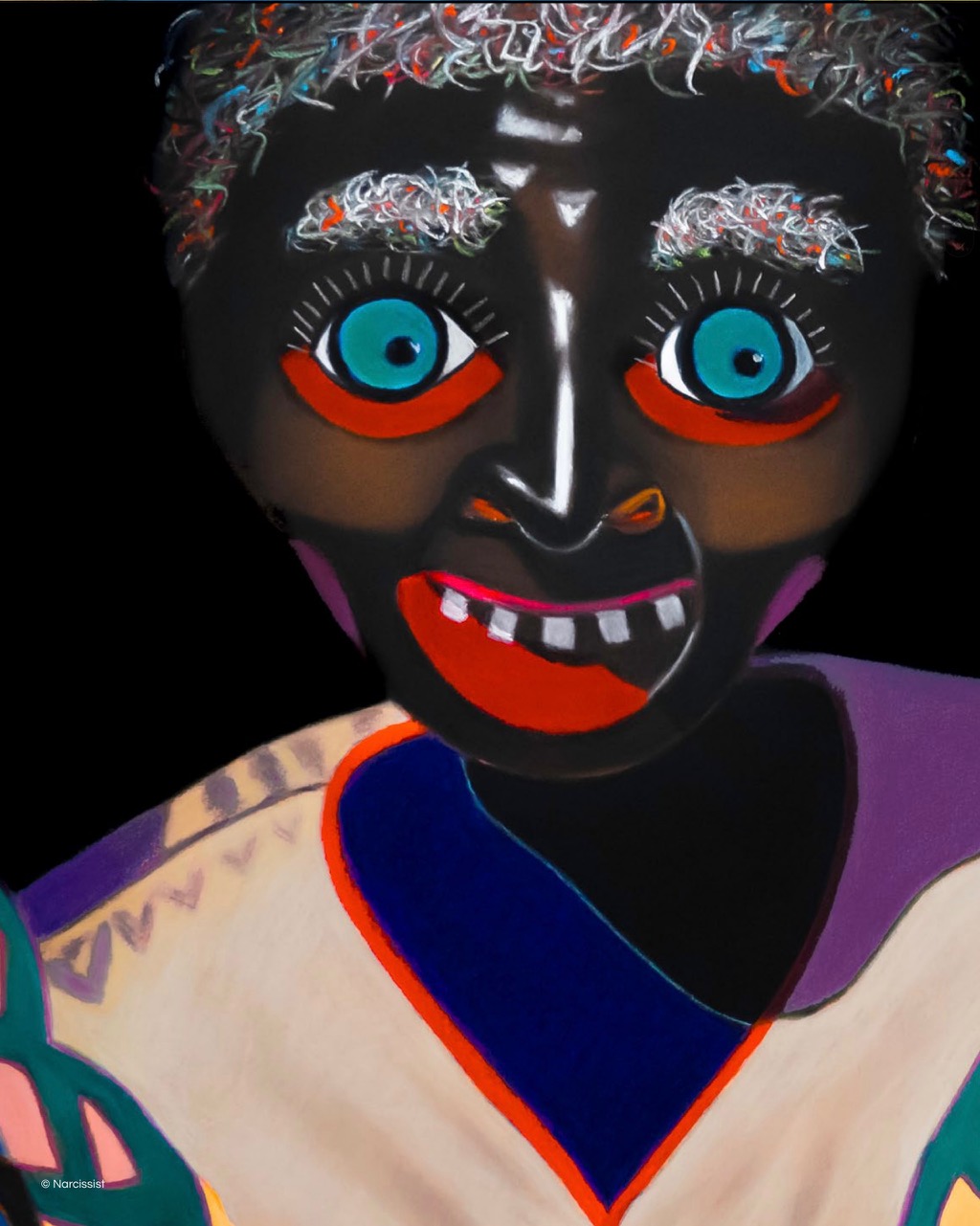
Q: I especially enjoy your “Black Paintings” series. You mention being influenced by the story of how Miles Davis developed cool jazz, making this work uniquely American all around. How did you use jazz history in this series?

“Between,” soft pastel on sandpaper, 20″ x 26″
A: In 2007 I finished the Domestic Threats series and was blocked, certain that a strong body of work was behind me. But what would come next?
The idea for the Black Paintings began when I attended a jazz history course at Lincoln Center and learned how Miles Davis developed cool jazz from bebop. In bebop the notes were played hard and fast as musicians showcased their musical virtuosity. Cool jazz was a much more relaxed style with fewer notes being played. In other words, the music was pared down to its essentials. Similarly, the Black Paintings evolved from dense, intricate compositions into paintings that depicted only the essential elements. As the series evolved, what was left out became more important, resulting in more demands being placed on the viewer.
Eventually, after much reflection, I had an epiphany and my painful creative block ended. “Between,” with drastically simplified imagery, was the first in a new series called Black Paintings. I like to think this series includes work that is richer and more profound than the previous Domestic Threats.
Comments are welcome!
Q: What has been your scariest experience as an artist?
“Between,” soft pastel on sandpaper, 20″ x 26″
A: It was the approximately six months in 2007 when I finished the “Domestic Threats” series and was blocked, certain that a strong body of work was behind me, yet not knowing what in the world to do next! For a professional artist who had been working non-stop for 21 years, this was a profoundly painful, confusing, and disorienting time. I remember continuing to force myself to go to the studio and for lack of anything much to do there, spending long hours reading and thinking about art.
Eventually after all of this reflection, I had an epiphany. “Between,” with drastically simplified imagery, was the first in a new series called, “Black Paintings.” I like to think this series includes work that is considerably richer and more profound than the previous “Domestic Threats.”
Comments are welcome!


 barbararachkoscoloreddust.com