Blog Archives
Travel photo of the month*
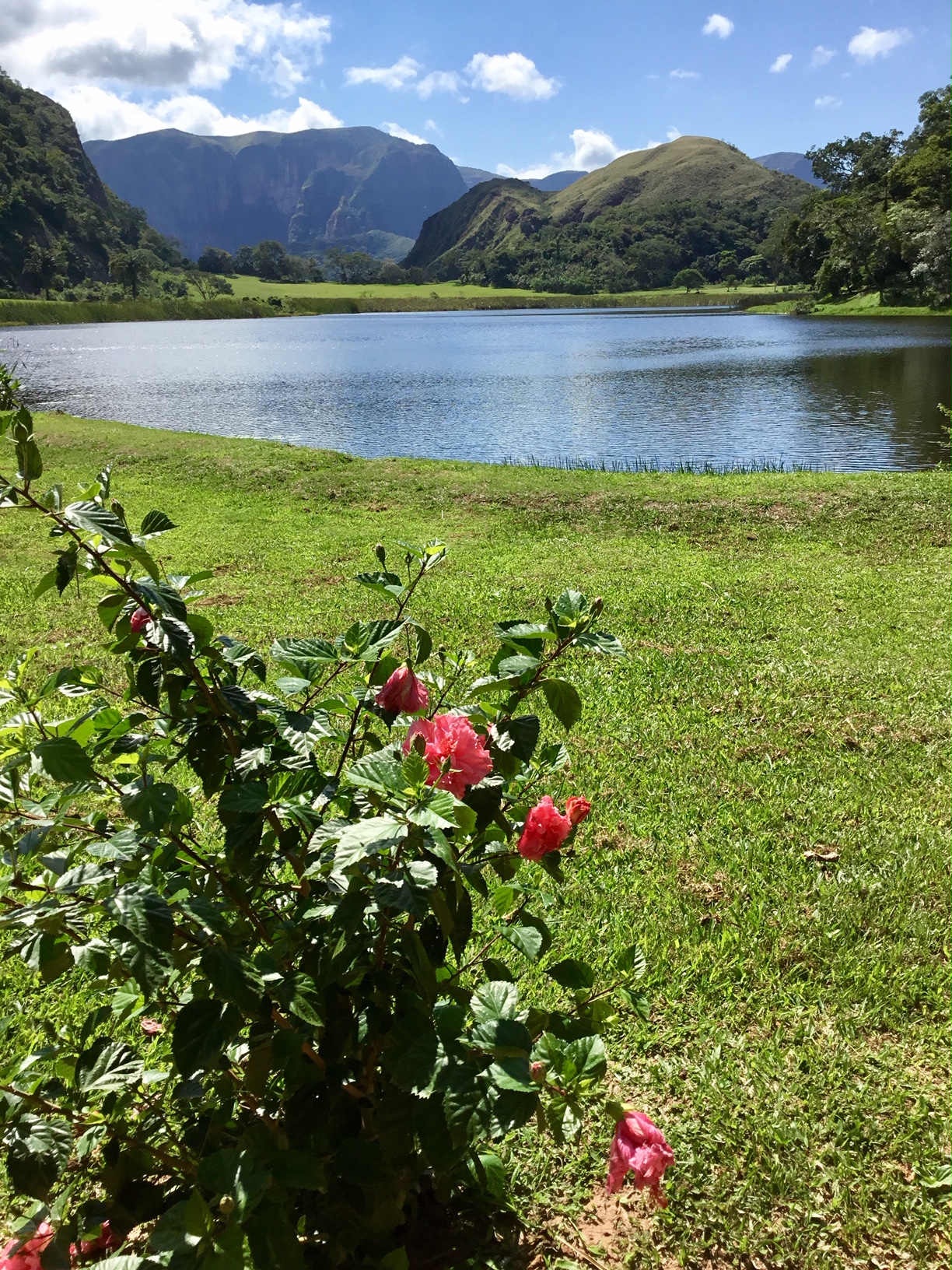
Near Santa Cruz, Bolivia
*Favorite travel photographs that have not yet appeared in this blog
Travel in Peru and Bolivia is life-altering. One takeaway: I adore clear, cool, crisp Andean light!
Comments are welcome!
Travel photo of the month*

Potosí, Bolivia
*Favorite travel photographs that have not yet appeared in this blog.
Comments are welcome!
Q: What’s on the easel today?
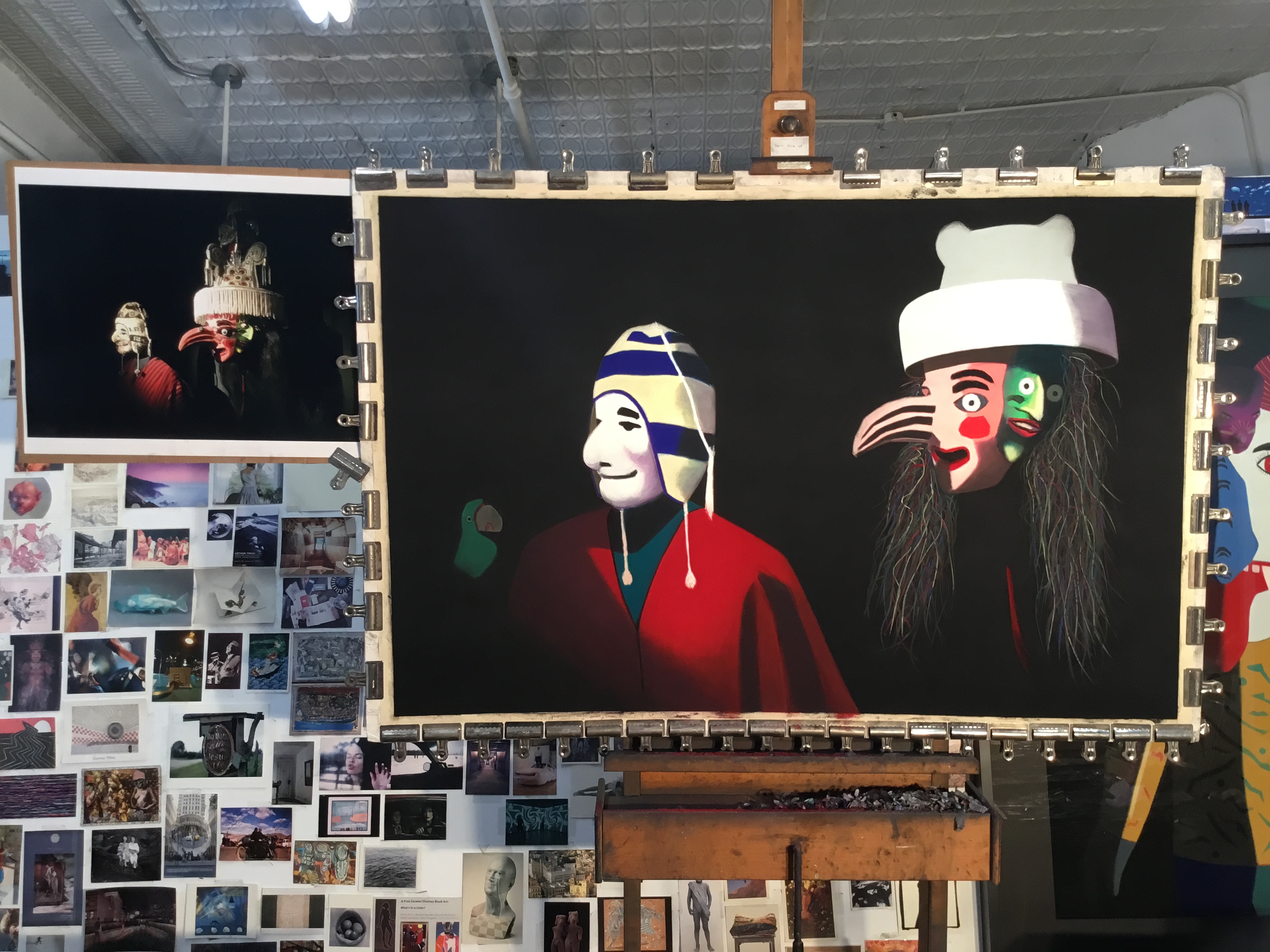
Work in progress
A: I continue working on a large pastel painting based on another of my photographs from La Paz, Bolivia.
Comments are welcome!
Q: Would you share your artist’s statement for the “Bolivianos” series?

Museum of Ethnography and Folklore, La Paz, Bolivia
A: Here it is.
My long-standing fascination with traditional masks took a leap forward in the spring of 2017 when I visited the National Museum of Ethnography and Folklore in La Paz, Bolivia. One particular exhibition on view, with more than fifty festival masks, was completely spell-binding.
The masks were old and had been crafted in Oruro, a former tin-mining center about 140 miles south of La Paz on the cold Altiplano (elevation 12,000’). Depicting important figures from Bolivian folklore traditions, the masks were created for use in Carnival celebrations that happen each year in late February or early March.
Carnival in Oruro revolves around three great dances. The dance of “The Incas” records the conquest and death of Atahualpa, the Inca emperor when the Spanish arrived in 1532. “The Morenada” dance was once assumed to represent black slaves who worked in the mines, but the truth is more complicated (and uncertain) since only mitayo Indians were permitted to do this work. The dance of “The Diablada” depicts Saint Michael fighting against Lucifer and the seven deadly sins. The latter were originally disguised in seven different masks derived from medieval Christian symbols and mostly devoid of pre-Columbian elements (except for totemic animals that became attached to Christianity after the Conquest). Typically, in these dances the cock represents Pride, the dog Envy, the pig Greed, the female devil Lust, etc.
The exhibition in La Paz was stunning and dramatic. Each mask was meticulously installed against a dark black wall and strategically spotlighted so that it became alive. The whole effect was uncanny. The masks looked like 3D versions of my “Black Paintings,” a pastel paintings series I have been creating for ten years. This experience was a gift… I could hardly believe my good fortune!
Knowing I was looking at the birth of a new painting series – I said as much to my companions as I remained behind while they explored other parts of the museum – I spent considerable time composing photographs. Consequently, I have enough reference material to create new pastel paintings in the studio for several years. The series, entitled “Bolivianos,” is arguably my strongest and most striking work to date.
Comments are welcome!
Travel photo of the month*
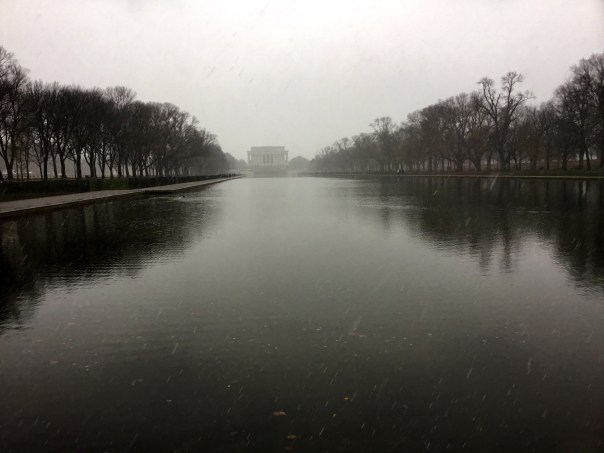
First snow of the season, Washington, DC
*Favorite travel photographs that have not yet appeared in this blog.
Comments are welcome!
Q: Would you comment on the origin of the title for your photographic series, “Gods and Monsters”?

Untitled c-print, 24″ x 24″ edition of 5
A: My title is borrowed directly from a 2001 catalogue essay by the late art critic, Gerritt Henry. The essay was about my first pastel painting series (“Domestic Threats”) and it’s called, “Barbara Rachko: Gods and Monsters.”
Among other shared interests, Gerritt and I both loved old Frankenstein movies from the 1940s. Around 1998 interest in James Whale, who had directed the original films, was riding high thanks to an Oscar-winning biopic about his last days in Hollywood. The film was called, “Gods and Monsters.” The title was taken from a line in “Bride of Frankenstein,” in which Dr. Pretorius toasts Dr. Frankenstein saying, “To a new world of gods and monsters.”
My photographic series came after “Domestic Threats” and some years after Gerritt’s essay was published. When I was searching for a title for the photos, “Gods and Monsters” seemed a perfect fit!
Comments are welcome!
Q: What genre do you work in?

“Broken,” soft pastel on sandpaper, 38″ x 58″ image, 50″ x 70″ framed
A: I consider all of my pastel paintings and photographs to be “contemporary conceptual realism.” In my work there is a disquieting quality, a feeling that things are not quite as innocent as they at first seem. The world I depict is a world of the imagination that owes little debt to the natural world. As one New York art critic noted, “What we bring to a Rachko… we get back, bountifully.”
Comments are welcome!
Q: Do you remember the first pastel painting that you ever made?
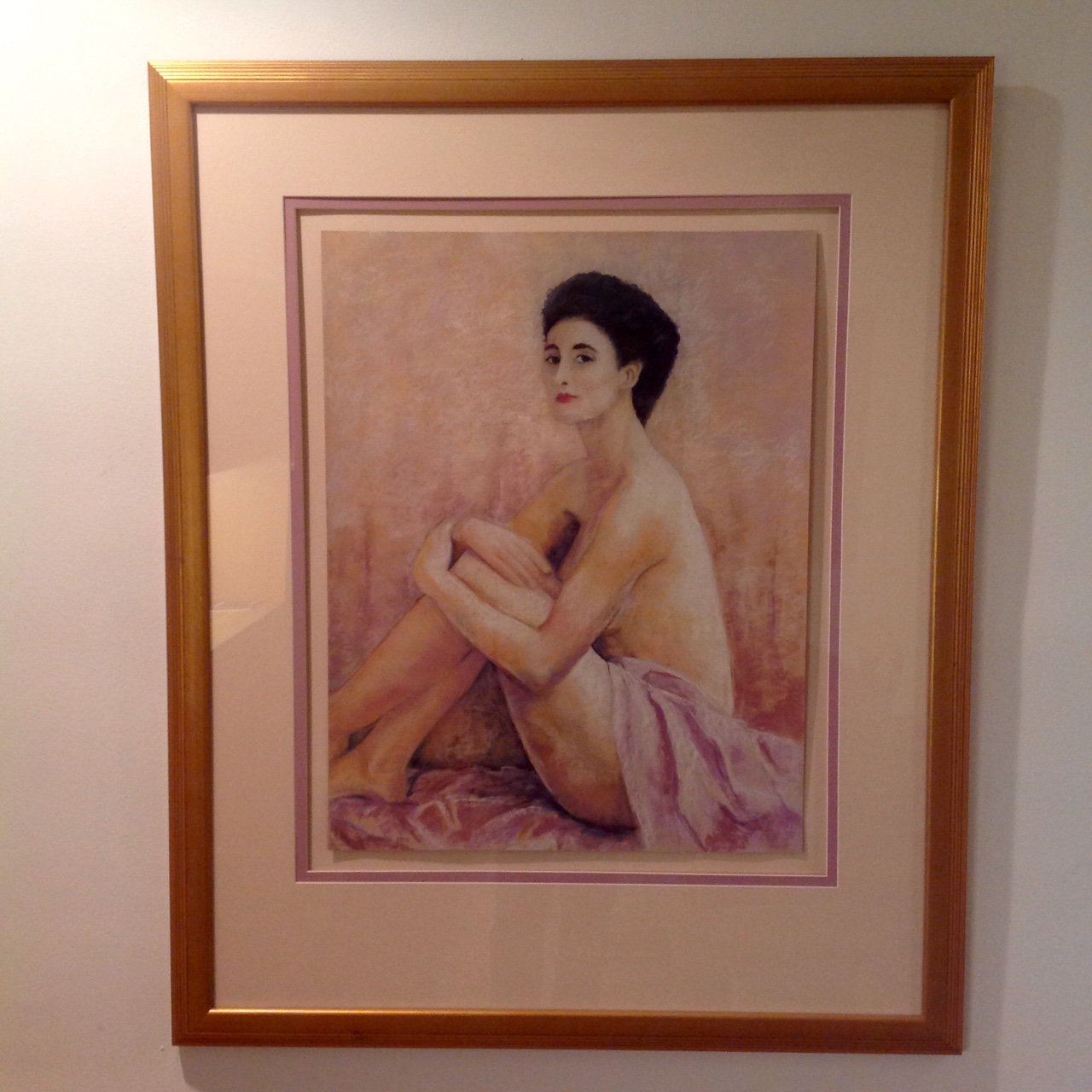
First framed pastel painting, 1988
A: Yes, it was a small head-and-neck portrait of a live model in a figure drawing class at The Art League School in Alexandria, VA. I don’t know what became of it.
I also remember the first pastel painting that I ever framed because it is still hanging in my Alexandria house. It is dated 1988 (see photo) and was made in a one-week workshop with Diane Tesler at The Art League. The workshop was specifically to teach artists how to paint from photographs and it was my first time studying with Diane. I made the mistake of bringing, as reference material, a magazine photograph that was originally a perfume ad in the The Sunday Times Magazine. Diane tactfully explained that it was wrong to use someone else’s photograph instead of my own, but let me do it this one time.
So many years later walking by my painting I still think of Diane. She taught me a valuable lesson: do not use anyone else’s photographs, ever!
Comments are welcome!
Q: Is there a pastel painting that you are most proud of?

“She Embraced It and Grew Stronger,” soft pastel on sandpaper, 58″ x 38,” 2003
A: Without a doubt I am most proud of “She Embraced It and Grew Stronger.”
After Bryan was killed on 9/11, making art again seemed an impossibility. When he was alive I would spend weeks setting up and lighting the tableau I wanted to paint. Then Bryan would shoot two negatives using his Toyo-Omega 4 x 5 view camera. I would select one and order a 20″ x 24″ reference photo to be printed by a local photography lab.
“She Embraced It…” is the first large pastel painting that I created without using a photograph taken by Bryan. This painting proved that I had learned to use his 4 x 5 view camera to shoot the reference photographs that were (and still are) integral to my process. My life’s work could continue!
Certainly the title is autobiographical. ‘She’ in “She Embraced It and Grew Stronger” is me and ‘It’ means continuing on without Bryan and living life for both of us.
Comments are welcome!
Q: Would you say there is a unifying quality to all of the work you have produced in the last thirty years?
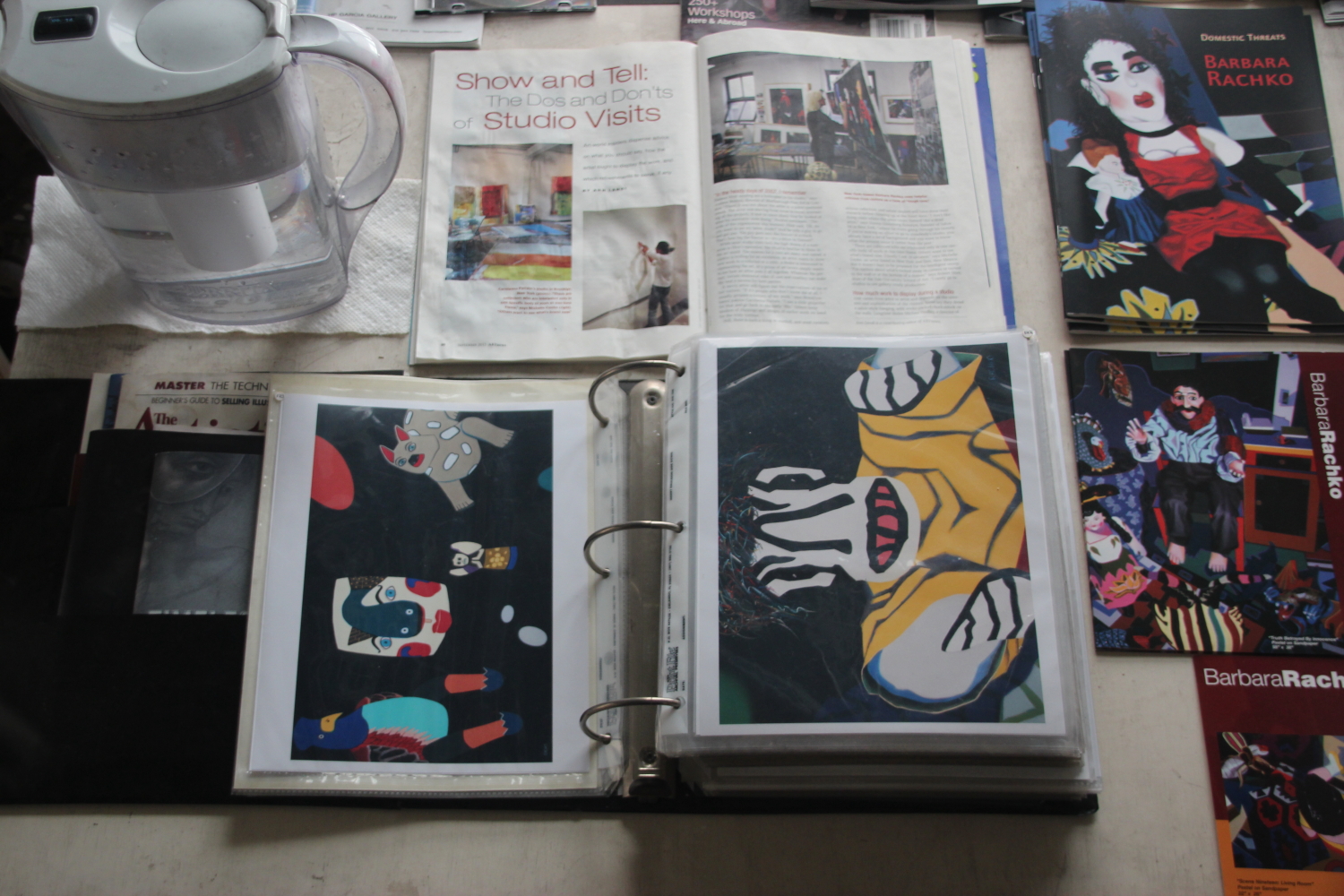
Barbara’s portfolio book
A: Yes, I can think of several. Whether making pastel paintings or printing photographs in the darkroom, I have always been concerned with quality and craftsmanship and never pronounce a work finished until it is the best thing I can make.
Although I started out as a maker of photorealist portraits in pastel, for twenty-odd years I have worked with Mexican folk art as my primary subject matter, treating these objects very differently in three separate series: “Black Paintings,” “Domestic Threats,” and “Gods and Monsters.” The first two are pastel-on-sandpaper paintings while the last is comprised of chromogenic photographs (c-prints). A few years ago I also started making “Teleidoscopes” using an iPad app to photograph my Mexican and Guatemalan folk art collection. This last one is just for fun; I do not offer them for sale.
Soft pastel is my first love and the two series of pastel paintings are my best-known work. My technique for using pastel continues to evolve in intriguing ways. I doubt I can ever learn all there is to know not only about color, but also about this medium. Pastel is endlessly fascinating, which is why I have never wanted to switch to anything else.
Comments are welcome!


 barbararachkoscoloreddust.com