Blog Archives
Pearls from artists* # 682
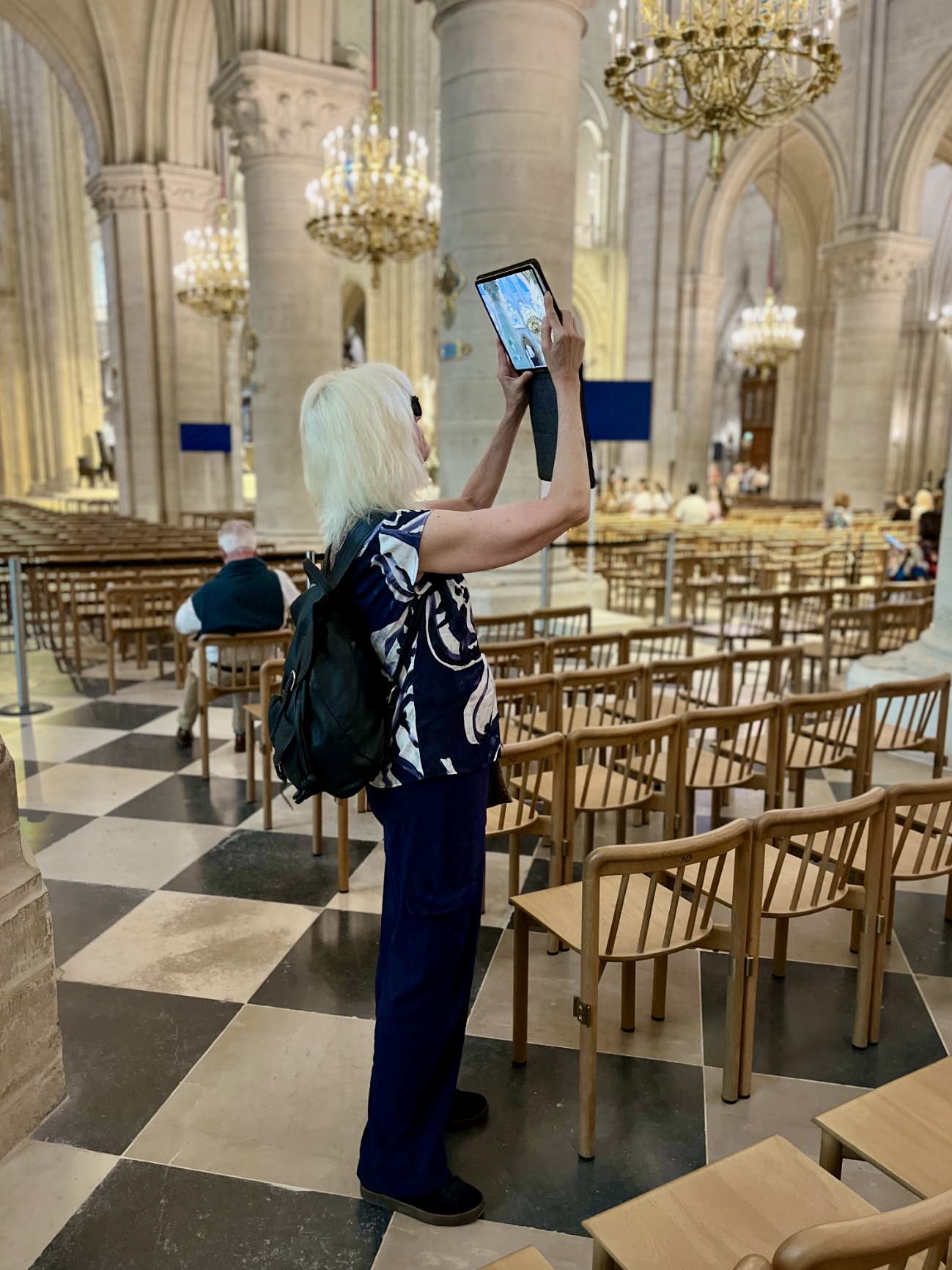
*an ongoing series of quotations – mostly from artists, to artists – that offers wisdom, inspiration, and advice for the sometimes lonely road we are on.
Following Julie’s lead, I’d started viewing the everyday the way I looked at art – with an extra beat, with an inquisitive eye, with a willingness to linger on form and ask why. I’d gone into her studio hoping to see art differently. Bit by bit, I saw everything differently. Have you contemplated the forlorn beauty of a stripped-down storefront glowing white on a dark street? Or watched tarps draped on construction sites shiver with the wind? Like nibbling on a magic mushroom, turning an eye on reality makes you feel as if the world is performing just for you.
Bianca Booker in Get the Picture: A Mind-Bending Journey Among the Inspired Artists and Obsessive Friends Who Taught Me How to See
Comments are welcome!
Pearls from artists* # 600
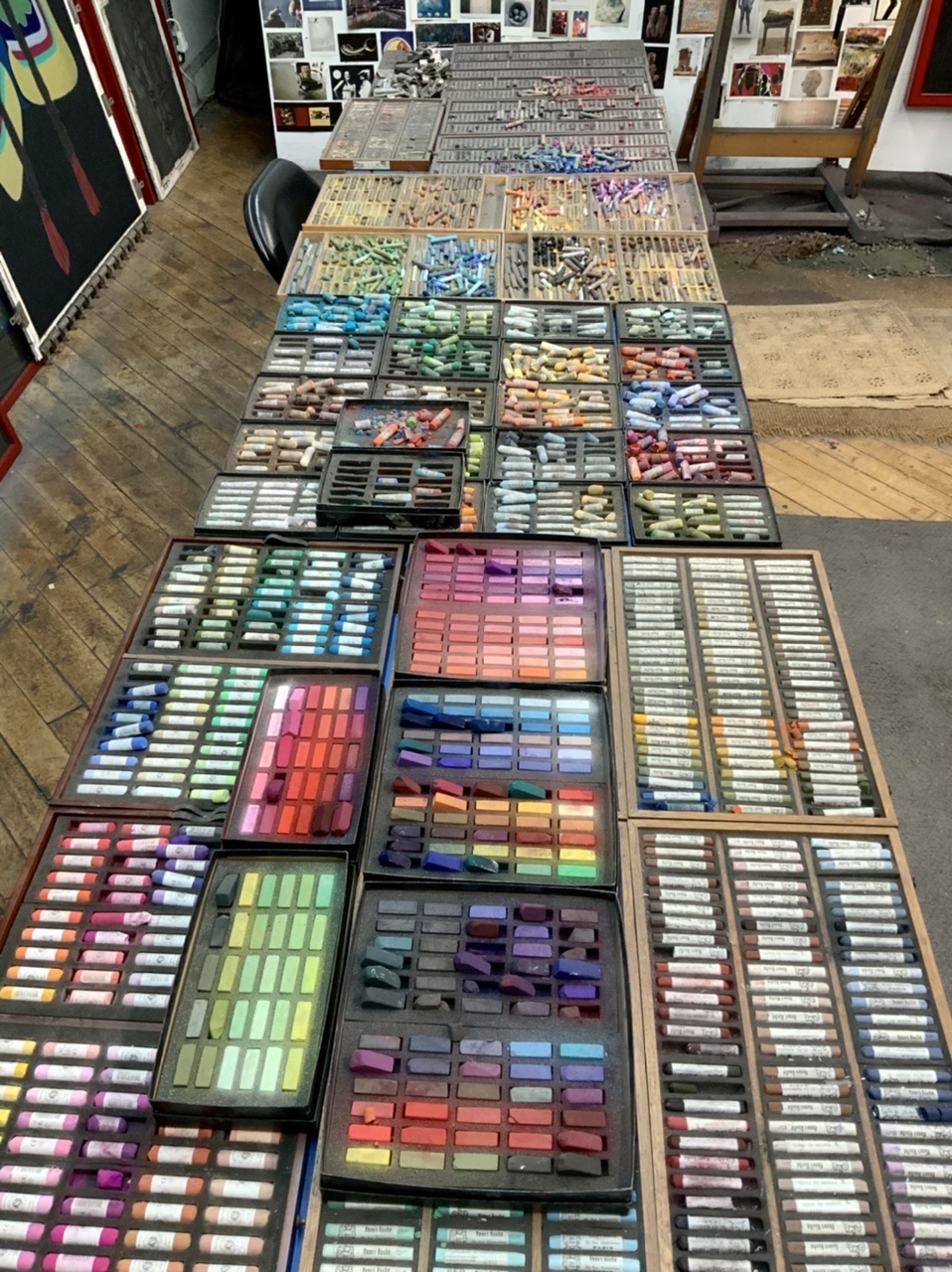
*an ongoing series of quotations – mostly from artists, to artists – that offers wisdom, inspiration, and advice for the sometimes lonely road we are on.
I am always between two currents of thought: first the material difficulties, turning round and round and round to make a living; and second, the study of color. I am always hoping to make a discovery here, to express the feelings of two lovers by a marriage of two complementary colors, their mingling and their opposition, the mysterious vibrations of kindred tones. To express the thought behind a brow by radiance of a bright tone against a somber background. To express hope by some star, the eagerness of a soul by a sunset glow.
Vincent van Gogh quoted by Stephen Nachmanovitch in “Free Play: Improvisation in Life and Art
Comments are welcome!
Q: It must be tricky moving pastel paintings from your New York studio to your framer in Virginia. Can you explain what’s involved? (Question from Ni Zhu via Instagram)
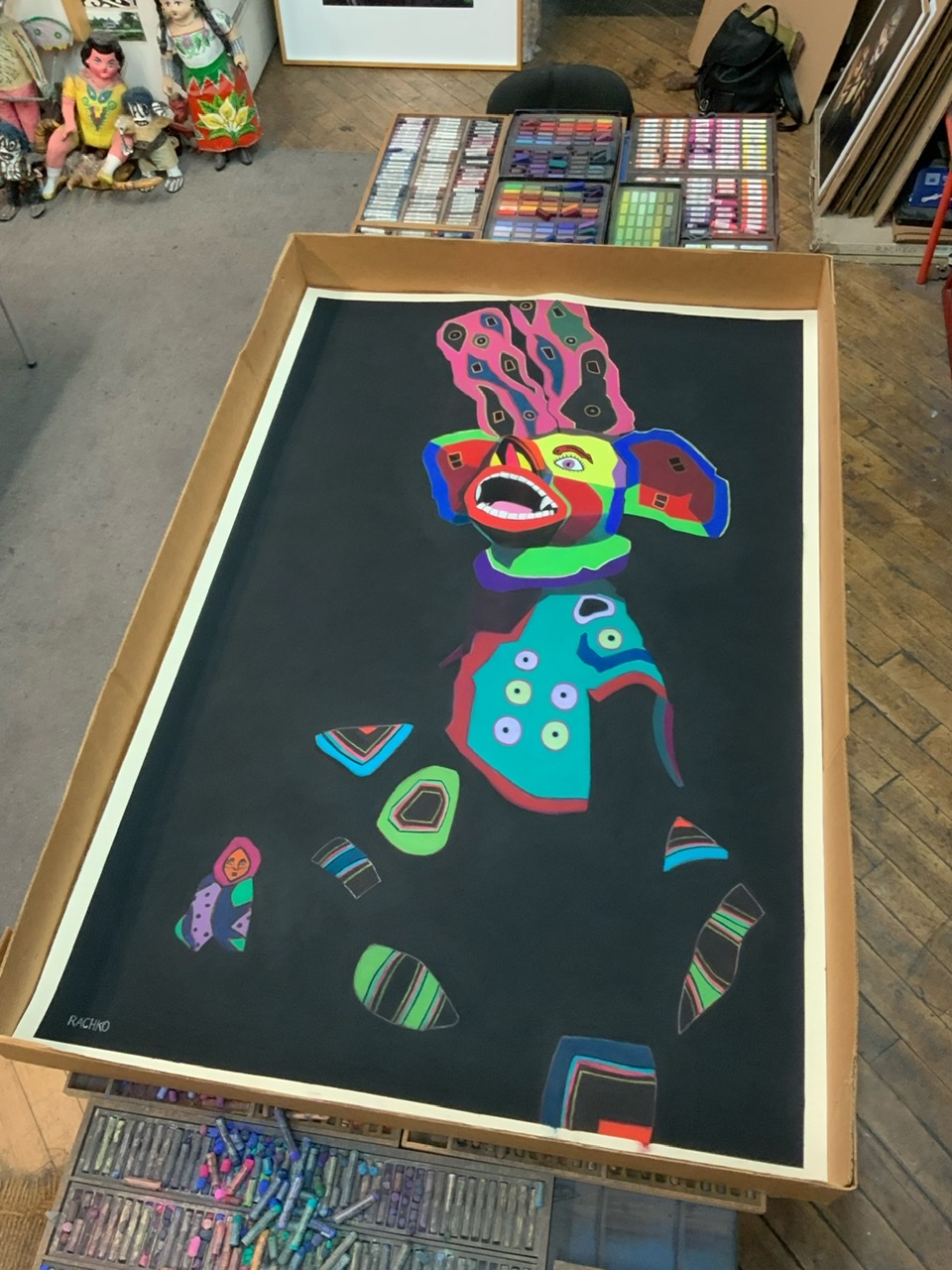
“Impresario” partially boxed for transport to Virginia
A: Well, I have been working with the same framer for three decades so I am used to the process.
Once my photographer photographs a finished, unframed piece, I carefully remove it from the 60” x 40” piece of foam core to which it has been attached (with bulldog clips) during the months I worked on it. I carefully slide the painting into a large covered box for transport. Sometimes I photograph it in the box before I put the cover on (see above).
My studio is in a busy part of Manhattan where only commercial vehicles are allowed to park, except on Sundays. Early on a Sunday morning, I pick up my 1993 Ford F-150 truck from Pier 40 (a parking garage on the Hudson River at the end of Houston Street) and drive to my building’s freight elevator. I try to park relatively close by. On Sundays the gate to the freight elevator is closed and locked so I enter the building around the corner via the main entrance. I unlock my studio, retrieve the boxed painting, bring it to the freight elevator, and buzz for the operator. He answers and I bring the painting down to my truck. Then I load it into the back of my truck for transport to my apartment.
I drive downtown to the West Village, where I live, and double park my truck. (It’s generally impossible to park on my block). I hurry to unload the painting, bring it into my building, and up to my apartment, all the while hoping I do not get a parking ticket. The painting will be stored in my apartment, away from extreme cold or heat, until I’m ready to drive to Virginia. On the day I go to Virginia, I load it back into my truck. Then I make the roughly 5-hour drive south.
Who ever said being an artist is easy was lying!
Comments are welcome!
Pearls from artists* # 213
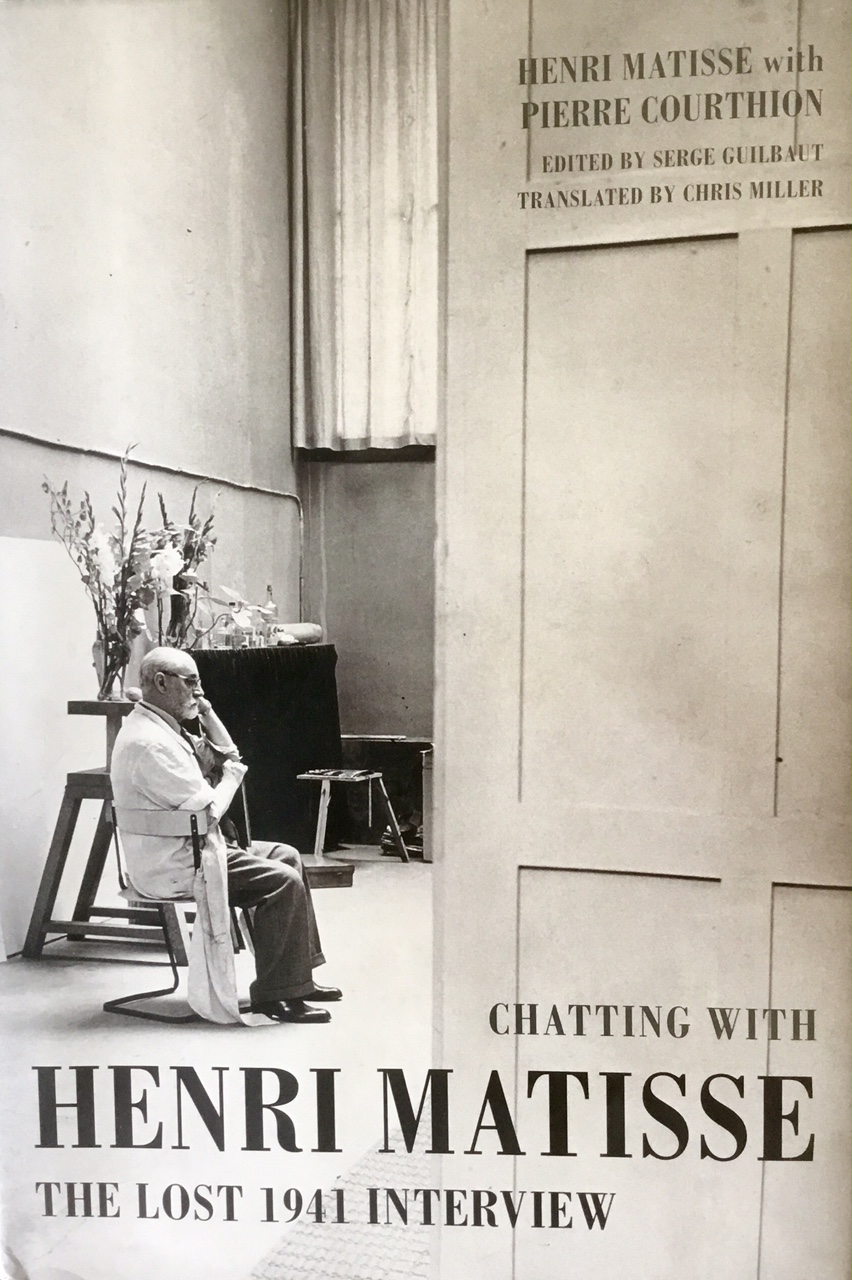
Matisse Book Cover
* an ongoing series of quotations – mostly from artists, to artists – that offers wisdom, inspiration, and advice for the sometimes lonely road we are on.
I am astonished by the accuracy with which Matisse remembers the most trifling facts; he describes a room that he went into forty years ago and gives you the measurements, where every piece of furniture stood, how the light fell. He is a man of astounding precision and has little time for anything that he has not confirmed for himself. In art matters, he is not the sort to go looking for a profile fortuitously created by cracks in the wall. Elie Faure writes that Matisse is perhaps the only one of his contemporaries (in particular Marquet and Bonnard) to know exactly where he comes from and the only one who never allows it to show “because his inveterate, invincible, vigilant willpower is always focused on being himself and nothing but.”
Matisse neglects nothing. He seems to know as much about the art market as about painting.
So many stratagems to sell a painting, from intimidating the purchaser to seeming to avoid him: Vollard used them all and used them successfully. Not least the lies that he told to reassure the client. “It works like this,” says Matisse: “To make a sale, you invent lies that have somehow disappeared into thin air by the time the deal is done.”
We talk of the difficulties faced by dealers hoping to gain access to Renoir in his Cagnes residence. Renoir didn’t like having people talk to him about selling his work,” says Matisse: “It bored him. About the only one who got a foot in the door was Paul Guillaume; he dressed up as a young worker with a floppy necktie: “You see, I’m a local. I’ve always loved your painting. I’ve just inherited a little money; I’d like to buy something.”
Chatting with Henri Matisse: The Lost 1941 Interview, Henri Matisse with Pierre Courthion, edited by Serge Guilbaut, translated by Chris Miller
Comments are welcome!
Q: How did you happen to have a photograph published in The Wall Street Journal?

Sun Tunnels by Nancy Holt
A. That is a long story. To get far away from New York for the ten-year anniversary of 9/11, my friend, Donna Tang, and I planned a two-week road trip to see land art sites in Arizona, New Mexico, Utah, and Colorado. (Donna did excellent research).
We hoped for a private tour of Roden Crater with James Turrell, which is not easy to arrange. I had also invited my friend Ann Landi, an art critic and arts writer, to join us, hoping she might get an interview with Turrell and write an article for Artnews. Turrell has been working on Roden Crater for 30+ years so Ann was interested in seeing it too! Ann contacted Turrell’s gallery – Gagosian – but they later relayed Turrell’s refusal.
We were planning to see other land art sites. As an alternative to Roden Crater and Turrell, Ann pitched a story to The Wall Street Journal about Sun Tunnels and Nancy Holt (Robert Smithson’s wife, who as the only woman in the land art movement, has never been given her due). The Journal said yes, so Ann made plans to join Donna and me in Salt Lake City.
The three of us visited Sun Tunnels, Spiral Getty, and other sites together. Ann had a brand new point-and-shoot camera that she hadn’t yet learned how to use. I always take lots of photos whenever I travel. After we returned home, I sent Ann a few images and she asked permission to submit them with her article. I was thrilled when The Wall Street Journal requested JPEGs. It was the first time I’ve had a photograph published in a major newspaper.
Comments are welcome!
Q: Can you talk about how you transport your large pastel-on-sandpaper paintings?
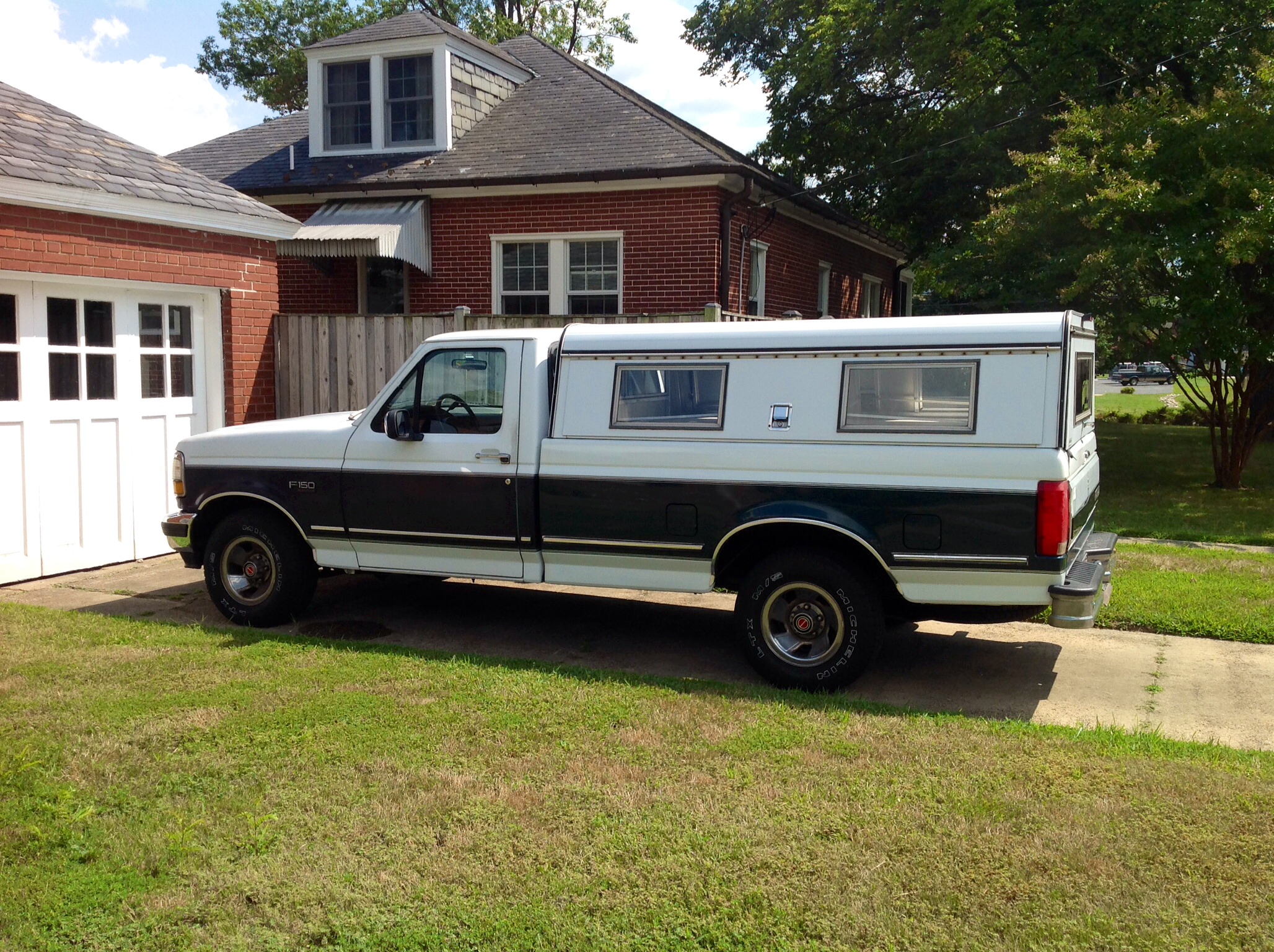
Barbara’s 1993 Ford truck
A: In 1993 Bryan and I bought a Ford F-150 pickup truck (he dubbed it “Sisyphus”) because it was the perfect size – 54” between the wheel wells – to slide my wrapped, framed paintings in and out of. Pastel paintings are fragile and need to lie flat while being transported. I remember that Bryan and I would go to a car dealership, a salesman would start his sales pitch, one of us would say, “Wait a minute,” and Bryan would hop into the back of a new truck with a tape measure to take a measurement! We both got a kick out of being such eccentric customers.
Fortunately, Ford trucks of that era are well-made. Mine has 198,000 miles on it. Whenever I bring it in for maintenance, there is some excitement at the dealership because, it’s all metal (not fiberglass) and there are no computers. Late model trucks are much smaller (most customers cares about low gas mileage; I still need that distance between the wheel wells). My paintings would not fit in any trucks made today (or any model since 1997, I believe) so I take good care of “Sisyphus.” I’m hoping it will still be going strong well beyond 200,000 miles!


 barbararachkoscoloreddust.com