Blog Archives
Q: All art media involve some level of toxicity. Do you use an air filter? How do you protect yourself against the harmful effects of working with soft pastel?

A: No, but I wear a surgical mask when I work, to prevent breathing the pastel dust. Also, before I begin, I apply a barrier cream, called Artgard, to my hands to prevent pigment being absorbed into my skin through any tiny cuts I may have.
My easel is tilted forward, allowing pastel dust to fall onto the easel and floor. I take care that my head is always higher than my hand as I work, so the dust is below my mouth and nose. I am well aware of the toxicity of pastel and believe I take the proper precautions. After nearly forty years working with soft pastel, so far I’ve managed to stay healthy.
Comments are welcome.
Pearls from artists* # 656

At Storm King Art Center, Cornwall-On-Hudson, NY. Photo: Susan Erlichman
*an ongoing series of quotations – mostly from artists, to artists – that offers wisdom, inspiration, and advice for the sometimes lonely road we are on.
The world needs artists more than they know, and you are entitled to be one of them. We altruistically create gifts, with no assurance those gifts will be appreciated. Like social workers, we do not make a lot of money, but we improve the quality of people’s lives through ripple effects. When our work shifts the perceptions of one viewer, the transformation often radiates to others around them. That includes dialogue and pushes the world toward more truth or justice and inspires others to do the same.
Kate Kretz in Art From Your Core: A Holistic Guide to Visual Voice
Comments are welcome!
Pearls from artists* # 613
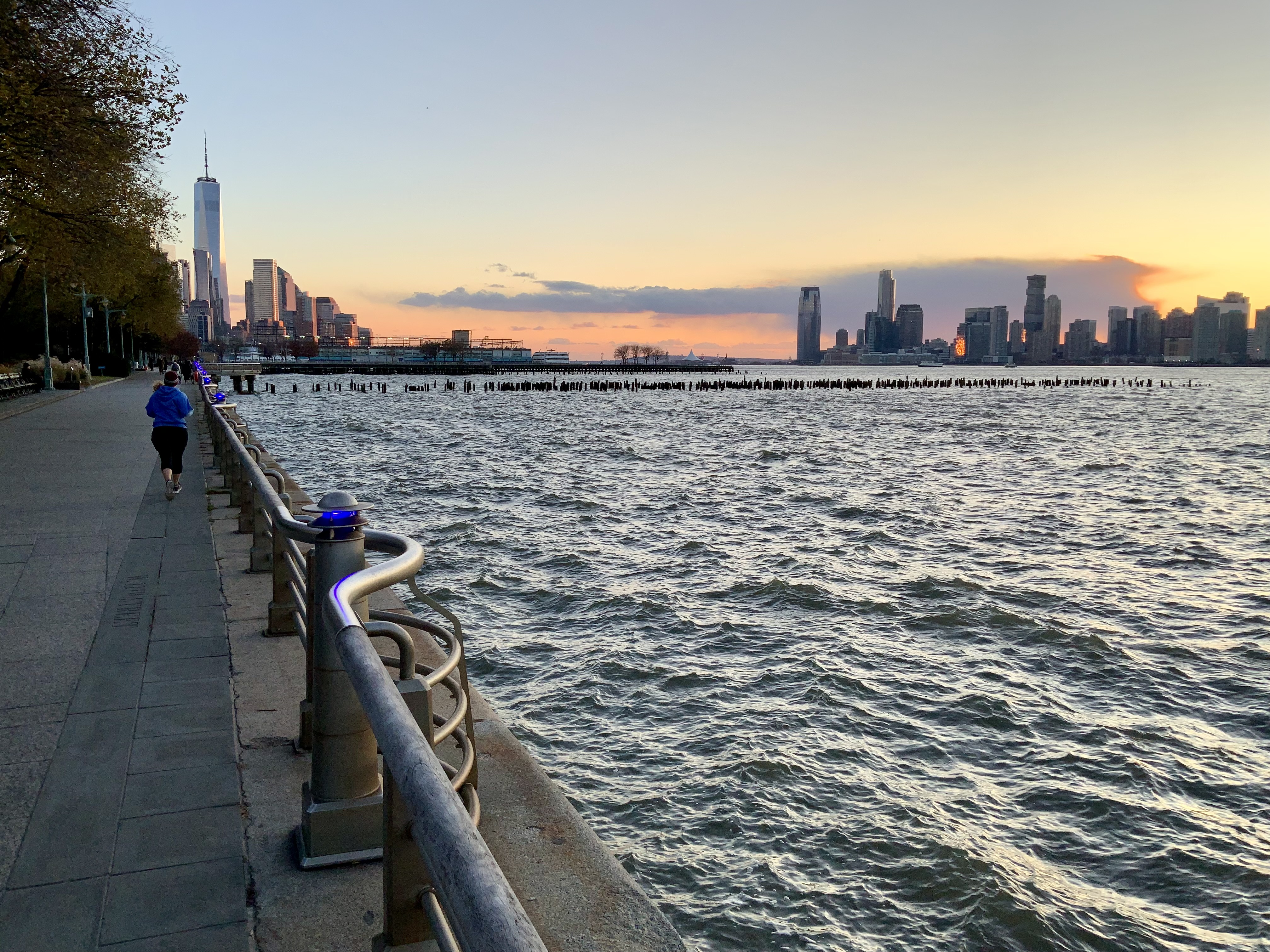
New York NY
*an ongoing series of quotations – mostly from artists, to artists – that offers wisdom, inspiration, and advice for the sometimes lonely road we are on.
A painting is a statement of the artist’s notions of reality in terms of plastic speech. In that sense the painter must be likened to the philosopher rather than to the scientist. For science is a statement of the laws that govern a specific phenomenon or category of matter or energy within the specified units and conditions of its operation. Philosophy, however, must combine all these specialized truths within a single system. It is because of this broad scope that Aristotle gives preeminence to the philosopher in the introduction to his Metaphysics, for he tells us that every man except the philosopher is an authority within his specific field, whereas the philosopher must have the acute knowledge that each man has in his own field plus the ability to relate all these fields to the operations of universality and eternity.
Therefore art, like philosophy, is of its own age; for the partial truths of each age differ from those of other ages, and the artist, like the philosopher, must constantly adjust eternity, as it were, to all the specifications of the moment. Art, too, creates at different times the notions of reality that the artist, as a man of the age, must inherit and develop and consider real along with the other intellectually conscious men of his time. His language, which is his plastic means, will also adjust itself to the possibility of making these notions manifest in their most coherent possibilities. The reality of the artist, therefore, reflects the understanding of his times, even as his creations shape those understandings. We posit this without wishing to attempt to untangle here the series of causes and effects, a process which would probably obscure more than it certified.
Mark Rothko in The Artist’s Reality: Philosophies of Art
Comments are welcome!
Q: What’s on the easel today?

Work in progress
A: I am planning my next pastel painting and the photo above shows a preliminary charcoal sketch for it. I’m continuing to study the effects of scaling my work up or down. This piece will be a smaller, 26” x 20,” version of “The Orator,” 38” x 58” (image), 50” x 70” (framed), from 2017.
Comments are welcome!

Pearls from artists # 429

*an ongoing series of quotations – mostly from artists, to artists – that offers wisdom, inspiration, and advice for the sometimes lonely road we are on.
Vincent [van Gogh] found himself in perfect harmony with[Emile] Zola’s world view. Neither of them sugarcoated or idealized the harsh reality of the everyday life that surrounded them, or the subjects it offered up. The same reality was at the heart of both of their work. In July 1883, Vincent read Zola’s essay on art, ‘Le Moment artistique,’ contained in one of his critical works on literary and artistic life, Mes haines (My Hatreds), in which Zola reflected on a crucial aspect of artistic creativity, going beyond the word ‘realistic;’ ‘the word “realist” means nothing to me, and I declare reality subordinate to temperament.’ Therefore, according to Zola, a ‘work of art is a corner of creation seen through a temperament.’ Vincent did not comment on this passage directly, but in his lines we see that in Zola’s words he found confirmation of his own beliefs. To Theo, in 1885, he wrote of his attempts to capture the effects of light in The Potato Eaters: “Not always literally exactly – rather never exactly – for one sees nature through one’s temperament.” The two contrasting souls that live side by side in the author of Les Rougon Macquart, one methodical, the other creative, reflected Vincent’s own creative approach.
Mariella Guzzoni in Vincent’s Books: Van Gogh and the Writers Who Inspired Him
Comments are welcome!
Pearls from artists* # 333

Studio entrance
*an ongoing series of quotations – mostly from artists, to artists – that offers wisdom, inspiration, and advice for the sometimes lonely road we are on.
… the Greeks and Romans both believed in the idea of an external daemon of creativity – a sort of house elf, if you will, who lived within the walls of your home and who sometimes aided you in your labors. The Romans had a specific term for that helpful house elf. They called it your genius – your guardian deity, the conduit of your inspiration. Which is to say, the Romans didn’t believe that an exceptionally gifted person was a genius; they believed that an exceptionally gifted person had a genius.
It’s a subtle but important distinction (being vs. having) and, I think, it’s a wise psychological construct. The idea of an external genius helps to keep an artist’s ego in check, distancing him somewhat from the burden of taking either full credit or full blame for the outcome of his work. If your work is successful, in other words, you are obliged to thank your external genius for the help, thus holding you back from total narcissism. And if your work fails, it’s not entirely your fault. You can say, “Hey, don’t look at me – my genius didn’t show up today!”
Either way, the vulnerable human ego is protected.
Protected from the corrupting influence of praise.
Protected from the corrosive effects of shame.
Elizabeth Gilbert in Big Magic: Creative Living Beyond Fear
Comments are welcome!
Q: Do you listen to music while you work?

A corner of the studio
A: I always have the stereo on when I work in my studio, either tuned in to WBGO (the Newark-based jazz station), WNYC (for news and talk radio; Leonard Lopate, Fresh Air, etc.), WFMU (Fordham University’s radio station, to learn what college kids are listening to) and other local radio stations. I still listen to cd’s, I read the lyrics and the liner notes, and I prefer to listen to music the way artists intended it, meaning that I listen to entire albums from start to finish instead of jumping around between single tracks by different artists. When it comes to music, I’m interested in everything: jazz (especially classic jazz artists like Thelonious Monk, Miles Davis, John Coltrane, Art Blakely, etc.), blues, classical, pop, rock, world music (especially artists from Brazil, Cuba, and any country in Africa), electronic, indy, experimental, ancient music, etc. You name it, I probably listen to it, and if I don’t, I’m eager to learn all about it. When I’m working, certain artists are better to listen to at particular points in a painting. For example, one of my favorite artists to start a new painting with is Lady Gaga. The beat, her energy, and sheer exuberance are perfect when I’m standing in front of my easel with a blank piece of sandpaper in front of me. Gaga’s music gets me moving and working fast, putting down colors instinctively without thinking about them, just feeling everything.
It’s a different story when I am at my apartment and am shooting a photo setup. Then I might or might not listen to music. Lately it’s more about working fast (I shoot 24 images in about 15 minutes), choosing a variety of interesting vantage points, getting surprising effects, etc.
Comments are welcome!


 barbararachkoscoloreddust.com
Pearls from artists* # 673
Oct 22
Posted by barbararachkoscoloreddust
Barbara’s Studio
*an ongoing series of quotations – mostly from artists, to artists – that offers wisdom, inspiration, and advice for the sometimes lonely road we are on.
You may occasionally have the opportunity to publicly comment about the work, which helps to shape its life, but others will also interpret, criticize, and project their own agendas onto it. You must learn to be ok with that. You cannot follow your art around, explaining it and defending it. Once released, the life of your work depends on all sorts of factors completely out of your control. Separating your ego and self-worth from what you produce can be challenging, but it is essential. It protects your vital studio activity from the damaging effects of the outside world. Letting go of the old work also frees you up to move forward and focus on the next great idea.
Kate Kretz in Art From Your Core: A Holistic Guide to Visual Voice
Comments are welcome!
Share this:
Posted in 2025, An Artist's Life, Inspiration, Pearls from Artists, Quotes, Studio
Comments Off on Pearls from artists* # 673
Tags: activity, agendas, around, ”Art From Your Core: A Holistic Guide to Visual Voice”, challenging, comment, completely, control, criticize, damaging, defending, depends, effects, essential, explaining, factors, follow, forward, interpret, Kate Kretz, letting, occasionally, opportunity, others, outside, produce, project, protects, released, self-worth, separating, Studio