Blog Archives
Pearls from artists* # 653

*an ongoing series of quotations – mostly from artists, to artists – that offers wisdom, inspiration, and advice for the sometimes lonely road we are on.
Watching online markers of approval climb into high numbers releases dopamine in our brains, which can become addictive. If we crave ‘likes,’ and consciously or unconsciously make more of what our audience wants, we become supply-and-demand widget makers. We start catering to the lowest common denominator, asking ourselves what kind of widget will get the most likes or shares. Would you allow a committee into your studio to dictate your next work, to tell you what goes and what stays? How is catering to ‘likes’ any different?
… Every time your work grows, you will gain and lose fans. The more followers you have, the more individuals will need to adjust to the shifts that are happening. Some are guaranteed to disapprove of any new direction, regardless of content. Those who cannot tolerate change will be replaced by supporters of a higher caliber who approve and encourage you to grow.
Kate Kretz in Art From Your Core: A Holistic Guide to Visual Voice
Comments are welcome!
Pearls from artists* # 624

Machu Picchu (Peru), June 2016
*an ongoing series of quotations – mostly from artists, to artists – that offers wisdom, inspiration, and advice for the sometimes lonely road we are on.
If we were speaking from the point of view of the historian, and if we desired to know as concretely as possible how those peoples of the past or present conceived of their world, we should have to turn to their philosophy to find how they thought about their world, and to their sciences to analyze the atomic factors that contributed to those thoughts, and to their applied arts for the understanding of how this notion appeared when necessarily vulgarized to the common denominator of intelligence. But we would have to turn to their art to understand how they “felt about their world,” to know how their notions of reality found expression in their sensual perception of the world. And we know, of course, how those expressions can differ by simply examining Christian art, which consciously discarded the reality of its predecessor, Greek Hellenistic art.
Mark Rothko in The Artist’s Reality: Philosophies of Art
Comments are welcome!
Pearls from artists* # 290

“Dichotomy,” soft pastel on sandpaper, 38″ x 58″
*an ongoing series of quotations – mostly from artists, to artists – that offers wisdom, inspiration, and advice for the sometimes lonely road we are on.
Rational functionalism is technique,
Irrational functionalism is art.
Art is creation
It can be based on but is independent of knowledge.
We can study art through nature,
but art is more than nature.
Art is spirit,
and has a life of its own.
Art in its nature is anti-historical
because creative work is looking forward.
It can be connected with tradition
but grows, consciously or unconsciously, out of an artist’s mentality.
Art is neither imitation nor repetition
but art is revelation.
Joseph Albers in Truthfulness in Art in Joseph Albers in Mexico, edited by Lauren Hinkson
Comments are welcome!
Q: Your pastel paintings are immediately recognizable as yours alone. Did you consciously try to develop a signature style in your work?
Barbara’s studio
A: I don’t believe that is even possible. An artist’s style is something that evolves with plain hard work and experience, over many years of trial and error, as one finds what techniques work best and discards those that don’t. It is a process of continually experimenting, refining, and clarifying. In other words, style is something that emerges naturally as you gradually strive to improve your art-making.
Style develops in close connection to what an artist is saying as she undergoes a very personal and idiosyncratic journey. Again, it would seem improbable for an artist to strive for any particular style, since style is not something over which an artist can exert much conscious control.
I would even say that each artist’s unique style is inevitable. It would be nearly impossible now to make a pastel painting or photograph that does NOT look like a Rachko.
Comments are welcome!
Q: How do you think living in New York affects your work?
Lower Manhattan
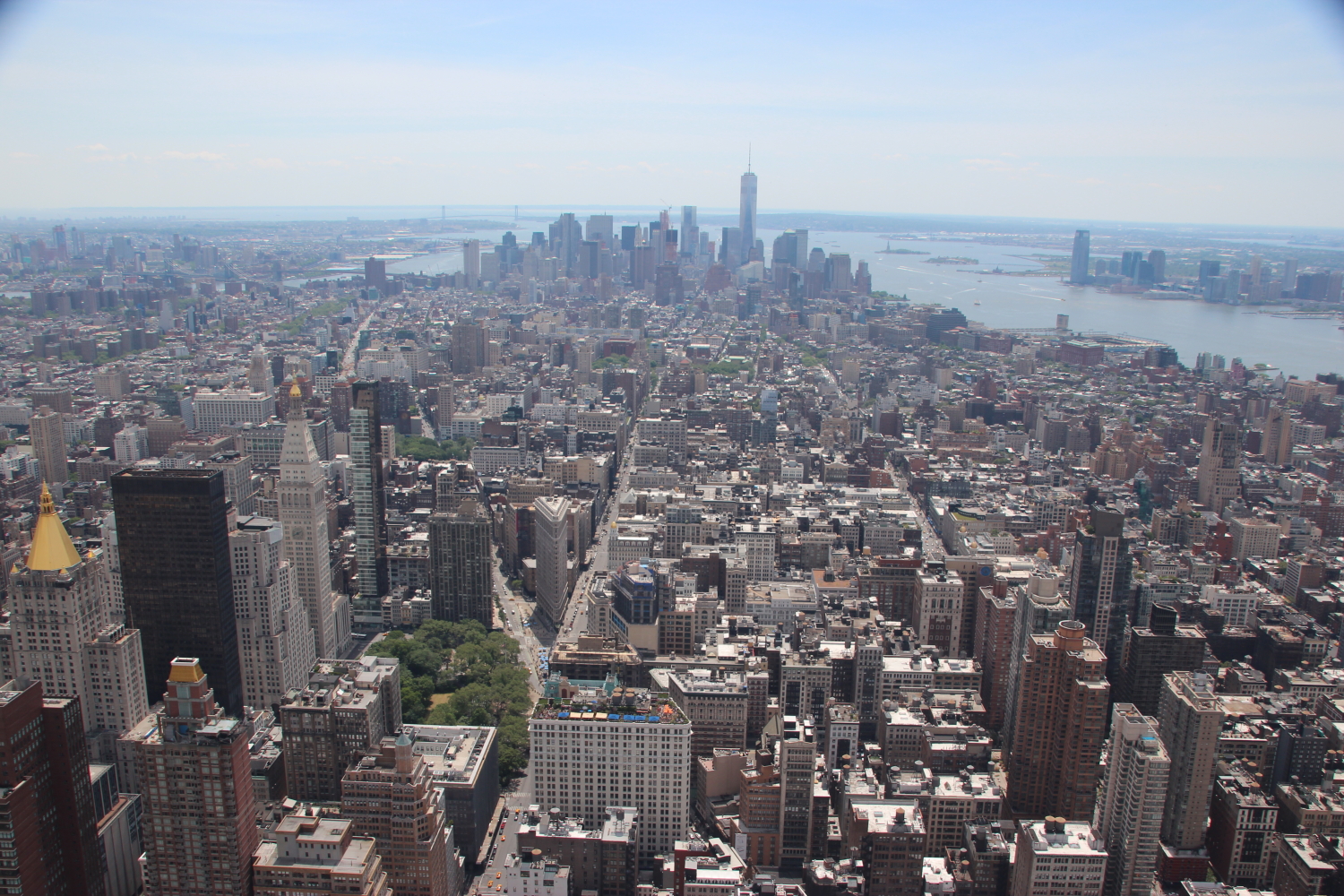
A: Arguably, life in New York provides an artist with direct access to some of the best international art of the past, the present, and probably the future. It is possible to see more art here – both good and bad – than in any other American city.
Just pick up any local magazine and scan the art listings! Our problem is never that there isn’t anything interesting to see or do. It’s “how do we zero in on the most significant local cultural activities, ones that might contribute to making us better artists?”
Certainly a visual artist’s work is consciously and unconsciously influenced not only by what she sees in museums and galleries, but by walking around the city. That’s partly why I am an inveterate walker. I never know what amazing things I am going to see when I leave my apartment.
Although living in New York City is a rich and heady mix for anyone, it is more so for sensitive artists. Artists are virtual sponges, soaking up experiences, processing them, and mysteriously expressing them in our work.
New York lets an artist ponder excellence as we see and experience firsthand what is possible. The best of the best manages to make its way here.
Undoubtedly, my own work is richer for having spent the last eighteen years in this fascinating, wild, and crazy city. For a visual artist New York is an infinitely fascinating place to live.
Comments are welcome!


 barbararachkoscoloreddust.com
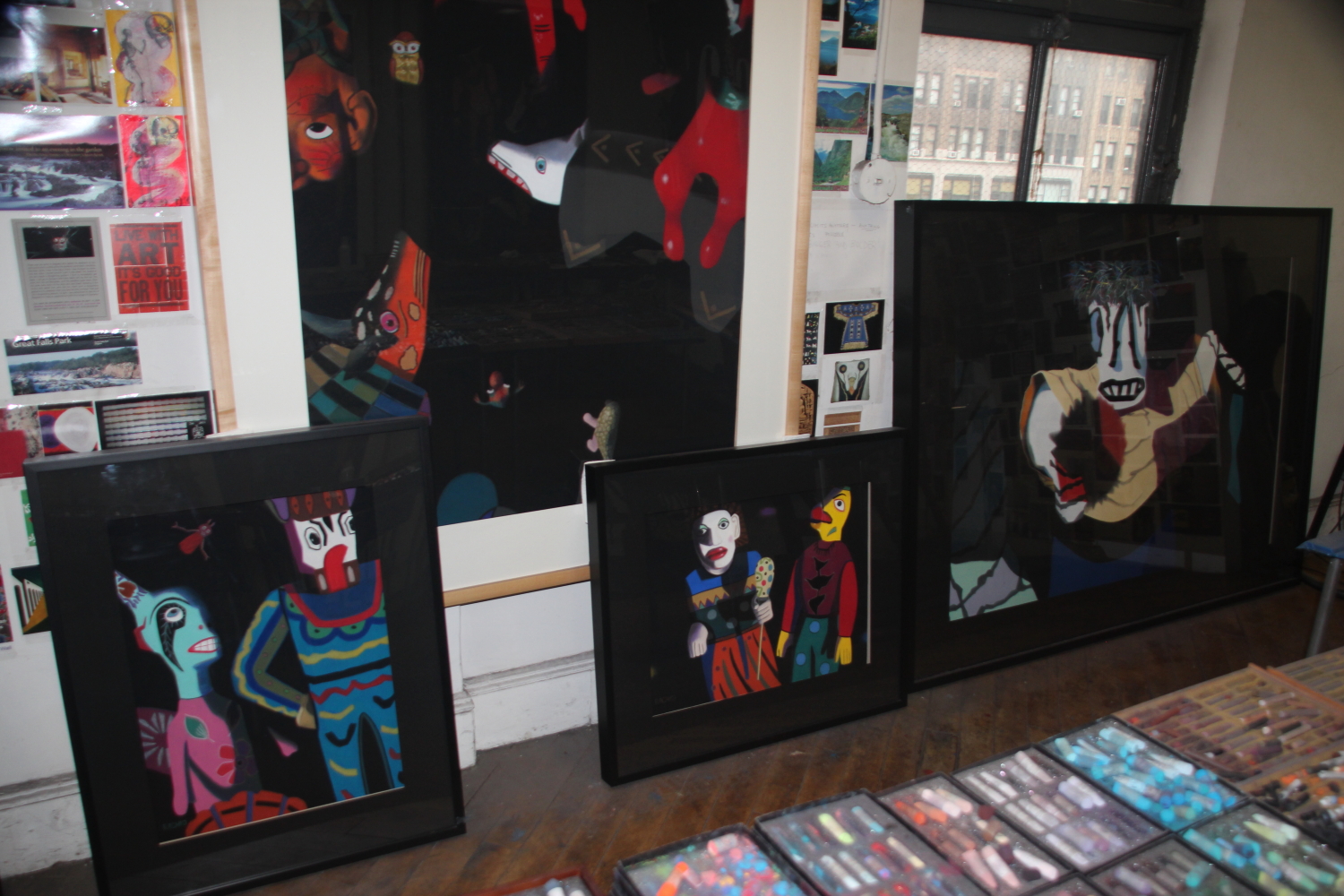
Q: Another interesting series of yours that has impressed me is your recent “Black Paintings.” The pieces in this series are darker than the ones in “Domestic Threats.” You create an effective mix between the dark background and the few bright tones, which establish such a synergy rather than a contrast, and all the dark creates a prelude to light. It seems to reveal such a struggle, a deep tension, and intense emotions. Any comments on your choice of palette and how it has changed over time?
Dec 6
Posted by barbararachkoscoloreddust
West 29th Street studio
A: That is a great question!
You are correct that my palette has darkened. It’s partly from having lived in New York for so long. This is a generally dark city. We famously dress in black and the city in winter is mainly greys and browns.
Also, the “Black Paintings” are definitely post-9/11 work. My husband, Bryan, was tragically killed onboard the plane that crashed into the Pentagon. Losing Bryan was the biggest shock I ever have had to endure, made even harder because it came just 87 days after we had married. We had been together for 14 ½ years and in September 2001 were happier than we had ever been. He was killed so horribly and so senselessly. Post 9/11 was an extremely difficult, dark, and lonely time.
In the summer of 2002 I resumed making art, continuing to make “Domestic Threats” paintings. That series ran its course and ended in 2007. Around then I was feeling happier and had come to better terms with losing Bryan (it’s something I will never get over but dealing with loss does get easier with time). When I created the first “Black Paintings” I consciously viewed the background as literally, the very dark place that I was emerging from, exactly like the figures emerging in these paintings. The figures themselves are wildly colorful and full of life, so to speak, but that black background is always there.
Comments are welcome!
Share this:
Posted in 2014, An Artist's Life, Art in general, Art Works in Progress, Black Paintings, Creative Process, Domestic Threats, Inspiration, Painting in General, Pastel Painting, Photography, Studio, Working methods
Comments Off on Q: Another interesting series of yours that has impressed me is your recent “Black Paintings.” The pieces in this series are darker than the ones in “Domestic Threats.” You create an effective mix between the dark background and the few bright tones, which establish such a synergy rather than a contrast, and all the dark creates a prelude to light. It seems to reveal such a struggle, a deep tension, and intense emotions. Any comments on your choice of palette and how it has changed over time?
Tags: after, always, another, around, art, background, better, between, biggest, black, Black Paintings, bright, browns, Bryan, changed, choice, city, colorful, comments, consciously, continuing, contrast, correct, course, crashed, create, dark, dealing, deep, difficult, Domestic Threats, dress, easier, effective, emerging, emotions, ended, endure, establish, exactly, extremely, famously, feeling, figures, first, full, generally, great, greys, happier, harder, horribly, however, husband, impressed, intense, interesting, killed, life, light, literally, lived, lonely, losing, loss, mainly, making, married, mix, New York, onboard, paintings, palette, partly, Pentagon, pieces, plane, post-9/11, prelude, question, rather, recent, resumed, reveal, senselessly, September, series, shock, something, speak, struggle, summer, synergy, tension, terms, themselves, time, together, tones, tragically, viewed, wildly, winter, work