Blog Archives
Pearls from artists* # 689

*an ongoing series of quotations – mostly from artists, to artists – that offers wisdom, inspiration, and advice for the sometimes lonely road we are on.
This is what I wish someone had told me years ago:
The art world is not a meritocracy. Like the world at large, it is a system based on hoarded capital and exploited labor. This system owes you nothing, even if you have extraordinary talent, work tremendously hard, never give up, and do all the right things. There are no ‘extra points’ for effort, earnestness, dedication, or sacrifice.
(We ALL think WE are going to be the exception.)
Unless you have fantastic connections or pedigree, after you build and maintain the basics of making strong work and getting the word out, a great deal depends on luck. Many of the artists you admire are likely living difficult lives you might not be willing to live, making sacrifices you might not be willing to make. Many who appear to support themselves with their work are in fact, partially or fully supported by spouses, family money, or jobs they do not discuss. They keep these jobs secret because some art world players refuse to validate your work if you are not ‘seriously committed’ enough to be a full-time artist. (Of course, artists who were not born wealthy need validation from these very players to be ABLE to create full-time.)
Kate Kretz in Art From Your Core: A Holistic Guide to Visual Voice
Comments are welcome!
Q: Over your 40-year career as an artist, you have managed to keep presentation, technical, subject matter, conceptual consistencies in your art practice and work. How do you manage to filter out inspirations that might be luring at that moment but do not support your art practice? For example, you master pastel works. There must have been moments when you might have been inspired to make oil works. How do you keep such inspirations aside. (Question from Vedica Art Studios and Gallery)

A: About thirty-five years ago, when my pastel paintings were becoming larger—around 60” x 40”—I had to choose between transitioning to oil on canvas or continuing with pastel. Framing was the main concern. I wasn’t certain large pastels could be framed, and even if they could, the cost might be prohibitive. However, I had already fallen in love with pastel and knew no other medium could offer such vibrant colors or velvety textures. Determined, I resolved the framing issue (art-making is fundamentally problem-solving), committed myself fully to soft pastel, and have continued inventing and refining techniques ever since.
My goal from the beginning has always been improvement as an artist. If an activity doesn’t contribute to my growth—as a person or as an artist—I typically don’t pursue it. Time and energy are finite resources, so I try to use them wisely.
Comments are welcome!
Pearls from artists* # 610
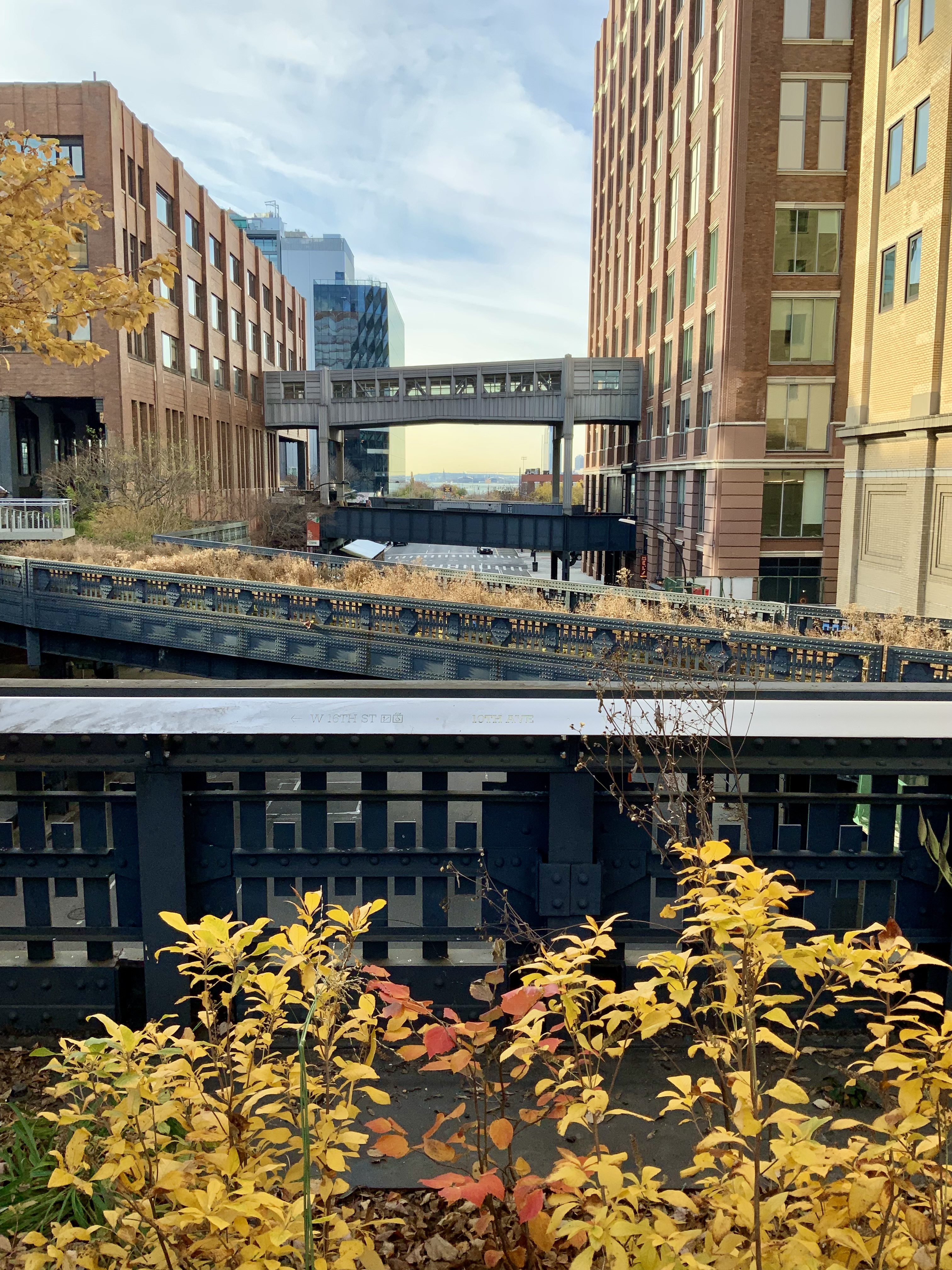
View from the High Line, New York NY
*an ongoing series of quotations – mostly from artists, to artists – that offers wisdom, inspiration, and advice for the sometimes lonely road we are on.
Just as the restless, committed, curious, and perhaps obsessed explorer follows the river from bend to bend, shooting rapids and pulling himself out of the water, so the self-dedicated artist launches himself on an exploratory art journey. He judges which fork in the river he will take, when he will rest and when he will push on, who he will take with him or whether he will travel alone. While he doesn’t possess unlimited freedom as he journeys, bound as he is by the demands of his personality, by his time and place, and by circumstances beyond his control, he does possess unrestricted permission from himself to explore every available avenue.
The contemporary artist must especially direct and trust himself because he lives in a constantly changing art environment. … as Pablo Picasso put it, “Beginning with Van Gogh we are all in a measure, autodidacts.” Painters no longer live within a tradition and so each of us must create an entire language.
Eric Maisel in A Life in the Arts: Practical Guidance and Inspiration for Creative and Performing Artists
Comments are welcome!
Pearls from artists* # 400

In the studio with friends
* an ongoing series of quotations – mostly from artists, to artists – that offers wisdom, inspiration, and advice for the sometimes lonely road we are on.
A student in the audience raised her hand and asked me:
“Why should I live?”
… In the very act of asking that question, you are seeking reasons for your convictions, and so you are committed to reason as the means to discover and justify what is important to you. And there are so many reasons to live!
As a sentient being, you have the potential to flourish. You can refine your faculty of reason itself by learning and debating. You can seek explanations of the natural world through science, and insight into the human condition through the arts and humanities. You can make the most of your capacity for pleasure and satisfaction, which allowed your ancestors to thrive and thereby allowed you to exist. You can appreciate the beauty and the richness of the natural and cultural world. As the heir to billions of years of life perpetuating itself, you can perpetuate life in turn. You have been endowed with a sense of sympathy – the ability to like , love, respect, help, and show kindness – and you can enjoy the gift of mutual benevolence with friends, family, and colleagues.
And because reason tells you that none of this is particular to you, you have the responsibility to provide to others what you expect for yourself. You can foster the welfare of other sentient beings by enhancing life, health, knowledge, freedom, abundance, safety, beauty, and peace. History shows that when we sympathize with others and apply our ingenuity to improving the human condition, we can make progress in doing so, and you can help to continue that progress.
Stephen Pinker in Enlightenment Now: The Case for Reason, Science, Humanism, and Progress
Comments are welcome!
Q: When you left the Navy you worked on commission as a portrait artist. Why don’t you accept commissions now?

Barbara’s studio
A: As I have often said, I left the active duty Navy in 1989, but stayed in the Reserves. The Reserves provided a small part-time income and the only requirement was that I work one weekend a month and two weeks each year. Plus, I could retire after 13 more years and receive a pension. (In 2003 I retired from the Navy Reserve as a Commander). The rest of the time I was free to pursue my studio practice.
For a short time I made a living making commissioned photo-realist portraits in soft pastel on sandpaper. However, after a year I became very restless. I remember thinking, “I did not leave a boring job just to make boring art!” I lost interest in doing commissions because what I wanted to accomplish personally as an artist did not coincide with what portrait clients wanted. I finished my final portrait commission in 1990 and never looked back.
To this day I remain reluctant to accept a commission of any kind. So I am completely free to paint whatever I want, which is the only way to evolve as a serious, deeply committed artist.
Comments are welcome!


 barbararachkoscoloreddust.com