Blog Archives
Pearls from artists* # 581

With recent “Bolivianos”
*an ongoing series of quotations – mostly from artists, to artists – that offers wisdom, inspiration, and advice for the sometimes lonely road we are on.
The essence of style is this: We have something in us, about us; it can be called many things, but for now let’s call it our original nature. We are born with our original nature, but on top of that, as we grow up, we accommodate to the patterns and habits of our culture, family, physical environment, and the daily business of the life we have taken on. What we are taught solidifies as “reality.” Our persona, the mask we show the world, develops out of our experience and training, step by step from infancy to adulthood. We construct our world through the actions of perception, learning, and expectation. We construct our “self” through the same actions of perception, learning, and expectation. World and self interlock and match each other, step by step and shape by shape. If the two constructions, self and world, mesh, we grow from child to adult becoming “normally adjusted individuals.” If they do not mesh so well, we may experience feelings of inner division, loneliness, or alienation.
If we should happen to become artists, our work takes on, to a certain extent, the style of the time: the clothing in which we are dressed by our generation, our country and language, our surroundings, the people who have influenced us.
But somehow, even when we are grown up and “adjusted,” everything we do and are – our handwriting, the vibrato of our voice, the way we handle the bow or breathe into the instrument, our way of using language, the look in our eyes, the pattern of whirling fingerprints on our hand – all these things are symptomatic of our original nature. They all show the imprint of our own deeper style or character.
Stephen Nachmanovitch in Free Play: Improvisation in Life and Art
Comments are welcome!
Q: You wear gloves and a mask when you are working in your studio, right? Can you tell me what kinds? (Question from Britta Konau)
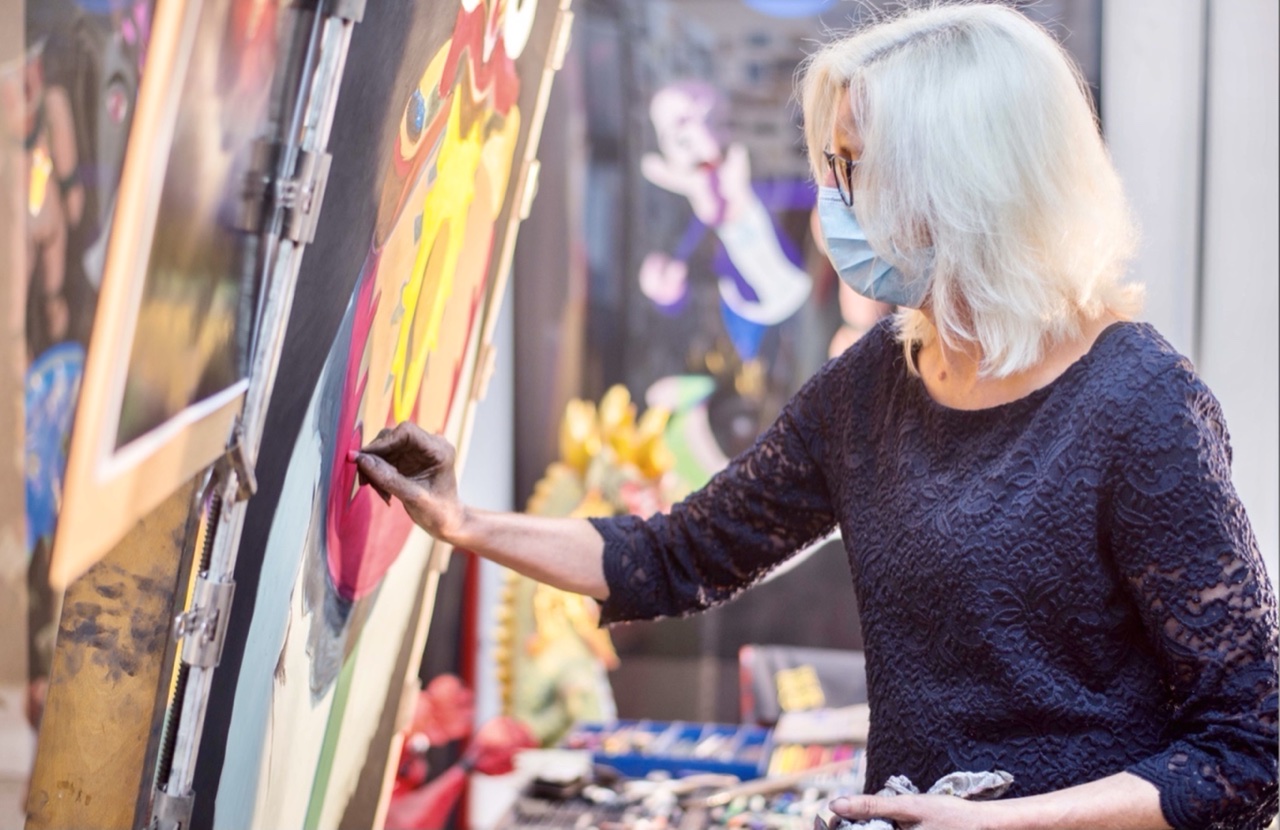
A: I wear a paper surgical mask – the type that has become ubiquitous since COVID – bought from a local medical supply store. I thoroughly coat my hands with barrier cream – Art Guard – to prevent pastel getting into my skin. The cream has an added benefit of making it easy to wash pastel off my hands. (Neither gloves nor individual finger cots ever worked for me. They made my fingers sweat and did not allow for the fine touch needed to blend new colors directly on sandpaper. Plus, they shredded from being rubbed against the paper’s grit). Also, it is very important that you work with your hand below your face so pastel dust falls below your nose, where you are less likely to breathe it in.
Comments are welcome!
Pearls from artists* # 433

Chatting with Jenny Holzer. It looks like she did not want her picture taken, but she was actually waiving.
*an ongoing series of quotations – mostly from artists, to artists – that offers wisdom, inspiration, and advice for the sometimes lonely road we are on.
…Two positions exist, the artistic and the commercial. Between these two an abiding tension persists. The eighteenth-century American painter Gilbert Stuart complained, “What a business is that of portrait painter. He is brought a potato and is expected to paint a peach.” The artist learns that the public wants peaches, not potatoes. You can paint potatoes if you like, write potatoes, dance potatoes, and compose potatoes, you can with great and valiant effort communicate with some other potato-eaters and peach-eaters. In so doing you contribute to the world’s reservoir of truth and beauty. But if you won’t give the public peaches, you won’t be paid much.
Repeatedly artists take the heroic potato position. They want their work to be good, honest, powerful – and only then successful. They want their work to be alive, not contrived and formulaic. As the Norwegian painter Edvard Munch put it: “No longer shall I paint interiors, and people reading, and women knitting. I shall paint living people, who breathe and feel and suffer and love.”
The artist is interested in the present and has little desire to repeat old, albeit successful formulas. As the painter Jenny Holzer put it, “I could do a pretty good third generation-stripe painting, but so what?
The unexpected result of the artist’s determination to do his [sic] own best art is that he is put in an adversarial relationship with the public. In that adversarial position he comes to feel rather irrational for what rational person would do work that’s not wanted?
…Serious work not only doesn’t sell well, it’s also judged by different standards. If the artist writes an imperfect but commercial novel it is likely to be published and sold. If his screenplay is imperfect but commercial enough it may be produced. If it is imperfect and also uncommercial it will not be produced. If his painting is imperfect but friendly and familiar it may sell well. If it is imperfect and also new and difficult, it may not sell for decades, if ever.
Ironically enough, the artist attempting serious work must also attain the very highest level of distinction possible. He must produce Crime and Punishment and The Brothers Karamazov but not also The Insulted and Injured or A Raw Youth, two of Dostoevsky’s nearly unknown novels. He is given precious little space in this regard.
I daresay, this last is why I devote my life to creating the most unique, technically advanced pastel paintings anyone will see!
Eric Maisel, A Life in the Arts: Practical Guidance and Inspiration for Creative and Performing Artists
Comments are welcome!
Q: Do you have a home studio or do you go to an outside studio to work? Which do you prefer and why?

At work
A: I have always preferred a separate studio. Pastel creates a lot of dust, it’s toxic to breathe, plus I do not want to live with the mess! I need a place to go in the mornings, someplace where I can focus and work without any distractions. It’s difficult to do that at home.
From the beginning of my time as an artist, in the mid-1980’s, I had a studio. My first one was in the spare bedroom of the Alexandria, Virginia, house that I shared with my late husband, Bryan, and that I still own.
For about three years in the 1990s I had a studio on the third floor of the Torpedo Factory Art Center, a building in Alexandria, VA that is open to the public. People would come in, watch artists at work, and sometimes buy a piece of art.
In April 1997 an opportunity to move to New York arose and I didn’t look back. By then I was showing in a good 57th Street gallery, Brewster Arts Ltd. (the gallery focused exclusively on Latin American artists; I was in the company of Leonora Carrington, Rufino Tamayo, Diego Rivera, etc.), and I had managed to find a New York agent, Leah Poller, with whom to collaborate.
I looked at only one other space before finding my West 29th Street studio and knew instantly it was the one! An old friend of Bryan’s from Cal Tech rented the space next door and he had told us it was available. Initially the studio was a sublet. The lease-holder was a painter headed to northern California to work temporarily for George Lucas at the Lucas Ranch. After several years she decided to stay so I was able to take over the lease. I feel extremely fortunate to have been in my West 29th Street, New York City space now for twenty-three years. In a city where old buildings are perpetually knocked down to make way for new ones this is rare.
My studio is an oasis in a chaotic city, a place to make art, to read, and to think. I love to walk in the door every morning and I feel calmer the moment I arrive. It’s my absolute favorite place in New York! Sometimes I think of it as my best creation. For more about this please see
https://artofcollage.wordpress.com/2020/04/30/artists-and-their-relationship-to-their-studio
Comments are welcome!
Q: What do you do to protect yourself from toxic pastel dust?
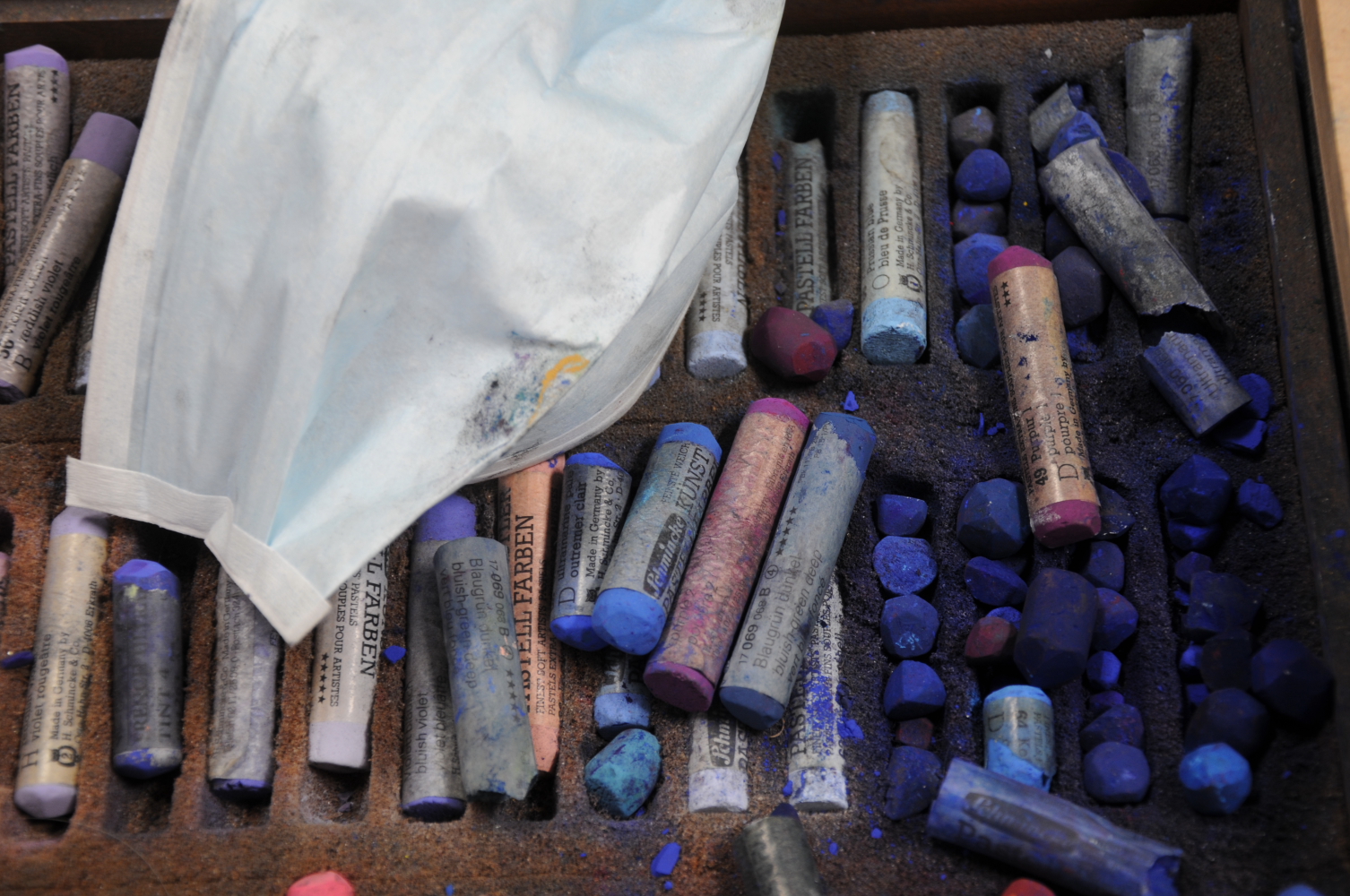
Used surgical mask
A: Certain sticks of soft pastel contain toxic lead and cadmium so some precautions are necessary. Before I begin working, I liberally apply a barrier cream, called Artguard, to my hands and wrists so that pastel will not be absorbed through my skin via small cuts that I might have. I wear a surgical mask to avoided breathing the dust. Also, I try to work so that my hand is below my head, to lessen the likelihood of breathing particles of pastel as they fall to the floor. I ensure there is good air circulation in my studio. Once the dust has settled onto the floor, I try not to stir it up again until I dispose of it. I’ve been working with soft pastel for 27 years and have managed to stay healthy so far.
Comments are welcome!
Pearls from artists* # 31
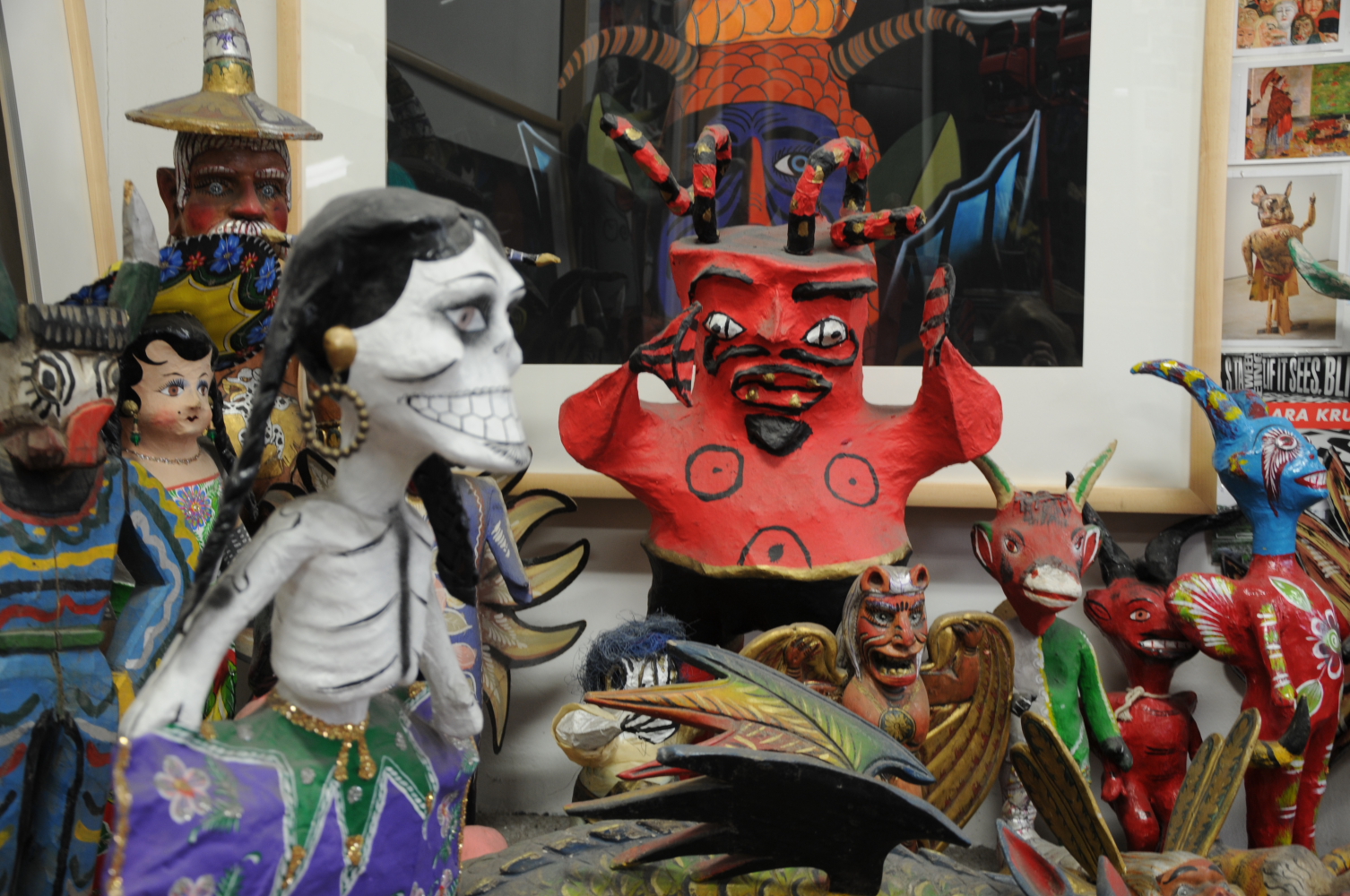
A corner of Barbara’s studio
* an ongoing series of quotations – mostly from artists, to artists – that offers wisdom, inspiration, and advice for the sometimes lonely road we are on.
When we are children we unquestioningly see the objects around us as alive; we speak to them, give them names, breathe life into them. The imagination knows no bounds. As we grow up, we gradually lose this facility, until we finally arrive in an utterly “demystified” world that draws clear boundaries between what is alive and what is not, between subjective and objective perception. According to Sigmund Freud, culture is the only domain in our modern society that gives a measure of legitimacy to the persistence of this infantile desire to see things as animate. In the field of art, imagination is the precondition on which fiction of any sort rests; in art, mental states can be projected onto objects and images, but not in social reality or the sciences.
Dietrich Karner in Animism: Modernity Through the Looking Glass
Comments are welcome!



 barbararachkoscoloreddust.com