Category Archives: Art in general
Pearls from artists* #309
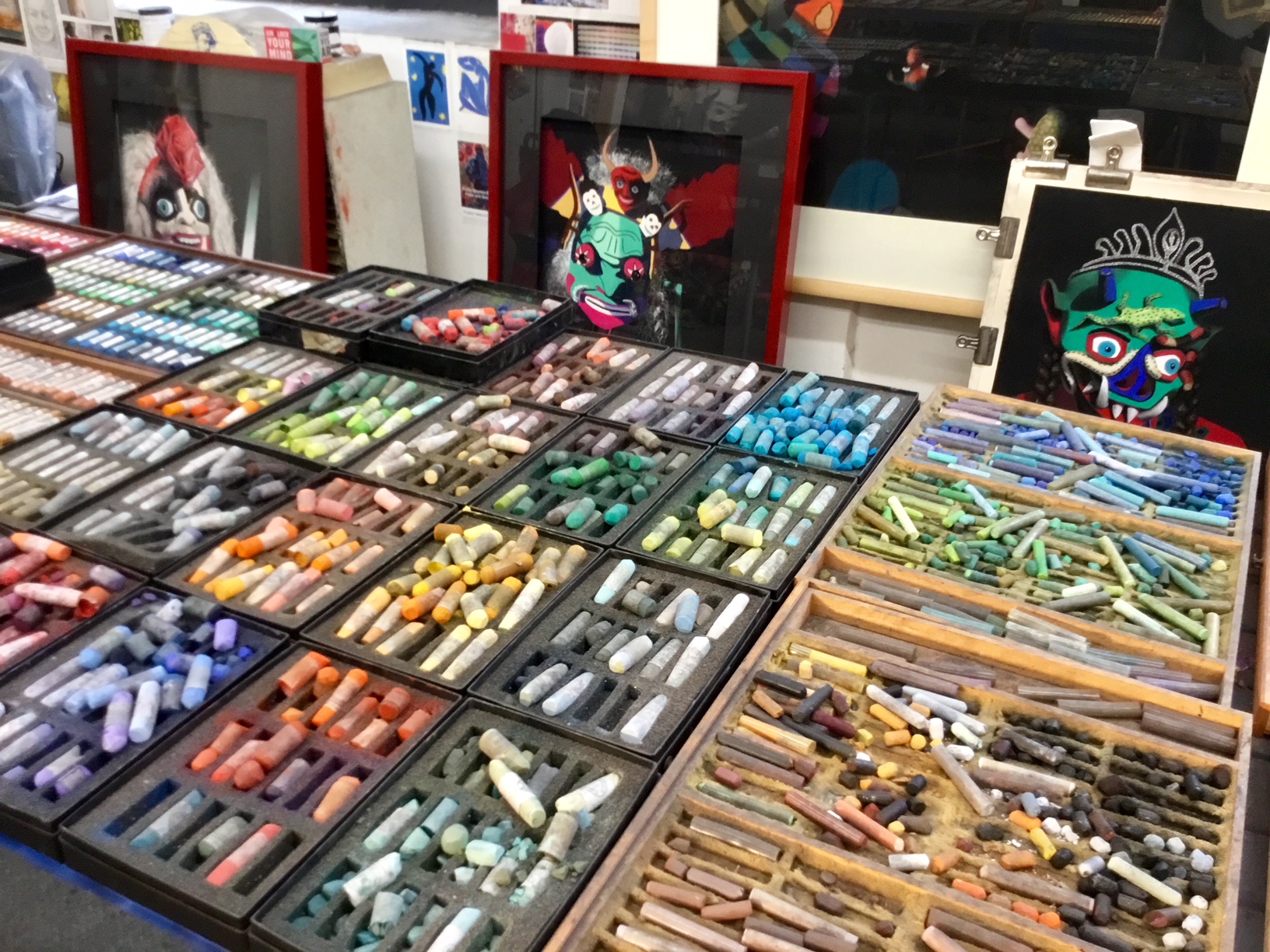
Barbara’s studio
*an ongoing series of quotations – mostly from artists, to artists – that offers wisdom, inspiration, and advice for the sometimes lonely road we are on.
It is a strange thing to catalog the conflicting theories as to what the first artists thought they were doing down there in the caves, because the truth is that, to this day, we do not know why we make art. In the end, art may not have been our invention at all. It may well have appeared in history as it does in the life of many individual artists: as an outside call, a sudden flash of inspiration, an inner wanderlust exerting such a powerful pull that ultimately we would have to say that Picasso got it wrong: the early humans did not invent art. Art invented humanity.
J.F. Martel in Reclaiming Art in the Age of Artifice: A Treatise, Critique, and Call to Action
Comments are welcome!
Pearls from artists* # 308
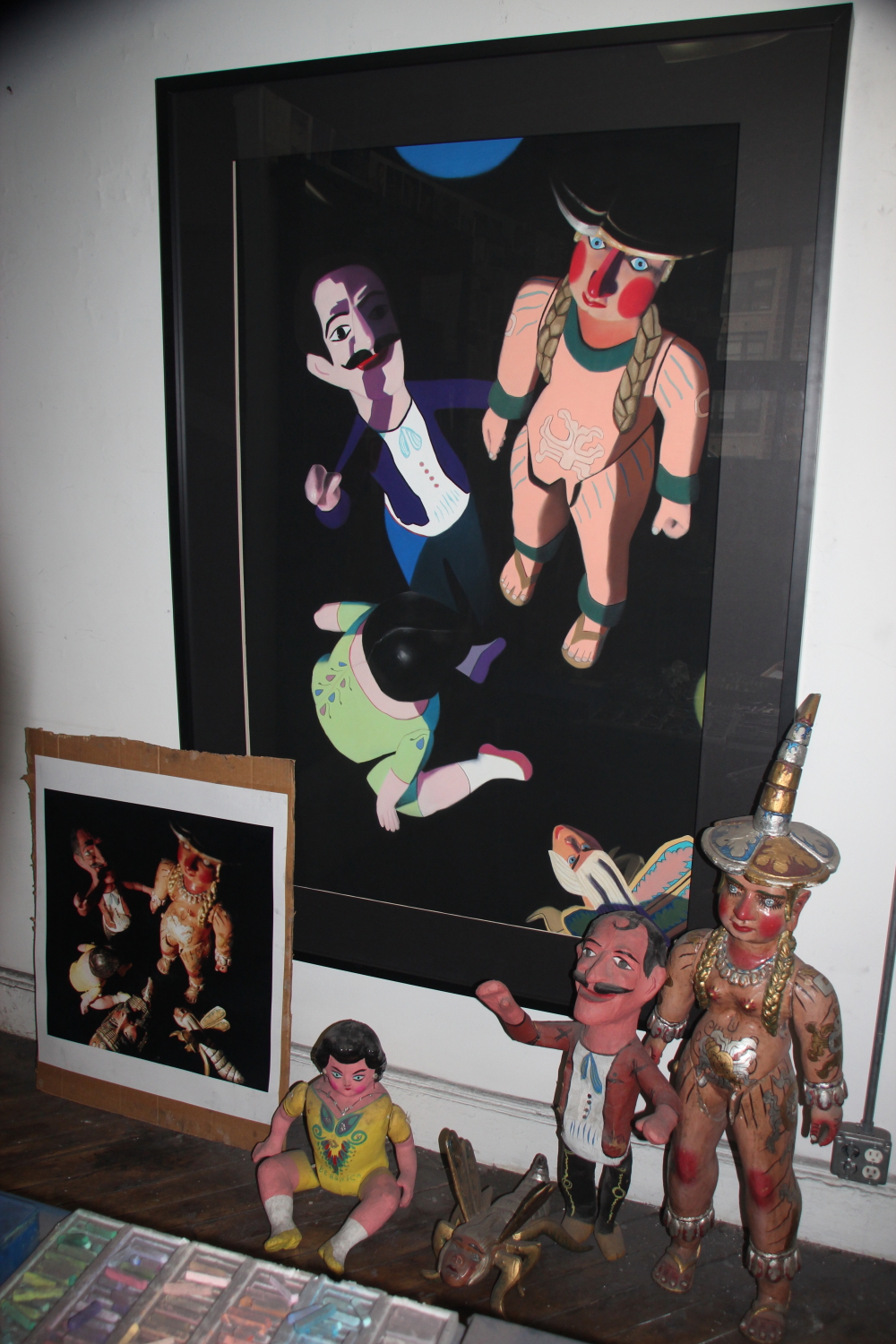
“The Ancestors,” 70” x 50” framed, in Barbara’s studio
*an ongoing series of quotations – mostly from artists, to artists – that offers wisdom, inspiration, and advice for the sometimes lonely road we are on.
Art is mysterious because its purpose is unknown and its effect always exceeds the ends we put it to. If it is true, for instance, that nearly all human societies see the possession of artistic objects as a sign of prestige and power, it may simply be because art’s primary quality makes it a suitable sign for those who want to legitimize their authority. And while it may be the case that art ennobles us by bringing beauty into our lives, or that it conveys complex cultural ideas simply and effectively, or that it preserves the beliefs of one age for the next – again, these functions could very well follow from art’s original, mysterious, irreducible shining. Just as it is the gleam of gold that makes it precious in our eye and not its preciousness that makes it gleam, so the primary quality of art could precede all of its uses and appropriations. In other words art may be something before it becomes all the things we claim it to be.
J.F. Martel in Reclaiming Art in the Age of Artifice: A Treatise, Critique, and Call to Action
Comments are welcome!
Pearls from artists* # 307
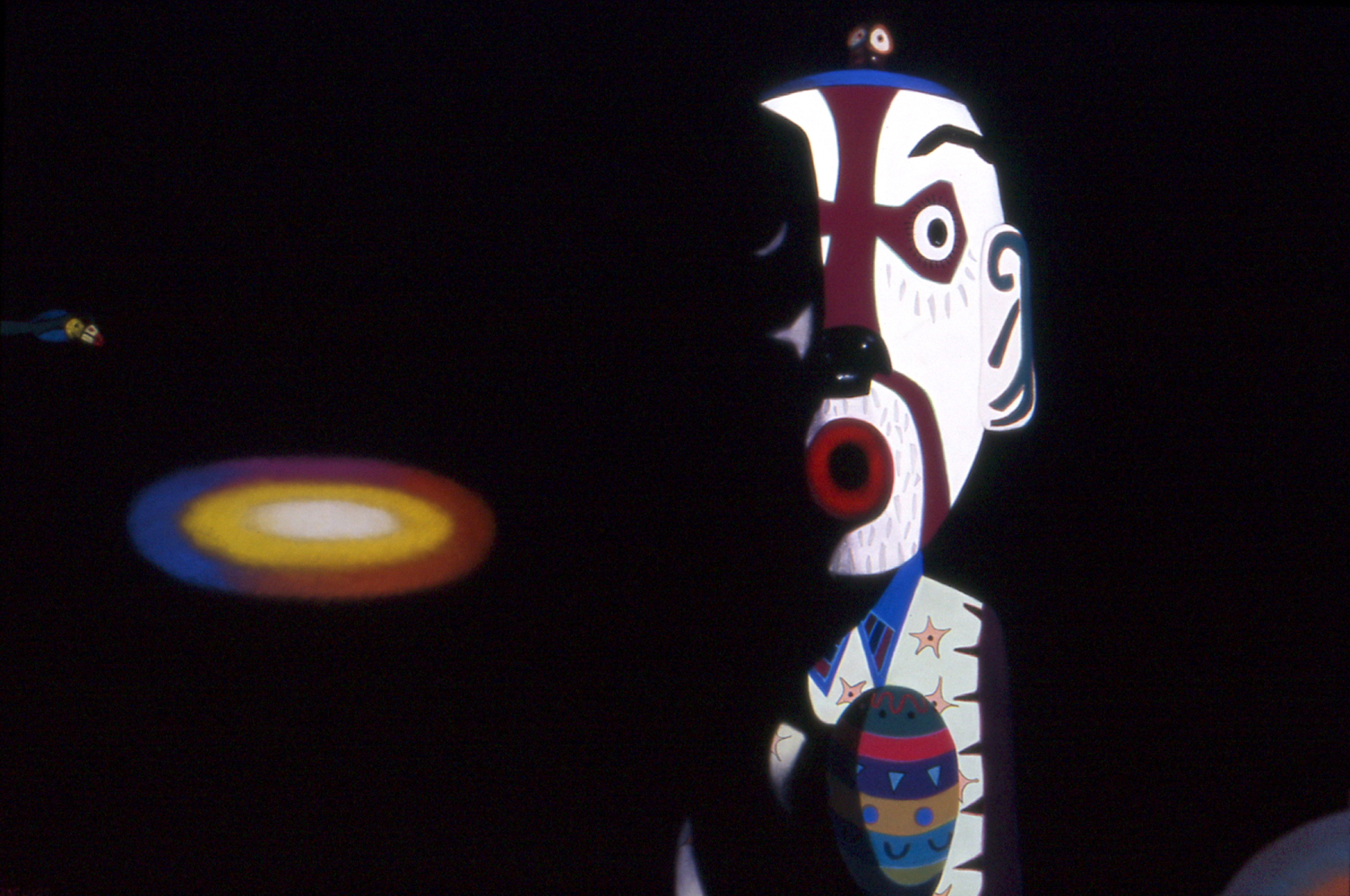
“Poker Face,” soft pastel on sandpaper, 38″ x 58″
* an ongoing series of quotations – mostly from artists, to artists – that offers wisdom, inspiration, and advice for the sometimes lonely road we are on.
Until fairly recently the word art as applied to pictures usually referred not just to representations of the world but to representations that suggested an importance greater than we might otherwise have assumed. Such pictures were said to instruct and delight, which they did by their wholeness and richness. The effect was to reinforce a sense of meaning in life, though not necessarily a belief in a particular ideology or religion, and in this they were a binding cultural achievement.
Unfortunately art of this quality is now little attempted, partly because of disillusionment from a century of war, partly because of sometimes misplaced faith in the communicative and staying powers of total abstraction, and partly because of the ease with which lesser work can be made and sold. This atrophying away of the genuine article is a misfortune because, in an age of nuclear weapons and over-population and global warming, we need more than ever what art used to provide. Somehow we have to recommit to picture making that is serious. It is impermissible any longer to endorse imitations that distract us or, openly or by implication, ridicule hope. The emptiness of material by Jeff Koons and Damien Hirst, for example, is born of cynicism and predictive of nihilism.
Robert Adams in Art Can Help
Comments are welcome!
Pearls from artists* # 306

New York, NY
* an ongoing series of quotations – mostly from artists, to artists – that offers wisdom, inspiration, and advice for the sometimes lonely road we are on.
It is the responsibility of artists to pay attention to the world, pleasant or otherwise, and to help us live respectfully in it.
Artists do this by keeping their curiosity and moral sense alive, and by sharing with us their gift for metaphor. Often this means finding similarities between observable fact and inner experience – between birds in a vacant lot, say, and an intuition worthy of Genesis.
More than anything else, beauty is what distinguishes art. Beauty is never less than mystery, but it has within it a promise.
In this way, art encourages us to gratitude and engagement, and is of both personal and civic consequence.
Robert Adams in Art Can Help
Comments are welcome!
Travel photo of the month*
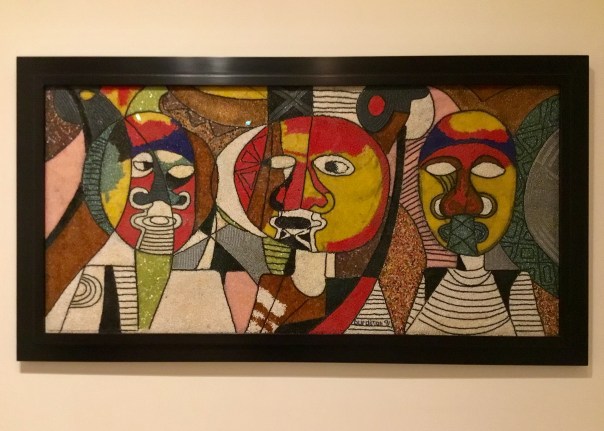
“The Three Wise Men,” Jimoh Buraimoh, Glass beads, plastic cylinders, cotton, epoxy, plywood, 1991
* Favorite travel and other photographs that have not yet appeared in this blog.
A: I saw this painting at the Baltimore Museum of Art and was intrigued by the intracacy and textures of the beads, cylinders, and other items used by Jimoh Buraimoh, a Nigerian modernist. The figures are his portrayal of the three men who traveled to England in 1960 to negotiate Nigeria’s independence. Buraimoh honors the nation’s founders with materials that glorify Yoruba heritage and artistic traditions. His title also associates the men with the three wise men of the Bible. I enjoy this work very much and couldn’t help being reminded of imagery by Picasso.
Comments are welcome!
Pearls from artists* # 304

“Palaver,” soft pastel on sandpaper, 26″ x 20″
* an ongoing series of quotations – mostly from artists, to artists – that offers wisdom, inspiration, and advice for the sometimes lonely road we are on.
… my job as a fiction writer is to write fiction, not to review it. Art isn’t explanation. Art is what an artist does, not what an artist explains. (Or so it seems to me, which is why I have a problem with the kind of modern museum art that involves reading what the artist says about a work in order to find out why one should look at it or “how to experience” it).
Ursula K. Le Guin in No Time to Spare: Thinking About What Matters
Comments are welcome!
Pearls from artists* # 303
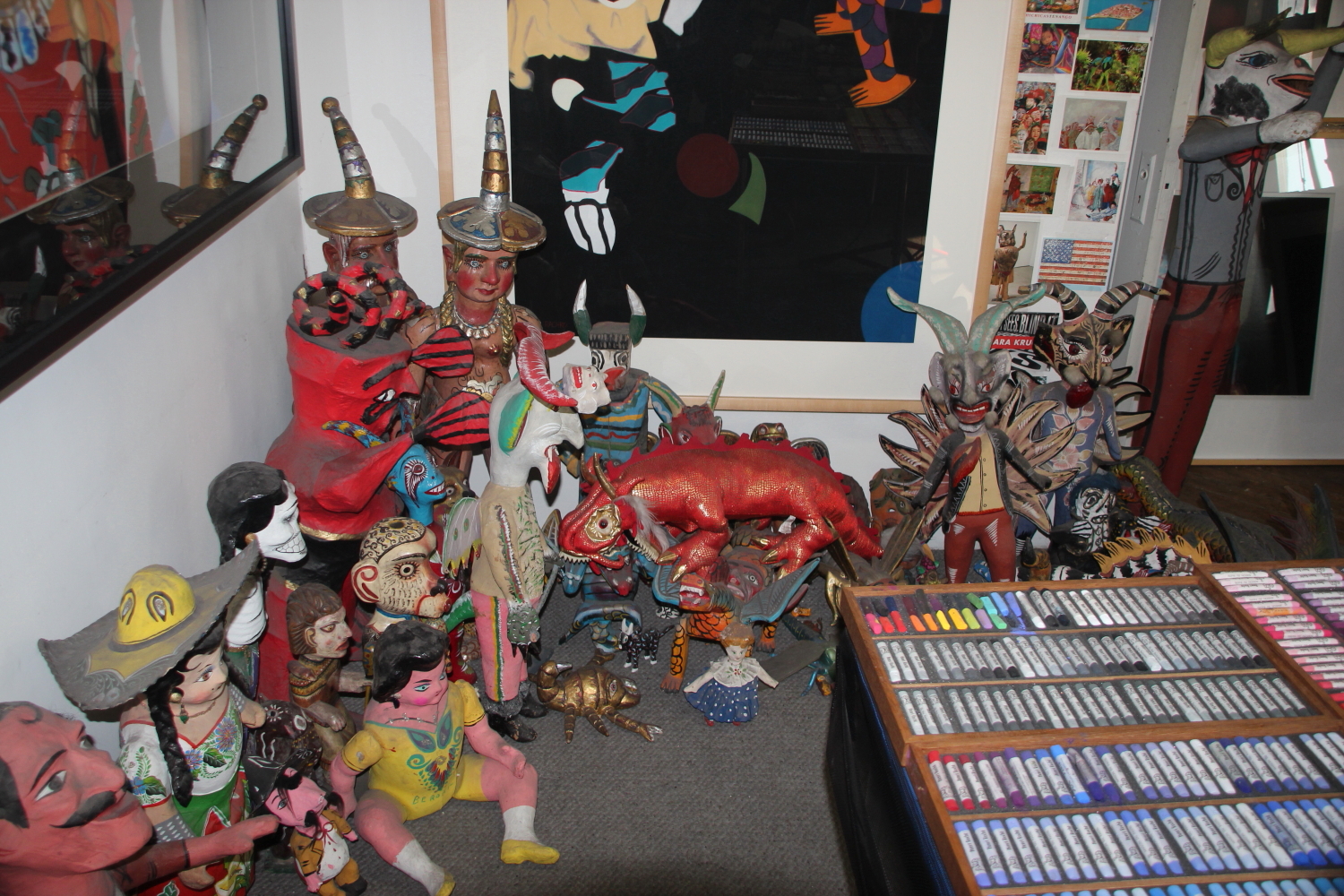
Barbara’s Studio
*an ongoing series of quotations – mostly from artists, to artists – that offers wisdom, inspiration, and advice for the sometimes lonely road we are on.
If the majority of aesthetic works fail to astonish us, then. it may have something to do with the ingrained insensitivity that is part and parcel of contemporary life. It may also have something to do with the fact that art, as Solzhenitsyn said so eloquently, is constantly being put to uses that are at odds with its essence. Indeed, the moment a work of art appears, all kinds of other factors come into play. Cultural institutions, social pressures, laws, customs, fashions, and trends pull it in every direction. Fame, money, conformism, attention-seeking, and knee-jerk rebellion can lure artists to abandon their own vision in order to emulate those of others, to adhere to formulas and paint by numbers, or to value external convention over vision. The inevitable result is a lot of bad art that couldn’t astonish anyone. It should come as no surprise, when looking over the glut of aesthetic objects that proliferate around us, if we feel the need to distinguish between authentic and inauthentic art – which is to say, art that astonishes us by attuning us to the radical mystery of being, and art that attempts to reinforce our shared illusions, comforting or intimidating us with the notion that there is nothing to wonder at since everything has been figured out.
J.F. Martel in Reclaiming Art in the Age of Artifice: A Treatise, Critique, and Call to Action
Comments are welcome!
Pearls from artists* # 302

“Epiphany,” soft pastel on sandpaper, 38″ x 58″
*an ongoing series of quotations – mostly from artists, to artists – that offers wisdom, inspiration, and advice for the sometimes lonely road we are on.
Regardless of personal convictions or professional concerns, an artist’s power comes down to two things: her sensitivity to the radical mystery of existence, and the artistry and craft with which she can channel that mystery into an object or performance. Neither existential awe nor a given metaphysical outlook need to serve as an explicit motivation. Simply, the emergence of artistic vision – and the need to express the vision without distorting or conceptualizing it – is contingent upon the underlying wonderment at being itself, a wonderment without which there would be no art.
J.F. Martel in Reclaiming Art in the Age of Artifice: A Treatise, Critique, and Call to Action
Comments are welcome!
Pearls from artists* # 301

Untitled reference photo for a pastel painting in the “Bolivianos” series
*an ongoing series of quotations – mostly from artists, to artists – that offers wisdom, inspiration, and advice for the sometimes lonely road we are on.
In 1917 the ballet impresario Sergei Diaghilev commissioned a new libretto from Jean Cocteau. When the young poet asked for advice on how to proceed, Diaghilev replied with a simple directive: “Astonish me.” The phrase would serve Cocteau as a mantra throughout his career, resurfacing, for instance, at the beginning of his classic film Orpheus. Not surprising, as few statements could better encapsulate the impetus that has driven artistic creation since the beginning. Astonishment is the litmus test of art, the sign by which we know we have been magicked out of practical and utilitarian enterprises to confront the bottomless dream of life in sensible form. Art astonishes and is born of astonishment. There is only one thing that it can be said to “communicate” more effectively than other mediums can, and that is “the weirdness of the Real.”
J.F. Martel in Reclaiming Art in the Age of Artifice: A Treatise, Critique, and Call to Action
Comments are welcome!
Pearls from artists* # 300
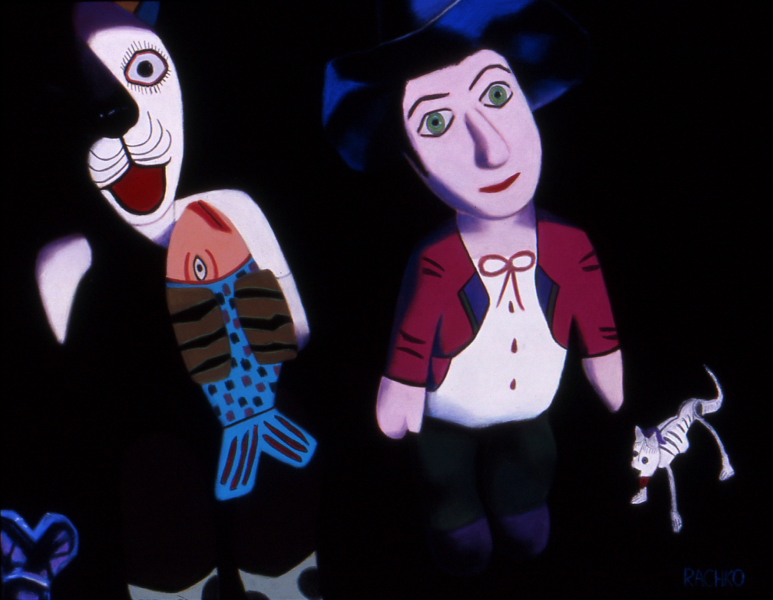
“Offering,” soft pastel on sandpaper, 20″ x 26″
*an ongoing series of quotations – mostly from artists, to artists – that offers wisdom, inspiration, and advice for the sometimes lonely road we are on.
Art breaks down the barriers that normally stand between the physical and the psychic, between your soul and the souls of others. “Through art alone are we able to emerge from ourselves, to know what another person sees of a universe which is not the same as our own and of which, without art, the landscapes would remain as unknown to us as those that may exist on the moon.” For the French novelist Marcel Proust, who wrote those words, art is a meeting place in which human beings commune at a level that ordinary language and sign systems do not allow. Without art, connection at this deeper level is impossible.
J.F. Martel in Reclaiming Art in the Age of Artifice: A Treatise, Critique, and Call to Action
Comments are welcome!



