Blog Archives
Pearls from artists* # 581

With recent “Bolivianos”
*an ongoing series of quotations – mostly from artists, to artists – that offers wisdom, inspiration, and advice for the sometimes lonely road we are on.
The essence of style is this: We have something in us, about us; it can be called many things, but for now let’s call it our original nature. We are born with our original nature, but on top of that, as we grow up, we accommodate to the patterns and habits of our culture, family, physical environment, and the daily business of the life we have taken on. What we are taught solidifies as “reality.” Our persona, the mask we show the world, develops out of our experience and training, step by step from infancy to adulthood. We construct our world through the actions of perception, learning, and expectation. We construct our “self” through the same actions of perception, learning, and expectation. World and self interlock and match each other, step by step and shape by shape. If the two constructions, self and world, mesh, we grow from child to adult becoming “normally adjusted individuals.” If they do not mesh so well, we may experience feelings of inner division, loneliness, or alienation.
If we should happen to become artists, our work takes on, to a certain extent, the style of the time: the clothing in which we are dressed by our generation, our country and language, our surroundings, the people who have influenced us.
But somehow, even when we are grown up and “adjusted,” everything we do and are – our handwriting, the vibrato of our voice, the way we handle the bow or breathe into the instrument, our way of using language, the look in our eyes, the pattern of whirling fingerprints on our hand – all these things are symptomatic of our original nature. They all show the imprint of our own deeper style or character.
Stephen Nachmanovitch in Free Play: Improvisation in Life and Art
Comments are welcome!
Pearls from artists* # 358
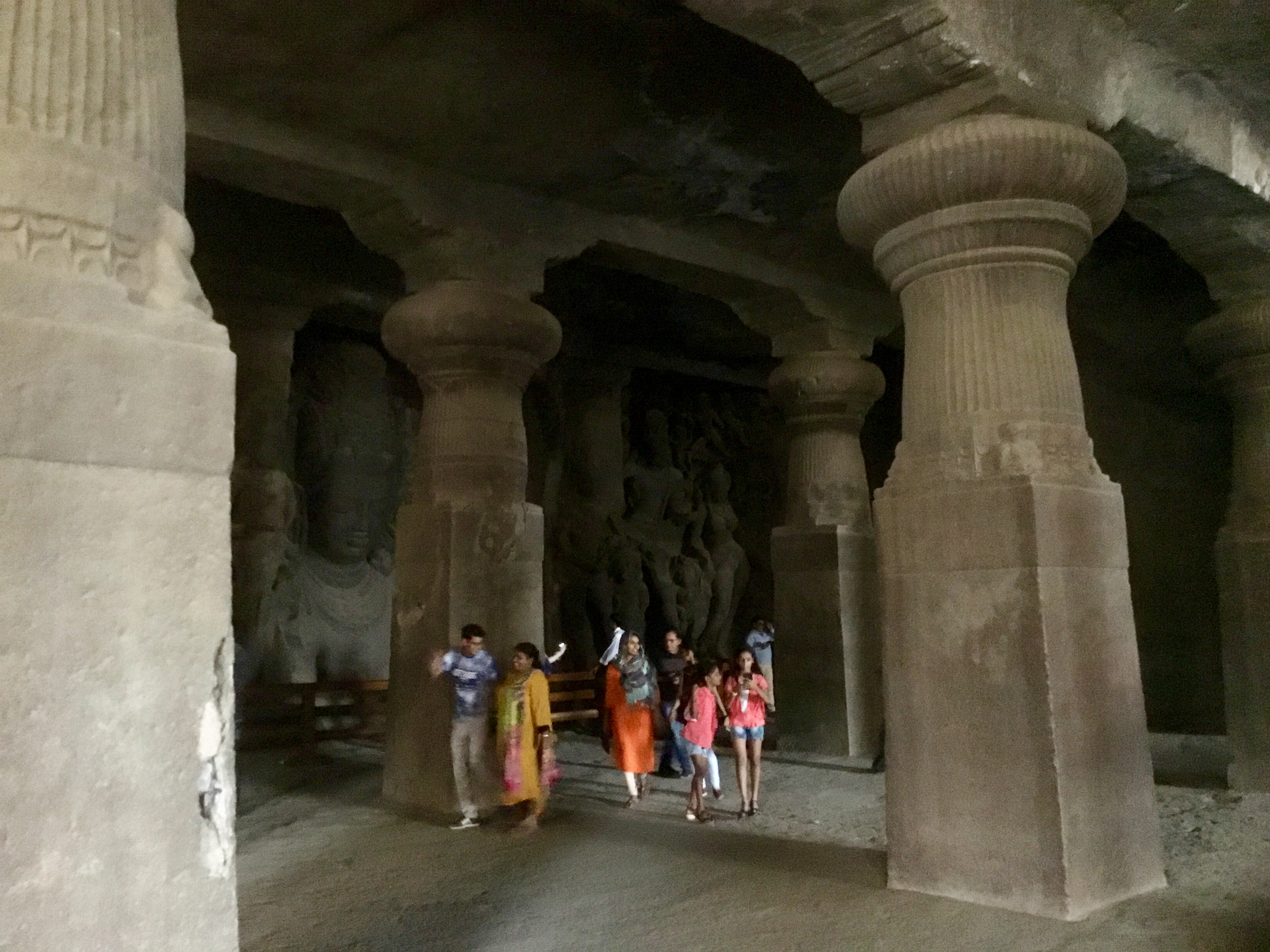
Elephanta Caves, India
*an ongoing series of quotations – mostly from artists, to artists – that offers wisdom, inspiration, and advice for the sometimes lonely road we are on.
According to [Rudolph] Arnheim, the way in which we reach out for and grasp the “object we see, either in our immediate range of perception or through the medium of photography, is dependent upon who we are and what we recognize from past experience.” The visual imprint of an image, an object, or a scene upon the eye is not at all “objective.” In the image-making process of thinking, we see, sort, and recognize according to the visual phenomenology of our own experience. What people notice in the “same” image – be it an image of a dancing Siva or a film of a Hindu festival procession – depends to some extent on what they can recognize from the visual experience of the past. In the case of film, of course, it also depends on what the photographer has seen and chosen to show us. Arnheim writes that the eye and the mind, working together in the process of cognition, cannot simply note down images that are “already there.” “We find instead that direct observation, far from being a mere ragpicker, is an exploration of the form-seeking, form-imposing mind, which needs to understand but cannot until it casts what it sees into manageable models.”
Diana L. Eck in Darsan: Seeing the Divine Image in India
Comments are welcome!
Pearls from artists* # 188
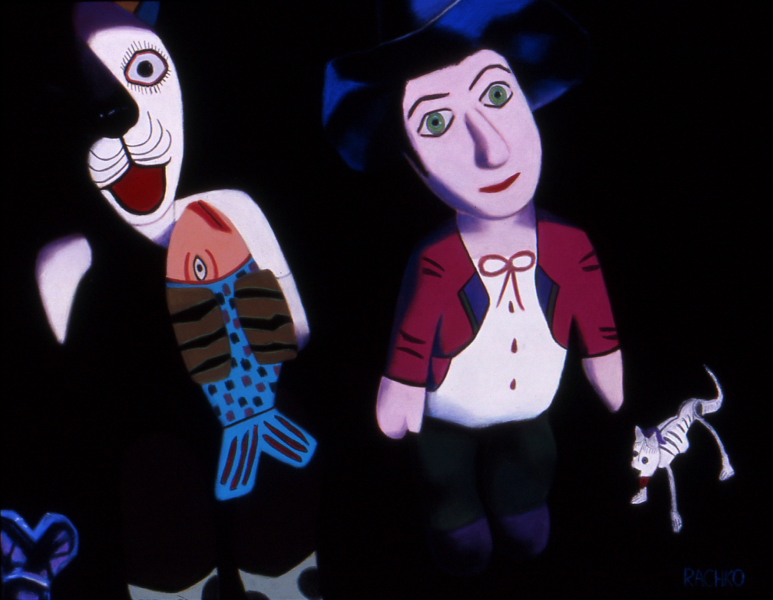
“Offering,” soft pastel on sandpaper, 20″ x 26″
* an ongoing series of quotations – mostly from artists, to artists – that offers wisdom, inspiration, and advice for the sometimes lonely road we are on.
HM: In order to create a work of art, you need an artist, an object, the work, and the audience. Indeed, where there’s no audience, there’s no artist. Renoir used to say, “No painters in Hamlet.” meaning that on a desert island you wouldn’t paint.
( I confess I am a little surprised. For my part, I find it difficult to believe that the true artist cannot work without hope. It seems to me that art is first and foremost an internal necessity, a need to escape from life. It is true that this is closer to the mystics’ point of view and that the artist, if he does not work directly for his contemporaries, at least looks forward to some future resonance. Nonetheless, I ask the same question again.)
PC: Even a true painter wouldn’t paint on a desert island?
HM: No… Painting is a means of communication, a language. An artist is an exhibitionist. Take away his spectators and the exhibitionist slinks off with his hands in his pockets.
The audience is the material in which you work. You don’t see the face of the audience. It’s huge, an immense mass. The public is – listen, it’s the man you encounter one fine day, who says, “Monsieur Matisse, I can’t tell you how much I love your picture, the one you exhibited at the salon,” and this man is a clerk who could never spend a red cent on painting. The public is not the buyer; the public is the sensitive material on which you hope to leave an imprint.
PC: Through the picture, the audience returns to the source of emotion.
HM: Yes, and the artist is the actor, the fellow with the wheedling voice who won’t rest until he’s told you his life story.
Chatting with Henri Matisse: The Lost 1941 Interview, Henri Matisse with Pierre Courthion, edited by Serge Guilbaut, translated by Chris Miller
Comments are welcome!


 barbararachkoscoloreddust.com