Blog Archives
Pearls from artists* # 625

Downtown Manhattan
*an ongoing series of quotations – mostly from artists, to artists – that offers wisdom, inspiration, and advice for the sometimes lonely road we are on.
Think of one of those rare, truly exceptional outings to the cinema. In the lobby afterward the experience elicits from us a language of paralysis and disappearance: “I forgot myself. It could have gone on forever.” Stepping out onto the street, we feel that somehow nothing is as it was before. The passing cars, the night sky above the glass towers, the streetlights reflected on the wet pavement: everything glows with a strange immediacy and newness. It is as if the film had done something to the world. A similar thing might happen when we put down a great novel or take in a powerful piece of music.
The Book of Revelation contains a memorable line: “Behold, I make all things new.” Reflecting on this ancient text, the critic Northrop Frye defined the Apocalypse as “the way the world looks once the ego has disappeared.” Every great artistic work is a quiet apocalypse. It tears off the veil of ego, replacing old impressions with new ones at once inexorably alien and profoundly meaningful. Great works of art have a unique capacity to arrest the discursive mind, raising it to a level of reality that is more expansive than the egoic dimension we normally inhabit. In this sense, art is the transfiguration of the world.
J.F. Martel in Reclaiming Art in the Age of Artifice: A Treatise,Critique, and Call to Action
Comments are welcome!
Pearls from artists* # 355

“The Champ,” soft pastel on sandpaper, 26″ x 20″
*an ongoing series of quotations – mostly from artists, to artists – that offers wisdom, inspiration, and advice for the sometimes lonely road we are on.
True art provides us with truth in a manner analogous to science. Its prophetic dimension – its knack for showing us the side of things that our interests blind us to – make it a source of knowledge, even though it is knowledge of a kind that instrumental reason has little time for. The psychologists who revolutionized our understanding of human psychology in the earliest twentieth century drew on two principal sources to build their concepts: the dream life of their patients and the great art of the past. Without this recognition of the primacy of imagination, Freud and Jung could never have drawn their maps of the psyche. Those who work for a better world would do well to follow their example and find the guiding patterns of life in the prophetic artistic works of the past and present. Only art can act as a counter-weight to that uniquely modern mentality that, wherever it becomes the only game in town, seeks to persuade us that the proper goal of human beings is to contain, dissect, and control everything – that even the most persistent mysteries are just problems to be solved.
J.F. Martel in Reclaiming Art in the Age of Artifice: A Treatise, Critique, and Call to Action
Comments are welcome!
Pearls from artists* # 334
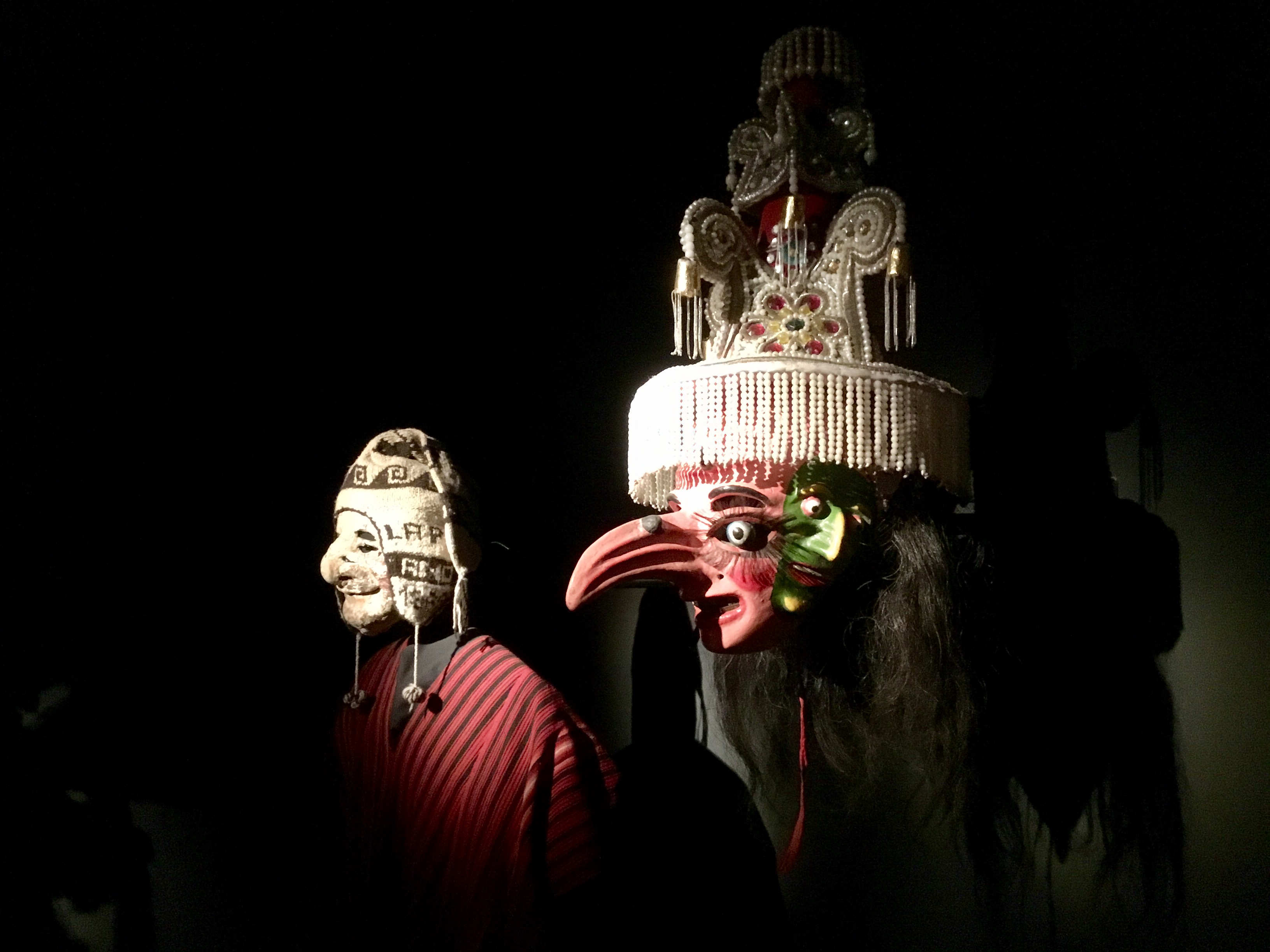
Masks at the National Museum of Ethnography and Folklore in La Paz
*an ongoing series of quotations – mostly from artists, to artists – that offers wisdom, inspiration, and advice for the sometimes lonely road we are on.
This celebration, renewal and collision with the past and with the indians’ own identity, breaks down everyday order and routine to establish the magic dimension, the exception and the anomaly. An explosion of vitality, abundance and liberty demolishes everyday slavery and misery. But the festive chaos which transports one to the anomalous and to the sacred, simultaneously causes the return to profane normality. Just when the disorder and confusion reach the state of paroxysm, when everything is agitated and intermixed indiscrimanently, the celebration is over. The bands all play at the same time in deafening competition, the dancers can no longer hold themselves up, and all distinctions between groups, musicians, dancers and sexes are erased. It is the kacharpaya, the limit of disorder and cataclysm, which signals the return to routine.
To Cover in Order to Uncover, by Fernando Montes in Masks of the Bolivian Andes, Photographs: Peter McFarren, Sixto Choque, Editorial Quipos and BancoMercantil
Comments are welcome!
Pearls from artists* # 325
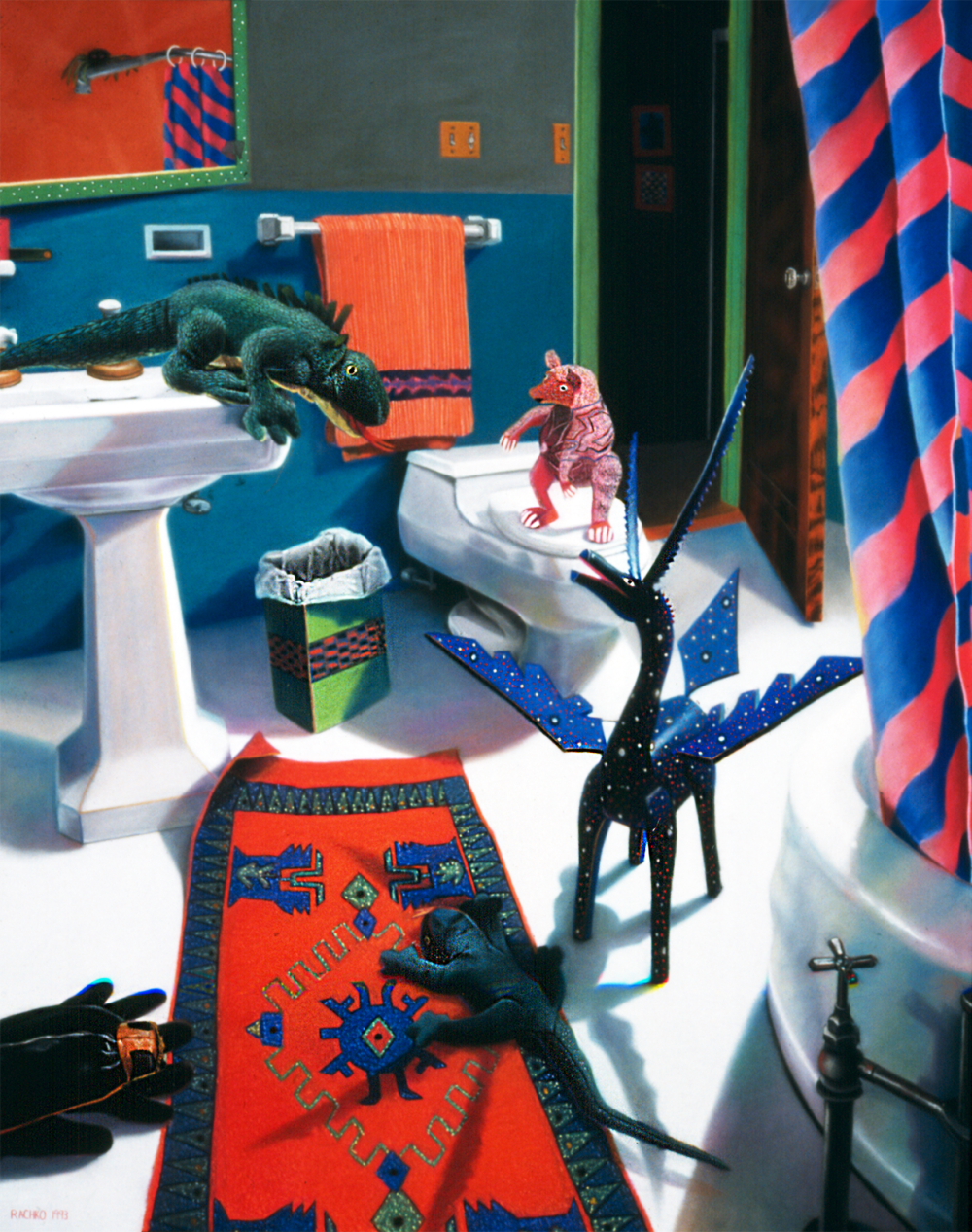
“Myth Meets Dream,” soft pastel on sandpaper, 47″ x 38″
*an ongoing series of quotations – mostly from artists, to artists – that offers wisdom, inspiration, and advice for the sometimes lonely road we are on.
Homo sapiens is the animal that means something, or that desperately wants to mean something. Undoubtedly our thirst for meaning has a lot to do with our petrifying awareness of death, itself a side effect of the imagination, and one that makes our unique position as much of a curse as it is a gift.
As the prime fruit of the imagination, art is the incontrovertible sign of humanity’s presence on earth. But what constitutes the human itself? The prehistoric paintings at Chauvet confront us with a dimension of ourselves that, though familiar in ways, remains in many respects unknown and may ultimately be unknowable. Human consciousness has access to a powerful otherworld, the place of dreams and myth, poetry and lunacy. [This is]… the “imaginal,” the name Henry Corbin gave to the intermediate realm, central to the inscrutable mind of God. As a concrete manifestation of this imaginal realm in the public sphere, art calls us back to the source as a matter of course.
J.F. Martel in Reclaiming Art in the Age of Artifice: A Treatise, Critique, and Call to Action
Comments are welcome!


 barbararachkoscoloreddust.com