Category Archives: Creative Process
Q: What’s on the easel today?
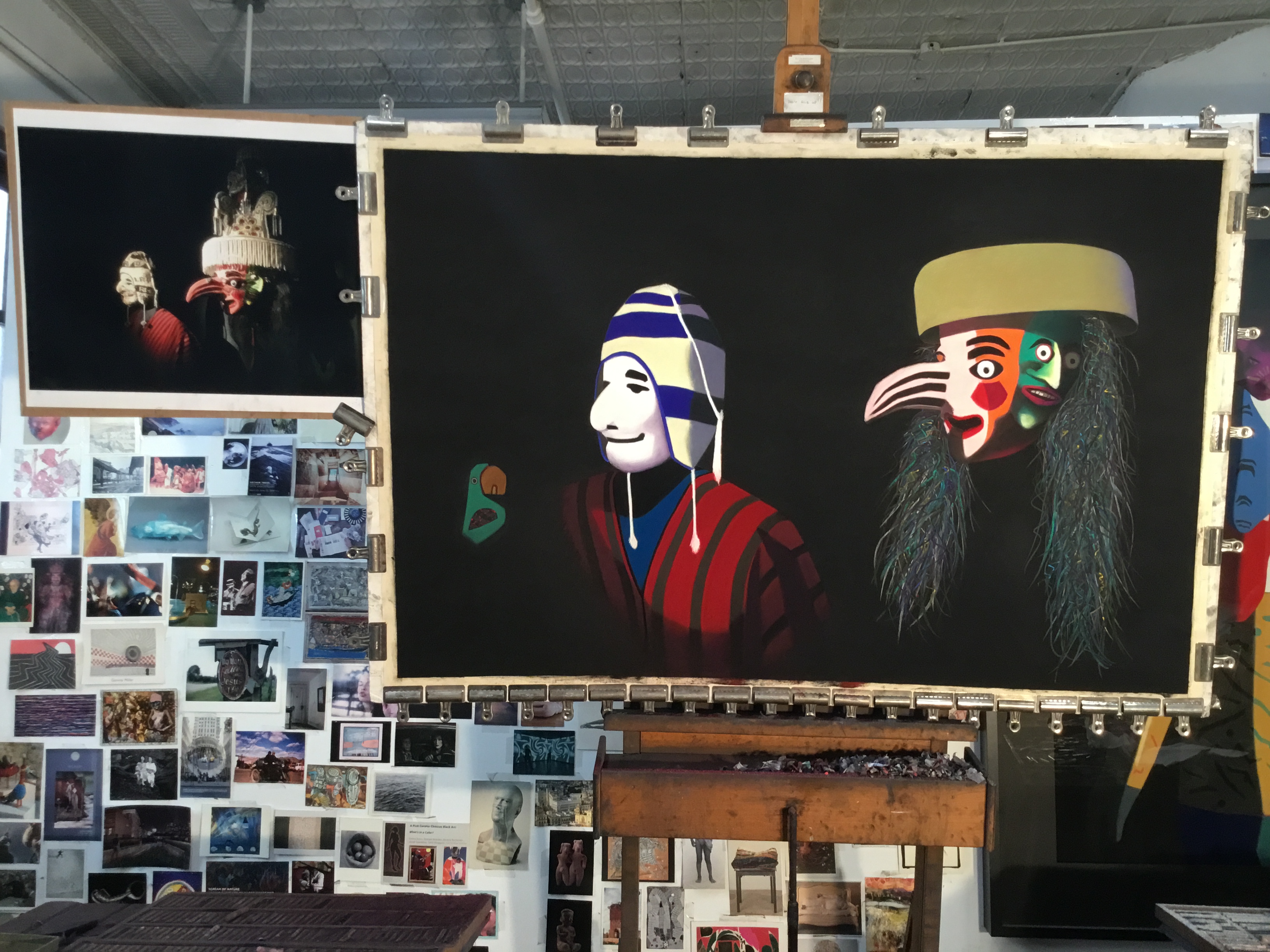
Work in progress
A: I continue working on “Acolytes,” soft pastel on sandpaper, 38” x 58.”
Comments are welcome!
Q: Do you have a favorite painting among all the work you have created?
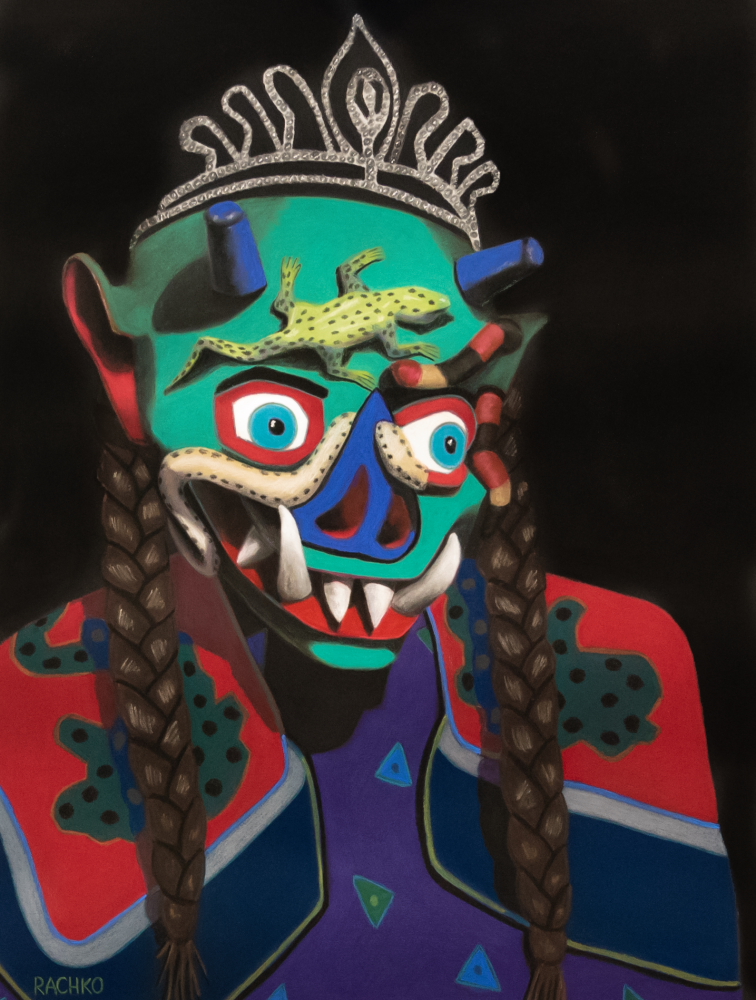
”Shamanic,” soft pastel on sandpaper, 26” x 20”
A: Generally, it’s the last one I completed, perhaps because it encapsulates everything I’m currently thinking about. At the moment my favorite is “Shamanic.”
I believe all of my prior experience in and out of the studio has contributed to making me a better artist and also a better person. So whichever work I finished last, seems the best somehow, and it’s also my favorite.
I wonder, do other artists feel this way, too?
Comments are welcome!
Q: What is more important to you, the subject of the painting or the way it is executed?

“Sam and Bobo,”soft pastel on sandpaper, 36″ x 31”, 1989
A: In a sense my subject matter – folk art, masks, carved wooden animals, papier mâché figures, toys – chose me. With it I have complete freedom to experiment with color, pattern, design, and other formal properties. In other words, although I am a representational artist, I can do whatever I want since the depicted objects need not look like real things. Execution is everything now.
This was not always the case. I started out in the 1980s as a traditional photorealist, except I worked in pastel on sandpaper. (For example, see the detail in Sam’s sweater above). As I slowly learned and mastered my craft, depicting three-dimensional people and objects hyper-realistically in two dimensions on a piece of sandpaper was thrilling… until one day it wasn’t.
My personal brand of photorealism became too easy, too limiting, too repetitive, and SO boring to execute! In 1989 I had at last extricated myself from a dull career as a Naval officer working in Virginia at the Pentagon. Then after much planning, in 1997 I was a full-time professional artist working in New York.
Certainly I was not going to throw away this opportunity by making boring photorealist art. I wanted to do so much more as an artist: to experiment with techniques, with composition, to see what I could make pastel do, to let my imagination play a larger role in the paintings I made. I was ready to devote the time and do whatever it took to push my art further.
After spending the early creative years perfecting my technical skills, I built on what I had learned. I began breaking rules – slowly at first – in order to push myself onward. And I continue to do so, never knowing what’s next. Hopefully, in 2018 my art is richer for it.
Comments are welcome!
Start/Finish of “Shamanic,” soft pastel on sandpaper, 26″ x 20”
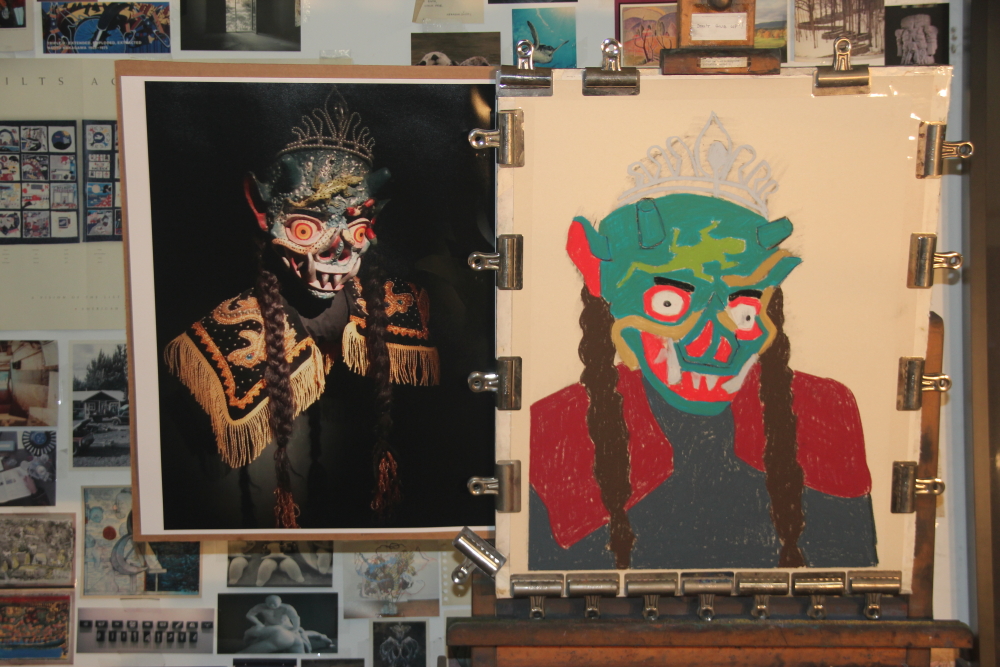
Start
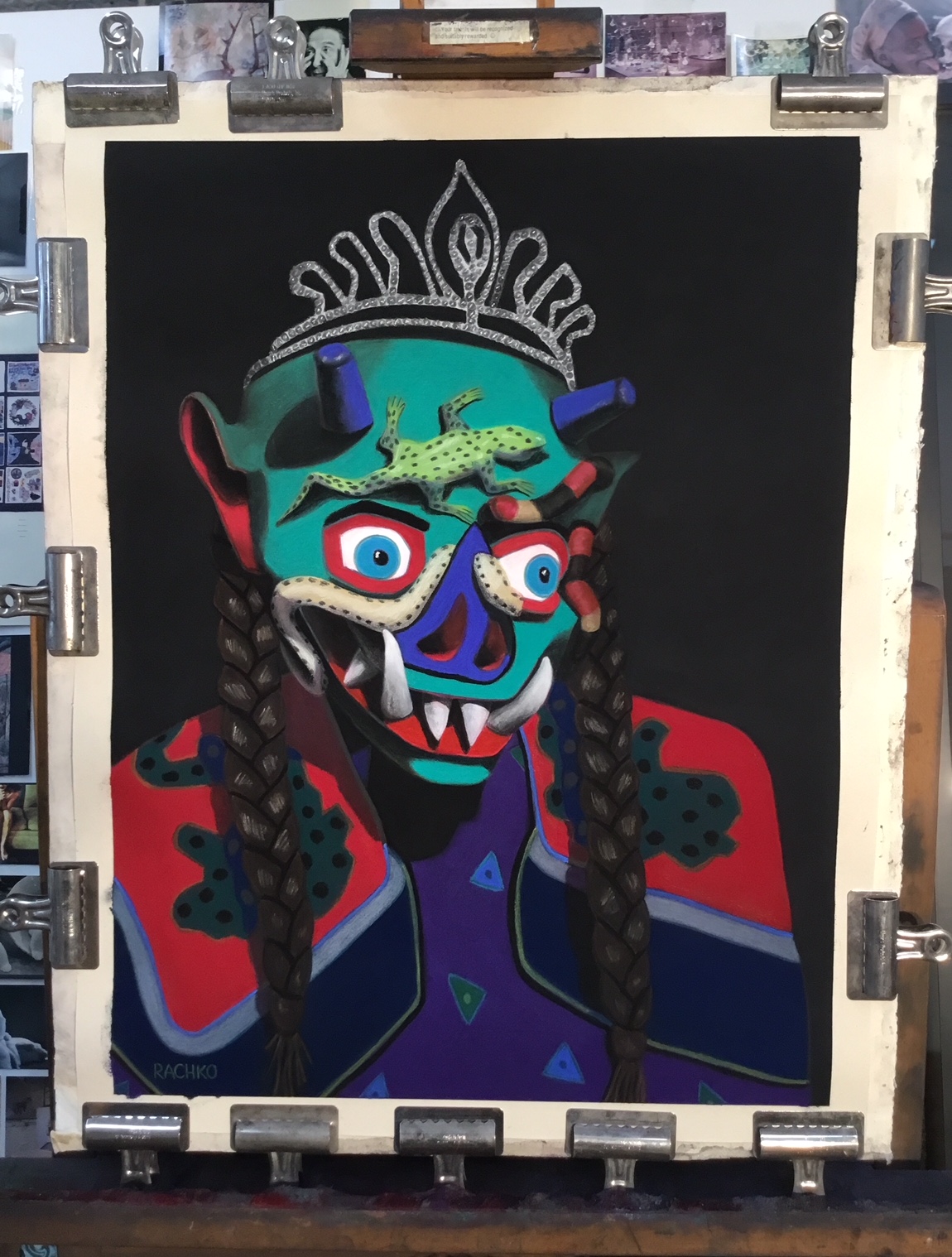
Finish
This one was tough going, but finally it’s ready for the framer!
Comments are welcome!
Q: What’s on the easel today?
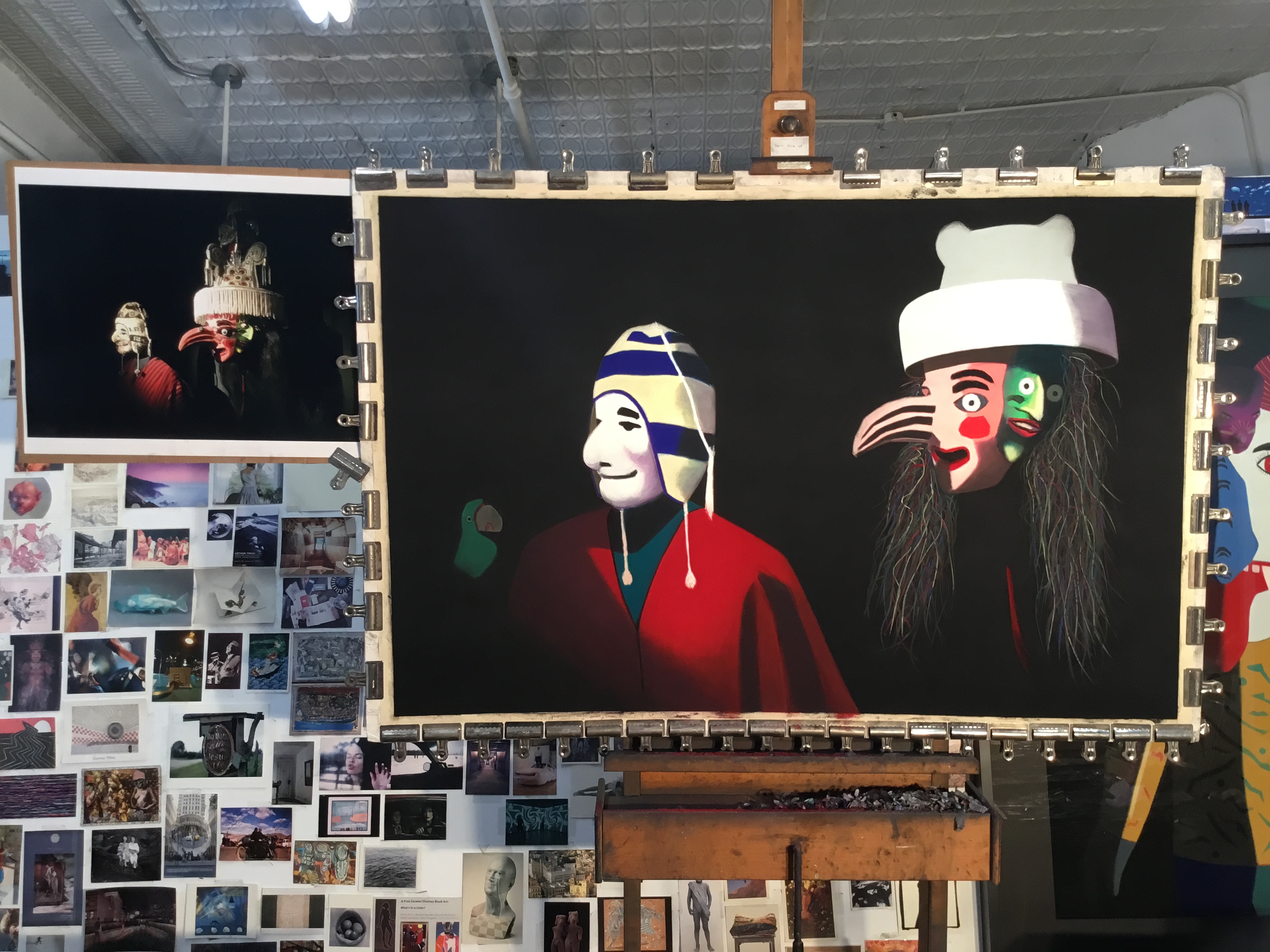
Work in progress
A: I continue working on a large pastel painting based on another of my photographs from La Paz, Bolivia.
Comments are welcome!
Pearls from artists* # 299

“The Storyteller,” soft pastel on sandpaper, 20″ x 26″
*an ongoing series of quotations – mostly from artists, to artists – that offers wisdom, inspiration, and advice for the sometimes lonely road we are on.
The artist is always and for all time a seer, and artistic creation is always and for all time an act of prophecy.
The artist does not choose the prophecy. Rather, the prophetic shines through her work. It comes from elsewhere.
The artist therefore needs enough courage to stay true to the work at hand. Even greater courage is required of those to whom the finshed work is given, for their interests will always recommend dismissing the vision for fear of its implications.
J.F. Martel in Reclaiming Art in the Age of Artifice: A Treatise, Critique, and Call to Action
Comments are welcome!
Q: You have spoken about your pastel technique, which involves layering pigments on top of each other, up to 25 to 30 layers. When you do this are you putting the same colors on top of each other?

An early version of “Oracle,” soft pastel on sandpaper, 26″ x 20″

Finished
A: I do layer Rembrandt black soft pastels on top of each other to achieve the dark backgrounds in my “Black Paintings” and “Bolivianos” series. Black Rembrandts are the pastels I use most so I order them several dozen at a time. The 400 or 500 grit sandpaper requires at least four layers of pastel just to achieve even coverage. Over the next few months I add many more layers of black pastel to achieve the final rich look.
The figures and shapes in each pastel painting are a different story. Were you to x-ray them, you’d see many different colors underneath the final one. Sometimes subsequent colors are closely related to earlier ones. With each additional layer, I correct, refine, and strengthen my drawing so the objects depicted become more solid and/or three-dimensional.
In addition to the thousands of pastels I have to choose from, I mix and blend new colors directly on the sandpaper. As I proceed, I am searching for the ‘best’ colors, those that make the overall painting more resonant, more alive, and more exciting to look at. Of course, this is wholly subjective.
Comments are welcome!
Q: For many artists the hardest thing is getting to work in the morning. Do you have any rituals that get you started?
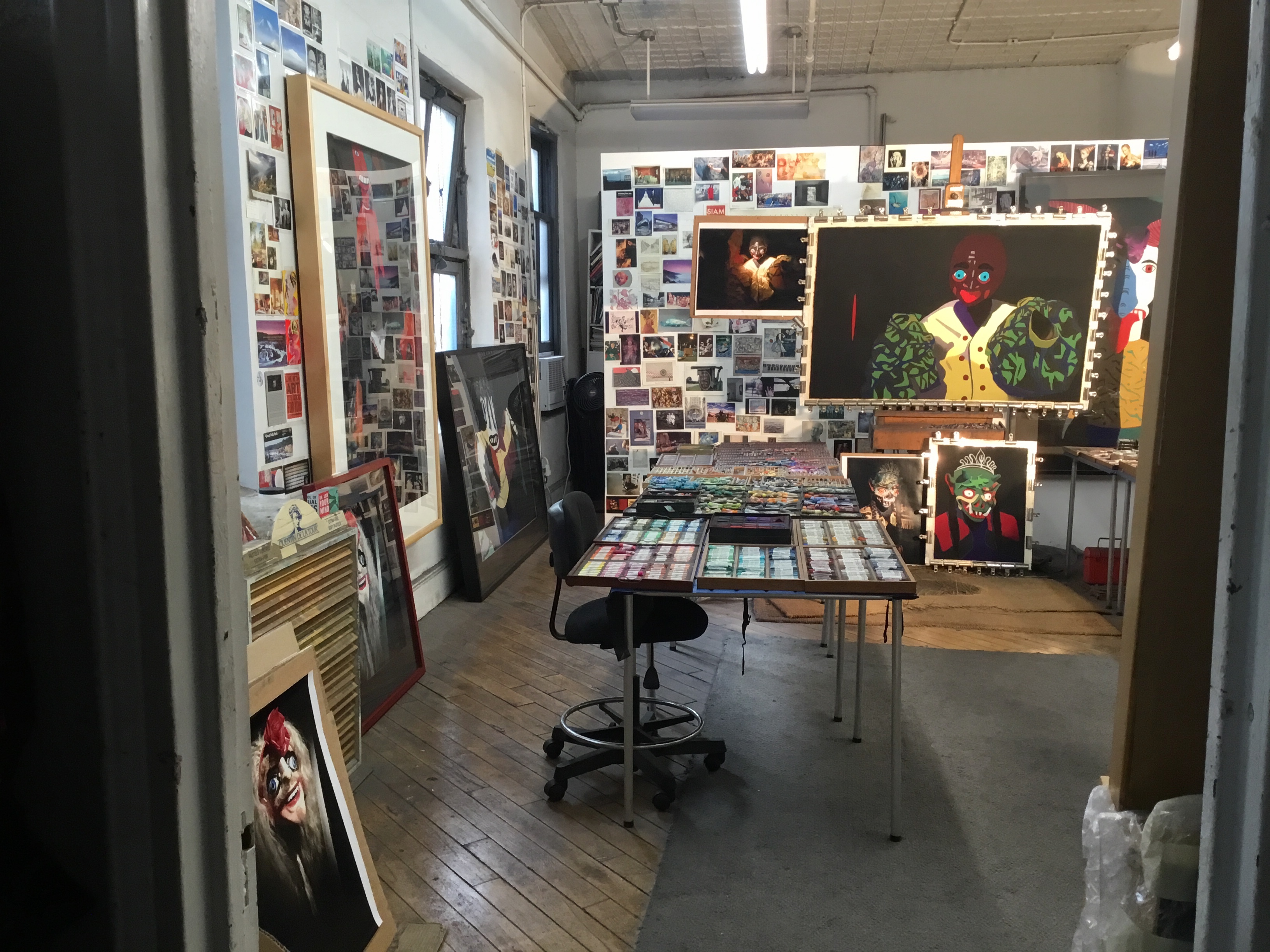
Entering Barbara’s studio
A: That has rarely been a problem because I love to work. The highlight of my day is time spent in the studio. After arriving, I begin working immediately or I read about art for a short time. When I pick up a pastel, it’s to begin working on something left unfinished from the day before.
Generally, I keep regular hours and strive to use studio time well. As a professional artist, one absolutely must be a self-starter! No one else cares about our work the way we do. Really why would they, when only the maker has invested so much love, knowledge, craftsmanship, experience, devotion, insight, money, etc. in the effort to evolve and improve.
Comments are welcome!
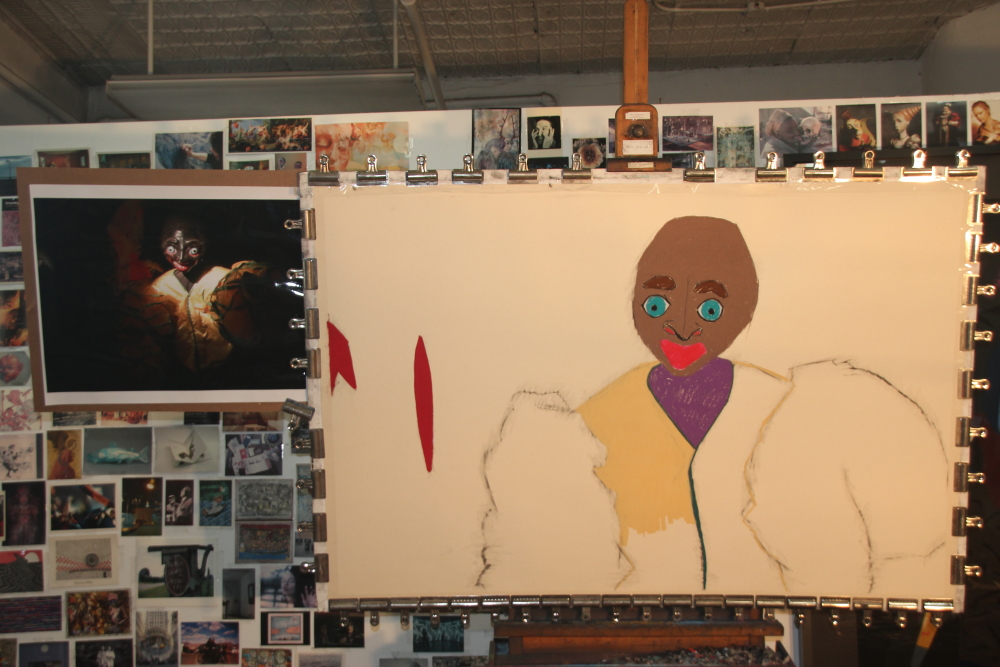
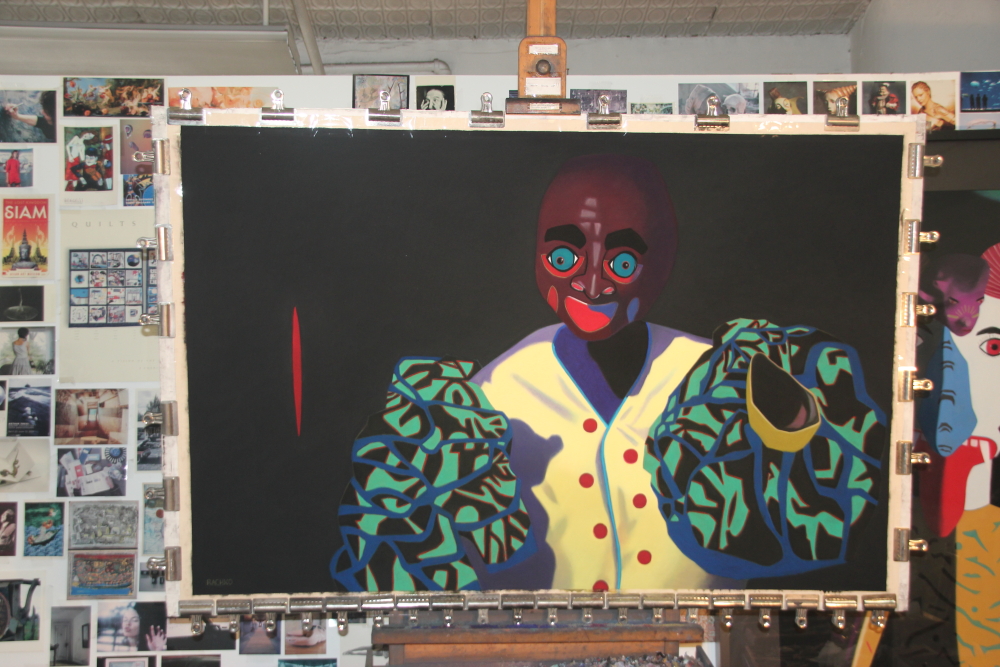
Q: (Part II) Would you share your story of how creating art enabled you to heal after losing your husband on 9/11?

“The Champ,” soft pastel on sandpaper, 35” x 28.5” framed. The first of my “Bolivianos”.
A: Continued from last Saturday’s post…
Because I use reference photos for my pastel paintings, the first challenge was to learn how to use Bryan’s 4 x 5 view camera. At that time I was not a photographer. Always Bryan had taken reference photos for me.
In July 2002 I enrolled in a view camera workshop at New York’s International Center of Photography. Much to my surprise I had already absorbed quite a lot from watching Bryan. After the initial workshop, I continued more formal studies of photography for a few years. In 2009, I am proud to say, I was invited to present a solo photography exhibition at a New York gallery!
In 2003 I resumed making my “Domestic Threats” series of pastel paintings, something that had seemed impossible after Bryan’s death. The first large pastel painting that I created using a reference photograph taken by me confirmed that my life’s work could continue. The title of that painting, “She Embraced It and Grew Stronger,” was autobiographical. “She” is me, and “it” meant continuing on without Bryan and living life for both of us.
Having had a long successful run, the “Domestic Threats” series finally ended in early 2007. Around that time I was feeling happier and had come to better terms with losing Bryan. While this is a tragedy I will never truly be at peace with, dealing with the loss became easier with time.
Then in 2007 I suddenly became blocked and did not know where to take my work next. I had never experienced creative block and for a full-time professional artist, this was a painful few months. Still, I continued to go to the studio every day and eventually, thanks to a confluence of favorable circumstances, the block ended.
My next pastel painting series was called, “Black Paintings.” I viewed the black background as literally, the very dark place that I was emerging from, exactly like the figures emerging in these paintings. The figures themselves were wildly colorful and full of life, but that black background is always there.
Still the work continues to evolve. Recently I began my third pastel painting series called, “Bolivianos,” based on a mask exhibition encountered in La Paz at the Museum of Ethnography and Folklore. Many people have proclaimed this to be my most bold, daring, and exciting pastel painting series yet. And I think they may be right! Continuing on the journey I began 30+ years ago, I am looking forward to creating many new, striking pastel paintings!
Comments are welcome!


 barbararachkoscoloreddust.com