Blog Archives

Q: Did you formally study art? (Question from “Cultured Focus Magazine”)

International Center of Photography website

A: My bachelor’s degree in Psychology is from the University of Vermont.  I did not formally study art, unless you want to count the several years-worth of drawing and painting classes I took at the Art League School in Alexandria, VA. I never went to art school so do not have a bachelor’s or master’s degree in art.  

Much later, in the early 2000s, I was compelled to study photography at the International Center of Photography in New York.  This is a rather long story.

On September 11, 2001, my husband Bryan Jack, a high-ranking federal government employee, a brilliant economist and a budget analyst at the Pentagon, was on his way to present his monthly guest lecture in economics at the Naval Postgraduate College in Monterey, CA. He was a passenger on the plane that departed from Dulles Airport and was high-jacked and crashed into the Pentagon.  

Losing Bryan on 9/11 was the biggest shock of my life, devastating in every way imaginable. We were soulmates and newly married. I have lived with his loss every single day for more than twenty years now.  Life has never been the same.

In the summer of 2002 I was beginning to feel ready to get back to work. Learning about photography and cameras became essential avenues to my well-being.  

My first challenge was learning how to use Bryan’s 4 x 5 view camera. Bryan had always taken the 4 x 5 negatives from which I derived the reference photos that were essential tools for making pastel paintings. I enrolled in a one-week view camera workshop at the International Center of Photography in New York.  Surprisingly, it was very easy. I had derived substantial technical knowledge just from watching Bryan for many years.

After the view camera workshop, I decided to throw myself into learning this new medium, beginning with Photography I. I spent the next few years taking many classes at ICP and learning as much as I could. Eventually, I learned how to use Bryan’s extensive collection of film cameras, to properly light the setups that served as subject material for my “Domestic Threats” pastel paintings, and to make my own large chromogenic prints in a darkroom. 

Then in October 2009 I was invited to present a solo photography exhibition at a gallery in New York. Continuing to make art after Bryan’s death had seemed like such an impossibility. I remember thinking how proud he would have been to know I became a good photographer.

Comments are welcome!

Pearls from artists* # 603

With friends in Alexandria, VA

*an ongoing series of quotations – mostly from artists, to artists – that offers wisdom, inspiration, and advice for the sometimes lonely road we are on.

The annals of art and science are full of studies of men and women who, desperately stuck on an enigma, have worked until they reached their wit’s end, and then suddenly made their longed-for creative leap of synthesis while doing errands or dreaming. The ripening takes place when their attention is directed elsewhere.

Insights and breakthroughs often come during periods of pause or refreshment after great labors. There is a prepatory period of accumulating data, followed by some essential but unforeseeable transformation. William James remarked in the same vein that we learn to swim in winter and skate in summer. We learn that which we do not concentrate on, the part that has been exercised and trained in the past but that is now lying fallow. Not doing can sometimes be more productive than doing.

Stephen Nachmanovitch in Free Play: Improvisation in Life and Art

Comments are welcome!

Q: Would you talk about your first solo exhibition in a commercial gallery?

"Big Deal," soft pastel on sandpaper, 58" x 38"

“Big Deal,” soft pastel on sandpaper, 58″ x 38″

A:  Although I had exhibited in a number of non-profit galleries in Virginia, Washington, DC, Maryland, New Jersey, and New York, my first solo in a commercial gallery was at 479 Gallery, 520 Broadway, in July 1996.  The previous summer I had entered a juried exhibition there.  My work won first prize and I was awarded a solo show the following July.

This exhibition was soon followed by representation at an important New York gallery, Brewster Fine Arts, at 41 West 57th Street.  I had my first two-person exhibition at Brewster in October 1996.  The gallery specialized in art by Latin American artists.  Besides myself, the sole non-Latina represented by Brewster was Leonora Carrington!  I quickly began exhibiting alongside a group of illustrious artists:  Leonora, Rufino Tamayo, Francisco Toledo, Francisco Zuniga, and other Latin American masters.  I could hardly believe my good fortune!   

Comments are welcome!       

Q: What was the first New York gallery that represented your work and how did they find you?

Exhibition Review

A: My first (and still the best) New York gallery was Brewster Gallery on West 57th Street in what, in 1996, was the most important gallery district in Manhattan. By joining Brewster, my work was exhibited alongside an impressive list of Latin American painters and sculptors such as Leonora Carrington, Frida Kahlo, Francisco Zuniga, Rufino Tamayo, Diego Rivera, Francisco Toledo, and more. Brewster was a prestigious and elegant gallery, well-known throughout the Latin American art world for their superb exhibitions and their contributions to art history scholarship.

Since I am not Latina, my work was selected by virtue of its Mexican subject matter and level of craftsmanship. Mia Kim, the owner/director, told me that amidst so many deserving, unrepresented, and talented artists of Latin American heritage, she was sometimes challenged to defend her decision to represent me. Mia’s response was always, “Barbara may not be of Latin American ancestry, but she most assuredly has the soul of a Latina! Her work has obvious affinities to Leonora’s, the other non-Latina that we represent.”

In July of 1996, while I was still living in Virginia, I mailed a slide sheet and reviews to Brewster, thinking that during the slow summer months, perhaps someone might actually LOOK at my material. Then I forgot all about it as Bryan and I headed off on a trip to Mexico. While we were in Mexico City, something told me to check our phone messages at the house in Alexandria. I did so and was floored to hear Mia offer me representation and a two-person show in October. The first time she would even see my work in person would be when I delivered it to the gallery!

In October my “Domestic Threats” pastel paintings were paired with work by Cuban artist, Tomas Esson, for an exhibition called “Monkey Business.” The opening was extremely well-attended by a sophisticated international New York crowd. A highlight was meeting Leonora Carrington, one of my artist heroes of long standing. Afterwards a large group of us were wined and dined at a French restaurant around the corner on West 58th Street. I remember looking at Bryan and saying, “I think I’ve made it!” The next day there was a favorable review in a publication called, “Open Air.” After working in complete obscurity for thirteen years, I was finally on my way.

Comments are welcome!

Pearls from artists* # 441

*an ongoing series of quotations – mostly from artists, to artists – that offers wisdom, inspiration, and advice for the sometimes lonely road we are on.

The most perennially popular category of art is the cheerful, pleasant, and pretty kind: meadows in spring, the shade of trees on hot summer days, pastoral landscapes, smiling children. This can be deeply troubling to people of taste and intelligence.   

… The worries about prettiness are twofold. First, pretty pictures are alleged to feed sentimentality. Sentimentality is a symptom of insufficient engagement with complexity, by which one really means problems. The pretty picture seems to suggest that in order to make life nice, one merely has to brighten up the apartment with a depiction of some flowers. If we were to ask the picture what is wrong with the world, it might be taken as saying ‘You don’t have enough Japanese water gardens’ – a response that appears to ignore all the more urgent problems that confront humanity (primarily economic, but also moral, political, and sexual). The very innocence and simplicity of the picture seems to mitigate against any attempt to improve life as a whole. Secondly, there is the related fear that prettiness will numb us and leave us insufficiently critical and alert to the injustices surrounding us.

Alain de Botton and John Armstrong in Art as Therapy 

Comments are welcome!

Q: What has been your biggest challenge so far?

"Us and Them," soft pastel on sandpaper, 47" x 38" image, 60" x 50" framed

“Us and Them,” soft pastel on sandpaper, 47″ x 38″ image, 60″ x 50″ framed

A:  On September 11, 2001, my husband Bryan, a high-ranking federal government employee, a brilliant economist (with an IQ of 180 he is the smartest man I have ever known) and a budget analyst at the Pentagon, was en route to Monterrey, CA to give his monthly guest lecture for an economics class at the Naval Postgraduate College. He had the horrible misfortune of flying out of Dulles Airport and boarding the plane that was high-jacked and crashed into the Pentagon, killing 189 people. Losing Bryan was the biggest shock of my life and devastating in every possible way.

The following summer I was ready to – I HAD to – get back to work. Learning about photography and pastel painting became avenues to my well-being. I use reference photos for my paintings, so my first challenge was to learn how to use Bryan’s 4 x 5 view camera (Bryan always took these reference photos for me).

In July 2002 I enrolled in a one-week view camera workshop at the International Center of Photography in New York. Much to my surprise, I had already acquired substantial technical knowledge from watching Bryan. Still, after the initial workshop, I threw myself into this new medium and continued studying photography at ICP for several years. I began with Photography I and enrolled in many more classes until I gradually learned how to use Bryan’s extensive camera collection, to properly light my setups, and to print large chromogenic photographs in a darkroom.

In October 2009 it was very gratifying to have my first solo photography exhibition with HP Garcia in New York. Please see http://barbararachko.art/images/PDFS/ BarbaraRachko-HPGargia.pdf. I vividly remember tearing up at the opening as I imagined Bryan looking down at me with his beautiful smile, beaming as he surely would have, so proud of me for having become a respected photographer.

Continuing to make art had seemed an impossibility after Bryan’s death. However, the first large pastel painting that I created using a self-made reference photograph proved my life’s work could continue. The title of that painting, “She Embraced It and Grew Stronger,” is certainly autobiographical. “She” is me, and “it” means continuing on without Bryan and living life for both of us.

Comments are welcome!

Q: Walk us through your “typical day”?

Barbara at work on “Schemer,” Soft Pastel on Sandpaper, 26” x 20”

Barbara at work on “Schemer,” Soft Pastel on Sandpaper, 26” x 20”

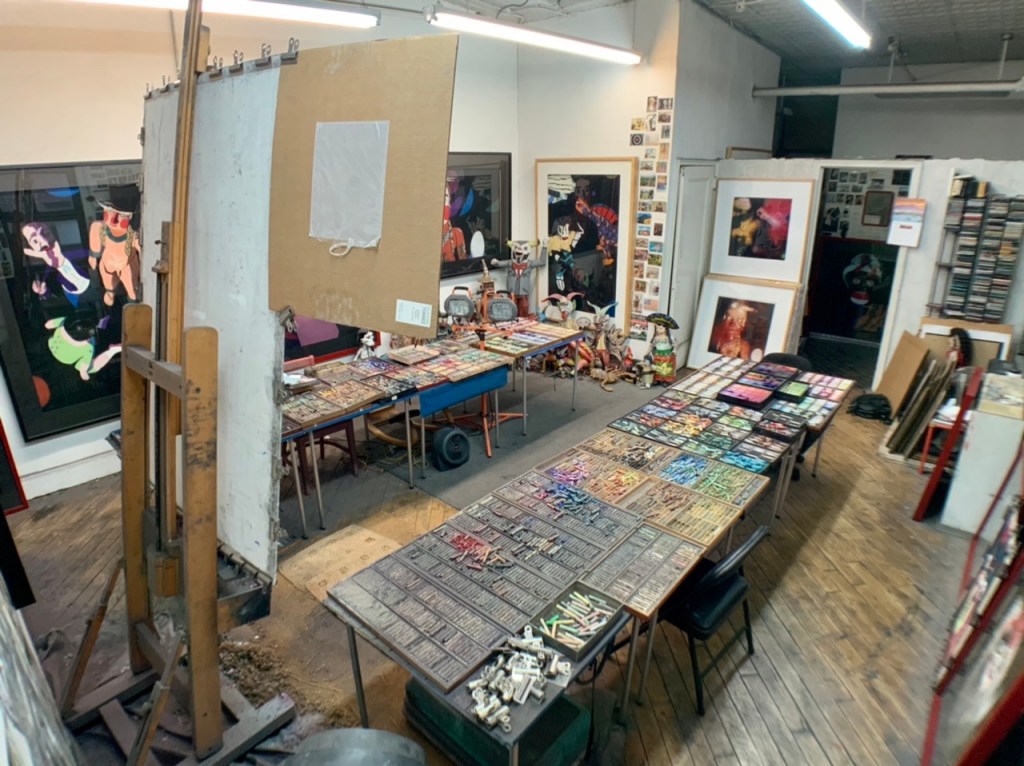
A:  I’ll describe a typical day at the studio.  When I first arrive in the morning, I read for 30 minutes. Reading focuses and quiets my mind and gets me ready to begin the day’s work.  While I read, I look at the pastel painting that’s on my easel to see where to begin.  Then I close the book, turn on some music, plug in the Halogen lamps I use while working, apply a barrier cream to my hands, put on a surgical mask (to avoid breathing pastel dust), pick up a pastel, and start.   

I never sit while working.  I enjoy the physicality of art-making and prefer to stand at my easel so I can back up to see how the pastel painting looks from a distance.  I like being on my feet all day and getting some exercise.  I work for a couple of hours, break for lunch, and then work the rest of the afternoon.

I believe artists need to be disciplined.  I work five days a week, taking Wednesdays and Sundays off, and spend seven hours or more per day in the studio.  Daylight is essential so I work more hours in summer, fewer in winter.  I like to think of art-making as independent of time tables, but I tend to work in roughly two-hour blocks before taking a break.  I typically work until 5:00 or so.

Studio hours are sacrosanct and exclusively for creative work.  I do not have WiFi at my studio and prefer to keep my computer and mobile devices elsewhere (they devour time).  Art business activities – answering email, keeping up with social media, sending jpegs, writing blog posts, doing interviews, etc. – are accomplished at home in the mornings, in the evenings, and on days off from the studio.

Comments are welcome!

Q: You have worked with twenty-plus galleries during your career. Which ones do you consider the best?

"Myth Meets Dream," 1993, soft pastel on sandpaper, the earliest painting that includes Mexican figures

“Myth Meets Dream,” 1993, soft pastel on sandpaper, the earliest painting that includes Mexican figures

A:  Probably the most prestigious gallery that represented my work was Brewster Fine Arts on West 57th Street in Manhattan.  Brewster was my first New York gallery.  In the summer of 1996 I mailed the gallery a sheet of slides, as we did in those days.  I was living in Virginia and had been a working artist for ten years.  In July while traveling around Mexico, I decided to check the phone messages at home in Virginia.  I was thrilled to receive an invitation from Mia Kim, the gallery director, to exhibit pastel paintings in October!  And she had not yet even seen my work in person.

Beginning that fall, I gained representation with Brewster Fine Arts, an elegant gallery specializing in Latin American Masters like Rufino Tamayo, Diego Rivera, and others.  I am not Latina, of course, but I showed there due to my subject matter.  At my October opening, I remember Mia declaring to the attendees, “Barbara has the soul of a Latina!”  That night I met fellow gallery artist Leonora Carrington. She and I were the only non-Latina artists respresented.  I knew I was on my way! 

The gallery continued to present my work in group exhibitions and the staff gave brilliant talks about me and my creative process.  For many years whenever I introduced myself to a new art aficionado, they already knew my work from having seen it at Brewster.  I continued to be represented there until the gallery closed years later.

Also, Gallery Bergelli in Larkspur, CA did an excellent job of representing my work.  I applied for one of their juried exhibitions, was accepted, and afterwards, they offered permanent representation.  Soon they introduced me to one of my best collectors, with whom I am still friends.

I have worked with many galleries, some good, some not, for various reasons.  Ours is an extremely tough business.  Unfortunately, many of the best and formerly-great galleries are gone forever.   

Comments are welcome!   

Q: During one of the most gripping times of your life, you were personally affected by the 9/11 attack on our country. Your husband was killed on the plane that crashed into the Pentagon. Would you mind telling us about it and how it has shaped your work?

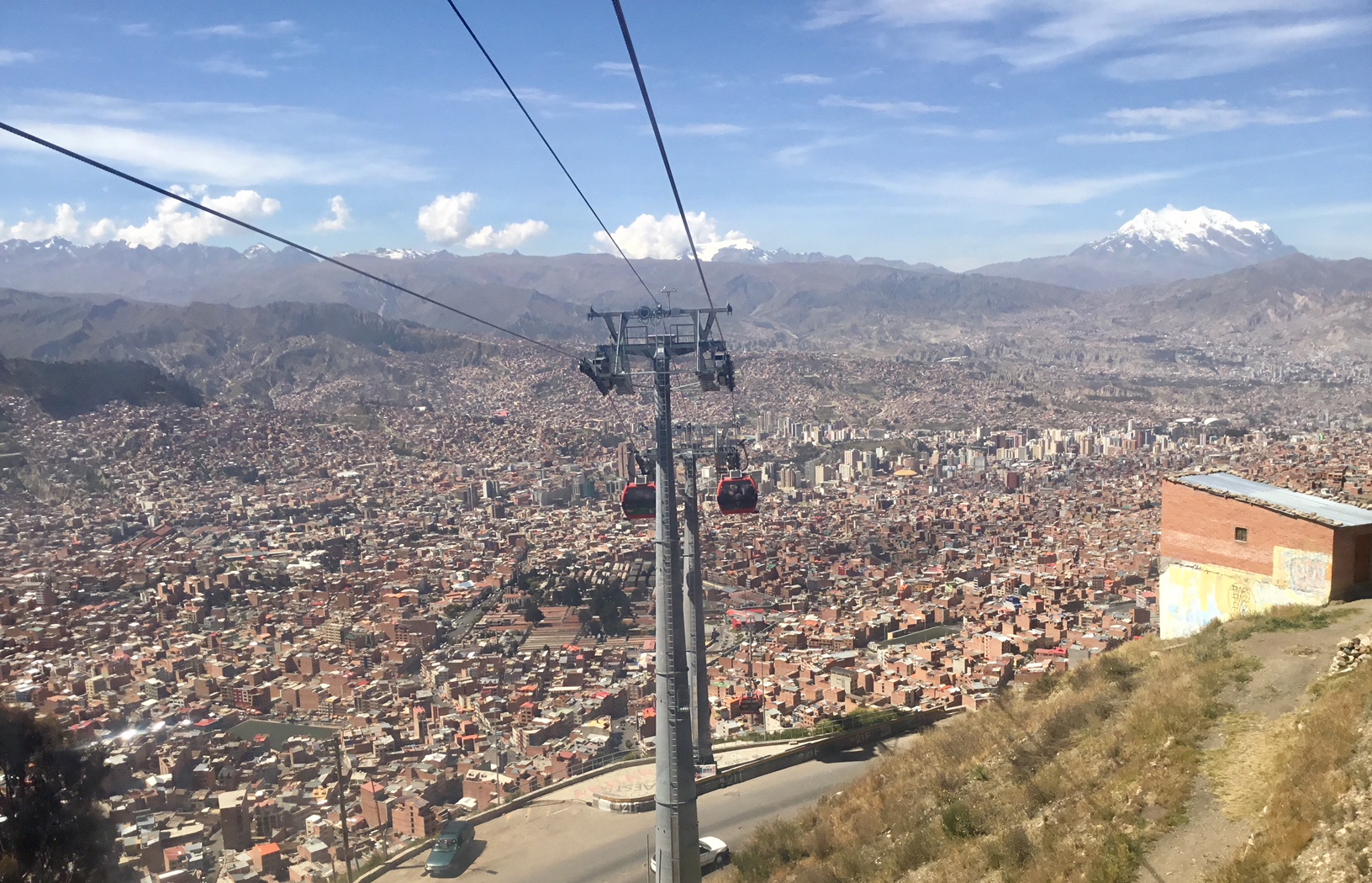
‘Mi Teleferico’ line, La Paz, Bolivia

‘Mi Teleferico’ line, La Paz, Bolivia

A:  In the summer of 2002 I was ready to – I HAD to – get back to work in my studio. I knew exactly what I must do.  More than ever before, learning and painting would become the avenues to my well-being.

Because I use reference photos for my pastel paintings, the first challenge was to learn how to use Bryan’s 4 x 5 view camera. At that time I was not a photographer. Bryan had always taken reference photos for me.

In July 2002 I enrolled in a view camera workshop at New York’s International Center of Photography. Much to my surprise I had already absorbed quite a lot from watching Bryan. After the initial workshop, I continued more formal studies of photography for several years. In 2009, I am proud to say, I was invited to present a solo photography exhibition at a New York gallery!

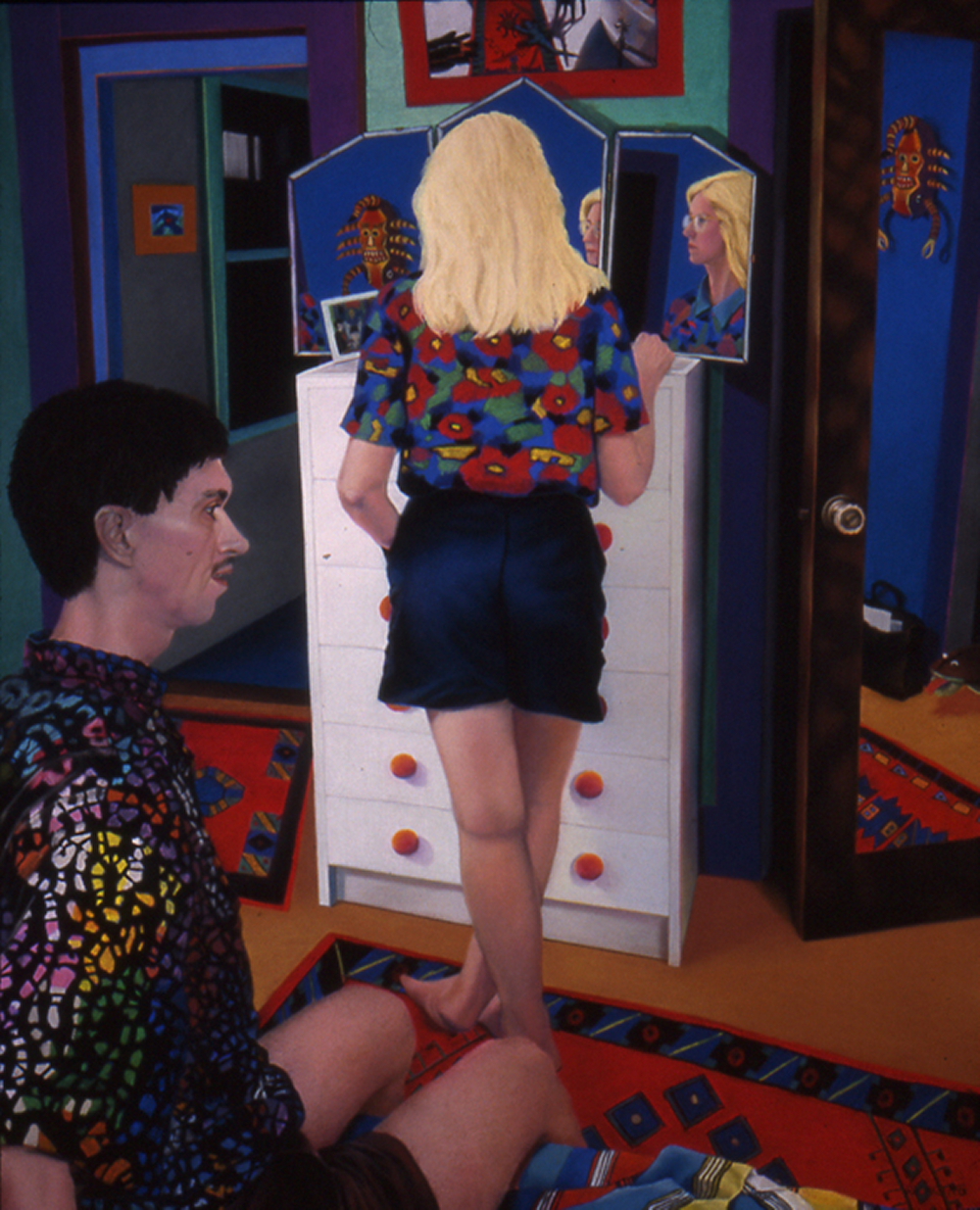
In 2003 I resumed making my Domestic Threats series of pastel paintings, something that had seemed impossible after Bryan’s death. The first large pastel painting that I created using a reference photograph taken by me confirmed that my life’s work could continue. The title of that painting, “She Embraced It and Grew Stronger,” was autobiographical. “She” is me, and “it” meant continuing on without Bryan and living life for both of us.

Having had a long successful run, the Domestic Threats series finally ended in early 2007. Around that time I was feeling happier and had come to better terms with losing Bryan. While this is a tragedy I will never truly be at peace with, dealing with the loss became easier with time.

Then in 2007 I suddenly became blocked and did not know where to take my work next. I had never experienced creative block and especially for a full-time professional artist, this was a painful time. Still, I continued to go to the studio every day and eventually, thanks to a confluence of favorable circumstances, the block ended.

My next pastel painting series was called Black Paintings. I viewed the black background as literally, the very dark place that I was emerging from, exactly like the figures emerging in these paintings. The figures themselves were wildly colorful and full of life, but that black background – one critic has dubbed it my “blackground” – is always there.

Still the work continues to evolve. In 2017 I began my third pastel painting series called Bolivianos, based on a mask exhibition encountered in La Paz at the The National Museum of Ethnography and Folklore. Many people have proclaimed this to be my most bold, daring, and exciting pastel painting series yet. And I think they may be right! Continuing on the journey I began 30+ years ago, I am looking forward to creating many new, striking pastel paintings!

Comments are welcome!