Blog Archives
Q: How large is your collection of Mexican folk art objects?

Part of my collection
A: I began collecting these figures in the early 1990s. I haven’t counted them, but my guess is that I have amassed around 200 pieces of various sizes. This includes some Guatemalan figures. I went to Guatemala in 2009 and 2010. Since I divide my time between a house in Alexandria, VA, an apartment in Manhattan, and a studio in Chelsea, a portion of my folk art collection resides in each of these places.
Since 2017 I have been creating pastel paintings in the “Bolivianos” series, which exclusively use my photographs of Bolivian Carnival masks as source material. Occasionally, I will add one of my smaller Mexican or Guatemalan figures to improve and enrich a painting’s composition. Otherwise, my Mexican collection sits gathering dust. My thinking and my ideas, not to mention my travels, have evolved and just naturally moved on with time.
Comments are welcome!
Q: You seem very disciplined. Do you ever have a day when you just can’t get excited about going to the studio to work?

Signing “Narcissist”
A: That happens occasionally, but I usually still go to the studio to work. You know the expression, “99% of life is just showing up”? Well, of course I have to show up at my studio to accomplish anything so I still try to keep fairly regular studio hours – 6 to 7 hours a day, 4 or 5 days a week. And that’s not to mention all the other work – answering email, checking social media, writing blog posts, etc. – which I tend to do at lunchtime, in the evenings, and on my days off from the studio.
When you are an artist there is always work to do and for some of it, no one else can do it because no one else knows the work from the inside the way the maker does. I like what Twyla Tharp says in her book, “The Creative Habit.” In order to progress an artist needs good work habits that become a daily routine. And Chuck Close used to say, “Inspiration is for amateurs,” meaning a professional works whether she’s in the mood or not. I completely agree so I keep working and slowly moving ahead.
As Tchaikovsky wrote in a letter to a friend:
We must always work, and a self-respecting artist must not fold his hands on the pretext that he is not in the mood. If we wait for the mood, without endeavoring to meet it halfway, we easily become indolent and apathetic. We must be patient, and believe that inspiration will come to those who can master their disinclination. A few days ago I told you I was working every day without any real inspiration. Had I given way to my disinclination, undoubtedly I should have drifted into a long period of idleness. But my patience and faith did not fail me, and today I felt that inexplicable glow of inspiration of which I told you; thanks to which I know beforehand that whatever I write today will have power to make an impression, and to touch the hearts of those who hear it.
Quoted in Eric Maisel’s A Life in the Arts: Practical Guidance and Inspiration for Creative and Performing Artists.
Comments are welcome!
Q: What are your most significant professional accomplishments to date?

“Big Deal,” soft pastel on sandpaper, 58″ x 38″
A: I will mention these: my 1996 solo exhibition at a venerable New York gallery that specialized in Latin American-influenced art, Brewster Arts Ltd. at 41 West 57th Street; completion of Aljira’s Emerge 2000 business program for professional artists; and a solo exhibition at the Walton Art Center in Fayetteville, AR, in 2005. All three were very important factors in my artistic and professional development.
In January I published my first eBook, From Pilot to Painter, on Amazon.
In February I was interviewed by Brainard Carey for his Yale University Radio program. It can be heard at
http://museumofnonvisibleart.com/interviews/barbara-rachko/
Most recently I was interviewed for a fourteen-page article (the longest they have ever published on a single artist!) in ARTiculAction Art Review. Please see
http://issuu.com/articulaction/docs/articulaction_art_review_-_july_201/30
Comments are welcome!
Q: I just got home from my first painting experience… three hours and I am exhausted! Yet you, Barbara, build up as many as 30 layers of pastel, concentrate on such intricate detail, and work on a single painting for months. How do you do it?
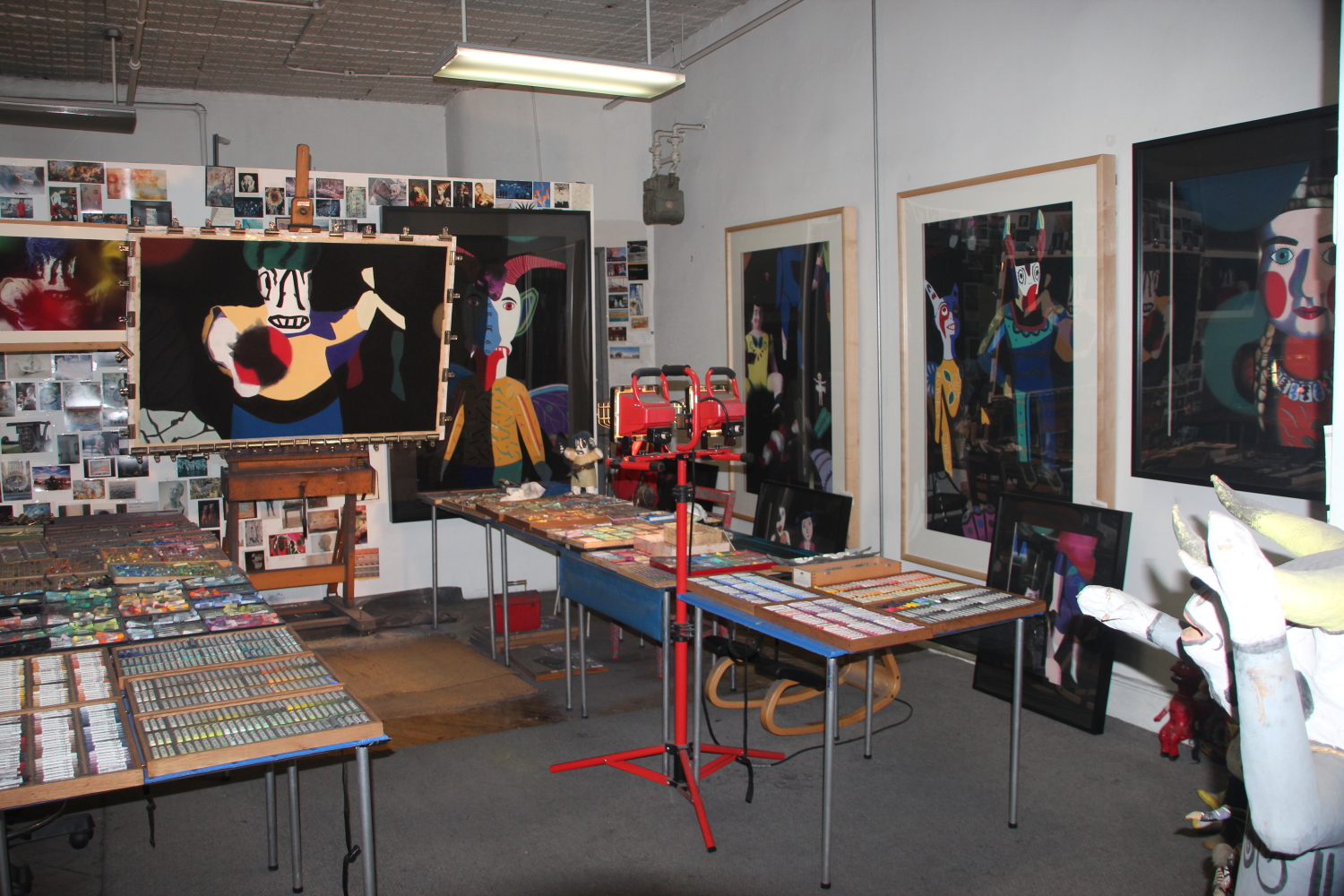
Barbara’s studio
A: The short answer is that I absolutely love making art in my studio and on the best days I barely even notice time going by!
Admittedly, it’s a hard road. Pursuing life as an artist takes a very special and rare sort of person. Talent and having innate gifts are a given, merely the starting point. We must possess a whole cluster of characteristics and be unwavering in displaying them. We are passionate, hard-working, smart, devoted, sensitive, self-starting, creative, hard-headed, resilient, curious, persistent, disciplined, stubborn, inner-directed, tireless, strong, and on and on. Into the mix add these facts. We need to be good business people. Even if we are, we are unlikely to make much money. We are not respected as a profession. People often misunderstand us: at best they ignore us, at worst they insult our work and us, saying we are lazy, crazy, and more.
The odds are stacked against any one individual having the necessary skills and stamina to withstand it all. So many artists give up, deciding it’s too tough and just not worth it, and who can blame them? This is why I believe artists who persevere over a lifetime are true heroes. It’s why I do all I can to help my peers. Ours is an extremely difficult life – it’s impossible to overstate this – and each of us finds our own intrinsic rewards in the work itself. Otherwise there is no reason to stick with it. Art is a calling and for those of us who are called, the work is paramount. We build our lives around the work until all else becomes secondary and falls away. We are in this for the duration.
In my younger days everything I tried in the way of a career eventually became boring. Now with nearly thirty years behind me as a working artist, I can still say, “I am never bored in the studio!” It’s difficult to put into words why this is true, but I know that I would not want to spend my time on this earth doing anything else. How very fortunate that I do not have to do so!
Comments are welcome!
Pearls from artists* # 79

Negombo, Sri Lanka
* an ongoing series of quotations – mostly from artists, to artists – that offers wisdom, inspiration, and advice for the sometimes lonely road we are on.
“What’s to say? Great paintings – people flock to see them, they draw crowds, they’re reproduced endlessly on coffee mugs and mouse pads and anything-you-like. And, I count myself in the following, you can have a lifetime of perfectly sincere museum-going where you traipse around enjoying everything and then go out and have some lunch. But … if a painting really works down in your heart and changes the way you see, and think, and feel, you don’t think, ‘oh, I love this picture because it’s universal.’ ‘I love this painting because it speaks to all mankind.’ That’s not the reason anyone loves a piece of art. It’s a secret whisper from an alleyway. Psst, you. Hey, kid. Yes, you.” Fingertip gliding over the faded-out photo – the conservator’s touch, a-touch-without-touching, a communion wafer’s space between the surface and his forefinger. “An individual heart-shock. Your dream … Vermeer’s dream. You see one painting, I see another, the art book puts it at another remove still, the lady buying the greeting card at the museum shop sees something else entire, and that’s not even to mention the people separated from us by time – four hundred years before us, four hundred years after we’re gone – it’ll never strike anybody the same way and the great majority of people it’ll never strike in any deep way at all – a really great painting is fluid enough to work its way into the mind and heart through all kinds of different angles, in ways that are unique and particular. Yours, yours. I was painted for you… fateful objects. Every dealer and antiquaire recognizes them. The pieces that occur and recur. Maybe for someone else, not a dealer, it wouldn’t be an object. It’d be a city, a color, a time of day. The nail where your fate is liable to catch and snag.”
Donna Tartt in The Goldfinch
Comments are welcome!


 barbararachkoscoloreddust.com