Blog Archives
Q: Does your work look different to you on days when you are sad, happy, etc.?

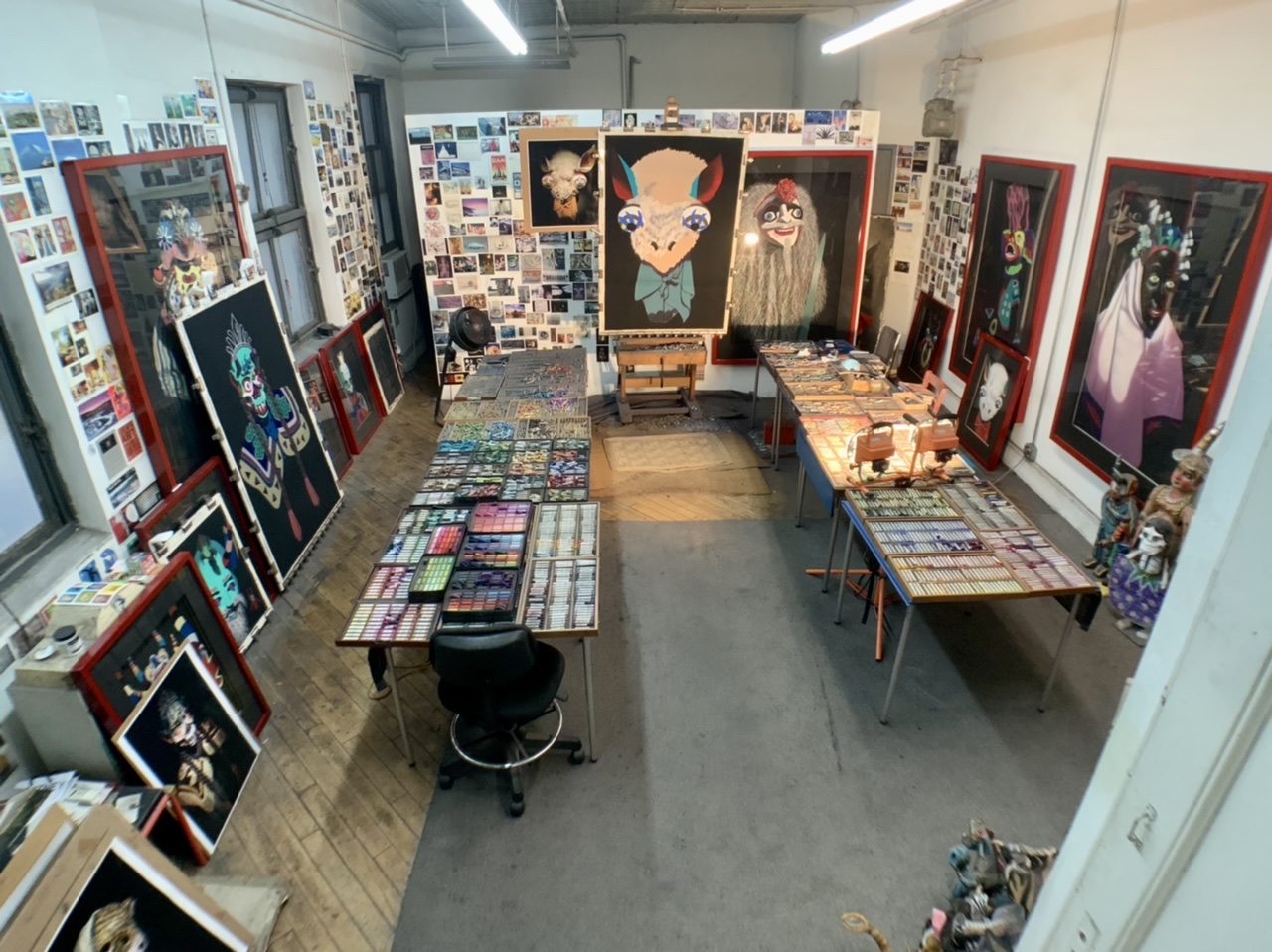
Barbara’s Studio
A: I am much more critical on days when I am sad so that the faults, imperfections, and things I wish I had done better stand out. Fortunately, all of my work is framed behind plexiglas so I can’t easily go back in to touch up perceived faults. I am reminded of the expression, “Always strive to improve, whenever possible. It is ALWAYS possible!” However, I’ve learned that re-working a painting is a bad idea. You are no longer deeply involved in making it and the zeitgeist has changed. The things you were concerned with are gone: some are forgotten, others are less urgent.
For most artists our work is autobiography. Art is personal. When I look at a completed pastel painting, I usually remember exactly what was happening in my life as I created it. Each piece is a snapshot – maybe a time capsule, if anyone could decode it – that reflects and records a particular moment. When I finally pronounce a piece finished and sign it, that’s it, THE END. It’s as good as I can make it at that point in time. I’ve incorporated everything I was thinking about, what I was reading, how I was feeling, what I valued, art exhibitions I visited, programs that I heard on the radio or watched on television, music that I listened to, what was going on in New York, in the country, and in the world.
It is still a mystery how this heady mix finds its way into the work. During the time that I spend on it, each particular painting teaches me everything it has to teach. A painting requires months of looking, reacting, correcting, searching, thinking, re-thinking, revising. Each choice is made for a reason and together these decisions dictate what the final piece looks like. On days when I’m sad I tend to forget that. On happier days I remember that the framed pastel paintings that you see have an inevitability to them. If all art is the result of one’s having gone through an experience to the end, as I believe it is, then the paintings could not, and should not, look any differently.
Comments are welcome.
Pearls from artists* # 635

Bourges, France
*an ongoing series of quotations – mostly from artists, to artists – that offers wisdom, inspiration, and advice for the sometimes lonely road we are on.
When we focus on the future, we do one of three things. We fantasize, which involves big dreams that are mostly for fun and entertainment; we dwell, which involves focusing on all the bad stuff that might happen – this was the official pastime of my hometown – or we hope, which involves envisioning the future while recognizing the inevitability of challenges. Interestingly, more hopeful people anticipate setbacks along the way and work to remove them. And yet I always imagined that hopeful and optimistic people are just born that way…
The Book of Hope: A survival Guide for Trying Times, Jane Goodall and Douglas Abrams with Gail Hudson
Comments are welcome!
Pearls from artists* # 527
*an ongoing series of quotations – mostly from artists, to artists – that offers wisdom, inspiration, and advice for the sometimes lonely road we are on.
Vocation was originally a religious term. The word comes from the Latin vocatio, which means a summons, a call. To be a priest, a monk, or a nun is to accept a calling – a vocation. The sense of an imperative – of an activity that’s a necessity, an inevitability – remains very much part of the meaning of the word today. A creative vocation isn’t a job. It’s a calling, even if for most modern artists the summons is an inner necessity, not the call of some divine figure or force. Even an artist as determinedly secular as Picasso saw echoes of religious vocation in his experience as an artist. When his mistress Francoise Gilot, wondering at his concentration and stamina, asked him if when he was painting “it didn’t tire him to stand so long in one spot,” this was his response: “No. That’s why painters live so long. While I work, I leave my body outside the door, the way Moslems take off their shoes before entering the mosque.” For creative spirits the studio or stage – or wherever they do their work – is a place apart. They may recoil from describing this as a sacred space, but there’s no question that these spaces have a special significance.
Jed Perl in Authority and Freedom: A Defense of the Arts
Comments are welcome!
Pearls from artists* # 49

Untitled, 24″ x 24″ chromogenic print, edition of 5
* an ongoing series of quotations – mostly from artists, to artists – that offers wisdom, inspiration, and advice for the sometimes lonely road we are on.
The beauty of art is better, “higher,” according to Hegel, than the beauty of nature because it is made by human beings and is the work of the spirit. But the discerning of beauty in nature is also the result of traditions of consciousness, and of culture – in Hegel’s language, of spirit.
The responses to beauty in art and to beauty in nature are interdependent. As Wilde pointed out, art does more than school us on how and what to appreciate in nature. (He was thinking of poetry and painting. Today the standards of beauty in nature are largely set by photography.) What is beautiful reminds us of nature as such – of what lies beyond the human and the made – and thereby stimulates and deepens our sense of the sheer spread and fullness of reality, inanimate as well as pulsing, that surrounds us all.
A happy by-product of this insight, if insight it is: beauty regains its solidity, its inevitability, as a judgment needed to make sense of a large portion of one’s energies, affinities, and admirations; and the usurping notions appear ludicrous.
Imagine saying, “That sunset is interesting.”
Paolo Dilonardo and Anne Jump, editors, Susan Sontag At the Same Time: Essays and Speeches
Comments are welcome!


 barbararachkoscoloreddust.com