Blog Archives
Q: Why did you first decide to depict Mexican folk art in your work?
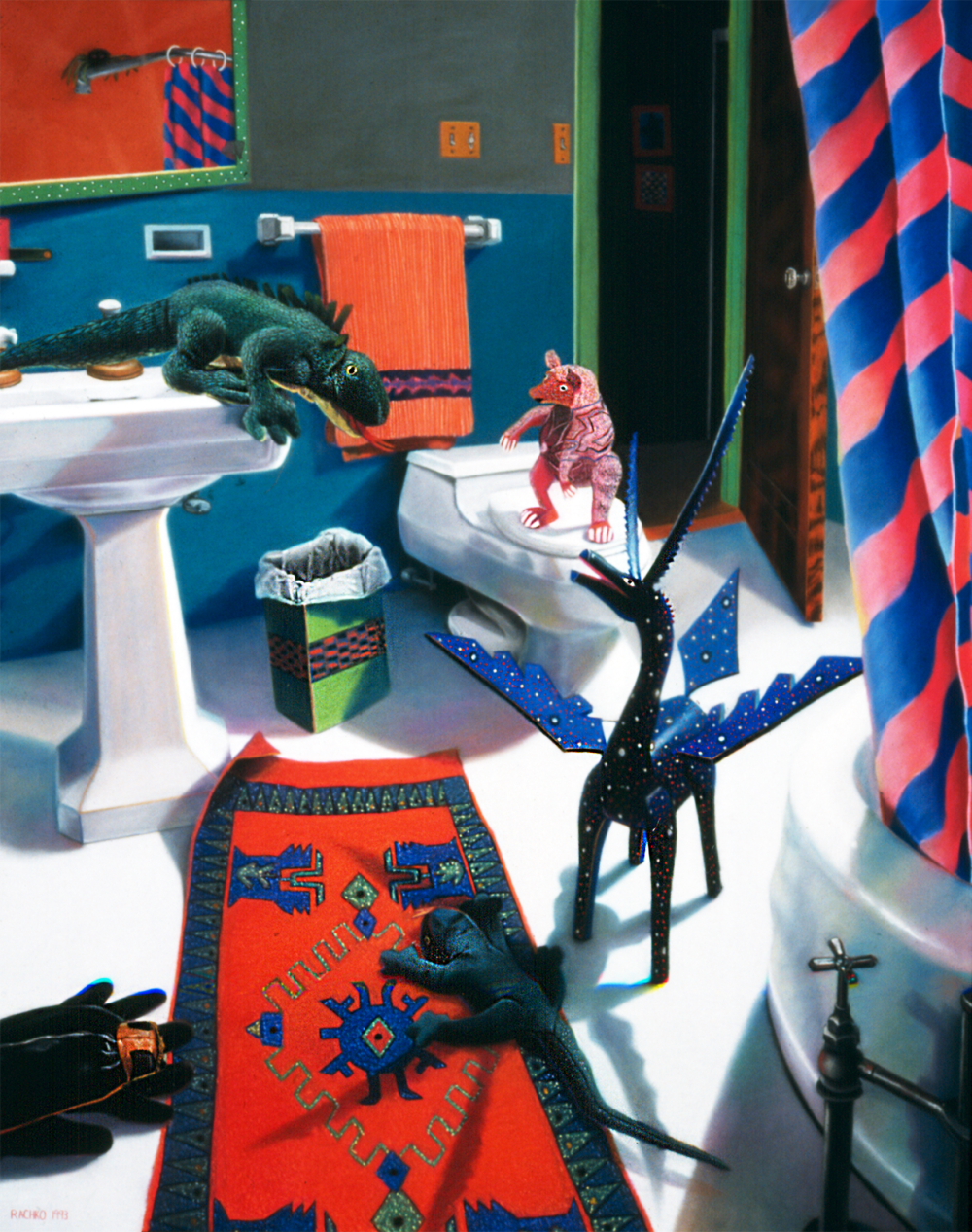
“Myth Meets Dream,” soft pastel on sandpaper, 47″ x 38″
A: As a Christmas present in 1991 my future sister-in-law sent me two brightly painted wooden animal figures from Oaxaca, Mexico. One was a blue polka-dotted winged horse. The other was a red, white, and black bear-like figure. See the two Mexican figures in “Myth Meets Dream” above.
I was enthralled with this gift and the timing was fortuitous because I had been searching for new subject matter to paint. Soon I started asking artist-friends about Oaxaca and learned that it was an important art hub. Two well-known Mexican painters, Rufino Tamayo and Francisco Toledo, had gotten their start there, as had master photographer Manual Alvarez Bravo. There was a “Oaxacan School of Painting” (‘school’ meaning a style, not an actual building) and Alvarez Bravo had established a photography school there (the building/institution kind). I began reading everything I could find. At the time I had only been to Mexico very briefly, in 1975, having made a road trip to Ensenada with my cousin and best friend from college.
The following autumn my then-boyfriend, Bryan, and I planned a two-week trip to visit Mexico. We timed it to see Day of the Dead celebrations in Oaxaca. (In my reading I had become fascinated with this unique festival). We spent one week in Oaxaca followed by one week in Mexico City. My interest in collecting Mexican folk art was off and running!
Comments are welcome!
Q: (Part II) Would you share your story of how creating art enabled you to heal after losing your husband on 9/11?

“The Champ,” soft pastel on sandpaper, 35” x 28.5” framed. The first of my “Bolivianos”.
A: Continued from last Saturday’s post…
Because I use reference photos for my pastel paintings, the first challenge was to learn how to use Bryan’s 4 x 5 view camera. At that time I was not a photographer. Always Bryan had taken reference photos for me.
In July 2002 I enrolled in a view camera workshop at New York’s International Center of Photography. Much to my surprise I had already absorbed quite a lot from watching Bryan. After the initial workshop, I continued more formal studies of photography for a few years. In 2009, I am proud to say, I was invited to present a solo photography exhibition at a New York gallery!
In 2003 I resumed making my “Domestic Threats” series of pastel paintings, something that had seemed impossible after Bryan’s death. The first large pastel painting that I created using a reference photograph taken by me confirmed that my life’s work could continue. The title of that painting, “She Embraced It and Grew Stronger,” was autobiographical. “She” is me, and “it” meant continuing on without Bryan and living life for both of us.
Having had a long successful run, the “Domestic Threats” series finally ended in early 2007. Around that time I was feeling happier and had come to better terms with losing Bryan. While this is a tragedy I will never truly be at peace with, dealing with the loss became easier with time.
Then in 2007 I suddenly became blocked and did not know where to take my work next. I had never experienced creative block and for a full-time professional artist, this was a painful few months. Still, I continued to go to the studio every day and eventually, thanks to a confluence of favorable circumstances, the block ended.
My next pastel painting series was called, “Black Paintings.” I viewed the black background as literally, the very dark place that I was emerging from, exactly like the figures emerging in these paintings. The figures themselves were wildly colorful and full of life, but that black background is always there.
Still the work continues to evolve. Recently I began my third pastel painting series called, “Bolivianos,” based on a mask exhibition encountered in La Paz at the Museum of Ethnography and Folklore. Many people have proclaimed this to be my most bold, daring, and exciting pastel painting series yet. And I think they may be right! Continuing on the journey I began 30+ years ago, I am looking forward to creating many new, striking pastel paintings!
Comments are welcome!
Q: What has been your scariest experience as an artist?

“Between,” soft pastel on sandpaper, 20″ x 26″
A: It was the approximately six months in 2007 when I finished the “Domestic Threats” series and was blocked, certain that a strong body of work was behind me, yet not knowing what in the world to do next! For a professional artist who had been working non-stop for 21 years, this was a profoundly painful, confusing, and disorienting time. I remember continuing to force myself to go to the studio and for lack of anything much to do there, spending long hours reading and thinking about art.
Eventually after all of this reflection, I had an epiphany. “Between,” with drastically simplified imagery, was the first in a new series called, “Black Paintings.” I like to think this series includes work that is considerably richer and more profound than the previous “Domestic Threats.”
Comments are welcome!
Q: Would you comment on the origin of the title for your photographic series, “Gods and Monsters”?

Untitled c-print, 24″ x 24″ edition of 5
A: My title is borrowed directly from a 2001 catalogue essay by the late art critic, Gerritt Henry. The essay was about my first pastel painting series (“Domestic Threats”) and it’s called, “Barbara Rachko: Gods and Monsters.”
Among other shared interests, Gerritt and I both loved old Frankenstein movies from the 1940s. Around 1998 interest in James Whale, who had directed the original films, was riding high thanks to an Oscar-winning biopic about his last days in Hollywood. The film was called, “Gods and Monsters.” The title was taken from a line in “Bride of Frankenstein,” in which Dr. Pretorius toasts Dr. Frankenstein saying, “To a new world of gods and monsters.”
My photographic series came after “Domestic Threats” and some years after Gerritt’s essay was published. When I was searching for a title for the photos, “Gods and Monsters” seemed a perfect fit!
Comments are welcome!
Q: How has your use of photography changed over the years?
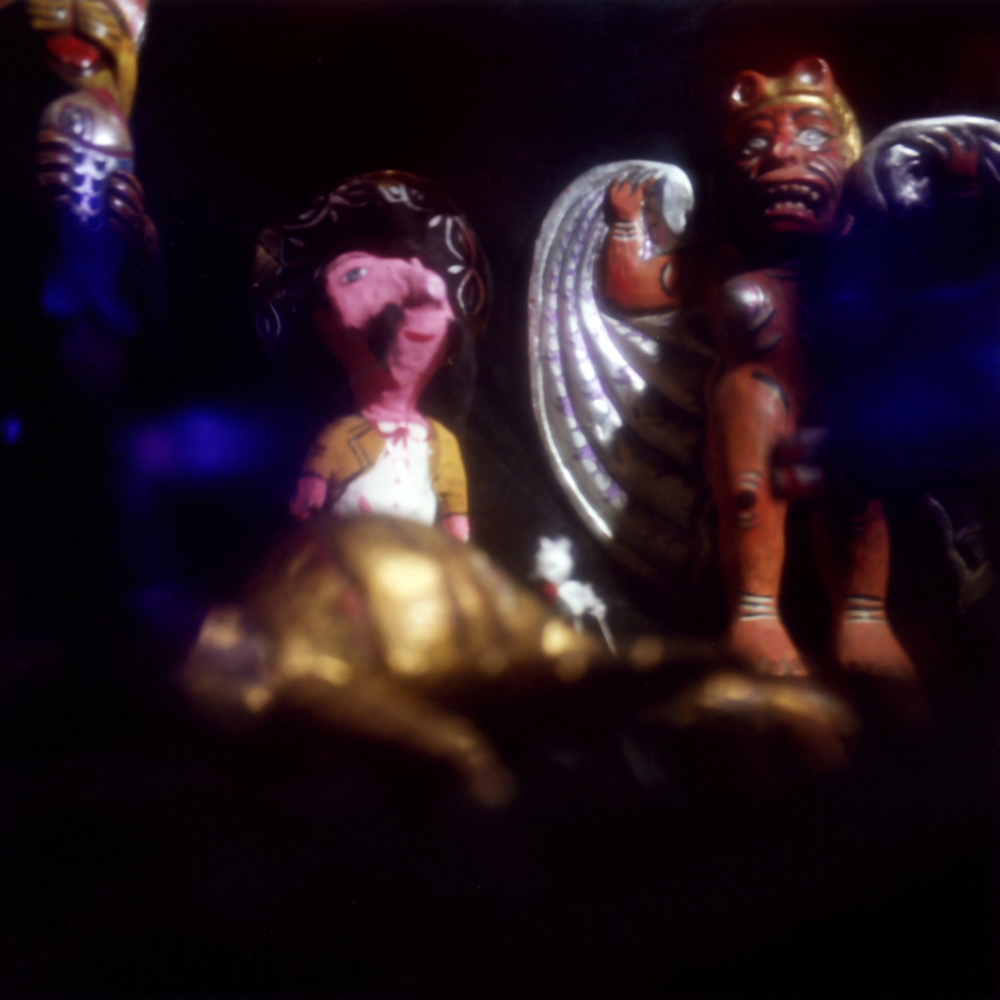
Untitled, 24″ x 24″ c-print
A: When my husband, Bryan, was alive I barely picked up a camera, except to photograph sights encountered during our travels.
Throughout the 1990s and ending in 2007, I worked on my series of pastel-on-sandpaper paintings called, “Domestic Threats.” These were realistic depictions of elaborate scenes that I staged first in our 1932 Sears house in Alexandria, Virginia, next in a New York sixth floor walk-up apartment, and finally in my current New York apartment.
I use Mexican masks, carved wooden animals, and other folk art figures that I discovered on trips to Mexico. I staged and lit these setups, while Bryan photographed them using his Toyo-Omega 4 x 5 view camera. We had been collaborating this way almost from the beginning (circa 1991). Having been introduced to photography by his father at the age of 6, Bryan was a terrific amateur photographer.
Bryan would shoot two pieces of 4 x 5 film at different exposures and I would select one, generally the one that showed the most detail in the shadows, to make into a 20 x 24 photograph. The photograph would be my starting point for making the pastel painting. Although I work from life, too, I could not make a painting without mostly looking at a reference photo.
After Bryan was killed on 9/11, I had no choice but to study photography. I completed a series of photography classes at the International Center of Photography in New York, turned myself into a skilled photographer, and presented my first solo photography exhibition at HP Garcia in New York in 2009.
Comments are welcome!
Q: One can’t help but make connections between the devastating effects of 9/11 and your series, “Domestic Threats.” Would they be right?

“No Cure for Insomnia,” soft pastel on sandpaper, 58″ x 38″
A: Well, not exactly, since I began this work in 1991.
All of the paintings in this series are set in places where I reside or used to live, either a Virginia house or two New York apartments, i.e., my personal domestic environments. Each painting typically contains a conflict of some sort, at least one figure that is being menaced or threatened by a group of figures. For example, in “No Cure for Insomnia (above) the threatened figure is me. So it was an easy decision to name the series “Domestic Threats.” My idea was that these paintings were psychological dramas: surrealistic, metaphoric depictions of human fears, anxieties, inner conflicts, demons, etc.
But depending on what is/was going on in the country at a particular moment, people make other associations. Since my husband was killed on 9/11, people think the title, “Domestic Threats,” was prescient and ascribed all kinds of domestic terrorism associations to the work. For a time viewers thought I was hinting at scenes of domestic violence, but that also is not what I intended. The title “Domestic Threats” has proven to be fraught with associations that I never considered.
However, I am fine with any interpretations that are elicited because it means my paintings are getting a response. That’s important. I have been working, studying, and thinking about art for thirty years and hopefully, that’s reflected in the work I create. It’s natural that it takes time for people to ponder all the complexities in a work of art.
Maybe this comment by the late Gerrit Henry, a New York critic, is more true now than when he wrote it sixteen years ago: “What we bring to a Rachko, in other words, we get back, bountifully.”
Comments are welcome!
Q: What is the one painting that you never want to sell?

“No Cure for Insomnia,” pastel on sandpaper, 58″ x 38″
A: There are two: “Myth Meets Dream” and “No Cure for Insomnia.” Both are part of my “Domestic Threats” series and were breakthroughs at the time I made them. They are relatively early works – the first from 1993, the latter from 1999 – and were important in my artistic development.
“Myth Meets Dream” is the earliest pastel painting in which I depict Mexican figures. It includes two brightly painted, carved wooden animals from Oaxaca sent to me in 1992 by my sister-in-law. I have spoken about them before. These figures were the beginning of my ongoing fascination with Mexico.
“No Cure for Insomnia” includes a rare self-portrait and is set in my late aunt’s sixth-floor walkup on West 13th Street, where I lived when I moved to New York in 1997. My four years there were very productive.
Comments are welcome!
Q: Would you say there is a unifying quality to all of the work you have produced in the last thirty years?
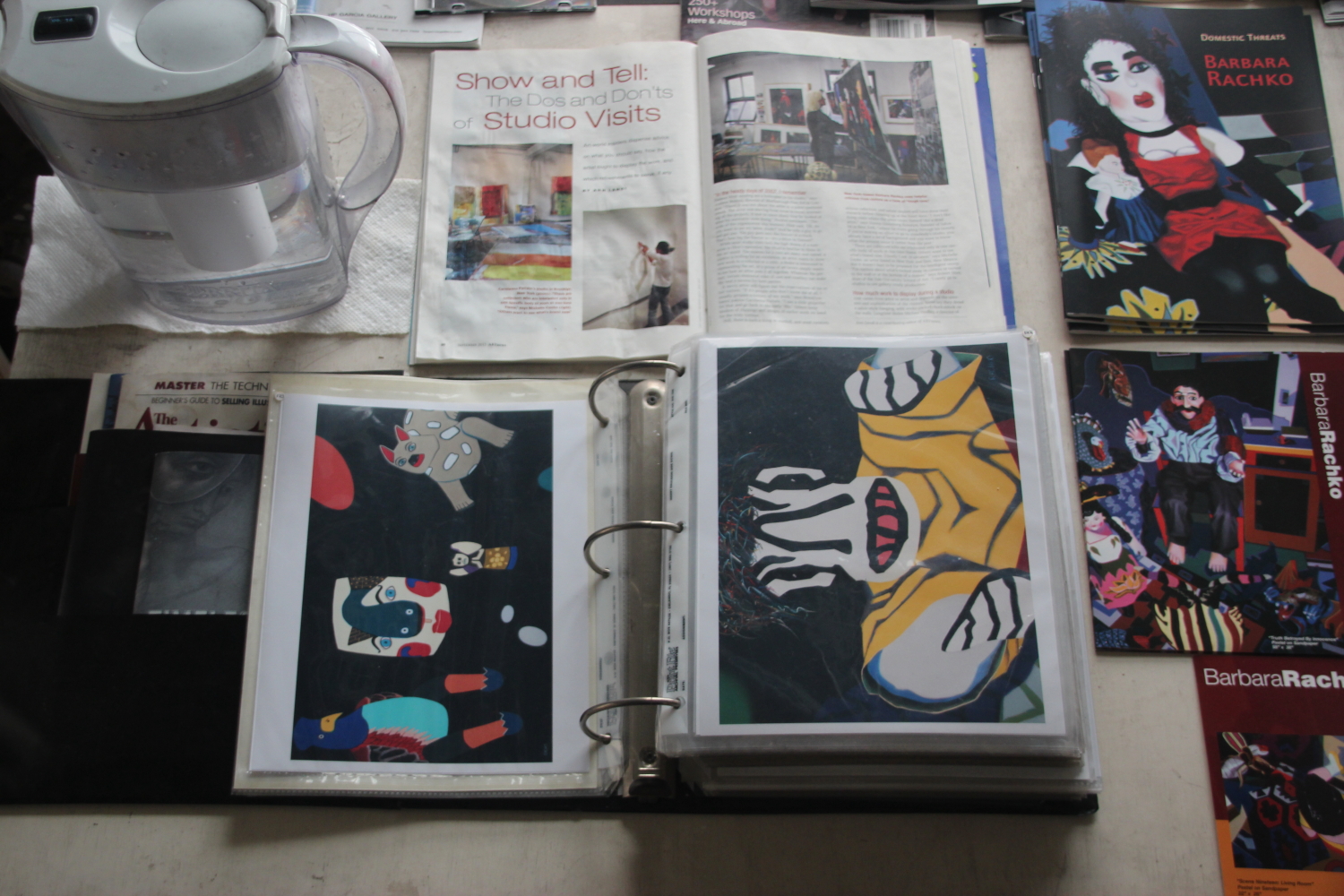
Barbara’s portfolio book
A: Yes, I can think of several. Whether making pastel paintings or printing photographs in the darkroom, I have always been concerned with quality and craftsmanship and never pronounce a work finished until it is the best thing I can make.
Although I started out as a maker of photorealist portraits in pastel, for twenty-odd years I have worked with Mexican folk art as my primary subject matter, treating these objects very differently in three separate series: “Black Paintings,” “Domestic Threats,” and “Gods and Monsters.” The first two are pastel-on-sandpaper paintings while the last is comprised of chromogenic photographs (c-prints). A few years ago I also started making “Teleidoscopes” using an iPad app to photograph my Mexican and Guatemalan folk art collection. This last one is just for fun; I do not offer them for sale.
Soft pastel is my first love and the two series of pastel paintings are my best-known work. My technique for using pastel continues to evolve in intriguing ways. I doubt I can ever learn all there is to know not only about color, but also about this medium. Pastel is endlessly fascinating, which is why I have never wanted to switch to anything else.
Comments are welcome!
Q: How do you know when a series has ended?

“A Promise, Meant to be Broken,” soft pastel on sandpaper, 58″ x 38″
A: I suppose it’s when there is nothing left to say within a particular body of work. The urgency to add something I haven’t tried vanishes. Usually I can’t even think of anything I haven’t tried.
I knew with certainty that the “Domestic Threats” series was finished while “A Promise Meant to be Broken” was still on my easel. It’s no accident that I included a self-portrait. This painting was my way of saying good-bye to an important body of work – literally turning my back on it – and summing up where the work had taken me.
For artists each series is a creative journey with a beginning, a middle, and an end. At a certain point it’s over. Then you build on what you’ve accomplished and move on to create something new. The connection between new work and old may not always be obvious, but one thing is certain: all the previous work laid the groundwork for what you make today.
Comments are welcome!
Q: Why do you call the small paintings in your “Domestic Threats” series, “Scenes?”
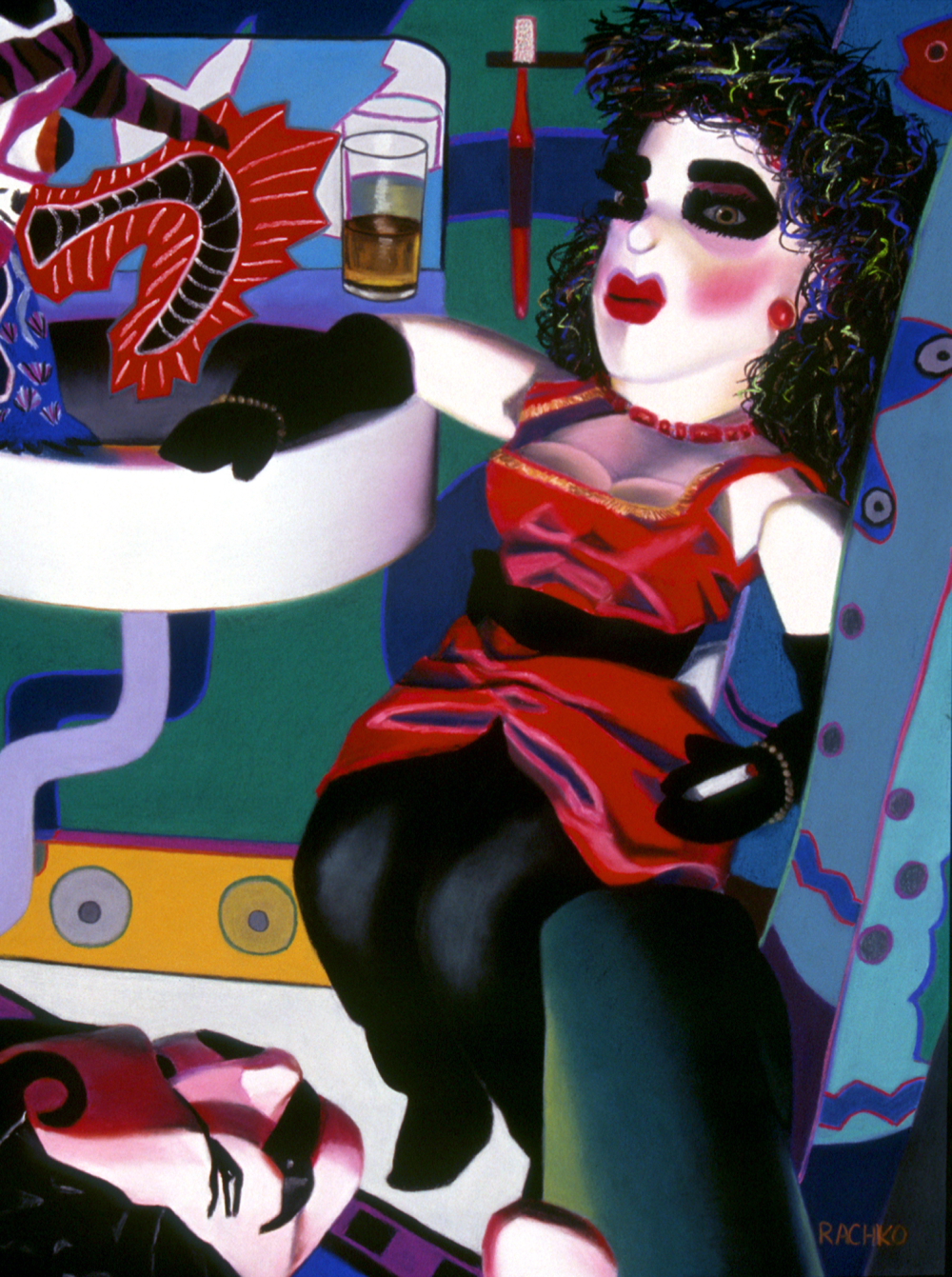
“Scene Thirteen: Bathroom,” 26″ x 20″, soft pastel on sandpaper
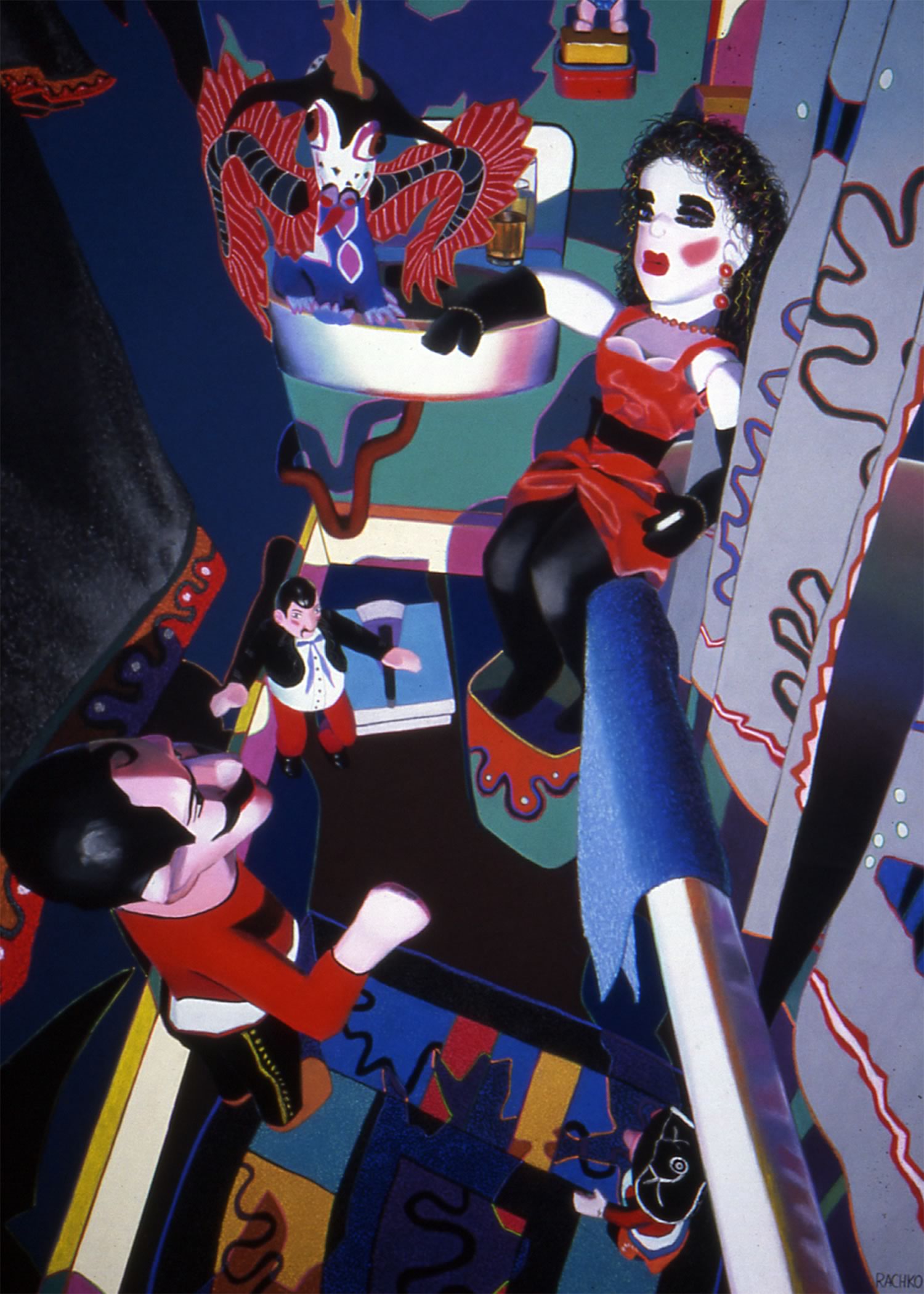
“He Urged Her to Abdicate,” 58″ x 38,” soft pastel on sandpaper
A: At first I didn’t know what to call them. I was looking for a word that meant “a piece of some larger whole.” Initially the word “shard” – a fragment of pottery – came to mind. However, that didn’t capture the meaning I was seeking, since my paintings have little to do with pottery.
My large “Domestic Threats” paintings are theatrical. There is substantial labor and much thought involved in their creation, so I often think of myself as a director and each image as a play.
Small “Domestic Threats” paintings are made from a portion of a photograph that I use as reference for a larger painting. For example, “Scene Thirteen: Bathroom” (above, top) is a small version of “He Urged Her to Abdicate” (above, bottom).
A “portion” of a play is a “Scene” so that’s what I finally named them. Additionally, I numbered the paintings in order of their creation and added the room where each takes place.
Comments are welcome!


 barbararachkoscoloreddust.com