Blog Archives
Pearls from artists* # 401

“Prophecy,” Soft Pastel on Sandpaper, 58″ x 38″ Image, 70″ x 50″ Framed
*an ongoing series of quotations – mostly from artists, to artists – that offers wisdom, inspiration, and advice for the sometimes lonely road we are on.
Said [Larry] Rivers,
You could be poor and think your life worthwhile – the dance of the mind, the leap of the intellect. If you made art that did not sell immediately, or ever, you could still be involved in a meaningful, inspiring activity that was a reward in itself, and you could show it to the people you dreamed of thrilling with your efforts; your friends were your audience. They were sitting on your shoulder watching you work. That was the opera of the time… Pursuit of a career and commercial success was selling out, losing one’s soul. In painting, writing, music, and dance, nothing could be more shameful.
Mary Gabriel in Ninth Street Women
Comments are welcome!
Pearls from artists* # 400

In the studio with friends
* an ongoing series of quotations – mostly from artists, to artists – that offers wisdom, inspiration, and advice for the sometimes lonely road we are on.
A student in the audience raised her hand and asked me:
“Why should I live?”
… In the very act of asking that question, you are seeking reasons for your convictions, and so you are committed to reason as the means to discover and justify what is important to you. And there are so many reasons to live!
As a sentient being, you have the potential to flourish. You can refine your faculty of reason itself by learning and debating. You can seek explanations of the natural world through science, and insight into the human condition through the arts and humanities. You can make the most of your capacity for pleasure and satisfaction, which allowed your ancestors to thrive and thereby allowed you to exist. You can appreciate the beauty and the richness of the natural and cultural world. As the heir to billions of years of life perpetuating itself, you can perpetuate life in turn. You have been endowed with a sense of sympathy – the ability to like , love, respect, help, and show kindness – and you can enjoy the gift of mutual benevolence with friends, family, and colleagues.
And because reason tells you that none of this is particular to you, you have the responsibility to provide to others what you expect for yourself. You can foster the welfare of other sentient beings by enhancing life, health, knowledge, freedom, abundance, safety, beauty, and peace. History shows that when we sympathize with others and apply our ingenuity to improving the human condition, we can make progress in doing so, and you can help to continue that progress.
Stephen Pinker in Enlightenment Now: The Case for Reason, Science, Humanism, and Progress
Comments are welcome!
Pearls from artists* # 399
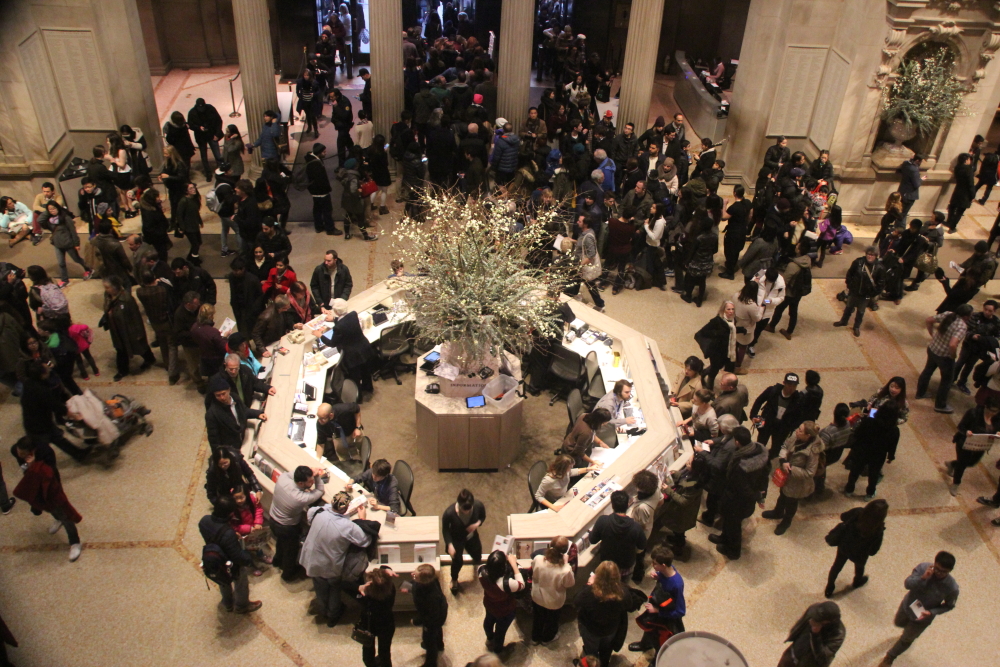
The Great Hall at the Met
* an ongoing series of quotations – mostly from artists, to artists – that offers wisdom, inspiration, and advice for the sometimes lonely road we are on.
Science is concerned with the general, the abstract, and the knowable. In contrast, art deals with the particular, the unknowable, the singular. This applies not just to the content of artistic works but also to the way this content is received. Even in the case of a film or concert attended by large numbers of people, the artistic experience remains fundamentally a solitary one. Each one of us lives the work alone. Whatever sense of togetherness accompanies the experience comes precisely from the fact that, faced with the singularity of the aesthetic moment, each percipient feels his aloneness before the radical mystery that enfolds us all. Wherever an act of creation is shared with others, then, there is individuation – not just for the author of the work but for the audience too. The singularity of art awakens us to our own singularity, and through it to the singularity in the Other. I have argued that artifice unifies by imposing an univocal image that replicates itself identically in each spectator. True art tears the spectator out of the mass of sameness, calling forth from the numberless crowd a new people and a new communion.
J.F. Martel in Reclaiming Art in the Age of Artifice: A Treatise, Critique, and Call to Action
Comments are welcome!
Top Facebook posts for 2019
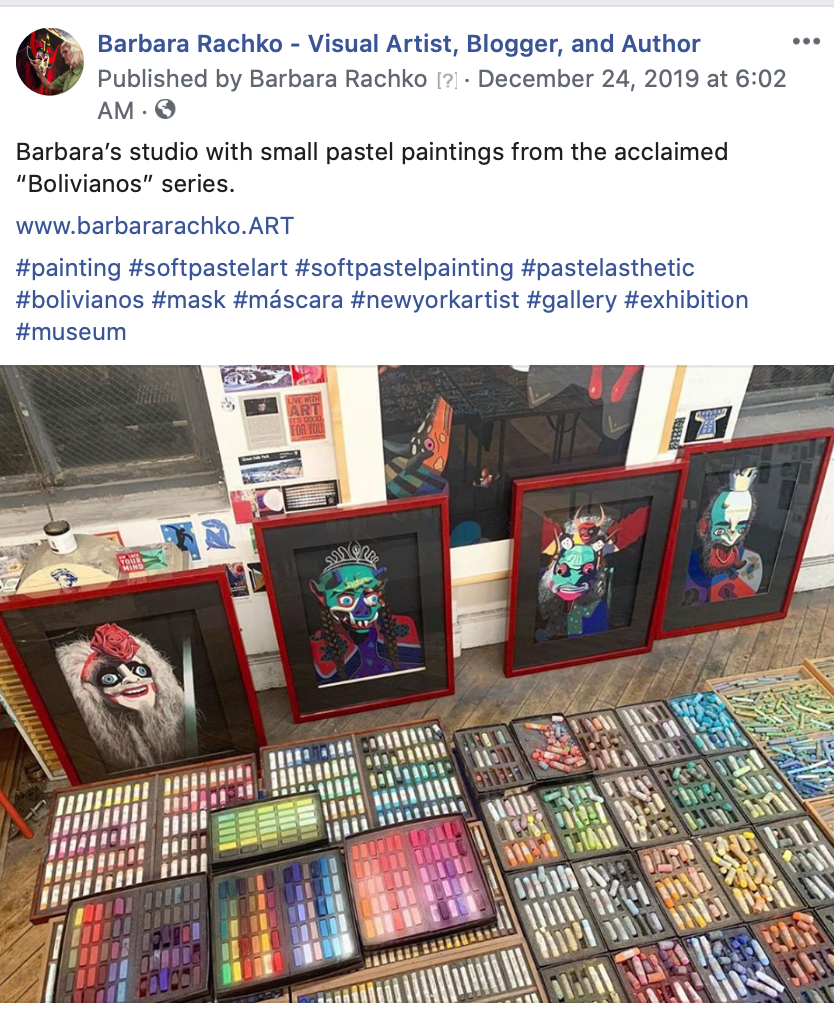
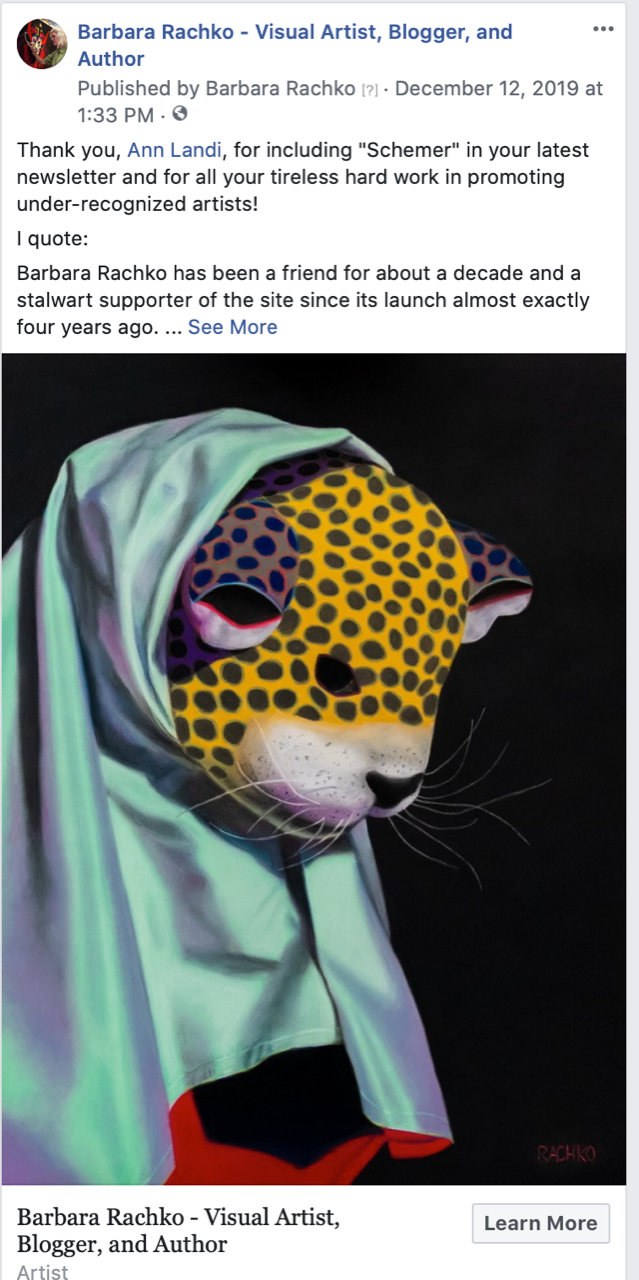
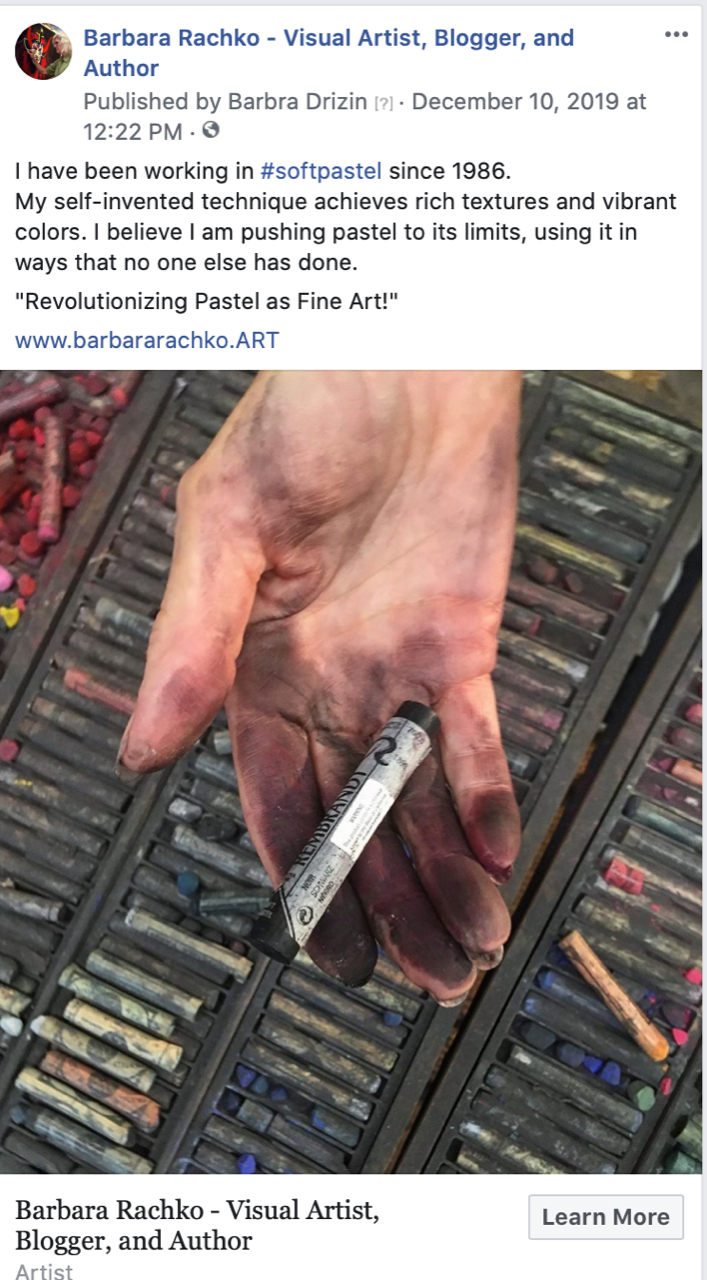
December was a busy month! Here are the most-liked 2019 posts – all dated December – from my Facebook fan page. Please join a worldwide audience of 48,000 people who follow my work at https://facebook.com/BarbaraRachko. Thank you for your support!
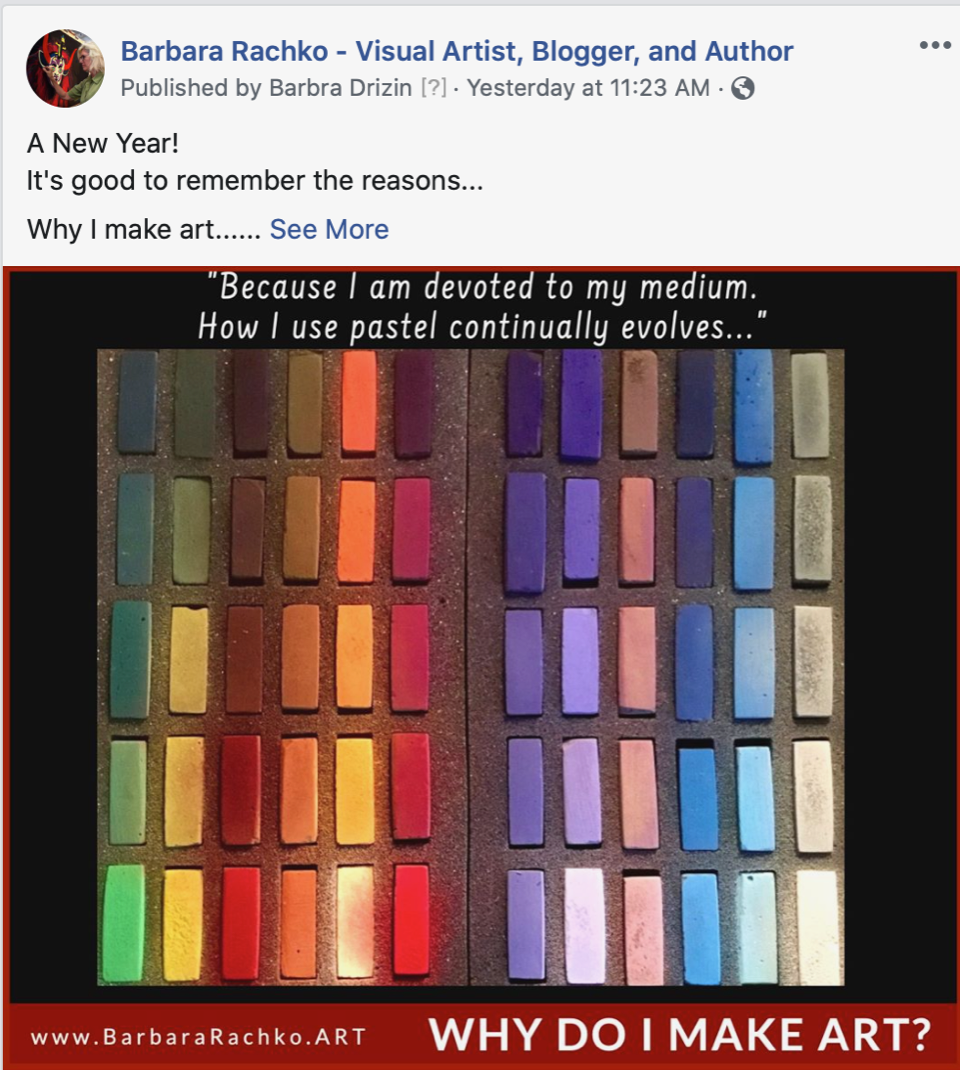
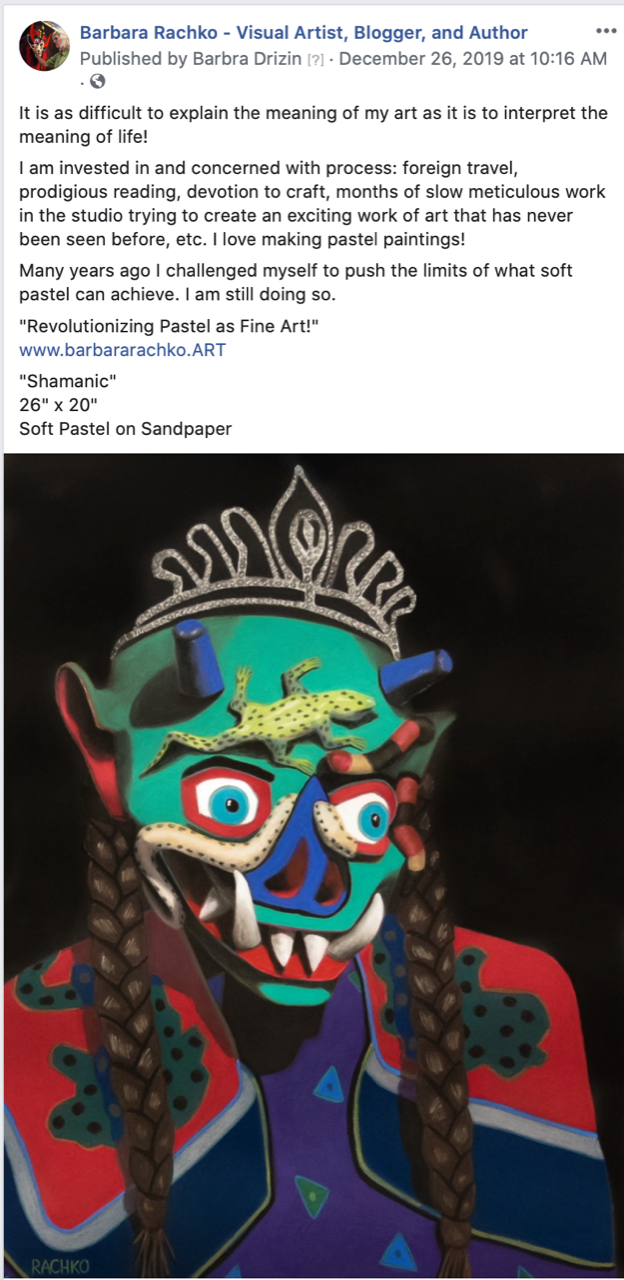
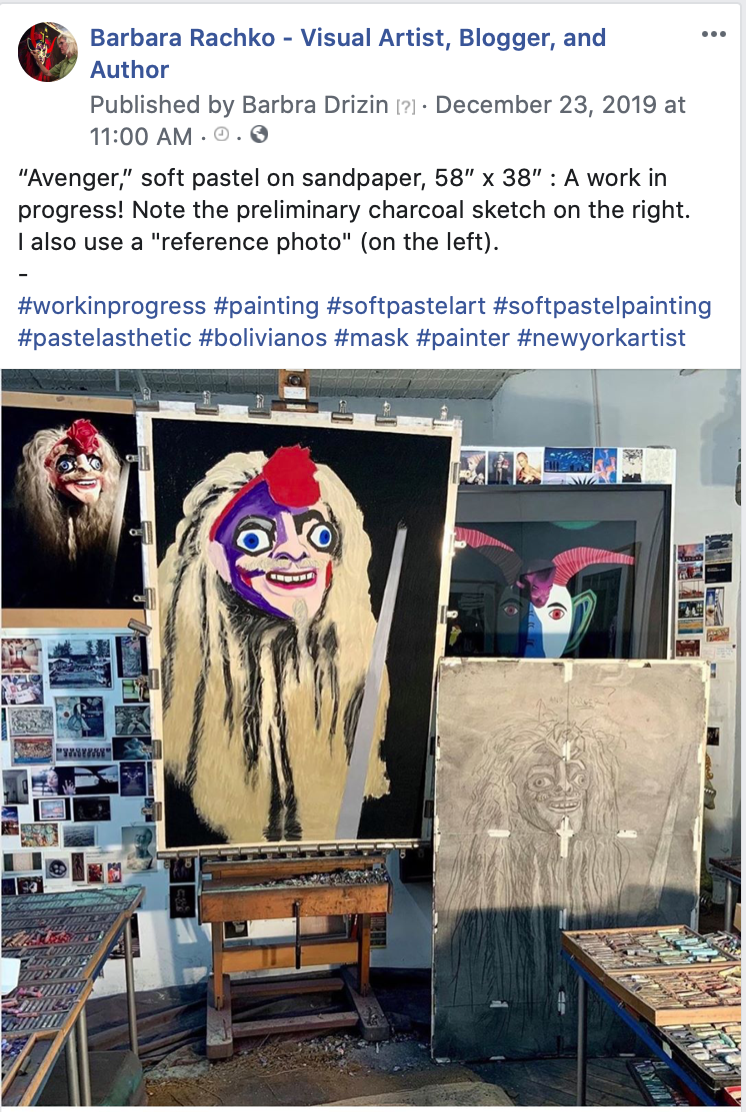
Comments are welcome!
Pearls from artists* # 369
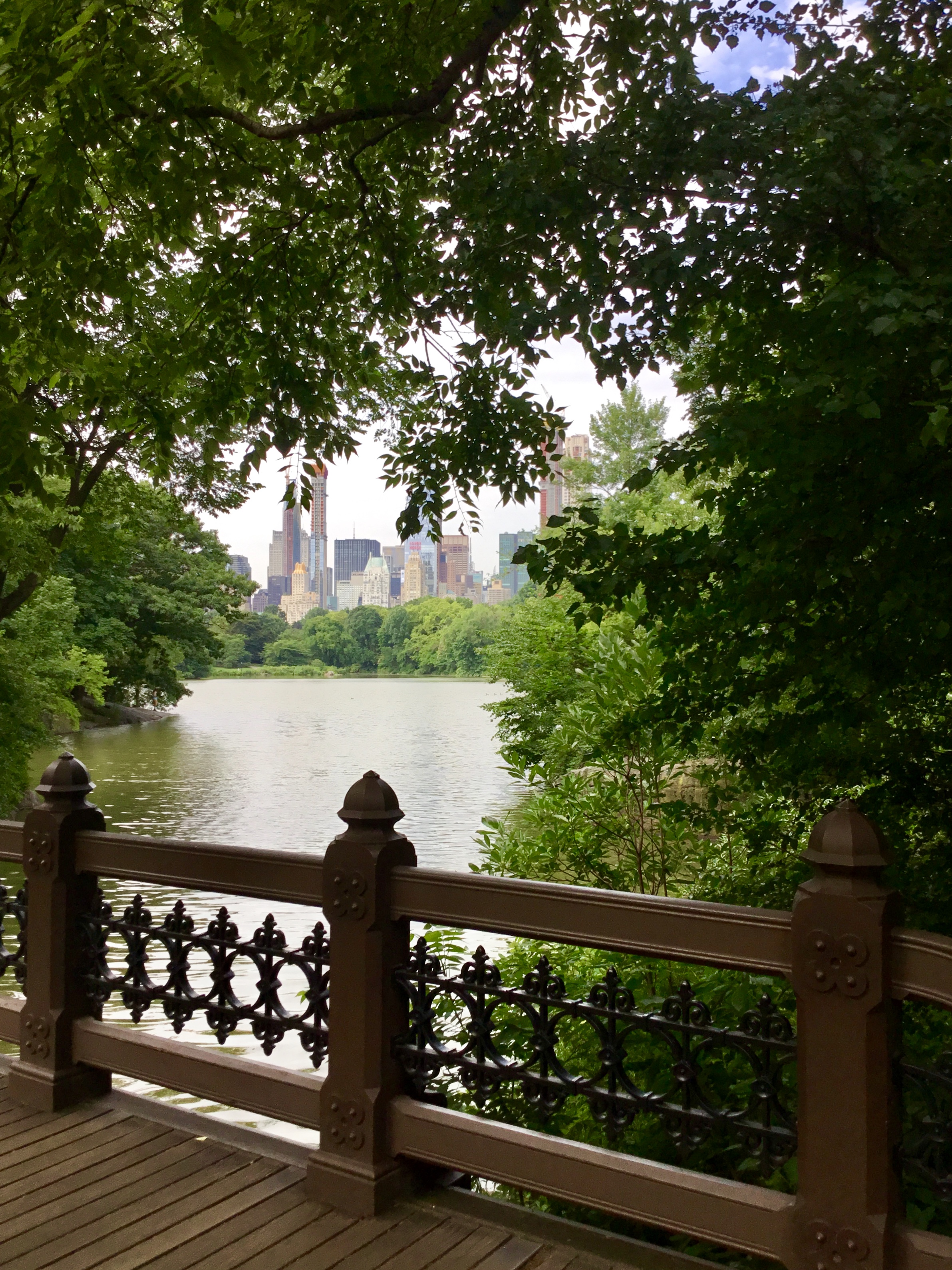
Central Park, NYC
* an ongoing series of quotations – mostly from artists, to artists – that offers wisdom, inspiration, and advice for the sometimes lonely road we are on.
Salieri wrote a memoir of his own, which his friend Ignacio von Mosel used as the basis for a biography, published in 1827. Salieri’s original document disappeared, but Mosel quoted parts of it. One anecdote is particularly winning. Salieri is recounting the premier, in 1770, of his second opera, “Le Donne Letterate” (“The Learned Woman”). The applause is vigorous, prompting the young composer to follow the audience out into the street, in the hope of soaking up more praise. He overheard a group of operagoers:
“The opera is not bad,” said one. “It pleased me right well,” said a second (that man I could have kissed). “For a pair of beginners, it is no small thing,” said the third. “For my part,” said the fourth, “I found it very tedious.” At these words I struck off into another street for fear of hearing something still worse.
Any creative person who has made the mistake of surreptiously canvassing public opinion will identify with Salieri’s fatal curiosity.
Alex Ross in Salieri’s Revenge in The New Yorker, June 3, 2019
Comments are welcome!
Pearls from artists* # 356
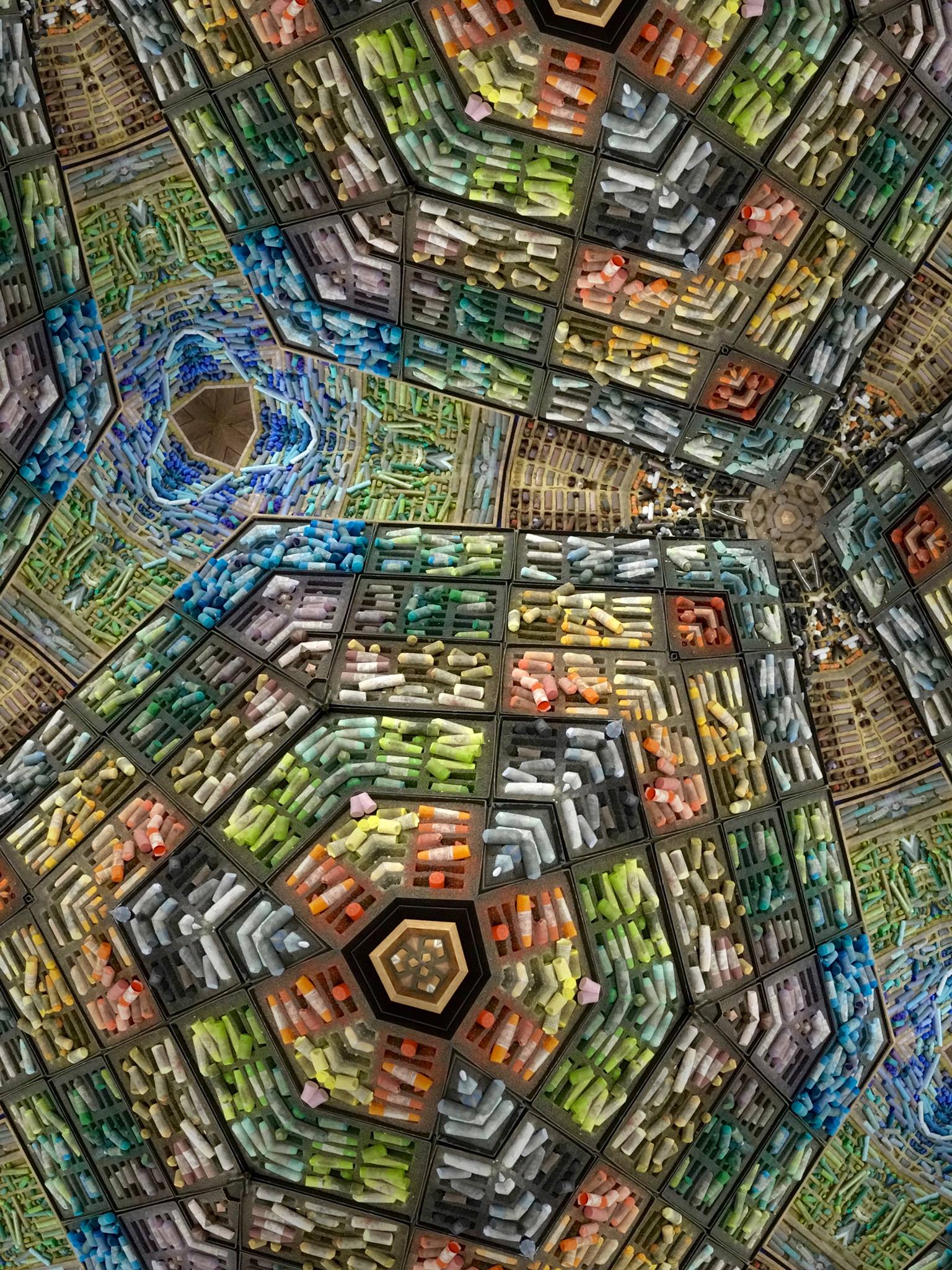
Some of Barbara’s pastels
*an ongoing series of quotations – mostly from artists, to artists – that offers wisdom, inspiration, and advice for the sometimes lonely road we are on.
Science is concerned with the general, the abstract, and the knowable. In contrast, art deals with the particular, the unknowable, the singular. This applies not just to the content of artistic works but also to the way this content is received. Even in the case of a film or concert attended by large numbers of people, the artistic experience remains a fundamentally solitary one. Each one of us lives the work from the work alone. Whatever sense of togetherness accompanies the experience comes precisely from the fact that, faced with the singularity of the aesthetic moment, each percipient feels his aloneness before the radical mystery that enfolds us all. Wherever an act of creation is shared with others, then, there is individuation – not just for the author of the work but for the audience too. The singularity of art awakens us to our own singularity, and through it to the singularity in the Other. I have argued that artifice unifies by imposing a univocal image that replicates itself indefinitely in each spectator. True art tears the spectral out of the mass of sameness, calling forth from the numberless crowd a new people and a new communion.
Reclaiming Art in the Age of Artifice: A treatise, Critique, and Call to Action
Comments are welcome!
Q: Do you work with a particular audience in mind?
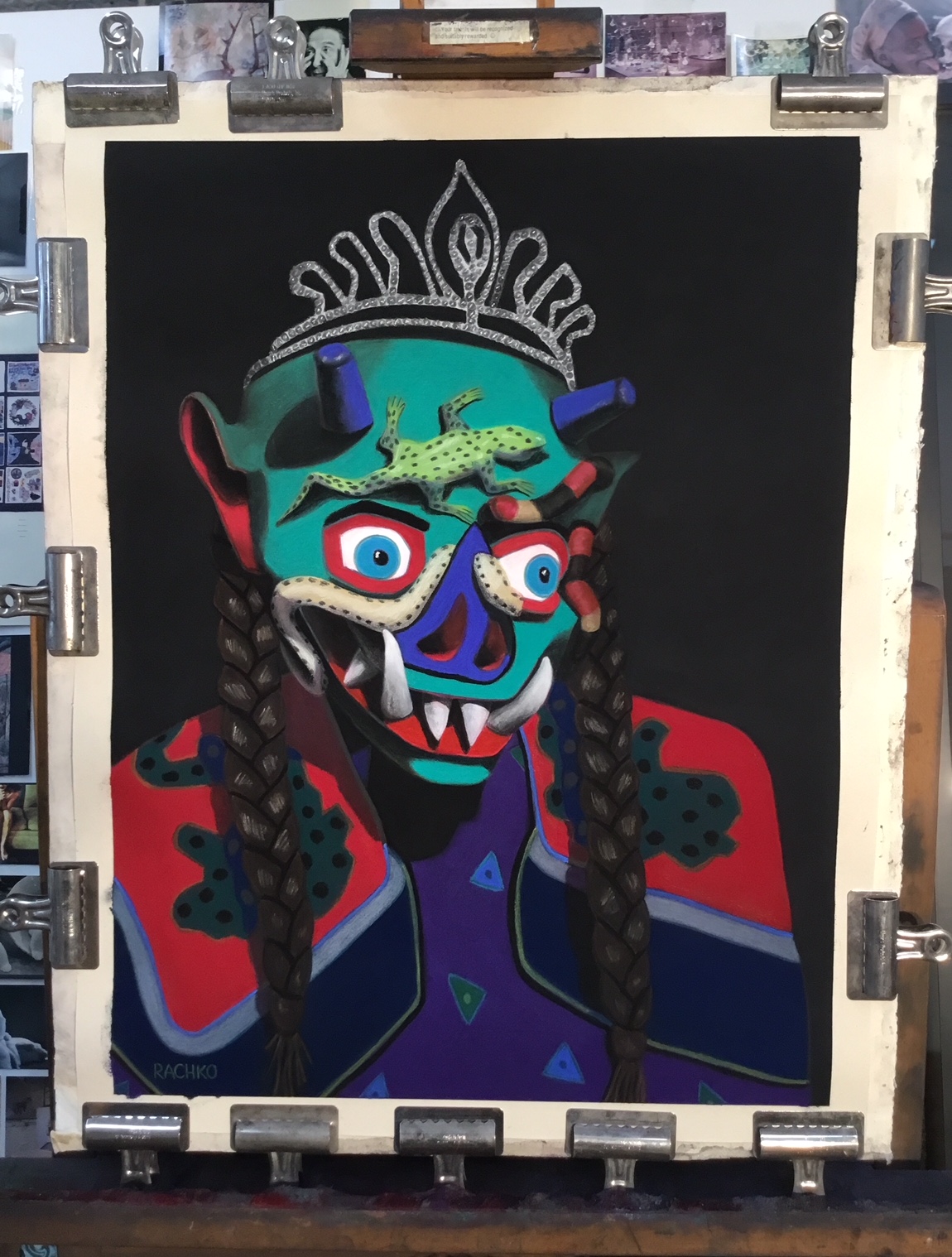
“Shamanic,” 26″ x 20,” finished
A: In general I would answer no, I have no ‘specific’ audience in mind. But I DO consider the audience in this sense. As I put finishing touches on a pastel painting, I pay attention to how all of my decisions up to that point lead the viewer’s eyes around. I fine tune – brightening some areas, heightening the contrast with what’s next to it, blurring, fading, and pushing back others – all to keep the viewer’s gaze moving around the painting. Once I am satisfied that it’s as visually exciting as I can make it, I consider the pastel painting finished, ready to be photographed, and driven to Virginia for framing.
Comments are welcome!
Pearls from artists* # 265
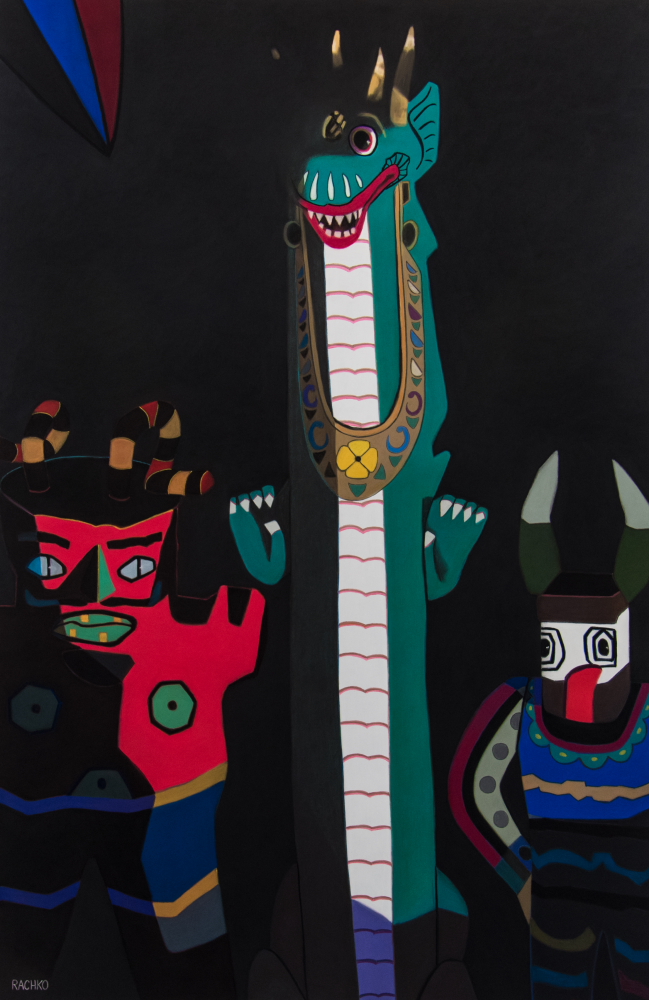
“Colloquium,” soft pastel on sandpaper, 58″ x 38″ image, 70″ x 50″ framed
* an ongoing series of quotations – mostly from artists, to artists – that offers wisdom, inspiration, and advice for the sometimes lonely road we are on.
I remember hearing Adolph Gottlieb on a panel once at NYU, and Adolph said, in effect – I’m not quoting him directly – “I don’t paint for the masses. I paint for the elite. The masses are not interested in what I do. They won’t understand this kind of painting that I do, and it won’t come through to them.”
I understood perfectly what he meant, and I was totally sympathetic. But the audience, which was not quite an audience of proletariat workers, but an audience of school of education, art teachers, or art teachers to be, were going out of their heads with rage just at the mention of the elite.
I think there is an elite, and there always was an elite for painting or good music or for good literature. For a long time there has been, and I don’t see anything wrong with it. What it means to a lot of people, the elite is the wealthy or something like that. Adolph, I don’t think, was referring to an elite of the wealthy, where the people run the government or something like that, but to those people who are concerned and interested in the most sophisticated, meaningful painting there is.
The Art Life: On Creativity and Career by Stuart Horodner
Comments are welcome!
Pearls from artists* # 262

“Big Deal,” soft pastel on sandpaper, 58″ x 38″
* an ongoing series of quotations – mostly from artists, to artists – that offers wisdom, inspiration, and advice for the sometimes lonely road we are on.
It may have been easier to paint bison on the cave walls long ago than to write this (or any other) sentence today. Other people, in other times and places, had some robust institutions to shore them up: witness the Church, the clan, ritual, tradition. It’s easy to imagine that artists doubted their calling less when working in the service of God than when working in the service of self.
Not so today. Today almost no one feels shored up. Today artwork does not emerge from secure common ground: the bison on the wall is someone else’s magic. Making art now means working in the face of uncertainty; it means living with doubt and contradiction, doing something no one much cares whether you do, and for which there may be neither audience nor reward. Making the work you want to make means setting aside these doubts so that you may see clearly what you have done, and thereby see where to go next. Making the work you want to make means finding nourishment within the work itself. This is not the Age of Faith, Truth, and Certainty.
David Bayles and Ted Orlando in Art & Fear: Observations On the Perils (and Rewards) of ARTMAKING
Comments are welcome!
Pearls from artists* # 188
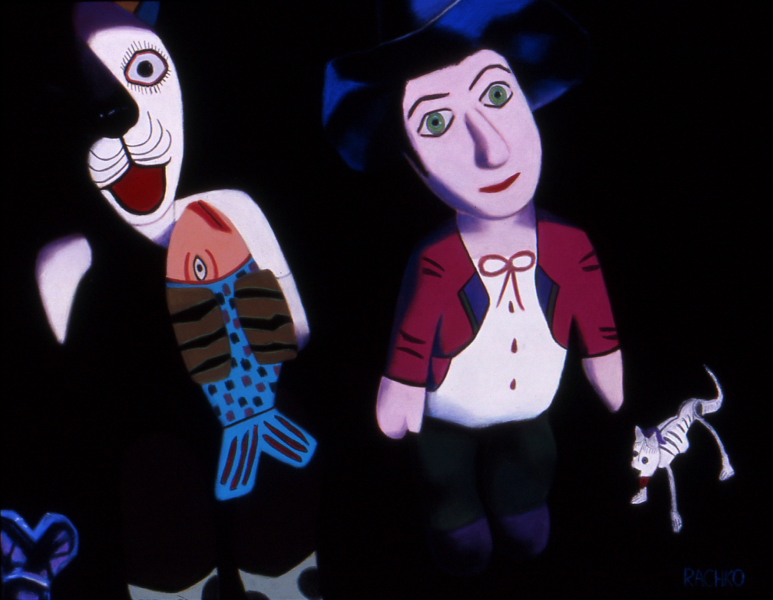
“Offering,” soft pastel on sandpaper, 20″ x 26″
* an ongoing series of quotations – mostly from artists, to artists – that offers wisdom, inspiration, and advice for the sometimes lonely road we are on.
HM: In order to create a work of art, you need an artist, an object, the work, and the audience. Indeed, where there’s no audience, there’s no artist. Renoir used to say, “No painters in Hamlet.” meaning that on a desert island you wouldn’t paint.
( I confess I am a little surprised. For my part, I find it difficult to believe that the true artist cannot work without hope. It seems to me that art is first and foremost an internal necessity, a need to escape from life. It is true that this is closer to the mystics’ point of view and that the artist, if he does not work directly for his contemporaries, at least looks forward to some future resonance. Nonetheless, I ask the same question again.)
PC: Even a true painter wouldn’t paint on a desert island?
HM: No… Painting is a means of communication, a language. An artist is an exhibitionist. Take away his spectators and the exhibitionist slinks off with his hands in his pockets.
The audience is the material in which you work. You don’t see the face of the audience. It’s huge, an immense mass. The public is – listen, it’s the man you encounter one fine day, who says, “Monsieur Matisse, I can’t tell you how much I love your picture, the one you exhibited at the salon,” and this man is a clerk who could never spend a red cent on painting. The public is not the buyer; the public is the sensitive material on which you hope to leave an imprint.
PC: Through the picture, the audience returns to the source of emotion.
HM: Yes, and the artist is the actor, the fellow with the wheedling voice who won’t rest until he’s told you his life story.
Chatting with Henri Matisse: The Lost 1941 Interview, Henri Matisse with Pierre Courthion, edited by Serge Guilbaut, translated by Chris Miller
Comments are welcome!


 barbararachkoscoloreddust.com