Blog Archives
Pearls from artists* # 685
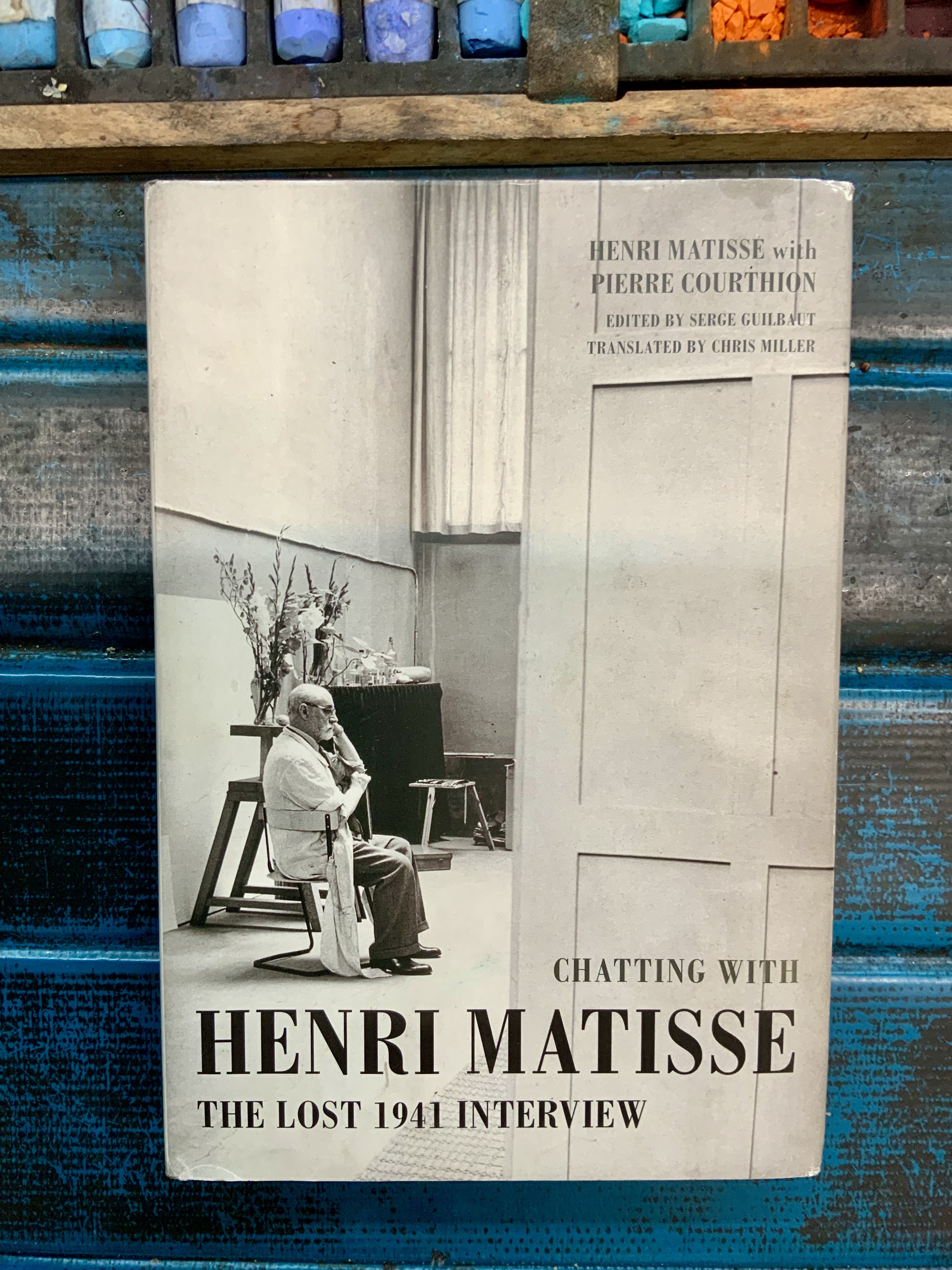
Another of my favorite books!
*an ongoing series of quotations – mostly from artists, to artists – that offers wisdom, inspiration, and advice for the sometimes lonely road we are on.
HM: The great benefit I took from visits with Renoir was realizing that even after a long working life, an artist’s curiosity could remain unquenched. The hope of some further progress, something to be added to his œuvre, was what kept Renoir alive. He was painting a “bathing” picture (now, finally, in the Musée du Louvre) and doing it with some difficulty because the picture was quite big and Renoir’s hands weren’t very nimble. But it’s only now, when I think about it, that I realize he must have found it hard; it would never occur to you when you saw him at his canvas – there was such intellectual urgency about everything he did.
Another big lesson I learned from visiting Renoir was that this man, riddled with pain and infirmity – his legs were so stiff he couldn’t walk a single step – could still be happy working and talking about his work. When you were with him for a while and he’d warmed to the conversation, you hadn’t the least sense that you were talking to an old man; his eyes were so full of life and intelligence that you forgot his age.
Henri Matisse in Chatting With Matisse: The Lost 1941 Interview, Henri Matisse with Pierre Courthion, edited by Serge Guilbault
Comments are welcome!
Pearls from artists* # 551

Barbara’s Studio
*an ongoing series of quotations – mostly from artists, to artists – that offers wisdom, inspiration, and advice for the sometimes lonely road we are on.
A creative process is a philosophical search, shaped by matters of practice and procedure that extend from the first touch of the artist’s pencil, brush, or chisel to the final decisions about what constitutes completeness.
Stylistic particularism – the decision as to what kind of abstract or representational artist you’re going to be – shapes, deepens, and extends the artist’s imaginative powers. Most artists who work for many years see their style evolve, sometimes dramatically. In the 1930s and 1940s Giacometti, who had first been admired for Surrealist sculptures in which representational elements are set in essentially abstract structures, found himself increasingly focused on the direct observation of the human figure. What by the mid-1940s could look like a wholesale transformation of his artistic language was the result of individual decisions all of which, during Giacometti’s career of nearly five decades, interlocked. They reinforced one another. They added up.
Between Abstraction and Representation by Jed Perl in The New York Review of Books, November 24, 2022
Comments are welcome!
Q: What are your current aspirations?

A: During the pandemic I was fortunate to have added three international galleries – in London, New Delhi, and Sweden – to the growing list of galleries that represent my work. (This is in addition to a gallery in Naples, FL that I have been working with for several years). It is extremely gratifying to discover that finally, after 36 years as a devoted and hard-working professional artist, galleries are seeking me out, instead of the other way around. Next I’d like to find a local home gallery in New York with whom to work. This will be the final piece of my business plan… at least for now!
Comments are welcome!
Q: What more would you wish to bring to your work?

Tile worker in South India
A: I tend to follow wherever the work leads, rather than directing it. I have never been able to predict where it will lead or what more might be added.
Travel is essential for inspiration. Besides many Mexican sojourns, I have been to Bali, Sri Lanka, South India, Guatemala, Honduras, Brazil, Peru, Argentina, Paraguay, and other places. A second trip to India is upcoming, to Gujarat and Rajistan this time.
Last year I had the opportunity to go to Bolivia. In La Paz I visited the Museum of Ethnography and Folklore, where a stunning mask exhibition was taking place. As soon as I saw it, I knew this would be the inspiration for my next series, “Bolivianos.” So far I have completed six “Bolivianos” pastel paintings with two more in progress now. This work is getting a lot of press and several critics have declared it to be my strongest series yet.
Comments are welcome!
Pearls from artists* # 140

“Big Wow,” soft pastel on sandpaper, 38″ x 58″
* an ongoing series of quotations – mostly from artists, to artists – that offers wisdom, inspiration, and advice for the sometimes lonely road we are on.
Frankly, I think you’re better off doing something on the assumption that you will not be rewarded for it, that it will not receive the recognition it deserves, that it will not be worth the time and effort invested in it.
The obvious advantage to this angle is, of course, if anything good comes of it, then it’s an added bonus.
The second, more subtle and profound advantage is that by scuppering all hope of worldly and social betterment from one creative act, you are finally left with only one question to answer:
Do you make this damn thing exist or not?
And once you can answer that truthfully for yourself, the rest is easy.
Hugh MacLeod in Ignore Everybody and 39 Other Keys to Creativity
Comments are welcome!
Q: Why do you call the small paintings in your “Domestic Threats” series, “Scenes?”
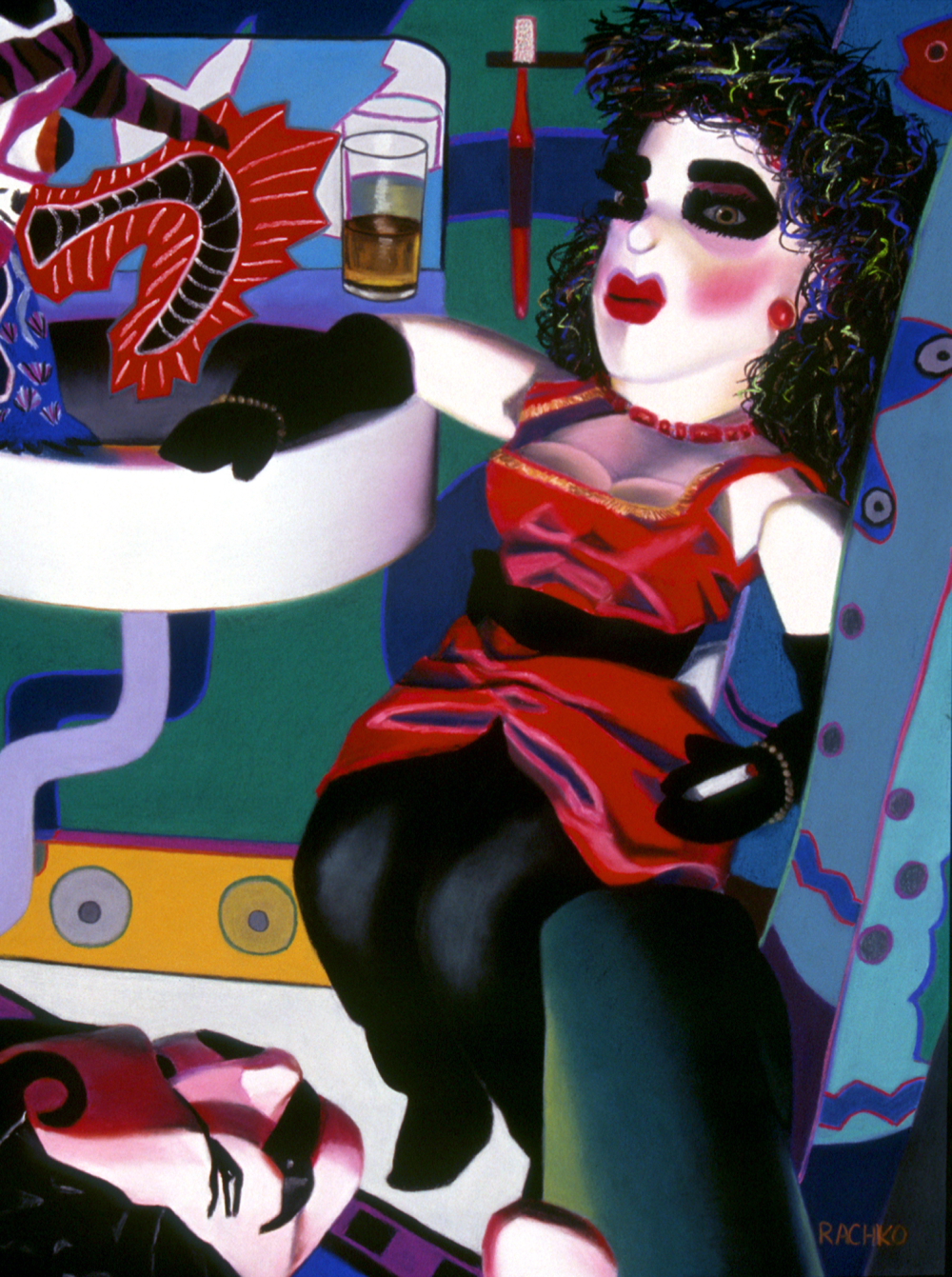
“Scene Thirteen: Bathroom,” 26″ x 20″, soft pastel on sandpaper
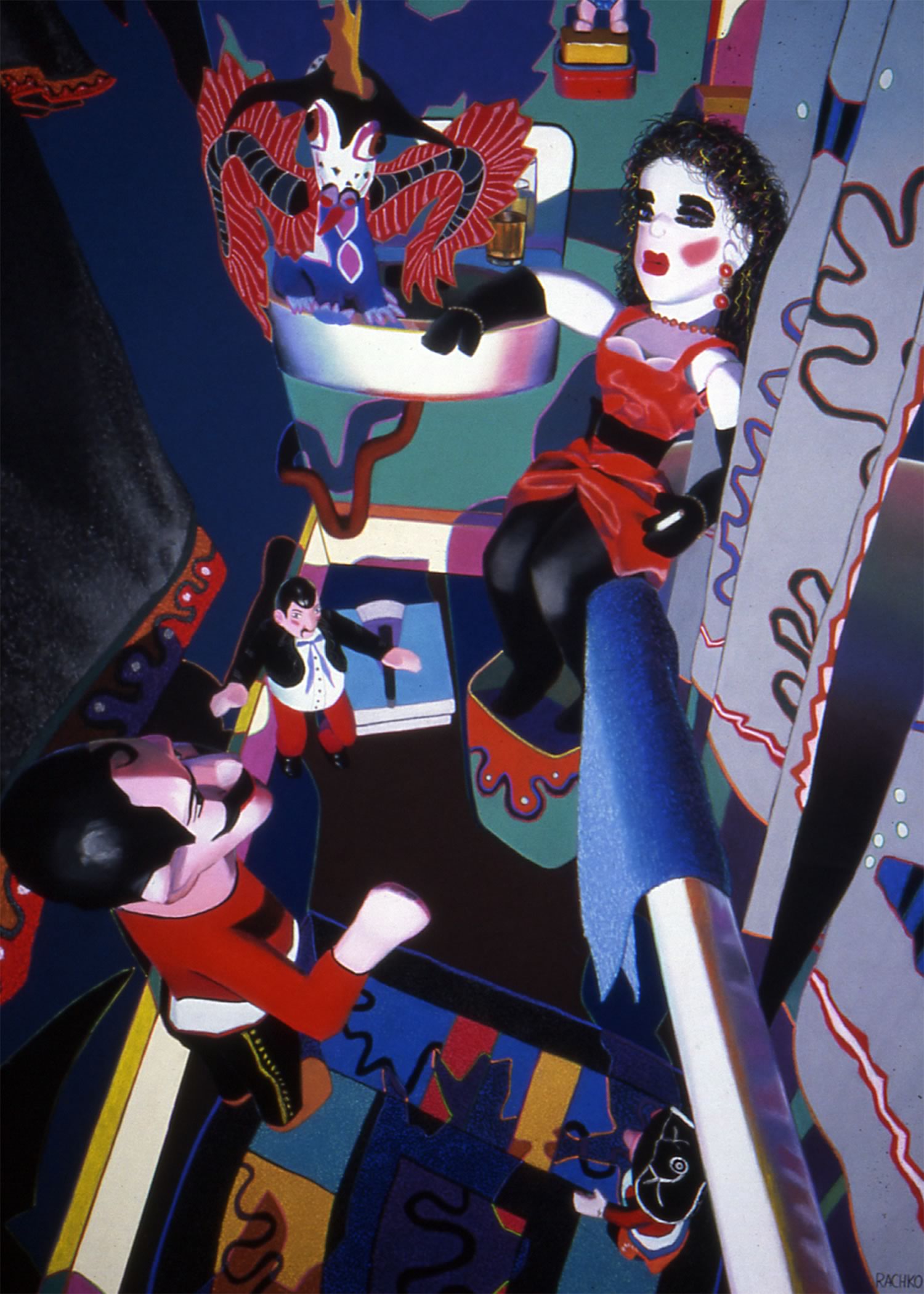
“He Urged Her to Abdicate,” 58″ x 38,” soft pastel on sandpaper
A: At first I didn’t know what to call them. I was looking for a word that meant “a piece of some larger whole.” Initially the word “shard” – a fragment of pottery – came to mind. However, that didn’t capture the meaning I was seeking, since my paintings have little to do with pottery.
My large “Domestic Threats” paintings are theatrical. There is substantial labor and much thought involved in their creation, so I often think of myself as a director and each image as a play.
Small “Domestic Threats” paintings are made from a portion of a photograph that I use as reference for a larger painting. For example, “Scene Thirteen: Bathroom” (above, top) is a small version of “He Urged Her to Abdicate” (above, bottom).
A “portion” of a play is a “Scene” so that’s what I finally named them. Additionally, I numbered the paintings in order of their creation and added the room where each takes place.
Comments are welcome!


 barbararachkoscoloreddust.com