Travel photo of the month*

Autumn in Alexandria, VA
*favorite travel photos that have not yet appeared in this blog
Comments are welcome!
Pearls from artists* # 628

*an ongoing series of quotations – mostly from artists, to artists – that offers wisdom, inspiration, and advice for the sometimes lonely road we are on.
Down the rabbit hole of my research, I’d stumbled into an odd conundrum: Even though art experts can’t agree on what art is, a large number of them are convinced that making and experiencing art is an innate human impulse. It’s not a learned pastime we dreamt up once we got bored of staring at blank walls or figured out how to live past age twenty, but a biological predisposition that has helped our species survive. (One we may share with songbirds, parrots, whales, and other animals that have their own “aesthetic culture,” writes evolutionary biologist Richard O. Prom.) One survival-of-the-most-artistic hypothesis contends that art is our version of peacock feathers: An extravagant, frivolous display by which Paleolithic humans showed potential mates that they were fit enough to hunt and gather and have time left-over to paint warty pigs. Another theory is that our art-inclined ancestors survived, thrived, and reproduced because making art offered a dress rehearsal for grappling with hostile conditions. (Nine-thousand-year-old Libyan rock paintings of spear-wielding figures sprinting after horned beasts come to mind.) The scholar Ellen Dissanayake, who’s dabbled in anthropology, archaeology, psychology, and art history, argues that art is a social glue that binds communities together and thus increases its members’ odds of survival. Also, she thinks the concept of “fine art” is a travesty that’s made us forget that “engaging with the arts is as universal, normal, and obvious in human behavior as sex or parenting.”
Bianca Bosker in Get the Picture: A Mind-Bending Journey Among the Inspired Artists and Obsessive Art Fiends Who Taught Me How to See
Comments are welcome!
Q: What’s on the easel today?

Pastel paintings in progress
A: Work continues on “Harbinger” (left) and “Magisterial” (right).
Comments are welcome!
Pearls from artists* # 627

With friends at the 2024 Whitney Biennial!
*an ongoing series of quotations – mostly from artists, to artists – that offers wisdom, inspiration, and advice for the sometimes lonely road we are on.
“People are really open here and very dynamic, and they really respect hard work. So if you are going to shows, if you are part of the community, if you go do studio visits, if you’re interested in other people, you can create a community, said Julie [Curtiss]. “You can’t be a lazy artist in New York.”
Julie Curtiss quoted in Get the Picture: A Mind-Bending Journey Among the Inspired Artists and Obsessive Art Fiends Who Taught Me How to See by Bianca Bosker
Comments are welcome!
Q: What inspires you to create? (Question from “Cultured Focus Magazine”)
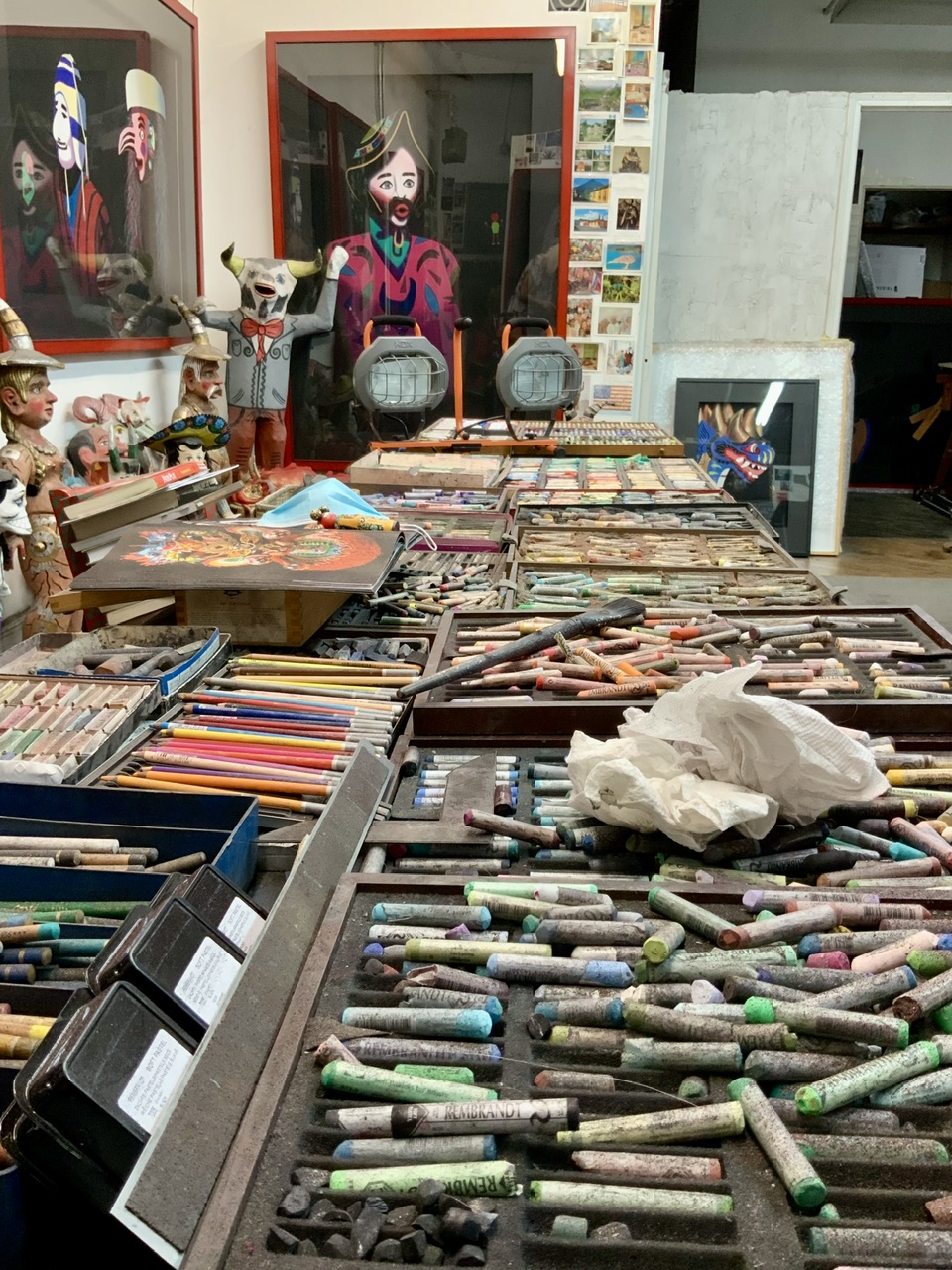
A: You remember the expression, to whom much is given, much is expected? Having discovered around the age of 5 or so that I could draw anything I could see, I know I have been given a tremendous gift. I remember being completely surprised as a kid to realize that not everyone can do this.
Therefore, I feel a kind of sacred obligation to develop my abilities as far as possible, to make the most of my short time on this earth. It is a thrill to see not only what is going to happen next in the studio, but also in my life. For example, I have become a world traveler. I wonder, which new country will I visit next?
Comments are welcome!
Pearls from artists* # 626

*an ongoing series of quotations – mostly from artists, to artists – that offers wisdom, inspiration, and advice for the sometimes lonely road we are on.
This is why, when writers who are just starting out ask me when it gets easier, my answer is never. It never gets easier. I don’t want to scare them, so I rarely say more than at, but the truth is that, if anything, it gets harder. The writing life is filled with predictable uncertainties, but with the awareness that we are always starting over. That everything we will ever write will be flawed. We may have written one book, or many, but all we know – if we know anything at all – is how to write the book we’re writing. All novels are failures. Perfection itself would be a failure. All we can hope is that we will fail better. That we will not fall prey to the easy enchantments of repeating what may have worked in the past. I try to remember that the job – as well as the plight, and the unexpected joy – of the artist is to embrace uncertainty, to be sharpened and honed by it. Each time we come to the end of a piece of work, we have failed as we have leapt – spectacularly, brazenly – into the unknown.
Dani Shapiro in Still Writing: The Perils and Pleasures of a Creative Life
Comments are welcome!
Q: What was it like having a documentary made about you? (Question from Culture Focus Magazine)

With Jennifer Cox at the 2023 Newport Beach Film Festival!
A: I loved the whole experience! Before this happened, I had wanted to make a film for ten years or so, ever since Brainard Carey, an artists’ coach, suggested the idea when I told him about my unusual background. Often I hear from artist friends and others that my life story is truly inspiring. Finally being able to make “Barbara Rachko: True Grit” and now to share it with a wider audience is a dream come true! Jennifer Cox, our director, and Annette Apitz, our co-producer, were ideal collaborators over the fifteen months it took to make the film.
It is truly gratifying to hear so many positive responses from viewers of our film. Surprisingly, the film has even gone on to have a life in film festivals. “Barbara Rachko: True Grit” made it’s World Premier at the prestigious 2023 Newport Beach Film Festival in Orange County, California, where it received both the Audience Award and the Best in category Award for Art, Architecture, and Design. In addition, we earned Honorable Mention at the 2023 International Fine Arts Film Festival Santa Barbara and were recognized as an Award Nominee at the 2023 Montreal Women Film Festival.
To date in 2024 our film has screened at New Plaza Cinema on the Upper West Side of Manhattan, and at Noise Media Art Fair in Vienna, Austria. I think I speak for the filmmakers and myself when I say, “Barbara Rachko: True Grit” has exceeded all of our expectations!
Watch here: https://www.youtube.com/watch?v=JJWLy84kXI0
Comments are welcome!
Pearls from artists* # 625

*an ongoing series of quotations – mostly from artists, to artists – that offers wisdom, inspiration, and advice for the sometimes lonely road we are on.
The artist not equipped with the necessary arrogance will be repeatedly sidetracked or subverted by the agendas of others. He will lack a sufficient sense of purpose, will frequently stall and block, and will bring a nagging passivity to his art career. His resolve to do great art may remain a potent idea only, a kind of unexplained force in his body. He is likely to accomplish much less than he otherwise might, support others rather than find support for himself, attempt the small rather than the large, and rebound less well from rejection.
The self-centered artist, on the other hand, is challenged to remember that he is neither god nor Superman, but a human being with human limitations. He hasn’t the time to turn every idea into a book, the ability to top each work with a greater one, the energy to toil ceaselessly at his art, nor the right to trample others as he pursues his goals. If he mistakes or oversteps these limits he will put himself in harm’s way and may find himself struck down by his own obsessional energy, by burnout, by depression, by self-abuse, or by the angry complaints of those whose rights he has cavalierly trampled.
Eric Maisel in A Life in the Arts: Practical Guidance and Inspiration for Creative and Performing Artists
Comments are welcome!
Travel photo of the month*

St. Malo, Brittany, France
*favorite travel photos that have not yet appeared in this blog
Comments are welcome!
Pearls from artists* # 624

View from New York City
*an ongoing series of quotations – mostly from artists, to artists – that offers wisdom, inspiration, and advice for the sometimes lonely road we are on.
Van Gogh’s drawings show a truly remarkable improvement over the course of the two years he set aside to intensely practice drawing. At the start of that period his sketches look clumsy and amateurish. With great ardor, thoughtfulness, and effort – by manifesting his creativity, in short – at the end of those two years Van Gogh was producing drawings that showed not only that he had mastered elements of technique but also that he had educated himself in ways that moved him far ahead of his classically trained peers.
Van Gogh’s progress excites the artist. It seems to hold the clear implication that by acting creatively the artist may significantly increase his talents or make manifest significant talent he didn’t know he possessed. Maybe a brilliant novel is within his grasp. Maybe he can achieve a breakthrough in the visual arts. Maybe he can play his instrument like a god.
Eric Maisel in A Life in the Arts: Practical Guidance and Inspiration for Creative and Performing Artists
Comments are welcome!


 barbararachkoscoloreddust.com