Blog Archives
Q: What made you fall in love with soft pastel versus another medium?
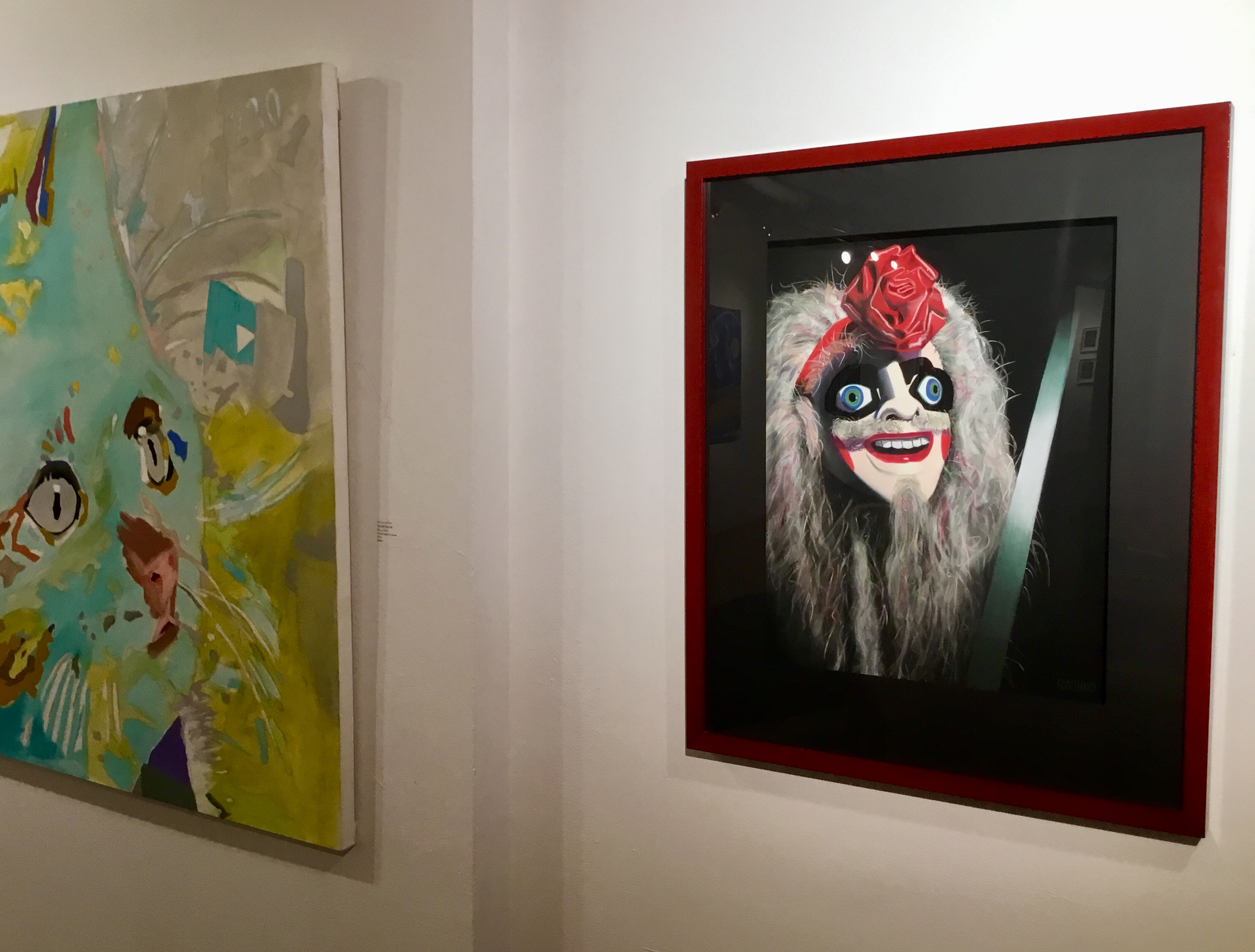
“The Champ” in “Worlds Seen & Unseen” at Westbeth Gallery, NYC
A: I like to get my hands right into my work. In other words, I don’t like brushes or anything else to intervene between my hands and what I’m working on.
I work with 400 or 500 grit Uart sandpaper so the downside is that I rub my fingertips raw from blending layers of soft pastel onto sandpaper. I’ve tried using rubber gloves (they make my fingers sweat and wear out fast), cotton gloves (they leave bits of lint on the paper), using a blending stump (it leaves lint on the paper), etc., but nothing works as well as my own fingers. So sore fingertips are an unavoidable occupational hazard. I sometimes take days off from the studio just so that my hands can heal.
I adore color and love looking at the thousands of pastels in my studio! After working with this medium for more than thirty years, I still love what I am able to accomplish and I am still pushing it to do new things. The colors are rich, intense, velvety. No other medium is as sensuous or as satisfying.
Comments are welcome!
Q: Do you have any ”dont’s” for artists that you swear by?
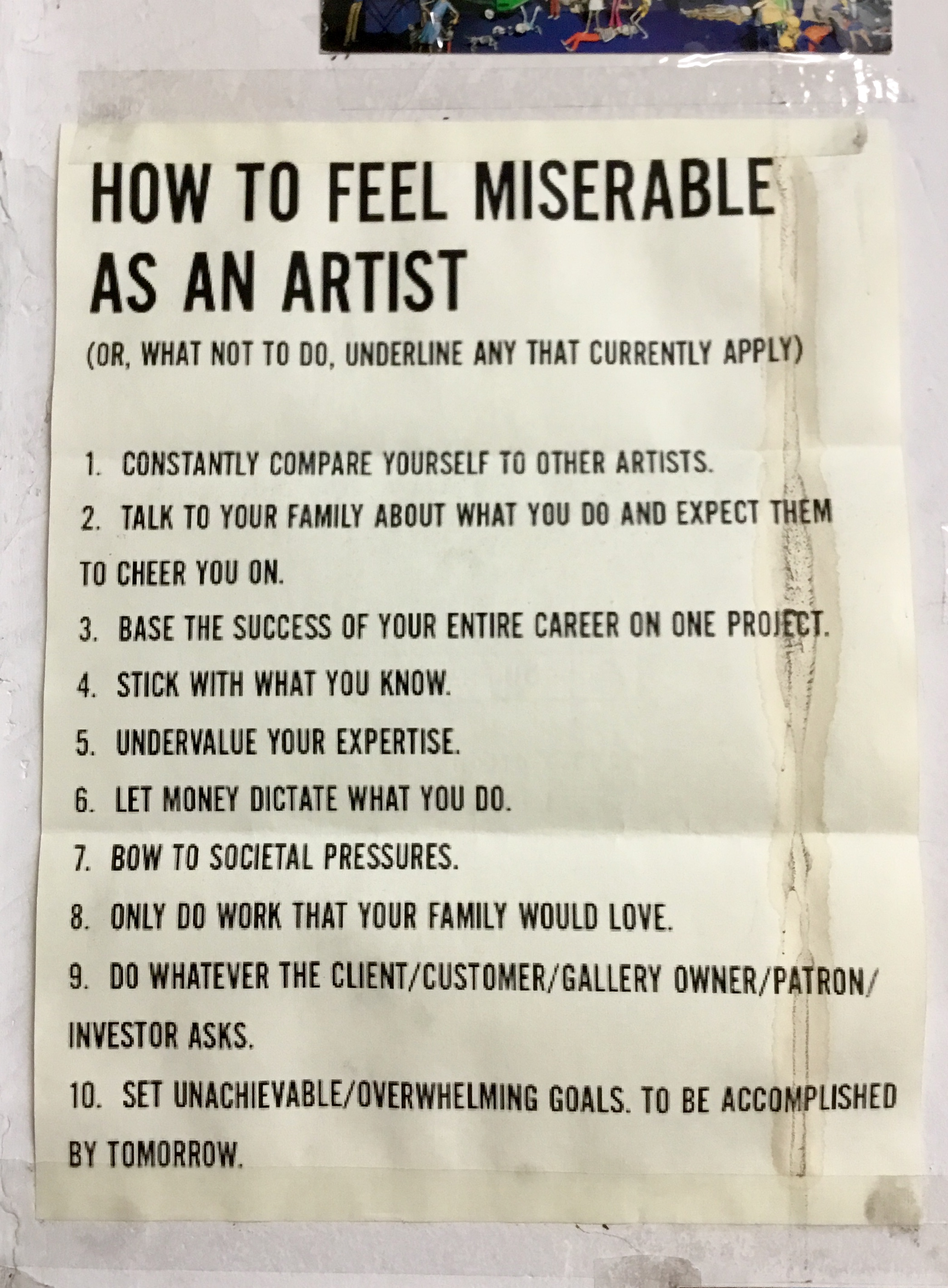
On my studio wall
A: I don’t remember where I found this list, but most artists probably need to be reminded once in awhile. I certainly do!
Comments are welcome!
Pearls from artists* # 346
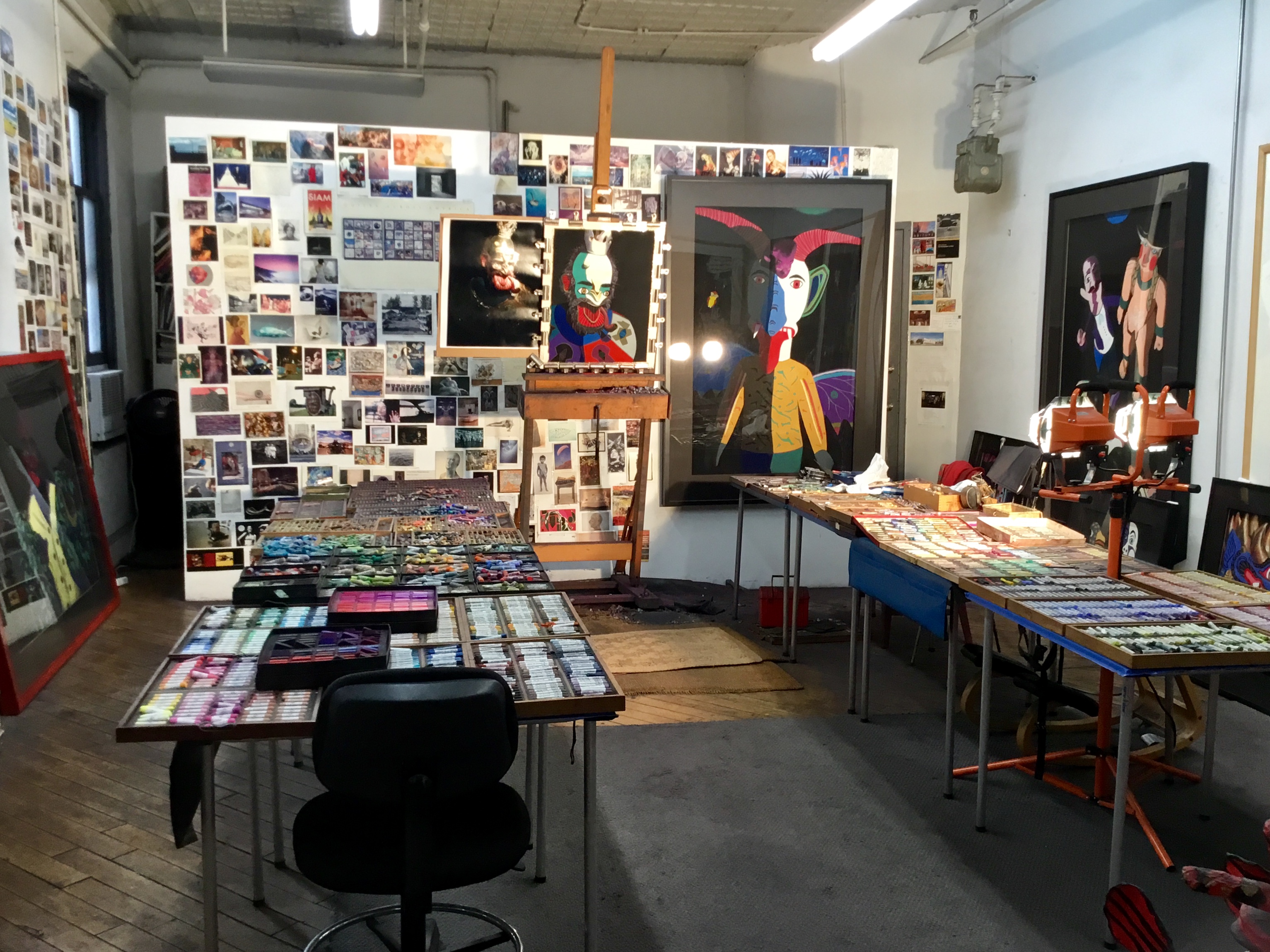
Barbara’s studio
*an ongoing series of quotations – mostly from artists, to artists – that offers wisdom, inspiration, and advice for the sometimes lonely road we are on.
In my view… the most useful definition of creativity is the following one: people are artistically creative when they love what they are doing, know what they are doing, and actively engage in the tasks we call art-making. The three elements of creativity are thus loving, knowing, and doing; or heart, mind, and hands; or, as Buddhist teaching has it, great faith, great question, and great courage.
Eric Maisel in A Life in the Arts: Practical Guidance and Inspiration for Creative and Performing Artists
Comments are welcome!
Pearls from artists* # 341
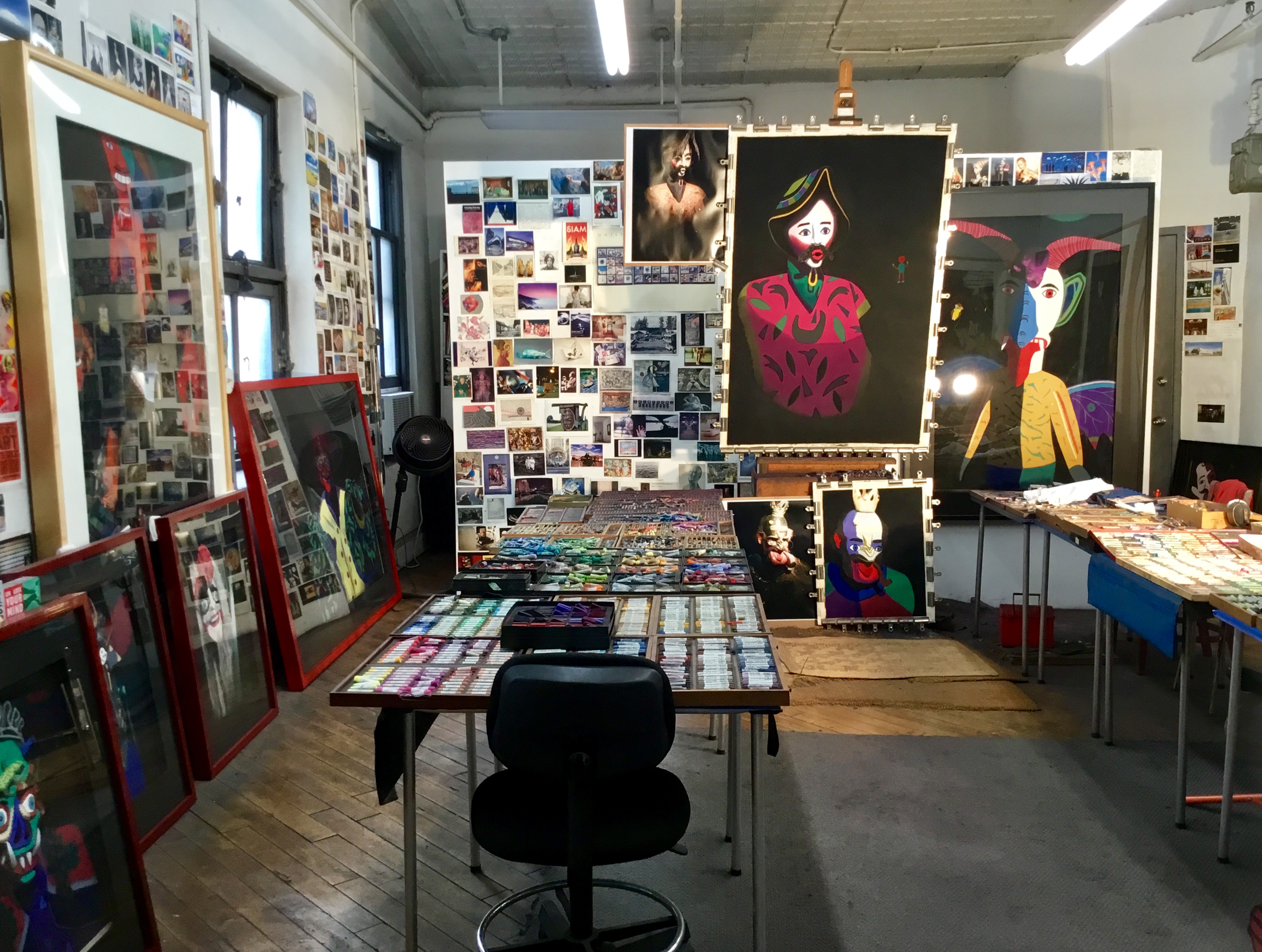
Barbara’s studio
*an ongoing series of quotations – mostly from artists, to artists – that offers wisdom, inspiration, and advice for the sometimes lonely road we are on.
The classic work of art is a form of life with its own bizarre consciousness. In the performing arts – theater, dance, music – this consciousness is not reducible to the minds of the performers onstage. The participants are parts of a spiritual organism that includes and transcends them. In our modern materialist mindset we naturally attribute the impression that a work speaks in its own voice to the intention of the author, who used it as a vehicle for her own ideas. But… works of art express much that their authors never intended to say: they exceed the limited views of those who bring them into being.
J.F. Martel in Reclaiming Art in the Age of Artifice: A Treatise, Critique, and Call to Action
Comments are welcome!
Pearls from artists* # 333

Studio entrance
*an ongoing series of quotations – mostly from artists, to artists – that offers wisdom, inspiration, and advice for the sometimes lonely road we are on.
… the Greeks and Romans both believed in the idea of an external daemon of creativity – a sort of house elf, if you will, who lived within the walls of your home and who sometimes aided you in your labors. The Romans had a specific term for that helpful house elf. They called it your genius – your guardian deity, the conduit of your inspiration. Which is to say, the Romans didn’t believe that an exceptionally gifted person was a genius; they believed that an exceptionally gifted person had a genius.
It’s a subtle but important distinction (being vs. having) and, I think, it’s a wise psychological construct. The idea of an external genius helps to keep an artist’s ego in check, distancing him somewhat from the burden of taking either full credit or full blame for the outcome of his work. If your work is successful, in other words, you are obliged to thank your external genius for the help, thus holding you back from total narcissism. And if your work fails, it’s not entirely your fault. You can say, “Hey, don’t look at me – my genius didn’t show up today!”
Either way, the vulnerable human ego is protected.
Protected from the corrupting influence of praise.
Protected from the corrosive effects of shame.
Elizabeth Gilbert in Big Magic: Creative Living Beyond Fear
Comments are welcome!
Q: When and where did you start your career in the visual arts?
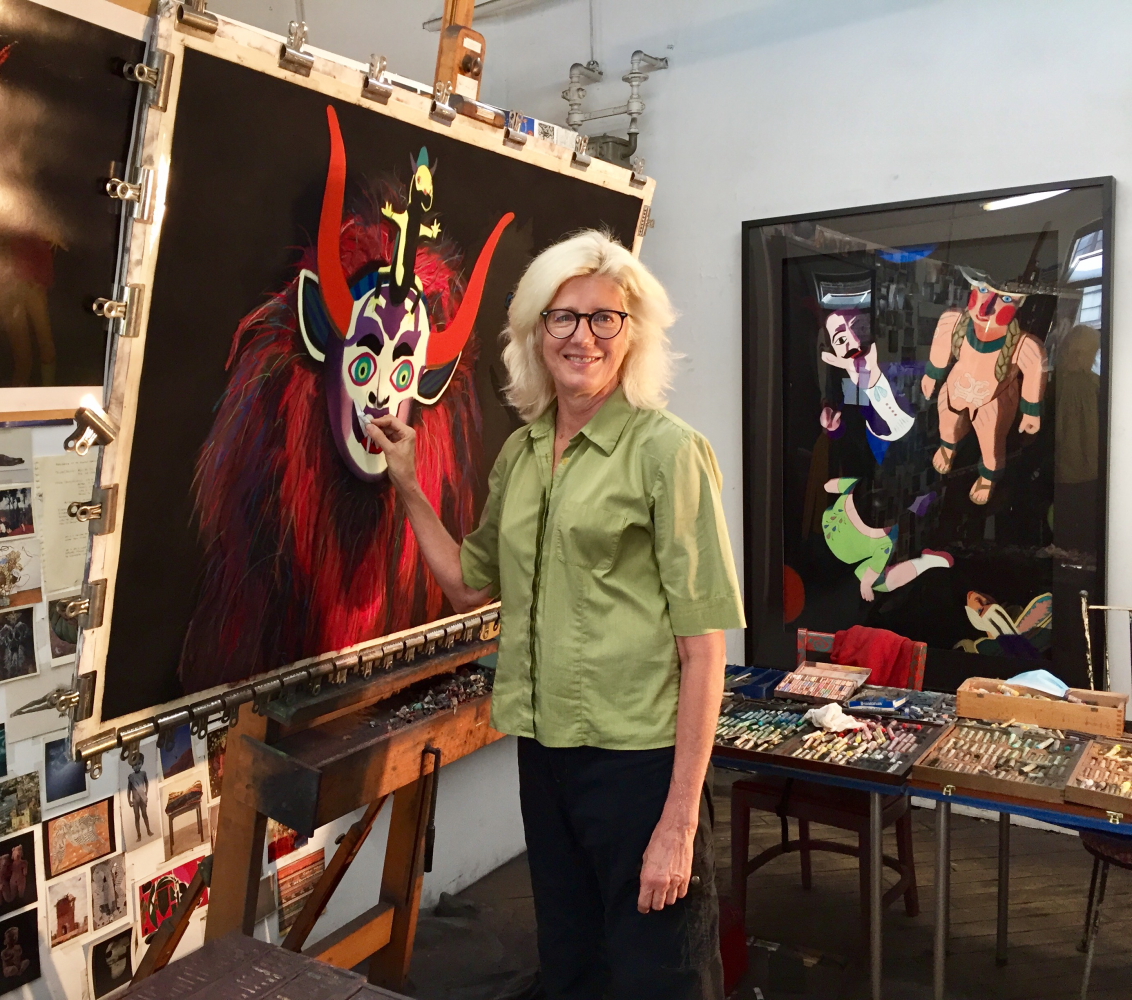
In the studio, Photo: Maria Cox
A: My journey to becoming an artist was circuitous. In the mid-1980s I was a thirty-something Navy lieutenant. I worked a soul-crushing job as a computer analyst on the midnight shift in a Pentagon basement. We were open 24/7 and supported the Joint Chiefs of Staff.
Remembering the joyful Saturdays of my youth in New Jersey, when I had studied with a local painter, I enrolled in a drawing class at the Art League School in Alexandria, Virginia. I loved it! I took more classes and became a highly motivated, full-time art student who worked nights at the Pentagon. After two years and as my skills improved, I discovered my preferred medium – soft pastel on sandpaper.
I knew I had found my calling, submitted my resignation, and left active duty. On October 1, 1989 I became a professional artist. However, I remained in the Navy Reserve for another fourteen years, working at the Pentagon one weekend a month. On November 1, 2003, I retired as a Navy Commander.
Comments are welcome!

Q: Do your materials have properties that allow you to maximize what you depict in your work?
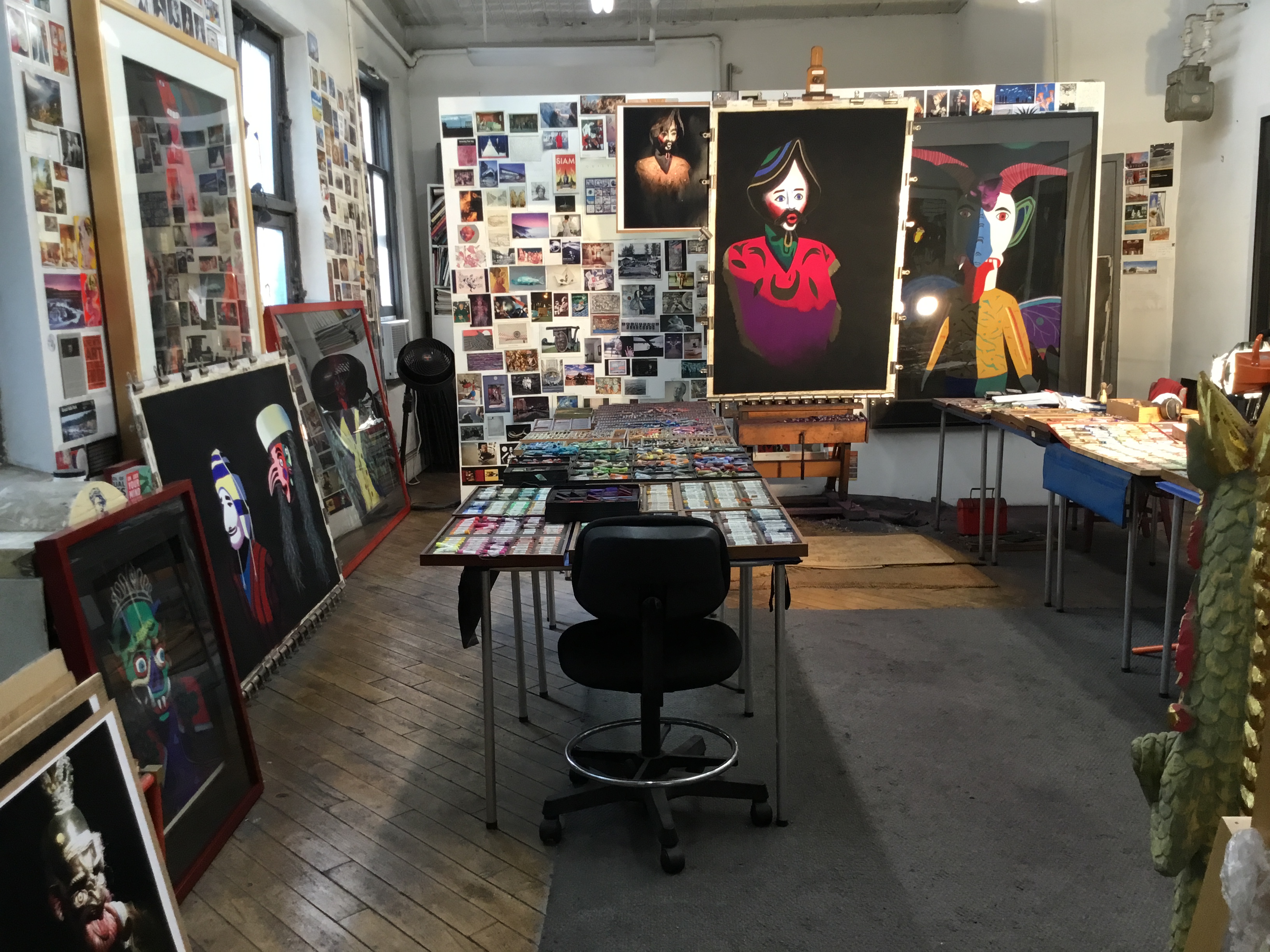
Barbara’s studio
A: I work exclusively in soft pastel on sandpaper. Pastel, which is pigment and a binder to hold it together, is as close to unadulterated pigment as an artist can get. It allows for very saturated color, especially as I utilize the self-invented techniques developed and mastered over more than thirty years as an artist. I believe my “science of color” to be unique, completely unlike how any other artist works. I spend three or four months on each painting, applying pastel and blending the layers together to mix new colors directly on the paper.
The sandpaper support allows the build up of 25 to 30 layers of pastel as I slowly and meticulously work for hundreds of hours to complete a painting. The paper is extremely forgiving. I can change my mind, correct, refine, etc. as much as I want until a painting is the best I can create at that moment in time.
Comments are welcome!
Pearls from artists* # 305
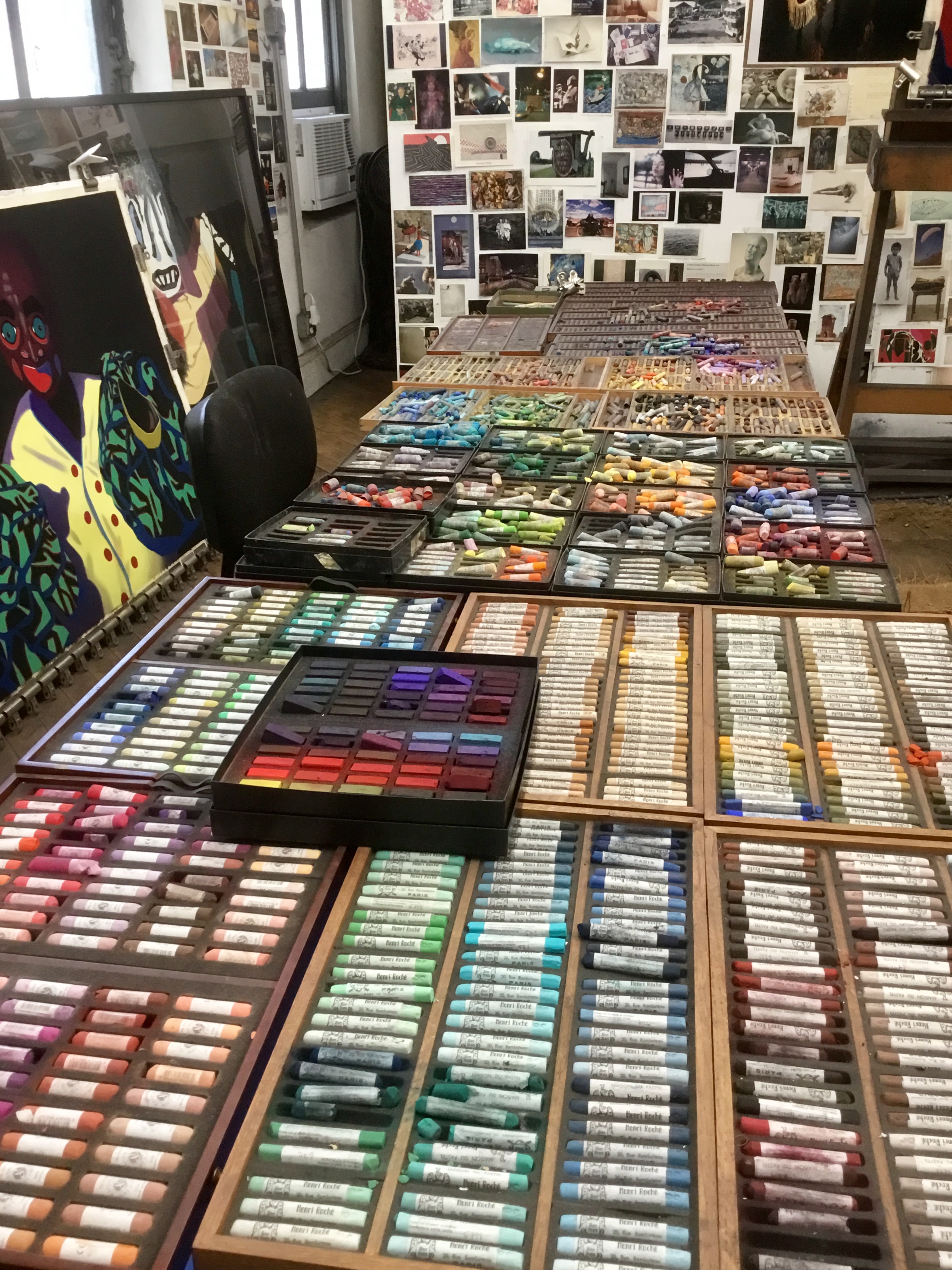
About half of Barbara’s pastels
* an ongoing series of quotations – mostly from artists, to artists – that offers wisdom, inspiration, and advice for the sometimes lonely road we are on.
When asked to talk about what I do, I’ve often compared writing with handicrafts – weaving, pot-making, woodworking. I see my fascination with the word as very like, say, the fascination with wood common to carvers, cabinetmakers – people who find a fine piece of old chestnut with delight, and study it, and learn the grain of it, and handle it with sensuous pleasure, and consider what’s been done with chestnut and what you can do with it, loving the wood itself, the mere material, the stuff of their craft.
Ursula K. Le Guin in No Time to Spare: Thinking About What Matters
Comments are welcome!
Q: (Part I) Would you share your story of how creating art enabled you to heal after losing your husband on 9/11?

“She Embraced It and Grew Stronger,” 2003, 70” x 50” framed, the first pastel painting I completed after Bryan was killed
A: On June 16, 2001, I married Dr. Bryan Jack, my longtime companion and soulmate, during a very private ceremony in the garden of an historic Alexandria, Virginia residence. In attendance were a justice of the peace, me, and Bryan. He and I were 48 years old and this was the first marriage for us both. Sadly, we never celebrated an anniversary. Exactly 87 days later my new husband was the victim of a terrorist attack.
On September 11, 2001, Bryan, a high-ranking federal government employee, a brilliant economist, and a budget analyst at the Pentagon, was en route to Monterey, CA to give his monthly guest lecture for an economics class at the Naval Postgraduate College. He boarded the American Airlines plane out of Dulles Airport that was high-jacked and crashed into the Pentagon, killing 189 people.
To this day I consider how easily I, too, could have been killed on 9/11, if I had just decided to travel with Bryan to California. Plus, the plane crashed directly into my Navy office on the fifth floor E-ring of the Pentagon. (I am a retired Navy Commander and worked at the Pentagon for many years). But for a twist of fate, we both would have died: Bryan on the plane, me either beside Bryan or inside the building.
In September 2001 Bryan and I had been together for fourteen and a half years. Surprisingly, we were happier than we had ever been. At a time when other couples we knew were settling into a certain boredom and routine, our life together was growing richer and more interesting. So losing Bryan – especially then – was heart-breaking, cruel, and devastating beyond comprehension. It was so unfair. I was numb and in shock.
The next six months passed by in a blur. But I had made a decision and pledged that I would not let the 9/11 attackers claim me as one more victim. My life had been spared for a reason so I began to pick up the pieces and worked to make every day count. Even many years later, wasting time still feels like a crime.
The following summer I was ready to – I HAD to – get back to work in my studio. I knew exactly what I must do. More than ever before, learning and painting would become the avenues to my well-being.
Continued next week…
Comments are welcome!


 barbararachkoscoloreddust.com
Q: It is well known that you gain inspiration from foreign travel. Has anyone ever accused you of stealing their culture?
Feb 9
Posted by barbararachkoscoloreddust
The Bolivian side of Lake Titicaca
A: Yes, a few people have done so via comments on Facebook. It came as a shock.
The logic of such an accusation presumes ownership. I don’t believe any person has a claim to owning culture.
Travel is arguably the best education there is. My travels around the world, supplemented with lots of research once I return home, are an important part of my creative process. This is how I develop ideas to forge a way ahead. It is difficult and solitary work.
Every artist is tasked with remaining open to influences – however, wherever, and whenever they appear. Somewhat late in life, travel as a source of inspiration found ME. And it has been a blessing!
People around the world have become fans. Many send messages of thanks saying they are proud that some aspect of their country’s culture has inspired my work. I am always grateful and touched to know this.
Comments are welcome!
Share this:
Posted in 2019, An Artist's Life, Bolivia, Creative Process, Inspiration, Studio, The West Village, Working methods
Comments Off on Q: It is well known that you gain inspiration from foreign travel. Has anyone ever accused you of stealing their culture?
Tags: accusation, accused, afterwards, arguably, around the world, aspect, blessing, comments, country, creative process, develop, education, Facebook, foreign travel, forge ahead, grateful, handful, influences, inspiration, inspired, Lake Titicaca, late in life, logic, messages, ownership, presumes, remaining open, research, sentiments, shock, singular, source of inspiration, stealing culture, Studio, supplemented, tasked, telling, thanks, touched, travel